In 2024, Republicans may complete a historic foreign policy reversal

In 2024, Republicans may complete a historic foreign policy reversal


CNN
 — 

The GOP in 2024 is moving toward a reprise of its most consequential foreign policy debate ever in a presidential primary. Only this time, the results may be reversed.

The 1952 GOP presidential nomination fight proved a turning point in the party’s history, when Dwight Eisenhower, a champion of internationalism and alliance with Europe to contain the Soviet Union, defeated Sen. Robert Taft, a skeptic of international alliances who wanted to shift America’s focus from defending Europe toward confronting communist China.

A similar divide is opening within the GOP now. In a distant echo of Taft, former President Donald Trump and Florida Gov. Ron DeSantis, the race’s two front-runners have both declared that defending Ukraine against Russia is not an American “vital interest” and “distracts” (as DeSantis put it) from the more important challenge of confronting China. Other likely 2024 candidates, such as former Vice President Mike Pence and former UN Ambassador Nikki Haley, come closer to upholding the Eisenhower position that the US must remain steadfast in protecting Europe against Russian aggression – and insisting that abandoning Ukraine would embolden China and other potential US adversaries.
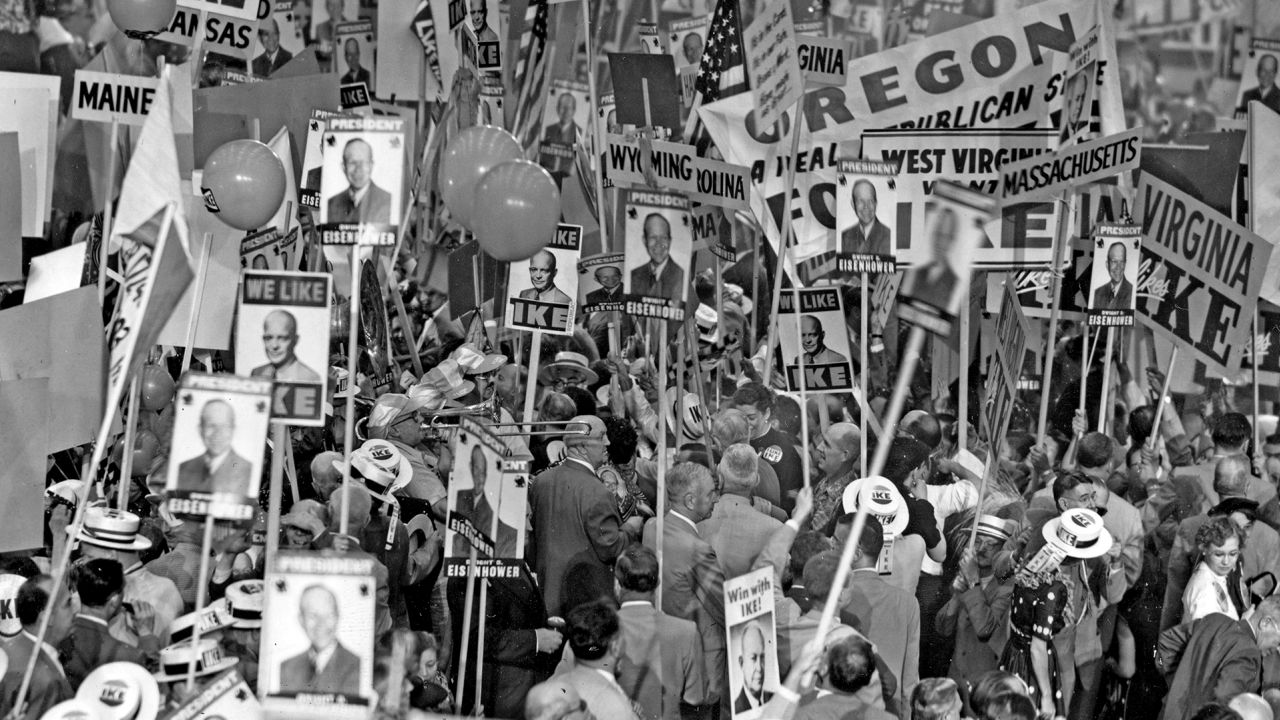
Delegates, many of whom support Dwight David Eisenhower as their candidate for President, gather at the Republican National Convention in Chicago in July 1952.

After Eisenhower’s landmark victory over Taft in 1952, every Republican presidential nominee over the next six decades – a list that extended from Richard Nixon through Ronald Reagan to George W. Bush, John McCain and Mitt Romney – identified more with the internationalist than isolationist wing of the party.

But Trump broke that streak when he won the nomination in 2016 behind a message of brusque economic nationalism and skepticism of international alliances. Now, the GOP appears on track for a 2024 nomination fight which may demonstrate that Trump’s rise has lastingly shifted the party’s balance of power on foreign policy – and ended the long era of GOP internationalism Eisenhower’s victory began.

The fact that DeSantis unveiled his views about Ukraine in a statement to Fox News host Tucker Carlson, a fierce opponent of American engagement with allies, underscored the governor’s determination to court Trump’s base with his provocative remarks. After several days of intense criticism from Republican internationalists, DeSantis retreated last week from his description of the war as a “territorial dispute” and called Russian President Vladimir Putin “a war criminal,” much harsher language than Trump has ever used. But DeSantis, in his interview with British journalist Piers Morgan for another Fox outlet, also reiterated his skepticism of open-ended US support for Ukraine. “I just don’t think that’s a sufficient interest for us to escalate more involvement,” the governor said.
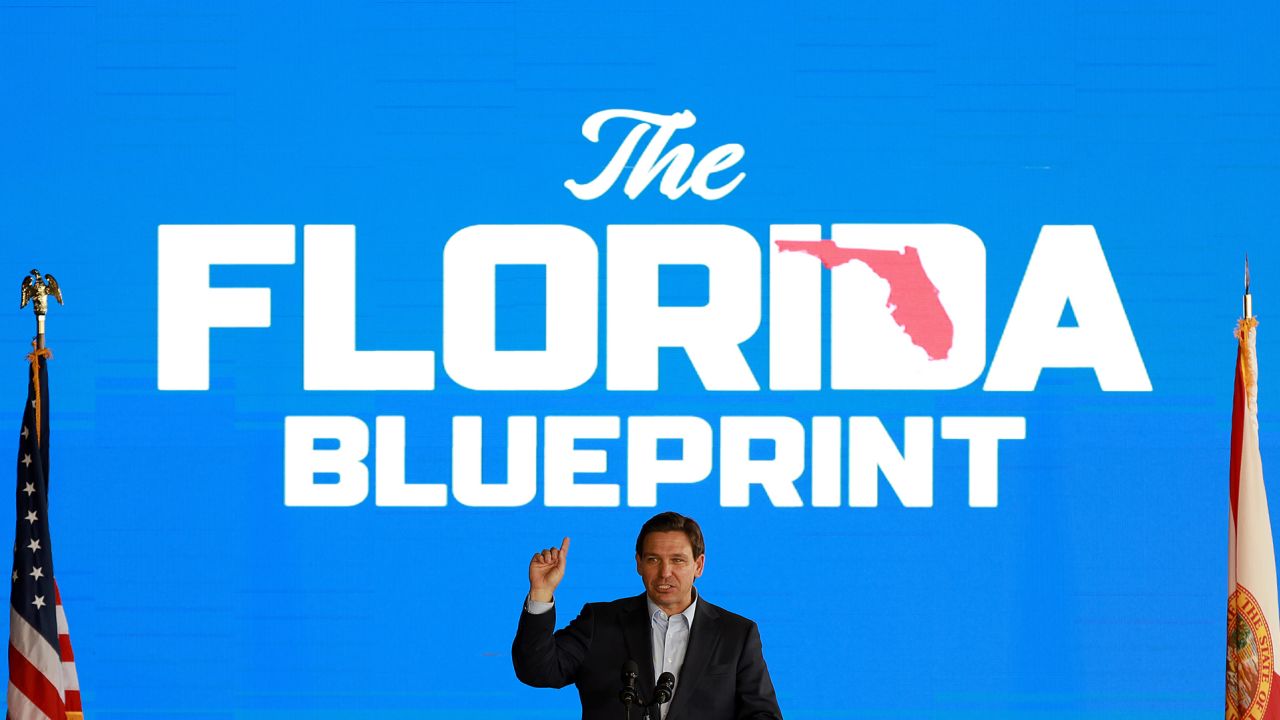
 Florida Gov. Ron DeSantis speaks during an event spotlighting his newly released book,

Even with his qualifying statements last week, DeSantis’ skeptical posture toward Ukraine shows the magnetic pull that Trump has exerted on his party, tugging it away from the Eisenhower tradition.

“Trump-ism is the dominant tendency in Republican foreign policy and it’s isolationist, its unilateralist, its amoral,” said Richard Haass, president of the Council on Foreign Relations and former director of policy planning at the State Department under George W. Bush. The “traditional institutional approach to the world [which was] … the dominant Republican approach since World War II … has clearly been eclipsed for now,” said Haass, who also held foreign policy positions in the Ronald Reagan and George H.W. Bush administrations.

Ivo Daalder, president of the Chicago Council on Global Affairs and former US permanent representative to NATO under Barack Obama, agrees. The fact that both 2024 GOP front-runners are expressing a broad skepticism about US engagement abroad, he said, raises the possibility that Republican “internationalists have not only lost in ’16 and ‘20” when Trump headed the GOP ticket, “but have lost the party forever.”

The 1952 presidential election, by contrast, was the moment when GOP internationalists seemed to win the party forever. Leading into World War II, the party had been closely split between an internationalist wing determined to counter Adolf Hitler and imperial Japan and an isolationist faction resistant to entanglement in the intensifying confrontation with fascism, especially in Europe. The divide was both ideological and geographic, pitting generally more moderate internationalist East Coast Republicans (many of them tied to Wall Street and international finance) against more conservative isolationist forces centered in the small towns and small businesses of the Midwest and the far West.

The Japanese surprise attack that triggered the US entry into World War II ended the political viability of a purely isolationist stance.

“After Pearl Harbor there was no way to be a strict isolationist and a national political [figure],” said Joyce Mao, an associate professor of history at Middlebury College and author of the book “Asia First,” which recounts the GOP foreign policy debates of that era.

After World War II, Republican internationalists joined with Democratic presidents Franklin Roosevelt and Harry Truman to build the international institutions meant to prevent another global war: the United Nations, the Marshall Plan to economically rebuild Europe and the North Atlantic Treaty Organization to militarily defend it from the Soviet Union. Eisenhower, who had organized the Allied invasion of Europe on D-Day in 1944, was firmly in that camp and, in fact, returned to Europe in January 1951 to serve as NATO’s first supreme commander.

But Robert Taft led a block of “old guard” congressional Republicans that remained much more skeptical of European commitments. Taft, a senator from Ohio and the son of former Republican president William Howard Taft, had generally opposed American aid to Europe before Pearl Harbor and even after the war he pushed to reduce the Marshall Plan and voted against the creation of NATO. Like many of the Republicans who initially resisted involvement in World War II, Mao noted, Robert Taft in the post-war period tried to separate himself both from that isolationist past and the contemporary priorities of GOP internationalists like Eisenhower by arguing for an “Asia First” foreign policy that would shift resources and emphasis from defending Europe to confronting the Communists who had seized control of China.

“Eisenhower was viewed by Taft and his colleagues as much too moderate,” Mao said. “His European focus was deemed by that conservative wing of the party as much too similar to the liberal Democrats. If this was going to be a moment for conservatism to reassert itself not only against liberalism but also against the moderates in the Republican Party, China provided an ideal plank” to do so.

All these strains culminated in the landmark battle for the 1952 GOP presidential nomination. Taft, the Republican Senate leader, was a passionate favorite of conservatives. Eisenhower, still in Europe as NATO supreme commander, was in many respects a reluctant candidate. But as Stephen Ambrose showed in his classic biography, Eisenhower felt compelled to run largely from fear that Taft would lead the US out of NATO, while simultaneously risking a catastrophic war in China. (Eisenhower was also deeply disenchanted with Truman’s leadership.) Eisenhower resigned his NATO position, returned to the US, mobilized enough support from the GOP’s internationalist wing to beat Taft at the 1952 Republican convention, and then decisively won the presidency that November. “Eisenhower became president precisely because he did not trust this version of isolationism in Taft,” said Peter Feaver, a Duke University political scientist who served as a senior adviser for strategic planning on the National Security Council under George W. Bush.

Both as a general election candidate and as president, Eisenhower tried to minimize his public conflicts with his party’s “old guard.” But he unmistakably steered the party (and the nation) toward acceptance of American global leadership within a robust international system of alliances. With only modest variation, that became the dominant foreign policy ideology of the GOP for the next 60 years under Presidents Richard Nixon, Gerald Ford, Ronald Reagan and George H.W. Bush. Late in that period, George W. Bush offered a different emphasis by stressing unilateral American action over coordination with allies, but even he emphasized the need for the US to remain engaged with the world. “It’s a pretty unbroken streak,” said Geoffrey Kabaservice, author of “Rule and Ruin,” a history of the struggles between GOP conservatives and moderates.

Taft-like isolationism, coupled with nativist opposition to immigration and protectionist opposition to free trade, first resurfaced as a major force in the GOP with the long-shot presidential campaigns of conservative commentator Patrick J. Buchanan in 1992 and 1996. Two decades later, Trump revived that same triumvirate of isolationism, protectionism and nativism – what scholars sometimes call “defensive nationalism” – in his winning drive for the 2016 GOP nomination.

Though some traditional GOP internationalists had hoped that Trump in office might moderate those impulses, as president he barreled down all those roads, repeatedly clashing with traditional allies. Now, DeSantis’ choice to echo Trump in devaluing Ukraine – following the calls from so many House conservatives to reduce the US commitment there – is deflating another hope of the GOP’s beleaguered internationalist wing: that Trump’s ascent represented a temporary detour and the party would snap back to its traditional support for international engagement once he left office.

“Trump-ism has to be taken seriously,” as a long-term force in GOP thinking about the world, Haass said. The foreign policy center of gravity in the Republican Party, he added, has moved toward “a much more pinched or minimal American relationship with the world, [with] not a lot of interest in contributing to global responses to challenges like climate change or pandemics.”

Even before DeSantis qualified his comments in the interview with Morgan, Feaver believed the Florida governor was trying to find a position on Ukraine somewhere between Trump’s undiluted skepticism and the unreserved support of Sens. Lindsey Graham of South Carolina and Mitch McConnell of Kentucky. But, Feaver said, by including such inflammatory language as “territorial dispute” in his initial comments, DeSantis demonstrated the risks of pursuing such a strategy of “triangulation.”

“Triangulation is a risky game because if you get the language off, you may commit yourself in a campaign to a line that makes no sense when you are governing,” Feaver said. “This is one of the hardest problems for newcomers and challengers when they are campaigning for president. By giving applause lines that work for the narrow segments of ideologically hardened factions that they are trying to win over for the primary, they can lock themselves into policy positions that are not sound when they actually win.”

As an example, Feaver said DeSantis’ insistence that the US should shift more attention from countering Russia to containing China – an argument he repeated with Morgan – was illogical because “abandoning Ukraine assists China’s most significant ally, Russia.” Haley made a similar case in her recent Wall Street Journal article criticizing DeSantis (though not by name) for his comments to Carlson. “It’s naive to think we can counter China by ignoring Russia,” Haley wrote.

Daalder points out another logical flaw in the updated “Asia First” arguments from DeSantis and Trump. “If the US were to abandon its allies in Europe … our allies in Asia are going to ask, ‘What’s to say they are not going to do the same with regards to China?’” Daalder said. “By demonstrating your willingness to stand up to Russia you are also strengthening the view that in Asia that when it comes to it that we will be there to help them.”

But polls leave no doubt that both prongs of the modern Robert Taft position – that the US should reduce its commitment to Europe-focused international alliances and harden its resistance to China – have a substantial base of support in the contemporary Republican coalition. In a Gallup poll released earlier this month, by a lopsided margin of 76{515baef3fee8ea94d67a98a2b336e0215adf67d225b0e21a4f5c9b13e8fbd502} to 12{515baef3fee8ea94d67a98a2b336e0215adf67d225b0e21a4f5c9b13e8fbd502}, Republican voters were more likely to identify China than Russia as the principal US adversary in the world. (More Democrats picked Russia than China.) Polls have also found a steady decline in Republican support for US aid to Ukraine: polls this year by both the Pew Research Center and Quinnipiac University found that the share of GOP voters who believe the US is doing too much now equals the combined percentage who think it is doing too little or the right amount. (Quinnipiac found big majorities of Democrats and independents still believe the US is doing the right amount or not enough.)

The latest Chicago Council on Global Affairs annual survey also tracks a broader retreat from the world among GOP voters. In that poll, conducted last November, the share of Republicans who said the US should take an active role in world affairs fell to 55{515baef3fee8ea94d67a98a2b336e0215adf67d225b0e21a4f5c9b13e8fbd502} – the lowest the survey has ever recorded. Underscoring that erosion, a slight majority of Republicans in the poll said the costs of an active US international role now exceed the benefits.

Opinions in the GOP about whether the US should do more or less in Ukraine don’t vary much along lines of education or age, the Pew poll found. But generally, these surveys show that the turn away from global leadership is most powerful among two distinct groups of Republicans: those who are younger, and those who lack college degrees. While a solid three-fifths of Republicans with a college degree in the Chicago Council poll said the benefits of US leadership exceed the costs, for instance, a majority of non-college Republicans disagreed. Younger Republicans were also much more likely than those over 60 to say the costs exceed the benefits.

It’s probably no coincidence that those two groups – Republicans without a college degree and those who are younger – have consistently registered as Trump’s strongest supporters in early polls about the 2024 race.

Former President Donald Trump arrives during a rally at the Waco Regional Airport on March 25 in Texas.

Trump is signaling that in a second term he will likely push even further in an isolationist and protectionist direction. John Bolton, Trump’s former national security adviser, has said he believed the former president came close to withdrawing the US from NATO and would likely do so if elected to a second term. Trump certainly hinted at that possibility in a recent campaign video in which he declared, “we have to finish the process we began under my administration of fundamentally reevaluating NATO’s purpose and NATO’s mission.” Trump has also said he would impose a four-year plan “to phase out all Chinese imports of essential goods, everything from electronics to steel to pharmaceuticals.” That would be a wrenching change in the global economy.

In all these ways, Trump is promising to fulfill Robert Taft’s vision from seven decades ago – and to erase Eisenhower’s lasting victory in setting the GOP’s direction. DeSantis does not appear to have decided to jump entirely on that Trump train – but neither is he lying down on the tracks to stop it. With these two men far ahead of any potential rival, it seems highly likely that the GOP in 2024 will continue to move away from Eisenhower-style international cooperation toward a volatile compound of isolationism and unilateralism. And that could generate enormous turbulence across the globe.

Trump’s first term, as Daalder noted, was a chaotic time for the international order and traditional US alliances. But “If an isolationist leader gets elected president in 2024,” Daalder added, “you haven’t seen nothing yet.”

Consumers Express a Little More Optimism About the Economy | Economy

Consumers Express a Little More Optimism About the Economy | Economy

Customer self-assurance shockingly rose in March as people turned more optimistic about the long run even though remaining worried about the existing state of the financial system, the Convention Board noted on Tuesday.

The current predicament index, measuring consumers’ assessment of present financial disorders, fell to 151.1 from 153. in February. The expectations Index, measuring the short-phrase outlook for the financial state edged up to 73 from 70.4 in February.

That even now leaves the anticipations index down below the stage of 80, typically a sign that a recession is probable inside the next 12 months. The study was completed about 10 times right after the failure of Silicon Valley Bank rattled markets.

“Driven by an uptick in expectations, shopper self esteem enhanced to some degree in March, but stays down below the ordinary level noticed in 2022 (104.5). The gain reflects an improved outlook for people beneath 55 yrs of age and for homes earning $50,000 and around,” claimed Ataman Ozyildirim, senior director, economics at the organization firm.

“While buyers really feel a bit more self-confident about what’s in advance, they are slightly a lot less optimistic about the existing landscape,” he included. “The share of people stating work are ‘plentiful’ fell, although the share of those stating work opportunities are ‘not so plentiful’ rose.”

“The most up-to-date success also expose that their expectations of inflation in excess of the next 12 months stays elevated – at 6.3 per cent,” Ozyildrim mentioned. “Overall obtaining strategies for appliances continued to soften whilst auto purchases noticed a slight boost.”

Political Cartoons on the Financial system

Even though people normally categorical doubts about the overall economy, they have continued to shell out. Nonetheless, there are signals that the economic climate and the labor industry, a resource of resilience all over the coronavirus pandemic, have both of those softened of late. Home price ranges fell a little in January but continue being 3.8{515baef3fee8ea94d67a98a2b336e0215adf67d225b0e21a4f5c9b13e8fbd502} earlier mentioned the stage of a 12 months in the past.

The path for the financial state stays uncertain, offered the current crisis in the banking business. Federal Reserve Chairman Jerome Powell warned previous 7 days that a credit crunch could be the result of banking institutions pulling in their horns in response to the strains they are going through.

The Fed continues to be dedicated to raising interest fees despite obtaining elevated them additional than fourfold in the final yr. But marketplaces are really pricing in fee cuts by the central financial institution this yr, despite the fact that that is not what Fed officials are forecasting.

“A recession in the 2nd 50 percent of 2023 continues to be our base case, but the odds of a later downturn have risen,” Vanguard Main World-wide Economist Joe Davis explained on Tuesday. “Core aspects of the economic system, this sort of as use and the labor market, proceed to show higher than-development activity.”

Stock futures muted, bond yields rise

Stock futures muted, bond yields rise

U.S. shares turned bitter on Tuesday, though bond yields ongoing to prolong gains as traders monitored the hottest developments in the banking sector immediately after the sale of Silicon Valley Financial institution.

The S&P 500 (^GSPC) and the Dow Jones Industrial Regular (^DJI) declined .1{515baef3fee8ea94d67a98a2b336e0215adf67d225b0e21a4f5c9b13e8fbd502}. Contracts on the technological know-how-heavy Nasdaq Composite (^IXIC) turned crimson by .5{515baef3fee8ea94d67a98a2b336e0215adf67d225b0e21a4f5c9b13e8fbd502}.

Bond yields moved higher. The produce on the benchmark 10-yr U.S. Treasury observe moved to about 3.56{515baef3fee8ea94d67a98a2b336e0215adf67d225b0e21a4f5c9b13e8fbd502} on Tuesday. On entrance finish of the yield curve, two-yr yields jumped about 4{515baef3fee8ea94d67a98a2b336e0215adf67d225b0e21a4f5c9b13e8fbd502}. WTI crude oil (CL=F) rose a lot more than 5{515baef3fee8ea94d67a98a2b336e0215adf67d225b0e21a4f5c9b13e8fbd502} to begin the 7 days on Monday, and it ticked up to earlier mentioned $73 a barrel Tuesday.

Shares ended Monday mixed, immediately after North Carolina-dependent To start with Citizens (FCNCA) financial institution bought Silicon Valley Bank. Communication solutions, tech, and genuine estate were being the only sectors to end the working day reduced the former two sectors also dragged on the Nasdaq, resulting in the tech-significant index to fall .5{515baef3fee8ea94d67a98a2b336e0215adf67d225b0e21a4f5c9b13e8fbd502}, in accordance to Bespoke Investments.

Shares of Initially Citizens jumped to a history superior, extending gains for the next consecutive day on Tuesday right after buying the deposits and loans of SVB. Meanwhile, shares of SVB Monetary, which had been delisted on the New York Stock Exchange, started investing around the counter for considerably less than 30 cents.

As banking companies dominated the headlines once again this 7 days, federal regulators ended up slammed with powerful inquiries from lawmakers on Tuesday with regards to the collapse of SVB and Signature Financial institution. All 3 regulators agreed that fiscal rules will need to be tightened next the modern turmoil.

“I anticipate the require to bolster capital and liquidity specifications for financial institutions with in excess of $100 billion,” Federal Reserve Vice Chair for Supervision Michael Barr claimed at the Senate Banking Committee listening to, responding to Democratic Senator Elizabeth Warren’s issue.

All through the listening to, lawmakers also pressed on the difficulty that executives of the banking institutions must face outcomes foremost up to the failures.

The Dwelling Economical Solutions Committee will maintain its have listening to on Wednesday and problem Barr, FDIC Chairman Martin Gruenberg, and Treasury Undersecretary Nellie Liang.

“If bank contagion fears subside, then we may see a resurgence in each bond yields and commodities as development, ahead of the banking crises, was more robust than envisioned led by the US and a reopened China,” wrote the U.S. current market intelligence staff at JPMorgan in a observe.

“However, banking crises normally have large-ranging, and negative, impacts on advancement and work,” the workforce included.

A general view of First Citizens Bank name an logo, after U.S. regulators said on Monday they would backstop a deal for regional lender First Citizens to acquire failed Silicon Valley Bank, triggering an estimated $20 billion hit to a government insurance fund, in Solana Beach, California, U.S., March 27, 2023.        REUTERS/Mike Blake

A general see of First Citizens Lender name and brand. U.S., March 27, 2023. REUTERS/Mike Blake

Financial institution sentiment turned purple on Tuesday. Regional lender shares traded down Tuesday, together with 1st Republic Lender (FRC), PacWest Bancorp (PACW), and Western Alliance Bancorporation (WAL).

Massive financial institution shares which includes Bank of The us (BAC), Wells Fargo (WFC) also moved lessen, when Citigroup (C), and JPMorgan Chase (JPM) traded up.

In the meantime, the major revenue managers have signaled that the Federal Reserve will continue on to increase premiums in spite of trader’s the latest bets amid the lender fallouts, in accordance to BlackRock.

BlackRock Expenditure Institute strategists, such as Wei Li, wrote in a consumer notice that the Fed and its friends have built it apparent that the troubles in the banking sector won’t detract from its fight towards inflation.

Independently, there’s speculation that Charles Schwab (SCHW) could be the next identify to observe in the banking sector’s difficulties, Bloomberg stories. This arrives as better desire rates have pushed some investors to go dollars out of certain accounts, which bolster Schwab’s bottom line and organization.

Right here are some trending tickers on Yahoo Finance:

  • Occidental Petroleum (OXY): Billionaire investor Warren Buffett amplified his shares in his most well-liked energy team.

  • Lyft (LYFT): The enterprise named previous Amazon govt David Risher as its CEO. The trip-hailing company’s co founders Logan Green and John Zimmer stepped down from their respective roles of CEO and president.

  • Alibaba (BABA): The Chinese tech large declared its options to break up its small business into 6 independently operate entities, signaling the greatest structural alter in its history.

  • Paramount (PARA): Lender of America analysts upgraded the inventory contacting the firm “a procuring record of appealing belongings.”

  • AMC Entertainment Holdings, Inc. (AMC): Stories swirling about that the e-commerce giant Amazon.com Inc was searching to get the theater chain.

  • Walgreens (WBA): The pharmaceutical giant described 2nd-quarter outcomes that beat expectations and maintained it’s profit advice.

On the economic front, February wholesale inventories acquired .2{515baef3fee8ea94d67a98a2b336e0215adf67d225b0e21a4f5c9b13e8fbd502} in contrast to economists expectations of .1{515baef3fee8ea94d67a98a2b336e0215adf67d225b0e21a4f5c9b13e8fbd502} and retail inventories climbed .8{515baef3fee8ea94d67a98a2b336e0215adf67d225b0e21a4f5c9b13e8fbd502}, the strongest looking through given that August, larger than anticipations of .2{515baef3fee8ea94d67a98a2b336e0215adf67d225b0e21a4f5c9b13e8fbd502}.

Separately, dwelling selling prices logged their seventh consecutive month to month decline in January as soaring interest costs continue on to stress prices and the housing market all round. In the meantime, the shopper pulse notched upward to 104.2 in March, larger than the prior month, in accordance to the Conference Board.

In other places, in the cryptocurrency world, Binance’s regulator situation is spilling outside of Changpeng Zhao’s corporation, Bloomberg studies, raising the stakes for American corporations that worked with the exchange.

Dani Romero is a reporter for Yahoo Finance. Stick to her on Twitter @daniromerotv

Simply click in this article for the most recent inventory market place news and in-depth examination, such as occasions that go stocks

Read the most recent fiscal and organization news from Yahoo Finance

News Corp’s Australian chair claims ‘activist’ athletes hurt grassroots sport | Australia sport

News Corp’s Australian chair claims ‘activist’ athletes hurt grassroots sport | Australia sport

Rupert Murdoch’s Australian chief executive has accused athletes of hurting sport when they become “activists” and reject sponsorships from mining or energy companies.

The executive chair Australasia of News Corp Australia, Michael Miller, told a sporting leadership conference that athletes who reject sponsors don’t lose any pay but the “grassroots” sporting organisations suffer as a result of their activism.

News Corp is the largest publisher in Australian with mastheads including the Australian, the Daily Telegraph, the Herald Sun and news.com.au, and the pay TV channel Sky News Australia.

Miller appeared to reference the withdrawal of Hancock Prospecting’s $15m sponsorship from Netball Australia last year after a player backlash.

The backlash was sparked by First Nations squad member Donnell Wallam who expressed an objection to wearing a uniform with the Hancock logo on it because the founder of Hancock Prospecting and father of Gina Rinehart, Lang Hancock, suggested Indigenous Australians should be sterilised.

Speaking on a panel at the SportNXT Shaping the Future of Sport conference in Melbourne, Miller said: “Stars are your biggest strength and your biggest liability.

Michael Miller: sports stars can have ‘negative impact’ when they become ‘activists’ – video

“When sporting stars become activists, it has a negative impact on the growth of the game, in terms of athletes choosing who their sponsors are and who they will and won’t work with.

A panel of globally recognised leaders chime in on the state of sport both in Australia and globally.

Moderated by @TraceyLeeHolmes, the panel incl. ICC Chair Greg Barclay, NBA Asia MD Ramez Sheikh, News Corp Exec Chairman Michael Miller & Melbourne FC President Kate Roffey. pic.twitter.com/lT7cxwZflM

— SportNXT (@sportnxtau) March 28, 2023

“You employ people, you come to work accepting that the team, the company you work for, make decisions your behalf, and for athletes to take a fairly firm decision they don’t want to take a sponsorship from a mining company, from an energy company … their pay isn’t going to suffer, but ultimately it’s the grassroots and pathway programs that will.”

Questioned by the moderator, ABC journalist Tracey Holmes, Miller doubled down on his remarks.

“I find that athletes feel they have permission to make those statements, but other organisations wouldn’t accept it,” he said. “If you don’t want to work for that organisation, you leave and work elsewhere.”

skip past newsletter promotion

Another panellist, the president of the Melbourne Football Club, Kate Roffey, disagreed with Miller.

Roffey said she supported her players, which she called her greatest assets, and if they had issues with sponsors, they were well within their rights to speak up.

“It’s only courtesy, it’s not my responsibility to ask them what’s important to them as athletes,” Roffey said.

Miller was critical of sporting codes that made it difficult for the media to cover them by scheduling multiple matches at the same time and said it was important to give the media access to stories and personalities.

He also said Foxtel’s sports streaming service, Kayo, had figures that showed more men were watching women’s sport than women and it was a challenge getting women to watch women’s sports.

Netanyahu agrees to pause judicial overhaul following widespread unrest

Netanyahu agrees to pause judicial overhaul following widespread unrest

Before the proposal was paused, massive crowds of protesters and counterprotesters collected in the shadow of the Supreme Court docket in Jerusalem, quite a few waving Israeli flags. Some chanted into megaphones or banged on drums.

Leah Basa, 23, said she felt Netanyahu’s approach would guide to the “downfall of democracy.”

“I am protesting the reform which is likely to get rid of the checks and balances and get rid of the separation of powers,” she said. “I feel that it is producing so several rips in society. No issue which aspect wins, nobody is heading to acquire in the stop, due to the fact no matter whether the reform passes or would not both of those sides just hate every other so a lot.”

Israel judicial reform protests
Israelis protest Key Minister Benjamin Netanyahu’s judicial overhaul strategy outside Parliament in Jerusalem on Monday. Ohad Zwigenberg / AP

Salome Dunaevsky, 57, explained she felt Netanyahu’s system would bring about chaos.

“It presents full energy, pretty much whole electrical power, to the politicians,” she said. “It suggests that there is no rule. You can do no matter what.”

But not everyone welcomed the delay.

“I feel awful,” Ori Rosenthal, 37, said. “We elected them to do the occupation, and they surrendered to every person. The minority is terrorizing the the greater part, and that’s not democracy.”

Israeli diplomatic staffers ended up amid all those on strike Monday on the suggestions of their trade union, stated a diplomat who was not approved to short the media. Israel’s embassies in Washington and elsewhere all-around the environment shut as a consequence, and some diplomats changed their social media profile images with the Israeli flag.

Peter Lerner, the head of global relations at Histadrut, the Israeli trade union umbrella group symbolizing 700,000 personnel, tweeted a movie of cheering activists. He stated the group’s chairman, Arnon Bar-David, experienced just told the assembly: “We are stopping the legal revolution.”

In response to Netanyahu’s tackle Monday evening, Bar-David ended the basic strike and explained he would assist him in leading negotiations.

“I get in touch with on all my close friends in the govt and in the Knesset, from the left and the suitable, to put ego apart and see the good of the folks and the potential of Israeli culture right before your eyes,” he explained.  

Monday’s unrest afflicted several sectors. Israel’s airport authority verified just right before 11 a.m. (4 a.m. ET) that all departing flights from Ben-Gurion Intercontinental Airport would be grounded.

Two of Israel’s major seaports, Haifa and Ashdod, explained in individual statements noted by Reuters that they would shut down in assistance of the common strike.

Large models also took section in the protest: McDonald’s reported it would start out closing its dining establishments across the region from midday (5 a.m. ET) right before a full countrywide closing beginning at 2 p.m. (7 a.m. ET).

Tens of thousands of Israelis have poured into the streets across the country in a spontaneous outburst of anger after Prime Minister Benjamin Netanyahu abruptly fired his defense minister for challenging the Israeli leader's judicial overhaul plan.
Israeli police use a drinking water cannon to disperse demonstrators in Tel Aviv early Monday. Oren Ziv / AP

Israel’s primary universities also shut Monday in protest in opposition to equally Netanyahu’s judicial overhaul program and Gallant’s firing, declaring in a statement that the alterations could lead to a “brain drain” in Israel and discourage intercontinental students.

Netanyahu’s planned overhaul also prompted intercontinental stress.

Israel’s consul common in New York, Asaf Zamir, introduced Sunday evening that he would resign right after 18 months in the occupation over the judicial variations and the defense minister’s firing.

And the White Property Nationwide Stability Council explained in a statement Sunday evening that the most new protests “further underscore the urgent require for compromise.”

“As the president not long ago talked over with Key Minister Netanyahu, democratic values have usually been, and need to stay, a hallmark of the U.S.-Israel relationship,” it explained.

Patrick Smith documented from London, Ali Zelenko described from Jerusalem, and Elizabeth Chuck noted from New York.

Josh Lederman contributed.

Babylon, Merrick, Farmingdale among hotspots for millennial homebuyers

Babylon, Merrick, Farmingdale among hotspots for millennial homebuyers

Matt and Michelle Porcaro had placed offers on 10 houses. They were two years into their search, with hearts set on living near their parents in Massapequa.

But time after time, they were beaten out by cash buyers — usually builders with big renovation plans, said Matt Porcaro.

“Because it was so challenging to find anything, we started sending mail to people in the area,” he said. “We wanted to go right to the sellers, to see if they’d be willing to sell directly to us.”

Matt and Michelle, both 32, work as an electric engineer and physician assistant, respectively. Together they drove around Massapequa, taking note of houses they liked. They wrote down the addresses and mailed letters to the homeowners, asking if they’d be interested in selling anytime soon. Ultimately, this is how they found their home.  

Michelle and Matt Porcaro found their East Massapequa home by mailing letters to addresses of houses they liked.
Credit: J. Conrad Williams

Because it was so challenging to find anything, we started sending mail to people in the area. We wanted to go right to the sellers, to see if they’d be willing to sell directly to us.

— Matt Porcaro

Millennials — anyone born between 1981 and 1996, per the Pew Research Center — represent about half the homebuyer market right now, said Compass real estate agent Kaitlynn McCartney. And several local agents agree that millennials, like the Porcaros, often come into the process dead-set on where they want to live.

Some hot spots for young buyers right now are in the eastern part of Nassau County and the western edge of Suffolk County: Farmingdale, Massapequa, Bellmore and West Babylon, to name a few. Some factors that are important to millennials while house-hunting are proximity to New York City, walkability and access to nightlife, local agents said.

“I think it’s really important for them to establish their roots in neighborhoods that have that convenience factor, as well as a social scene and some exclusivity in a way,” McCartney said. “They want to know the hottest new place to go.” 

Swapping city life for the suburbs

Elaine Patterson has been a real estate broker for more than 25 years, and has been at Douglas Elliman Real Estate since 2005. Farmingdale is a hot spot, she said, and most of her clients interested in the area are millennials.

Patterson has noticed that an essential factor is accessibility: Whether their house is close to major roadways and mass transit, but also walkable, with local businesses nearby. The apartments near the Long Island Rail Road station attracted plenty of millennial renters who wanted easy access to New York City, she said.

This generation of clientele also prefers turnkey over a fixer-upper, Patterson found.

“In that millennial age, they’re looking for things that are mostly done and updated,” she said. “They’re spending a lot of money on their home, and don’t want to spend a lot of money to make improvements on that home.”

Schools, distance to New York City and property size are all top of mind for Christine Collins’ millennial clients at Shane’s Anchor Realty in Seaford. But, “the closer you get to the city, the less property size you have. As you get closer to Suffolk, you get more,” she said.

Patterson agrees, noting that while property size is the obvious difference between the counties, taxes for starter homes have actually become comparable between Nassau and Suffolk in the last decade.

Collins looks at millennial hot spots by zones, an industry term real estate agents use to divide regions on Long Island. In her experience, zone five — southeastern Nassau communities, including Bellmore and Massapequa — is the most sought-after region in that age bracket. She said one reason is because many of these clients work in New York City.

Lots of millennials who grew up here are coming back to the area from Brooklyn and Queens, especially due to the COVID-19 pandemic, Patterson said.

Renee and Jonathan White moved from Queens to Bellmore.
Credit: Jeff Bachner

In our younger days, we would have stayed in Queens. But after having kids, we wanted to venture out and find better school systems and more space.

— Renee White

Renee White and her husband Jonathan, both 37, moved from Queens to North Bellmore in January 2021. Their house hunt began in 2017. The family had lived in Queens for about 15 years, and Jonathan is a New York City employee.

“The pandemic hit, and we stopped looking,” said Renee White, who works for an accounting firm based in Melville, “which was the biggest mistake we could have made.”

The couple was paying $2,200 a month for their apartment in Cambria Heights, but the landlord increased their rent in 2020 to $2,320, White said. It pushed them to continue their quest for homeownership, initially focusing on houses in Lynbrook and Valley Stream.

Then, while researching school districts for their daughters Milan and Sydney, ages 15 and 5, they discovered Bellmore and Merrick. White also found houses with larger yards as she looked farther east.

The couple purchased their house for $625,000 in October 2020.

“My husband works in Queens, and it’s still really close,” said White. And, as an avid traveler, being able to drive to Kennedy International Airport in under a half-hour without traffic is a plus.

White said their four-bedroom house, in a cul-de-sac among other millennial residents, doesn’t feel much different from their neighborhood back in the city. It’s within walking distance to the supermarket, restaurants and other businesses, she said.

“In our younger days, we would have stayed in Queens,” said White. “But after having kids, we wanted to venture out and find better school systems and more space.”

The search for a social scene

Real estate agent Kaitlynn McCartney has noticed Long Islanders in her age bracket flocking to areas with a vibrant social scene.
Credit: Rick Kopstein

A lot of [millennials] grew up in these towns… But you have to open up and look in a little bit of a larger scope, otherwise you’re not going to find anything.

— Kaitlynn McCartney

“In terms of millennials that I work with, everyone wants the same neighborhoods in Nassau County,” McCartney said. “And that’s Merrick, Bellmore, Wantagh, Seaford, Massapequa and Massapequa Park. It’s that straight run.”

As a millennial, McCartney, 30, has noticed Long Islanders in her age bracket flocking to areas with a vibrant social scene. Nunzi’s Restaurant, Croxley’s Ale House and 317 Main Street are popular spots in Farmingdale, and young adults want to move closer.

“I think that’s really where millennials want to be: at the center of the action,” she said.

On the other hand, many millennials end up settling in communities that feel familiar, Patterson noted.

“A lot of them grew up in these towns,” she said. “They left their families and moved west to be closer to work. But when they get married, not a lot of them move back to their hometown. It’s really interesting — they’ll look within a radius. But you have to open up and look in a little bit of a larger scope, otherwise you’re not going to find anything.”

Andrew Shapiro and his wife Ashley, both 33, were renting in Massapequa together before trying their luck on the buyer’s market. They both grew up in Levittown, so they started looking for their forever home around there. Andrew is CEO and founder of Tomahawk Shades, an eyewear company, while Ashley is vice president of training for Bareburger.

We saw 30 or 40 homes and couldn’t find anything we loved. But the minute we started to look in Babylon, we instantly found something that we liked.

— Andrew Shapiro

“Originally we were looking at Massapequa, Seaford, Wantagh and Levittown,” he said. “And we were just kind of looking, no expectations.”

But the Shapiros quickly found that for their selected price range and radius, the houses available would need a lot of renovation. So they expanded their search.

“We looked in Lindenhurst, and Islip was a thought,” Shapiro said. “And it was strange because when we were looking, we saw 30 or 40 homes and couldn’t find anything we loved. But the minute we started to look in Babylon, we instantly found something that we liked.”

In February 2023, the median price among closed sales in Nassau was $640,000, per data from OneKey MLS. Meanwhile in Suffolk, the median price at that time was $533,500.

The couple bought a house in West Babylon for $550,000, and moved in last December. “Our backyard neighbors all have young kids, with pools and trampolines, and they’re roughly our age,” he said. “So it’s good to see that in our area.”

The Island’s future

Hempstead native Lauren French initially looked at houses in Rockville Centre and Merrick before settling in Wantagh.
Credit: Alejandra Villa Loarca

[Rockville Centre and Merrick] were significantly out of my budget. And Wantagh was not on my radar.

— Lauren French

Rakisha Johnson, a real estate agent at Fave Realty Inc. in New Hyde Park, has encouraged her clients to consider looking at houses that are farther east than their preferred radius. Last year, after lots of searching, she ended up helping a homebuyer move from Brooklyn to Medford.

“But people love Nassau,” said Johnson, who has lived in Baldwin for 19 years. “They really do. It’s just about the convenience of it all.”

Johnson has been in the business for five years, and has learned to give her clients as many options as possible so they can figure out exactly what they want.

“I’ll just show them a lot of places,” she said. “Something they can’t afford, and places that they can.”

While ‘people love Nassau,’ real estate agent Rakisha Johnson encourages clients to consider looking farther east than their preferred radius.

Credit: J. Conrad Williams Jr.

Lauren French, 33, grew up in Hempstead. After being relocated to Houston for work, she made her way back to Long Island in hopes of starting a family and living near her parents. At first, she looked for houses in Rockville Centre and Merrick.

“Both were significantly out of my budget,” she said. “And Wantagh was not on my radar.”

But her real estate agent found her a three-bedroom home in Wantagh that French purchased for $505,000. The home has an in-ground pool, which French saw as “a nice perk” and uses the app Swimply to rent it out by the hour.

“It allows me to collect additional funds as a homeowner,” said French, who works in finance.

As for the Porcaros, they purchased their ranch-style East Massapequa home from its original owner for $615,000 last June. The place needs some work, Porcaro said, but he is up for the job.

“We took out a HomeStyle Renovation loan,” he said, referring to a program through Fannie Mae, “which allows you to purchase a property and wrap the renovation budget into your mortgage. So we were looking for anything that could use some TLC to be able to afford it and make it our own.”

The couple has a 1-year-old son, Luca, and welcomed their second baby, Capri, last month. Without a doubt, they’re here to stay, Porcaro said.

“With Long Island, people are here for a reason,” he said. “Our entire family is here, and we’re lucky enough to have them nearby. We want this to be our forever home. As long as our family’s here, we’re going to stay here.”

4 things Long Island real estate agents say millennial homebuyers want

1. Nassau over Suffolk

“It’s just about the convenience of it all.” — Rakisha Johnson

2. In or around Merrick, Bellmore, Wantagh, Seaford, Massapequa and Massapequa Park

“I think that’s really where millennials want to be: at the center of the action.” — Kaitlynn McCartney

3. Turnkey over fixer upper

“They’re spending a lot of money on their home, and don’t want to spend a lot of money to make improvements on that home.” — Elaine Patterson

4. Good schools, close to NYC, decent property size

“But, the closer you get to the city, the less property size you have.” — Christine Collins