Guest Posting in a Fast-Moving Media Landscape

Guest Posting in a Fast-Moving Media Landscape

News moves quickly, but useful reporting and analysis still take time to produce. For independent websites, contributed articles can bring fresh expertise to readers and broaden the range of voices in a publication. For writers and organizations, they offer a way to share knowledge with an audience beyond their own channels. The value depends on the quality of the work and how carefully it fits the site—not simply on how often a piece is published.

A thoughtful guest posting approach starts with the reader. Before pitching an article, consider what the publication covers, how its articles are structured, and what questions its audience may have. A good contribution should answer a real question or offer a useful perspective, rather than repeat material that readers can find everywhere.

Choose a topic that serves the publication

Begin by reviewing the site’s recent coverage. Look for subjects that appear regularly, gaps that have not been addressed, and the level of detail readers expect. A general news and media audience may respond to practical explanations of changing technology, digital publishing, public communication, or how a wider trend affects everyday decisions. A pitch should make the connection clear.

Specificity helps. Instead of proposing an article about “the future of media,” suggest an examination of how small newsrooms can verify images shared during a breaking story, or how publishers can make corrections easier for readers to find. The narrower idea is easier to assess, research, and shape into a useful article.

Pitch with clarity

Editors have limited time, so a concise pitch is more helpful than a lengthy introduction. State the proposed headline or topic, explain the central point, and identify why it suits that particular publication. If the subject involves a recent development, clarify what the article will add beyond a summary of the news. A timely piece can still offer context, practical steps, or a careful explanation of competing viewpoints.

It is also useful to be clear about what you can deliver. Mention relevant experience where it supports the proposal, but avoid treating credentials as a substitute for a strong idea. Editors need to understand the intended reader benefit and the likely scope of the piece.

Build the article around evidence

Once an idea is accepted, organize the article so readers can follow the argument. An opening paragraph should establish the issue and its importance. Use descriptive sections to break up complex material, and make each paragraph advance the explanation. When a claim depends on data, expert opinion, or a specific event, identify the basis for it and check that the information is current.

Careful sourcing matters especially in news-related writing. Distinguish verified information from interpretation, avoid overstating what a study or statement proves, and provide context that could change how a reader understands a figure. If details remain uncertain, say so plainly. Accuracy is not only about avoiding errors; it is also about showing the limits of what is known.

Make the editing process straightforward

A submission should be clean enough for an editor to assess without first correcting basic problems. Check names, dates, figures, spelling, and formatting. Remove repeated points and generic openings. If the publication provides guidelines, follow them on length, tone, and structure. A well-prepared draft leaves more room for meaningful editorial discussion.

Writers who need extra capacity may work with freelancers for research assistance, editing, design, or other production tasks. A marketplace such as Osdire brings buyers and freelancers together across more than 900 categories, including writing and translation, graphics and design, programming and tech, video, audio, photography, and marketing. Its flat pricing and payment process—where funds are held during an order and released after the buyer approves the work—can be relevant when planning a defined project. Regardless of who contributes, the publisher remains responsible for the accuracy and suitability of what appears under its name.

Think beyond publication day

Publishing is not the final measure of whether an article worked. Consider whether readers spent time with it, shared it, or raised useful questions in response. Those signals can help a writer refine future pitches and help an editor identify subjects worth revisiting. If the article includes a call to action, it should be relevant to the discussion and not distract from the information readers came for.

Contributed writing works best when all sides understand their roles. The writer brings a clear idea and careful research; the editor protects the publication’s standards; and the article gives readers something they can use or understand more fully. In a crowded media environment, that combination is more durable than volume alone. A focused topic, transparent evidence, and respectful editing can make a guest contribution a genuine part of a publication’s coverage rather than an interruption to it.

Oliva Gibbs Moves to New Space in Louisiana: Continues To Expand Team

Oliva Gibbs Moves to New Space in Louisiana: Continues To Expand Team
Oliva Gibbs is pleased to share that the Lafayette team has relocated to new office space with additional capacity for continued strategic growth in the Louisiana market. The new office address is 4906 Ambassador Caffery Parkway, Building K, Lafayette, LA 70508.

“This new location provides another exciting opportunity to expand the services we offer to clients active in the Louisiana upstream energy market,” said Partner, Brad Gibbs.

The firm’s Lafayette office opened in 2022 and the Louisiana energy team now includes six attorneys. The group works with developers, owners, operators, producers and investors to navigate the distinct oil and gas laws and regulations governing natural resources in Louisiana, which have unique implications, particularly regarding mineral ownership and pooling. Most recently, the firm welcomed Senior Attorney Amy Duplantis Gautreaux to the Lafayette office. Amy is an experienced oil and gas attorney who has handled a variety of complex matters in various oil and gas formations and fields throughout Louisiana. She also represents clients in connection with offshore oil and gas projects and is skilled in analyzing complicated title matters related to mineral servitude and mineral royalty ownership interests. Amy has been recognized by Best Lawyers and Super Lawyers for Louisiana oil and gas legal work. Other team members advising clients with business interests in Louisiana, include Gabe Ackal, Kate Labue, Joey Manning, Rusty McCay, and Patrick Schenkel.

“We are thrilled to continue the growth of our Louisiana transactional, title, and regulatory practices,” said Partner Patrick Schenkel. “Amy is an excellent oil and gas attorney and, as a Louisiana native, she brings deep ties to the community, which is important to us. The growth of our team is exciting and with the new office space, we can better support clients and continue to build out our practice by strategically adding additional talent in Lafayette,” he added.

About the Firm

Oliva Gibbs LLP is a nationally recognized law firm with offices in Louisiana, Ohio, Oklahoma, and Texas. Highly skilled oil and gas attorneys anchor a team focused on oil, gas, and mineral transactions, title opinions; regulatory matters; arbitration and litigation; and energy contracts. The team includes former landmen and attorneys certified in Oil, Gas and Mineral law by the Texas Board of Legal Specialization.

Louisiana team members advise on natural resources transactions and title matters, including acquisition, drill site, and division order title opinions (and related curative work); regulatory matters, including representing clients in hearings before the Office of Conservation and Office of Mineral Resources; operating and farmout agreements; leases; mineral servitudes and royalty conveyances; pooling and unitization issues; Concursus Proceedings and land matters – including issues relating to roadways, riverbeds and waterways.

For more information, visit oglawyers.com.

Elite Law Schools Boycotted the U.S. News Rankings. Now, They May Be Paying a Price.

Elite Law Schools Boycotted the U.S. News Rankings. Now, They May Be Paying a Price.

It may well be a circumstance of be careful what you would like for.

7 months in the past, dozens of elite regulation colleges and professional medical colleges announced that they were being boycotting the U.S. Information & World Report rankings and refusing to give the publication any data. The rankings, they said, have been unreliable and skewed academic priorities.

Last 7 days, U.S. Information previewed its initial rankings given that the boycott — for the leading dozen or so regulation and clinical colleges only — and now, it seems, many of these very same colleges treatment fairly a great deal about their portrayal in the publication’s pecking order.

In fact, their problems about the methodology were being so forceful that U.S. News introduced on Wednesday that it experienced indefinitely postponed the ranking’s formal publication.

“The level of fascination in our rankings, together with from those faculties that drop to take part in our study, has been beyond something we have experienced in the past,” U.S. News wrote on its website, describing why it was delaying the release.

Yale Legislation University, the instigator of the boycott, is between all those that see the rankings as incorrigible. “What we are seeing unfold with U.S. Information on a weekly basis is specifically why so lots of educational institutions no longer participate,” stated Debra Kroszner, an affiliate dean and chief of staff members at the regulation faculty. ”It’s a deeply flawed process.”

This hottest skirmish — which will come as learners are committing on their own to faculties, typically with U.S. Information as a guidebook — demonstrates that even a boycott enveloped in the ivy of Yale and Harvard may be no match for the affect of the U.S. Information rankings system.

Yale exited in November, adopted shortly thereafter by Harvard, Stanford, Georgetown, Columbia and the College of California, Berkeley, amid others. Harvard was the to start with medical college to depart, adopted by faculties like Columbia and the College of Pennsylvania.

Experiencing a revolt, U.S. News went on a listening tour of additional than 100 colleges and carried out what it mentioned was the most substantial revision of its methodology ever. To fill in the lacking data from boycotting colleges, it employed community numbers from resources like the American Bar Affiliation.

When the rankings preview was unveiled, not much modified. Yale Legislation Faculty was nevertheless No. 1 (although now tied with Stanford). U.C.L.A’s law university bumped Georgetown out of the “Top 14.” Harvard Healthcare College dropped to No. 3 from No. 1 in the analysis rating, replaced in the major location by Johns Hopkins.

But boycotting universities were even now upset in excess of some of the information, primarily the way that U.S. News counted following-graduation employment.

U.S. News experienced stated that it would adjust its methodology and rely learners on fellowships as utilized, with the caveat that the fellowships ended up extended phrase and expected passage of the bar exam (or, at the pretty the very least, that a legislation degree gave an benefit to the fellowships).

Factoring in the fellowships, Yale envisioned its work amount to increase to practically 100 per cent from 90 p.c. Instead, it dropped to 80 percent, at least from what Yale explained it experienced gathered from listening to about the info through media reports. (Yale stated it had not ordered obtain to the info or been in touch with U.S. Information.)

“If this is the work metric that they’re applying for Yale Regulation School, it is entirely incorrect and flatly inconsistent with the methodologies outlined on their web-site,” said Ms. Kroszner.

The College of California, Berkeley, experienced equivalent grievances, indicating that college students in its joint legislation and Ph.D. plan, who just take extended to graduate, were remaining counted as unemployed. The regulation school’s dean, Erwin Chemerinsky, claimed he experienced complained to U.S. News but not however heard again.

Mr. Chemerinsky, even so, batted back again any idea that he cared about the ratings.

The issue is not that educational facilities quickly have come to be believers in the value of the rankings, he said. Somewhat they feel that if U.S. News is likely to make rankings irrespective of a school’s cooperation, the information should at the very least be correct.

“I hope that by making this choice we have undermined the credibility of U.S. Information, because it has much much too much impact about instruction,” Mr. Chemerinsky stated. “But I’m a realist. I know they’re performing rankings. I want to make positive that whichever the details is, it is accomplished precisely.”

To some college officials, the dust-up reveals the hypocrisy of the large-minded educational institutions.

Peter B. Rutledge, dean of the College of Georgia legislation school, which did not boycott the rankings, stated that he assumed the improvements in methodology have been a authentic endeavor to incorporate what U.S. Information had learned from its listening tour. His school had just one query about the info, and it was answered, he claimed.

“In my estimation, U.S. Information has finished its degree best to have interaction deans in a dialogue,” he said. “The radical transform in methodology was not a thing that U.S. News waved its magic wand and plucked out of a hat.”

Mr. Rutledge said that he was respecting the embargo and would not say regardless of whether Georgia, which final year put 29th, rose or fell in the rankings.

To other observers, having said that, the haggling reveals the arbitrariness of the knowledge that can be disrupted by a simple adjust in metrics.

Michael Thaddeus, a math professor at Columbia who has criticized the rankings for getting far too conveniently manipulated by the schools, said it did not encourage self confidence that U.S. News was renegotiating rankings on the eve of their launch.

“It’s sort of like the wizard of Oz indicating, ‘Pay no consideration to the gentleman powering the curtain,’” Dr. Thaddeus said.

Whilst numerous organizations rank colleges and universities, U.S. News is possibly the most outstanding of them. Learners throughout the nation use its rankings as a information to the most prestigious schools, and as a software for choosing the place to enroll. The rankings also influence how potential companies evaluate graduates.

Schools make investments time and funds in improving the metrics that U.S. Information values — for instance, admissions examination scores, school-to-university student ratios, class dimensions and post-graduation employment.

Now it appears that the variations in some of individuals metrics have experienced unanticipated penalties for some of the elite educational institutions that demanded them.

“When you believe about every thing else going on in the environment, there is a facet of it that type of looks like a tempest in a teapot,” Mr. Rutledge, the Ga dean, claimed. “Then you recognize that this is an sector wherever the incumbents have for 30 a long time created their design close to a somewhat predictable and unchanged regimen for how to generate a very ranked regulation college.”

Paul Caron, dean of the Pepperdine College Caruso College of Regulation, which ranked 52nd past year, prompt that the phrase “boycott” in this context is a kind of gaslighting. In a current headline on his weblog, he observed that U.S. Information experienced once again delayed the launch of its rankings due to the fact of inquiries, “including from colleges that are ostensibly boycotting the rankings.”

Wyoming school leaders agree to ‘monumental’ remake of K-12 education

Wyoming school leaders agree to ‘monumental’ remake of K-12 education

Wyoming’s top education leaders have agreed to collaborate on pilot projects that could kickstart the remaking of the state’s K-12 education system.

In a first, a formal partnership will unite the Wyoming State Board of Education, Wyoming Department of Education, University of Wyoming and Gov. Mark Gordon’s office and their educational initiatives to put all of the state’s power behind transitioning education in Wyoming toward a system that’s center on individual student progress rather than seat time.

“Our listening carefully to educators across Wyoming reveals a hunger for student-centered innovation and competency-based approaches to teaching and learning,” Scott Thomas, the dean of UW’s College of Education, said in a statement. “This deliberate collaboration represents a signal moment for innovating education and advancing children’s learning throughout the state.”

People are also reading…


Riverton High School

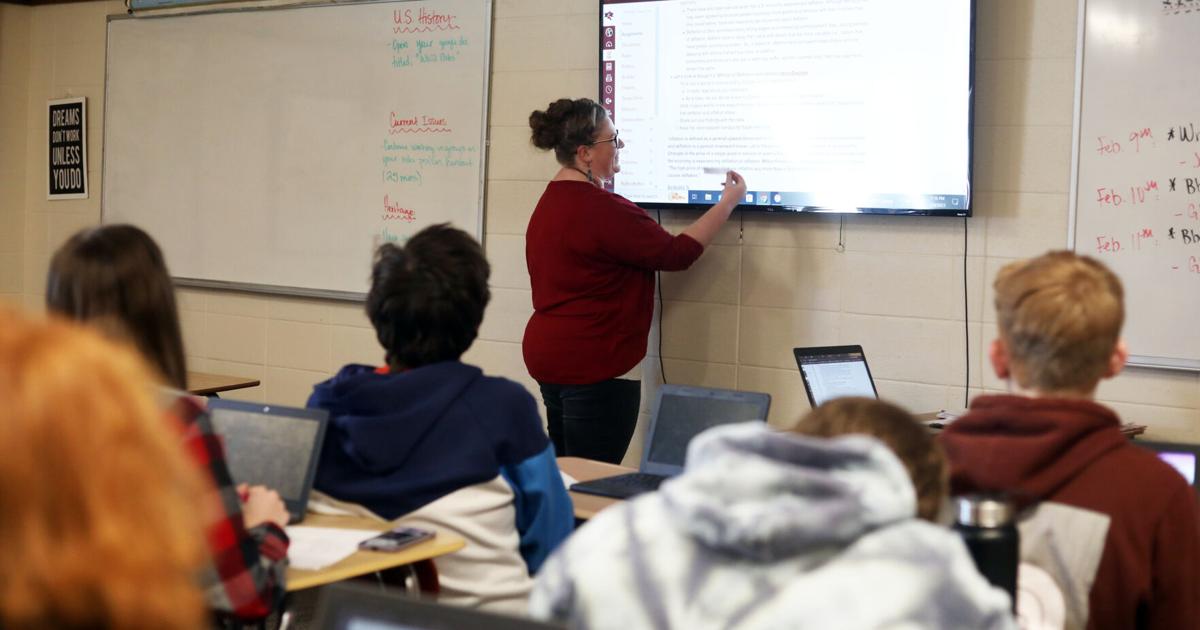
Desks at Riverton High School are pictured on Feb. 9. 


The State Board of Education, which includes Thomas and State Superintendent of Public Instruction Megan Degenfelder, voted Thursday at a meeting in Riverton to formalize their cooperation and start on pilot projects that will move some schools toward competency-based learning, allowing them to focus more on the individual learning of students.

The pilots will be voluntary for schools, but those that join will change how they instruct and assess students.

Two paths forward

Diana Clapp, the coordinator for the Wyoming State Board of Education, presented members of the State Board of Education with two options.

In the first, the group will collaborate with schools and communities to expand on the work that they are already doing around competency-based learning. Schools would “mainstream” the programs they already have in place, such as career readiness and technical training programs, so that they reach more students.


Gordon initiative calls for remaking of Wyoming's education system

The group would guide the schools through the transition, helping them with planning and giving them the support that they need to scale competency-based education. The Wyoming School-University Partnership, an alliance between school districts, community colleges, UW and state education organizations, would serve as a hub, acting as a facilitator so that schools could share their work and learn from one another.

The second option would involve starting from scratch. It would include the complete reorientation of pilot schools and pave the way for “systemic change” in Wyoming education.

The state would place pilot schools into small groups, which would then work together with the Department of Education, State Board of Education and the others to transform how they teach students. The schools and their communities would focus on the “application and transference of learning, personalized learning experiences, and alternative demonstrations of competency,” moving students away from seat time and traditional testing and assignments, according to a State Board of Education memo.

Outside experts would help the schools, which would open up their graduation requirements so that students could earn credits for educational opportunities outside of school. For example, instead of requiring a student to take a biology or environmental science course with exams, they may earn credit by working with the Wyoming Game and Fish Department on research. 

In both pilots, schools would reconsider course and graduation requirements, give more weight to opportunities such as internships, capstones and work-based learning opportunities, and would allow students more flexibility to work at their own pace and follow their interests. The schools would also emphasize learning through projects.

“The willingness of the Governor, State Board and University to partner with us on this call for innovation is the key to our state achieving student centered education that best prepares students for the workforce,” Degenfelder said in a statement.


Megan Degenfelder

Martin Carman, 12, shows now Wyoming Superintendent of Public Instruction Megan Degenfelder how to fly a drone on Aug. 11 at Code Ninjas in Casper. Degenfelder is a former Department of Education administrator and worked for an energy company before taking office.


The state’s education leaders have yet to decide on a particular direction and have yet to select schools, but they will begin to outline plans for the pilots in the coming weeks, said Linda Finnerty, a spokesperson for the Department of Education.

Degenfelder said during the board’s meeting that the goal is to begin the pilots next fall.


Degenfelder prioritizes teacher retention, school choice in first 90 days

An audible excitement swept those at the State Board of Education as they discussed the pilot projects and the shift toward competency-based learning.

“You’re talking about changing the bedrock essentially of education,” Lachelle Brant, Gordon’s education policy adviser, told the State Board of Education.

The board’s members acknowledged that the pilot schools could be the start of a monumental shift for Wyoming’s K-12 education.

“Sometimes a person gets on a board and you don’t really know what you’re supposed to be doing or what you’re accomplishing,” said Ellen Creagar, a member of the board and a social science and business professor at Eastern Wyoming College. “This isn’t that board folks. This is a board that’s really moving, shaking and making big, important, positive change for students and changing the face of education in Wyoming. It’s exciting.”

Bringing together initiatives

Competency-based education essentially means moving from a system in which students mold to education to one in which education molds to individual students.

It’s going from school desks lined up in rows, students listening to a PowerPoint lecture, to tests that ask a student to successfully perform a science experiment. It’s students taking the knowledge and skills that they build and applying them to the world outside of the classroom.

Competency-based education is premised on the “mastery” of a subject, not a test score or the time spent in a classroom.

Each of the four state bodies has led their own push toward competency-based education.

US Reading and Math Scores , Fell Sharply During Pandemic, , New Data Reveals. National Assessment of Educational Progress scores of fourth-grade students were released by the Education Department on Sept. 1. The scores reveal the most significant drop in math and reading scores for nine-year-olds in decades. The age of students is considered developmentally crucial. The scores are considered a prominent indicator of educational performance and economic outlook. Education scholars lamented the news, saying it is unlikely that the students affected by the pandemic will be able to catch up in the coming years. I don’t think we can expect to see these 9-year-olds catch up by the time they leave high school, Dr. Aaron Pallas, Teachers College Columbia University, via ‘The Wall Street Journal’. This is not something that is going to disappear quickly, Dr. Aaron Pallas, Teachers College Columbia University, via ‘The Wall Street Journal’. According to ‘The Wall Street Journal,’ . some scholars believe it could take decades for many students to return to pre-pandemic academic performance levels. COVID-19 shocked American education and stunted the academic growth [of students], Peggy G. Carr, National Center for Education Statistics Commissioner, via ‘The Wall Street Journal’. Average scores for math fell seven points from their pre-pandemic levels. Average scores for reading fell five points from their pre-pandemic levels. The numbers are the steepest decline in scores since 1990


The Department of Education and UW’s College of Education have focused on teachers, using the approach as a new way to train and certify educators. For Wyoming students, the most notable steps have come from Gordon’s office and the State Board of Education.

Gordon announced the creation of his Reimagining and Innovating the Delivery of Education (RIDE) initiative in May 2021. He asked the advisory group to broadly study how Wyoming could better prepare its K-12 students amid concerns about state funding for schools.

The group started a public input process to hear what Wyoming’s “consumers” – students, parents, businesses and educators – wanted from schools. It released a survey and held more than a dozen listening sessions across the state, producing a report in December that called for the remaking of Wyoming’s education system to focus on individualized learning for students.

In its report, the advisory group recommended the state strengthen career-connected education and change its K-12 system so that students progress through school based on academic mastery of subjects.

Gordon’s RIDE initiative paralleled an ongoing effort from the State Board of Education triggered several years before when the addition of computer science standards for K-12 raised questions about graduation requirements.

The State Board of Education started public outreach for its Profile of a Graduate initiative in March 2021 as it looked to shape Wyoming’s high school graduation requirements. The board asked Wyomingites to share the skills and knowledge that they wanted to see from the state’s graduates.

A survey and dozens of listening sessions revealed that the state’s residents wanted graduates to have seven key competencies, including mastering, applying and transferring foundational knowledge and skills, communicating effectively, and thinking critically.

While the State Board of Education and Gordon’s RIDE advisory group communicated with one another, their work was siloed – even as they found the same appeal of competency-based learning.

The vote Thursday at the State Board of Education marks the first time that all four state bodies have agreed to work together to advance competency-based learning in Wyoming.

“It is an honoring of the voices of the people of Wyoming,” Clapp told the board.

But while the board, UW, Department of Education and Gordon have bonded together, they still face a challenging road ahead.

A transition to competency-based learning is an enormous task and will not happen overnight. Board members acknowledged that the most significant obstacle will be educating parents, schools and communities about what may seem like a radical change.

Yet, they shared resolve that competency-based learning is the future of K-12 education in Wyoming.

“We’re all really in this together,” Degenfelder said.

Higher education enrollment dropping in Michigan

Higher education enrollment dropping in Michigan

GRAND RAPIDS, Mich. (Wooden) — Bigger education institutions in Michigan proceed to encounter challenges with enrollment.

Western Michigan University’s Cooley Law Faculty stated it will not enroll an incoming 2023 summer season class. Having said that, it will carry on to hold courses in the summer time at its Michigan and Florida campuses and new students will be enrolled in the slide and spring.

In accordance to knowledge from the American Bar Association, Cooley Legislation College had much more than 3,600 learners in the tumble of 2011. As of Oct. 2022, that range has fallen to all around 500.

Ryan Fewins-Bliss, govt director of the Michigan College Accessibility Community, reported enrollment in the state is a quite severe challenge that a lot of in larger instruction are facing.

“There’s about 52,000 less higher education students in the state write-up-pandemic, than there was pre-pandemic, and frankly we ended up headed in the mistaken direction pre-pandemic previously,” Fewins-Bliss stated.

Because of to COVID-19, Fewins-Bliss stated lots of college students became disconnected with establishments like larger education.

“Our complete lives transformed throughout that time time period and it’s really hard to get back into the swing of issues,” Fewins-Bliss claimed.

He also feels that the discussion bordering higher education has been shifting for the final decade.

“Parents made use of to be definitely proud when their university student was heading off to Harvard or Northwestern or College of Michigan, and now men and women appear to be significantly less probable to brag about their students going to a fantastic school,” Fewins-Bliss said.

Fewins-Bliss mentioned that numbers present that the worth of an instruction over and above high university has not gone absent.

“All of the details throughout in Michigan and across the condition claims you will make additional with an associates diploma or bachelor’s degree or outside of, you are going to have job stability and be up for more promoitions,” Fewins-Bliss stated.

According to details from the National Pupil Clearinghouse Exploration Center, Michigan local community schools have also witnessed a sharp fall in enrollment. From the fall of 2017 to 2022, full enrollment fell by about 31{515baef3fee8ea94d67a98a2b336e0215adf67d225b0e21a4f5c9b13e8fbd502}.

“Community university enrollment traditionally has been truly tied to the labor industry and I feel a great deal of persons know there are good work opportunities suitable now and pupils are typically earning option between finding a occupation and going to university,” mentioned Erica Orians, vice president of Michigan Neighborhood College or university Association.

Orians mentioned prices are also a barrier and a new condition scholarship should really present substantially wanted assist.

“The new Michigan Accomplishment Scholarship is offered to the course of 2023 which can deliver tuition guidance to some learners who are enrolling in college,” Orians reported.

The Michigan Accomplishment Scholarship makes it possible for college students to get up to $5,500 for every 12 months, based on the form of university a person attends.

Fewins-Bliss reported increased education is receiving inventive to boost enrollment and it’s vital for Michigan’s overall economy.

“Because if we really do not, possibly our corporations will leave the point out to uncover that workforce or they’ll begin to important educated personnel in from other states or nations,” Fewins-Bliss claimed.

Governor Gretchen Whitmer has set a target of 60{515baef3fee8ea94d67a98a2b336e0215adf67d225b0e21a4f5c9b13e8fbd502} of the state’s functioning-age older people getting a university diploma or techniques certification by 2030. In accordance to the Lumina Basis, Michigan is at the moment just above 50{515baef3fee8ea94d67a98a2b336e0215adf67d225b0e21a4f5c9b13e8fbd502}.

First STAAR test in 2023 | Texas education news

First STAAR test in 2023 | Texas education news

TEA Deputy Commissioner of School Programs Lily Laux claimed college students shouldn’t worry in excess of the STAAR test, even with new alterations in place.

HOUSTON — The initial STAAR examination of the year will be on Tuesday, and this year, the tests will glance a little distinct: They’ll be solely on-line.

The Texas Education and learning Company has some recommendations for dad and mom to know. They are stressing that it really is not a higher-stakes exam for students and they’re self-assured with the on the internet structure.

“We’re hunting ahead to looking at how it goes,” TEA Deputy Commissioner of University Packages Lily Laux claimed.

The exam is the TEA’s way of testing the state’s instruction.

“So the take a look at is an crucial knowledge place for us to know … how we’re accomplishing as a state and gives wonderful personal information for pupils. But it’s never ever intended to be the photograph of every little thing about a college student and it is not a thing they really should strain as they get ready for the assessment this spring,” Laux reported.

In 2019, the Texas Legislature built adjustments to the STAAR check. Section of all those alterations was going it 100{515baef3fee8ea94d67a98a2b336e0215adf67d225b0e21a4f5c9b13e8fbd502} on the net.

https://www.youtube.com/view?v=JQndK6bEh9w

“A person of the other benchmarks that make us truly feel really assured heading into this spring is that very last 12 months when it was optional to be totally on the net, we had practically 80{515baef3fee8ea94d67a98a2b336e0215adf67d225b0e21a4f5c9b13e8fbd502} of pupils nonetheless pick to test absolutely on the net,” Laux claimed.

There are backup plans in spot in circumstance technical difficulties occur through testing.

“We have backup plans on backup designs. I should really know,” Laux claimed. “If we have some variety of technological concern or a little something, it’s a massive condition, a lot transpires during screening so our workforce is constantly out there and we respond to calls from districts on any form of difficulty and we help them trouble resolve.”

The actual exam will be different, also. Various-decision queries will be no much more than 75{515baef3fee8ea94d67a98a2b336e0215adf67d225b0e21a4f5c9b13e8fbd502} of the examination and all quality ranges will see creating issues.

“A little something that we’re hoping appears a good deal a lot more like classroom instruction … contains non-various option items, has crafting at just about every grade and is fully on line,” Laux reported.

Dad and mom can help their kids put together for the check.

“The primary one (suggestion) is just remind (them), you can find no tension on this for their college student. This is not some thing which is significant-stakes and this is a thing the place they really should actually just take a deep breath and do their greatest,” Laux explained.

After the exams are carried out, mom and dad can go on the web to see how their children did.

Janelle Bludau on social media: Fb | Twitter | Instagram