The worldwide financial state will occur “perilously close” to a economic downturn this calendar year, led by weaker advancement in all the world’s prime economies – the United States, Europe and China – the Environment Lender warned on Tuesday.
In an annual report, the Earth Financial institution, which lends revenue to poorer nations around the world for progress projects, mentioned it had slashed its forecast for world-wide expansion this 12 months by virtually fifty percent, to just 1.7 per cent, from its past projection of 3 p.c. If that forecast proved precise, it would be the third-weakest annual enlargement in 30 several years, behind only the deep recessions that resulted from the 2008 world-wide economic disaster and the coronavirus pandemic in 2020.
Though the United States could prevent a recession this calendar year – the Entire world Bank has predicted the US economic system will eke out expansion of .5 {515baef3fee8ea94d67a98a2b336e0215adf67d225b0e21a4f5c9b13e8fbd502} – world weak spot will probably pose one more headwind for US businesses and customers, on top rated of large costs and a lot more high-priced borrowing prices. The US would also keep on being vulnerable to more source chain disruptions if COVID-19 keeps surging or Russia’s war in Ukraine worsens.
And Europe, long a major exporter to China, will very likely go through from a weaker Chinese overall economy.
The Earth Lender report also noted that soaring fascination premiums in developed economies like the United States and Europe will attract financial commitment money from poorer nations, thus depriving them of essential domestic expenditure. At the similar time, the report mentioned, these large desire premiums will sluggish progress in made nations around the world at a time when Russia’s invasion of Ukraine has saved earth food prices higher.
“Russia’s invasion of Ukraine has extra big new fees,” Earth Bank President David Malpass explained on a simply call with reporters. “The outlook is specifically devastating for many of the poorest economies where poverty reduction is currently ground to a halt and accessibility to electricity, fertiliser, foodstuff and capital is very likely to continue to be limited for a extended interval.”
The influence of a international downturn would tumble notably tricky on poorer nations around the world in these kinds of, parts as Saharan Africa, which is house to 60 per cent of the world’s inadequate. The World Bank has predicted for every capita earnings will develop just 1.2 percent in 2023 and 2024, which is this sort of a tepid rate that poverty charges could rise.
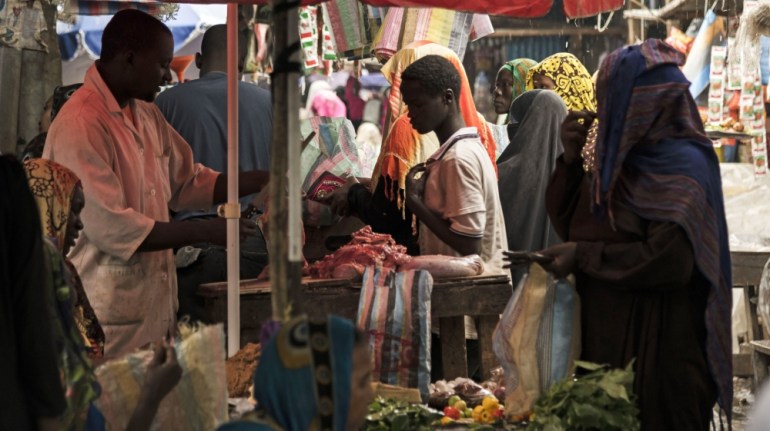
For most of the earth, this is going to be a ‘tough year’ [File: Xaume Olleros/Bloomberg]
“Weakness in growth and organization investment decision will compound the previously devastating reversals in education and learning, well being, poverty and infrastructure and the rising demands from weather transform,” Malpass mentioned. “Addressing the scale of these issues will involve appreciably much more methods for enhancement and global public goods.”
Along with trying to get new financing so it can lend a lot more to poorer international locations, Malpass explained, the Entire world Financial institution will, among other items, request to improve its lending phrases that would raise personal debt transparency, “especially for the soaring share of very poor international locations that are at superior risk of credit card debt distress”.
Major a few slowdown
The report adopted a likewise gloomy forecast a 7 days before from Kristina Georgieva, the head of the Global Financial Fund, the world lending company. Georgieva approximated on US news community CBS’s, Confront the Country, that one particular-3rd of the environment will tumble into recession this year.
“For most of the earth economy, this is likely to be a difficult 12 months, harder than the 12 months we leave behind,” Georgieva said. “Why? Simply because the three significant economies – US, EU, China – are all slowing down simultaneously.”
The World Financial institution has projected that the European Union’s economy will not increase at all subsequent year just after obtaining expanded 3.3 p.c in 2022. It foresaw China developing 4.3 {515baef3fee8ea94d67a98a2b336e0215adf67d225b0e21a4f5c9b13e8fbd502}, just about a share point lower than it experienced beforehand forecast and about 50 {515baef3fee8ea94d67a98a2b336e0215adf67d225b0e21a4f5c9b13e8fbd502} the speed that Beijing posted in 2021.
The bank predicted building countries to fare greater, expanding 3.4 {515baef3fee8ea94d67a98a2b336e0215adf67d225b0e21a4f5c9b13e8fbd502} this calendar year, the same as in 2022, though nonetheless only about fifty percent the speed of 2021. It forecast Brazil’s advancement slowing to .8 p.c in 2023, down from 3 {515baef3fee8ea94d67a98a2b336e0215adf67d225b0e21a4f5c9b13e8fbd502} previous calendar year. In Pakistan, it predicted the economy to broaden just 2 {515baef3fee8ea94d67a98a2b336e0215adf67d225b0e21a4f5c9b13e8fbd502} this year, one-third of last year’s speed.
Other economists have also issued bleak outlooks, although most of them not rather as dire. Economists at JPMorgan are predicting slow progress this 12 months for innovative economies and the environment as a total, but they do not be expecting a worldwide economic downturn. Past thirty day period, the bank predicted that slowing inflation will bolster consumers’ potential to shell out and electricity advancement in the US and elsewhere.
“The world growth will transform into 2023 bent but not damaged,” the JPMorgan report reported.
This will be a major 7 days for financial information. The shopper value index will come out Thursday and notify us irrespective of whether inflation proceeds to moderate less than the influence of continuing Federal Reserve price hikes. And the kickoff of company earnings time will also aid fill in the around-phrase picture for desire charges and a potential economic slowdown.
Friday, we’ll listen to from a gaggle of huge financial institutions: JPMorgan Chase, Citigroup, Lender of The usa and Wells Fargo. So significantly, predictions aren’t good for company earnings in Q4 — when the financial state was slowing and layoffs had been spreading in tech and finance.
Equity analyst Ken Leon at CFRA Exploration sees the significant banks’ earnings reports as a harbinger of what’s to occur: “a weaker fourth quarter in ’22 versus ’21, lots of uncertainty for 2023.”
Mortgage loan finance, investment banking, mergers and preliminary public choices have all slumped, Leon said, as markets faltered and borrowing charges enhanced.
But higher desire prices also develop an upside for banking companies, in accordance to Mark Zandi at Moody’s Analytics.
“The desire fees on their deposits, they’re climbing incredibly slowly,” he said. “But the desire price they cost on their financial loans are up, so they are carrying out rather very well on that so-termed net curiosity margin — which is their revenue margin.”
But Zandi does not imagine that’ll final, which could possibly be welcome news for savers. “I do assume financial institutions will need to have to shell out their depositors extra to keep on to deposits. They are setting up to drop deposits.”
What comes about to banks’ stability sheets in 2023 will explain to us a good deal about recession danger, stated Karen Petrou at Federal Economic Analytics.
“Banks are canaries in the financial coal mine,” she reported.
Quincy Krosby, chief international strategist at LPL Fiscal, puts it this way: “Whatever transpires in the financial system is likely to manifest itself in the banking companies.”
She’ll be observing for any rise in defaults on mortgages, car or truck financial loans and credit history playing cards and how considerably banking institutions have to set apart to go over those people losses.
“That will give us an sign of how People in america are dealing with paying out back again personal debt,” Krosby said.
Banks’ reporting on credit rating card use has now advised us something vital, she additional. “Lower-wage earners have been working with their cards more and more for necessities than just discretionary things.”
Which is a sign that large costs and dwindling price savings are pushing individuals consumers a tiny closer to the edge.
There is a lot going on in the planet. Via it all, Market is right here for you.
You count on Marketplace to break down the world’s occasions and tell you how it influences you in a reality-based mostly, approachable way. We count on your financial guidance to maintain building that achievable.
China’s overall economy, the next most significant in the earth, has constantly been in the spotlight. A short while ago, the nation has deployed its financial do the job for 2023, opening a new chapter for its economic progress and filling us with self esteem in China’s economic system in the new calendar year.
But where does this confidence arrive from?
Wanting at the more substantial photo, the 10 new avoidance and manage steps ushered in a new phase of China’s COVID-19 reaction. Whilst the pandemic has not still arrive to an finish, the optimized technique will unquestionably increase financial action, and facilitate the circulation of economic variables and commodities. Set just, the optimized tactic has reinvigorated the financial system. The roadways are busier, the malls have a lot more shoppers, and travel apps have found an uptick in prospects. The optimized COVID-19 approach and updated economic coverage have introduced China’s financial system into a new progress stage.
In phrases of distinct economic measures, “expanding domestic demand” has grow to be a major precedence in reaching the goal of making sure secure growth in 2023. Predictions for this 12 months depict a bleak global financial outlook with sluggish external demand. In distinction with the Keynesian perception that “demand produces its have supply,” China emphasizes building powerful desire by superior-top quality offer, which usually means continually innovating to make bigger-stage products and solutions. For illustration, even with the saturated cellphone sector, the emergence of smartphones redefined cellphones, making need from 7 billion people today for the new items. This represents the underlying logic at the rear of China’s efforts to deepen supply-aspect structural reform.
According to a modern report from the Planet Lender, China contributed an average of 38.6{515baef3fee8ea94d67a98a2b336e0215adf67d225b0e21a4f5c9b13e8fbd502} to worldwide economic development from 2013 to 2021, a lot more than the G7 nations put together. Expanding domestic need suggests further more tapping the large possible of China’s supersized market place of 1.4 billion individuals. This will translate into a essential driving power to the economies of each China and the planet.
In addition, building the non-public sector is also a vital precedence. With non-public companies, this sort of as Huawei, Alibaba and ByteDance, accounting for a large proportion of China’s economy, the non-public sector has now grow to be a key financial participant in the region. Stats present that in the 1st 11 months of 2022, the import and export volume of China’s private enterprises amounted to 19.41 trillion yuan (about $2.82 trillion), or 50.6{515baef3fee8ea94d67a98a2b336e0215adf67d225b0e21a4f5c9b13e8fbd502} of the country’s total. Non-public enterprises have also demonstrated more robust vitality and resilience, specifically in phrases of the sustainable improvement of new varieties of international trade.
Therefore, China is scaling up its help for the non-public sector, consistently urging equivalent procedure of personal businesses and their state-owned counterparts, and assisting micro-, small- and medium-sized enterprises to overcome difficulties posed by the pandemic. These supporting actions intention to encourage the audio progress of non-public companies. Likewise, the thriving of private companies will in return bolster the economic system by making more work, guaranteeing the ongoing growth of disposable incomes, and further more expanding domestic demand and boosting use. As these kinds of, we are also confident about the development of the non-public sector in 2023.
China’s financial system has withstood a number of exams and worries throughout the three yrs since the outbreak of the pandemic, and the 12 months 2023 is bound to be a brand new journey in striving for economic expansion. Nevertheless, with the present insurance policies, innovation capacity and different driving forces, we are confident that China’s financial system will grow steadily, go on to act as an engine for the worldwide financial state and propel additional progress. Supply: China.org
THE END (MIGHT) BE IN SIGHT — Rep. Kevin McCarthy flipped 15 detractors in his hunt for the speakership today, but fell just short of being elected — for now. The House is adjourned until 10 p.m. EST this evening.
The six Republicans who remained opposed to McCarthy throughout the day were Reps. Andy Biggs (Ariz.), Lauren Boebert (Colo.), Eli Crane (Ariz.), Matt Gaetz (Fla.), Bob Good (Va.) and Matt Rosendale (Mont.). If McCarthy can keep the rest of his conference together, he only needs two more flips from the remaining six to secure the speakership, assuming all House members are voting.
WELL-BALANCED — You wanted the perfect Goldilocks jobs report — not too hot, not too cold? Well, you pretty much got exactly that in December with hiring still quite strong at 223,000 but slowing down a bit with wage gains easing.
The jobless rate ticked back to a forty-year low of 3.5 percent, the Labor Department said today, as nearly half a million Americans returned to the labor force.
That means, at least for the moment, that the fabled and rarely achieved economic “soft landing” — in which the Federal Reserve’s campaign of rate hikes cools off inflation but doesn’t tip the economy into recession — is still very much a possibility, if a fairly narrow one.
And the new economic conventional wisdom that any recession would probably be short and shallow looks like it could actually be correct. To be clear, a foam-the-runway style, fiery crash landing remains quite possible. But as the new year begins, it’s no longer fashionable to be an economic doom-and-gloomer. And with pretty good reason.
Just look at the numbers. Job gains are now at their lowest point in two years as the flood back from Covid runs its course and Fed hikes start to pinch businesses and limit hiring plans. But they are still quite strong. That’s great from a Fed perspective.
And the central bank’s biggest concern, a wage-price inflation spiral in which ever-rising compensation forces companies into more and bigger price hikes on consumer products, does not appear to be happening. The Fed — and American workers — love wage gains. But not if they run out of control and drive up overall consumer inflation.
And in December, wages ticked up 0.3 percent on a monthly basis, less than what Wall Street forecast. Wages are now up 4.6 percent on an annual basis, down from a March peak of 5.6 percent. In the short term, this is rough for workers as it now means their pay hikes are again being entirely eaten up by inflation.
Still, it’s good news for the Fed. Chair Jerome Powell and his central bank colleagues can now point to some pretty concrete signals that the hot labor market is finally cooling a bit. While still high, wage gains are slowing down, which is exactly what the Fed wants to see. And nearly half a million Americans rejoined the workforce in December, perhaps a signal that depleted Covid-era savings are finally forcing people back into jobs.
That good news for the Fed could lead to a smaller rate hike of just a quarter point next month. And that, in turn, meant good news for Wall Street, with all major averages jumping around 2 percent on the news. Big Wall Street banks are mostly no longer calling for an imminent recession, though risk levels remain high.
Instead, what appears to be happening at the moment is the American economy is very slowly starting to resemble what it was before Covid: slow growing, plagued by inequality and other systemic issues but generally… basically pretty OK.
The “Goldilocks” analogy — cliche though it is — dripped from nearly every economist’s lips today. And the report came as strong news for Democrats and President Joe Biden as their argument — that the president’s big fiscal and social policy wins from the last two years will help avoid recession — now appears to have some more merit.
But, but, but … and you knew this bit was coming. It’s not like a soft-landing is a lock, or the economy is fully healed from Covid. There are already significant layoffs in the interest rate sensitive technology and financial services sectors as companies prepare for a Fed-dampened economy. Temporary help has fallen by 110,000 over the past five months. New orders for manufactured goods dropped by 1.8 percent in November, the Commerce Department said, well above the expected decline.
“The third straight hefty drop in temp hiring, down 35,000, is an ominous sign,” Pantheon Macroeconomics’ chief U.S. economist Ian Shepherdson wrote in a client note today. “We think substantially slower payroll growth is coming very soon.”
And a business survey on activity in the services sector showed a decline in December for the first time since early in the pandemic. The labor force is still 2.6 million people smaller than it was before the pandemic. And it was already way too small. That means continued pressure on wages until more people get back to work.
While encouraging for the Fed, wages are still growing faster than they would like — as is overall inflation. If current trends don’t continue on inflation, the central bank will absolutely err on the side of sparking recession with more big hikes. So keep the cigars unlit for now.
Welcome to POLITICO Nightly. Contact tonight’s author at [email protected] or on Twitter at @morningmoneyben.
HOUSE GRINDS TO A HALT — The House must select a speaker before swearing in members or passing a new set of chamber rules and the paralysis affects lawmakers, staffers and constituents alike. Here are four ways the turmoil has disrupted normal operations.
Security clearance: Lawmakers still don’t have the clearance needed to take classified briefings with intelligence, military and senior administration officials on an array of sensitive issues. Reps. Mike Turner (R-Ohio), Mike McCaul (R-Texas) and Mike Rogers (R-Ala.) issued a joint statement criticizing the turmoil for hindering their ability to perform White House oversight.
Staffer pay: According to guidance provided by the House Administration Committee, if by the end of Jan 13. a rules package has not been adopted, “no committee will be able to process payroll” since authority would rest in the new Congress. That disrupts payment for staffers as well as the processing of student loan forgiveness programs for House employees.
Constituent casework: Several lawmakers have said some federal agencies have been unable to process casework until the new Congress is officially sworn in. That puts a dent in everything from renewing passports, updating tax information and applying for federal benefits. One GOP staffer told POLITICO’s Olivia Beavers they are “not sure people realize the non-political ramifications this has on our ability to help folks.”
C-SPAN gone wild: While the majority party typically imposes strict rules on the kinds of shots that can be filmed, procedures are peeled back for special events like the election of House speaker. As the drama unfolds, C-SPAN has deployed roaming cameras filming whatever and wherever they like. The shots offer rare glimpses into high-stakes negotiations served directly to the public.
THE LONG SHADOW — Today marks the two-year anniversary of the January 6, 2021 attack on the Capitol. House Democrats gathered on the steps of the Capitol to commemorate the day, joined by only one Republican, Pennsylvania Rep. Brian Fitzpatrick. Nightly compiled stories that are worth reading to understand the day and its legacy:
— Covid cases, hospitalizations spike as new variant gains foothold: Covid-19 cases are spiking as a new variant, which may be the most transmissible yet, spreads across the country. Roughly 6,500 people in hospitals in the U.S. have tested positive for Covid-19, according to the CDC, more than double the number from one month ago, and more than 10,000 people have died from Covid in the last month, the highest four-week total since the summer.
— Miami Democrats face internal feud after disastrous 2022 midterms: The 2022 midterms saw Republicans win Miami-Dade County for the first time in 20 years. Now, the Democratic infighting has begun. Ten party officials in Florida’s most populous county are asking the statewide Florida Democratic Party to audit the county party over alleged campaign finance “improper activity.” The request comes after Republicans won nearly every race in the county, which Hillary Clinton won by nearly 30 percentage-points just six years ago. The county has long been held up as an overwhelming Democratic home turf.
PEDDLING PROPAGANDA — Latvia’s intelligence services arrested Latvian national Marat Kasem, the editor-in-chief for the Lithuanian edition of Sputnik, the Kremlin-backed news website. He is suspected of “providing economic resources to a Kremlin propaganda resource” under European Union sanctions last Tuesday, the state’s Security Service announced in a statement.
Baltic news outlet Delfi identified Kasem, who has been placed in detention, writes Nicolas Camut.
Both Sputnik and Russia Today (also known as RT) have been banned from the EU since last March after spreading disinformation about Russia’s full-scale invasion of Ukraine. The ban extends to all platforms and the two outlets’ content can no longer be accessed from inside the EU.
“The person is employed at one of the information resources of the agency ‘Rossiya Segodnya’ [Russia Today], which is under the Kremlin control and disseminates narratives in line with the Kremlin’s interests, including regularly discrediting Latvia and its allies,” the statement from the Latvian agency reads.
TRUE CRIME-MANIA — We live in an era where true crime podcasts accounted for 17 percent of those mentioned in year end lists from publications such as Esquire and The New York Times and Netflix’s “Dahmer” saw viewing times exceed one billion, so it’s no secret that serial killers are an entertaining (and profitable) topic for many. What is the root of this fascination with murder? Who is the typical true crime fan and what does their love for the subject really tell us? The Believer’s Sarah Marshall explores these topics through a history lesson on the serial killers of the 70s and 80s and a deep dive into the topic’s current popularity. Unpacking the women’s liberation movement and the way killers are depicted in media such as “Criminal Minds” or “Silence of the Lambs,” Marshall covers all facets of the serial killer phenomenon.
SMOOTH TRANSITION — While a bitterly divided Washington slogs on under the shadow of Jan. 6, Massachusetts Playbook author Lisa Kashinsky writes in to Nightly about a just-completed transfer of power between parties that was almost jarring in its level of civility and collegiality.
After eight years as chief executive, Republican Charlie Baker handed the key to the Massachusetts governor’s office over to Democrat Maura Healey in a ceremonial exchange of gifts this week that ended with not just one hug, but three. The newly elected governor is also keeping one of Baker’s Cabinet secretaries and retaining another as a transition adviser. In her inaugural address Thursday, Healey even vowed to pursue some of the policies — tax relief, chief among them — that Baker failed to get across the finish line.
Solidly blue Massachusetts, of course, doesn’t have a recent history of bitter partisan conflict. (Republicans here are too busy fighting themselves). But the state has a habit of electing moderate Republican governors to balance its Democratic supermajority Legislature.
Baker was in that tradition, a bastion of old-school, centrist New England Republicanism even as his party moved away from it. He left office having been consistently ranked as one of the nation’s most popular governors.
His decision not to seek a third term paved the way for Democrats to retake the corner office and usher in a new era of one-party rule on Beacon Hill. Healey, a progressive former prosecutor who repeatedly sued former President Donald Trump’s administration in her role as state attorney general, has consistently lauded the outgoing GOP governor and sought to ensure a smooth transition.
The first woman elected governor of Massachusetts, Healey’s tenure is starting off as something of an extension of her Republican predecessor. And that’s won her plaudits from Republicans and Democrats alike.
“Charlie did a terrific job as governor. It can’t hurt by taking the best of Charlie and whatever it is that she wants to put her own stamp of approval on,” White House climate envoy John Kerry, a former U.S. senator from Massachusetts who was on hand for Healey’s inauguration Thursday, told reporters. “But I think there will be continuity. I don’t think it’s going to be craziness like we’re seeing down in Washington. Far from it.”
And Healey, addressing reporters from the executive suite for the first time today, said that’s “the way it should be.”
“I hope our state can be an example to others at a time where unfortunately across this country we’ve seen a lot of divisive rhetoric and ugly political discourse, and too many politicians looking to divide and really exploit misinformation, disinformation and even people for their own perceived politician gain,” she said.
Did someone forward this email to you? Sign up here.
There wasn’t much in the way of reassuring news for investors and the Federal Reserve in 2022. But 2023 is starting off on a better foot with the December jobs report.
The latest reading on the jobs market showed an easing of wage pressures since November, which had sparked renewed inflation concerns. At the same time, job growth has moderated from last year’s elevated pace, and yet remained healthy. That dynamic threads the needle of showing some impact on the economy from the Fed’s efforts to slow the economy and fight inflation through interest-rate increases and, at the same, offering no signs of a more significant slowdown that would reflect an economy tipping into recession.
“Today’s report showed that excess labor demand may be diminishing, helping to slow wage growth and ultimately slow inflation,” says chief U.S. economist at Morningstar Preston Caldwell. “Nevertheless, the report also showed continued robust growth in jobs.” Caldwell says the report won’t shift the Fed’s decision-making in a major way, and job growth is still far above recessionary levels.
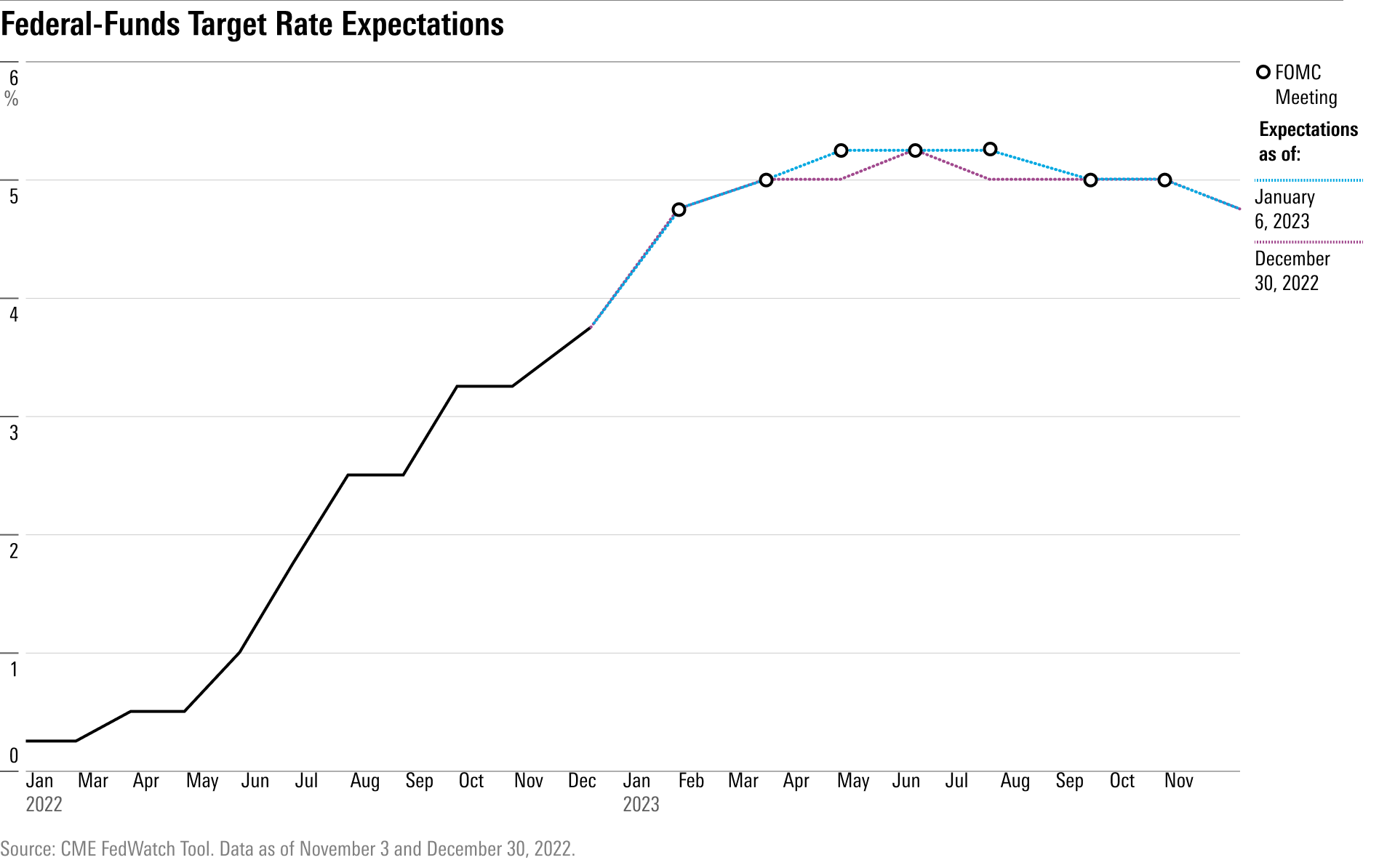
The bond futures market suggests the Fed is expected to raise the federal-funds rate by 0.25 percentage points when officials next meet at the beginning of February. That would be the first time since last March that the Fed raised rates by just a quarter point, having engineered multiple half-point and three-quarters of a point hikes since then.
Attention will now turn to the upcoming December Consumer Price Index report due out next Thursday for confirmation of hopes that inflation pressures are continuing to ease.
Puzzlingly Strong Job Growth
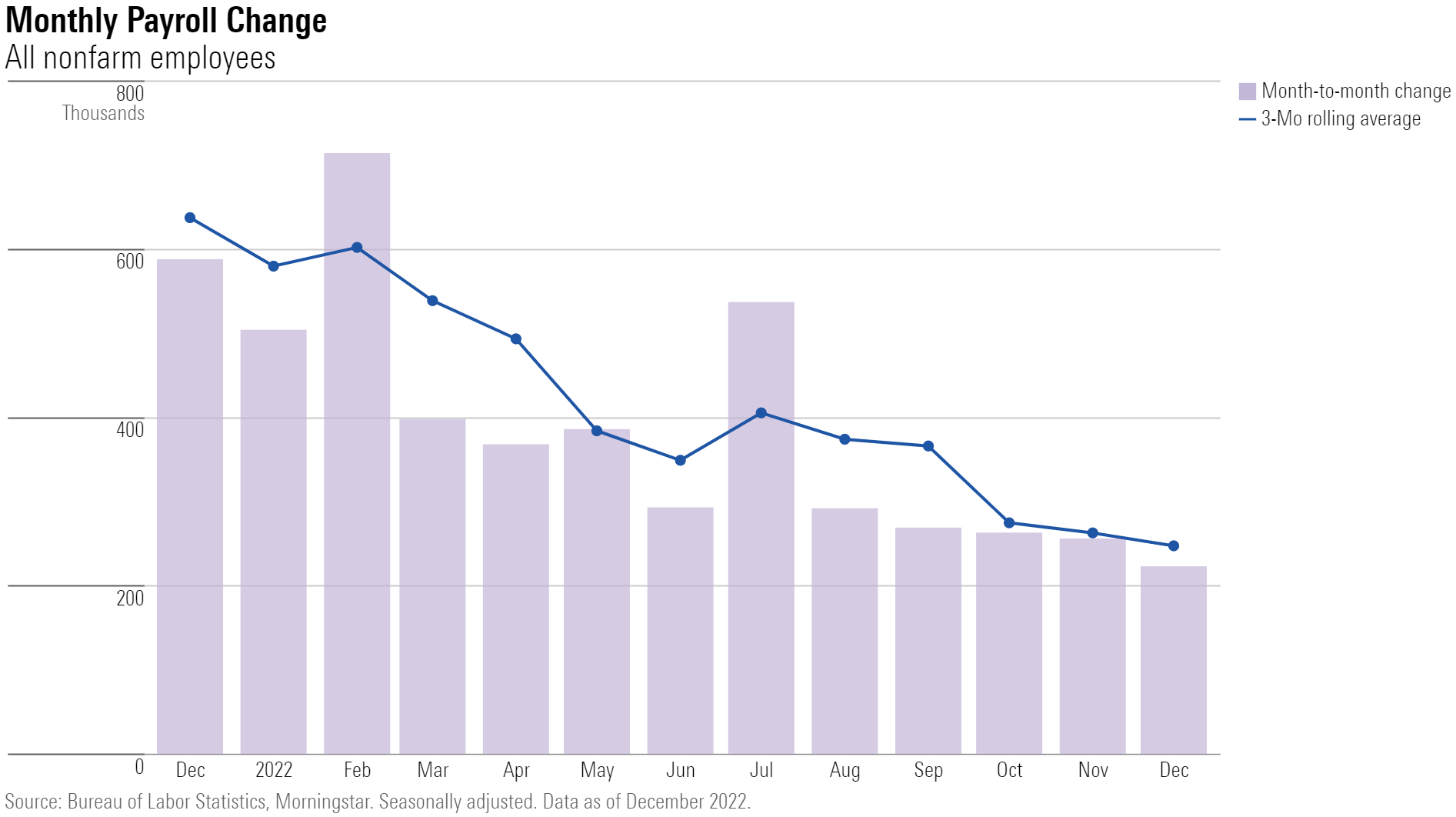
The December jobs report from the Bureau of Labor Statistics showed total nonfarm payrolls rose by 223,000, roughly in line with consensus expectations of 210,000. Job gains were led by leisure and hospitality, healthcare, construction, and social assistance.
With the December gains in hiring, 2022 clocked in as the second-best job creation year in history after 2021.
“Job growth has continued its gradual downtrend, but it’s still puzzlingly strong compared to growth in economic activity,” Caldwell says.
Nonfarm employment rose 3{515baef3fee8ea94d67a98a2b336e0215adf67d225b0e21a4f5c9b13e8fbd502} in December from year-ago levels, according to Caldwell. His forecasts show that real domestic product growth in the fourth quarter is likely to post an increase of around 0.5{515baef3fee8ea94d67a98a2b336e0215adf67d225b0e21a4f5c9b13e8fbd502}-1{515baef3fee8ea94d67a98a2b336e0215adf67d225b0e21a4f5c9b13e8fbd502} year-over-year. “In ordinary times, we would expect employment growth to track about 1{515baef3fee8ea94d67a98a2b336e0215adf67d225b0e21a4f5c9b13e8fbd502} lower than real GDP growth.”
Lowest Unemployment Rate in 50 Years
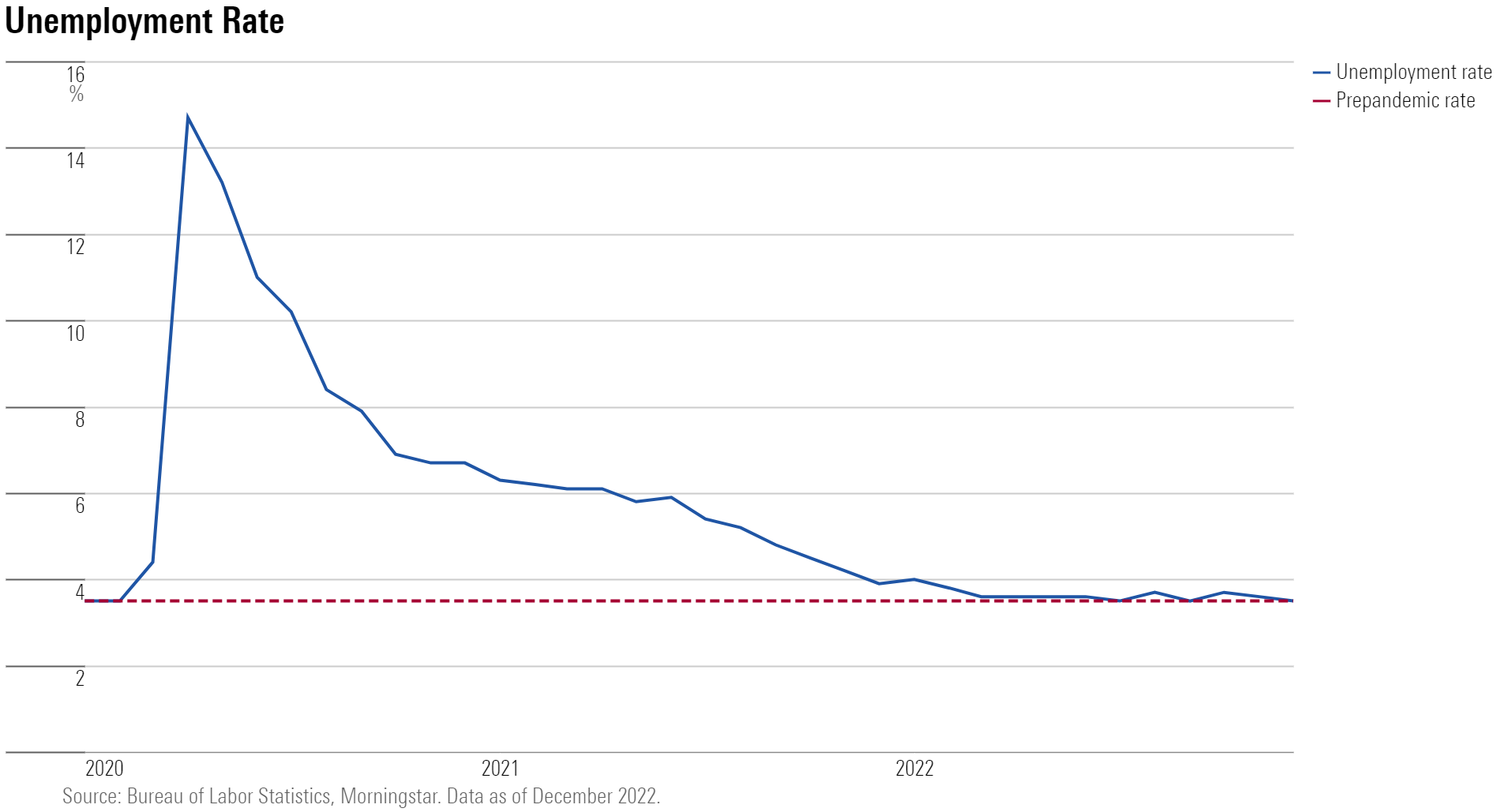
The unemployment rate edged down to 3.5{515baef3fee8ea94d67a98a2b336e0215adf67d225b0e21a4f5c9b13e8fbd502} in December, the Labor Department reported, down from a revised 3.6{515baef3fee8ea94d67a98a2b336e0215adf67d225b0e21a4f5c9b13e8fbd502} in November. The unemployment rate has held between 3.5{515baef3fee8ea94d67a98a2b336e0215adf67d225b0e21a4f5c9b13e8fbd502} and 3.7{515baef3fee8ea94d67a98a2b336e0215adf67d225b0e21a4f5c9b13e8fbd502} since March, but with December’s reading, the unemployment rate statistically matched its lowest since 1969.
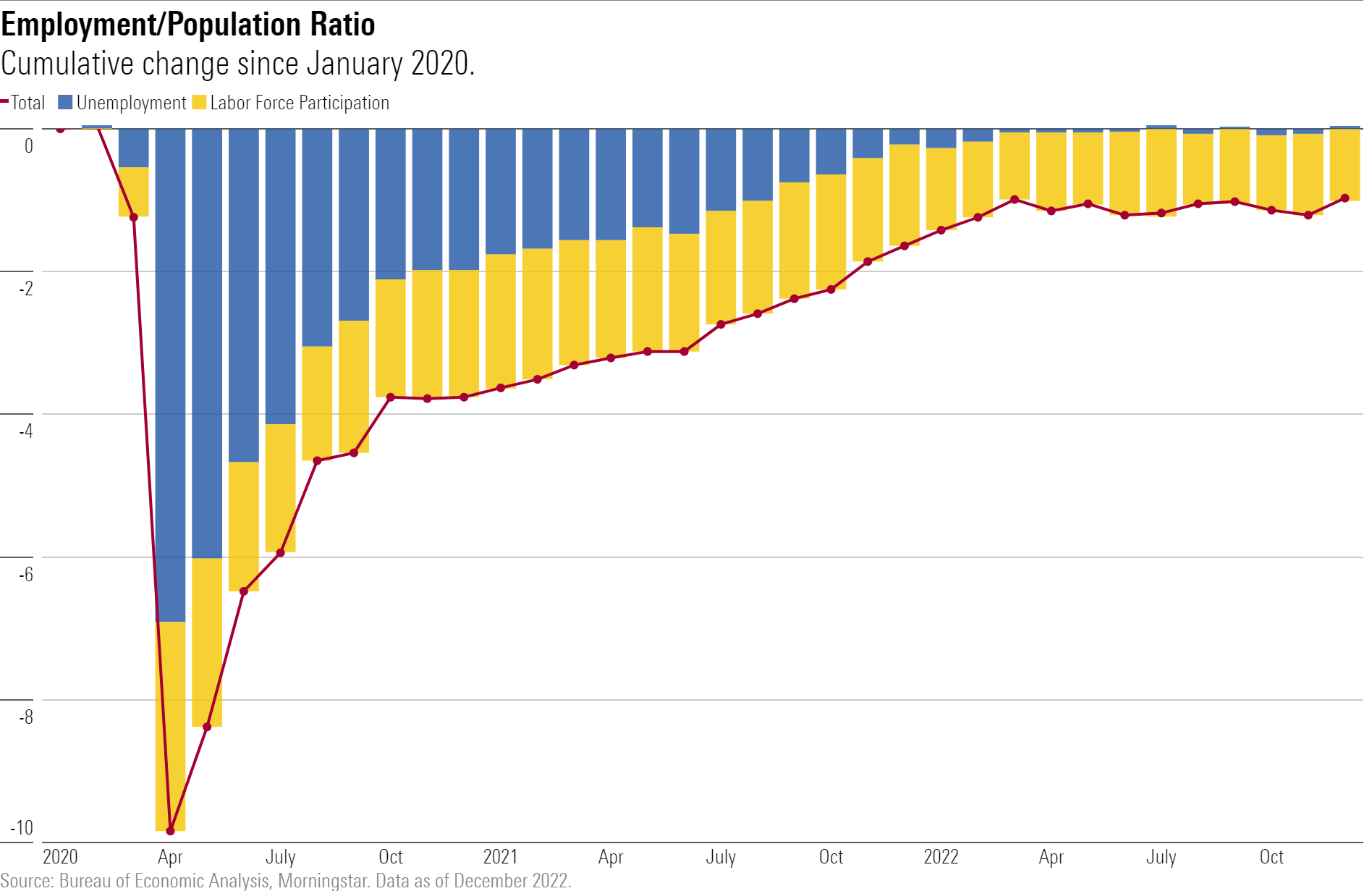
One area within the jobs report that economists have been focusing on has been the overall size of the labor market. Among the many unexpected patterns in the economy in the wake of the pandemic is the large number of workers who never returned to the job market after losing jobs, or quitting, when COVID-19 hit.
The employment/population ratio increased by 0.2 percentage points over the month to 60.1{515baef3fee8ea94d67a98a2b336e0215adf67d225b0e21a4f5c9b13e8fbd502}. The labor force participation rate held steady at 62.3{515baef3fee8ea94d67a98a2b336e0215adf67d225b0e21a4f5c9b13e8fbd502}.
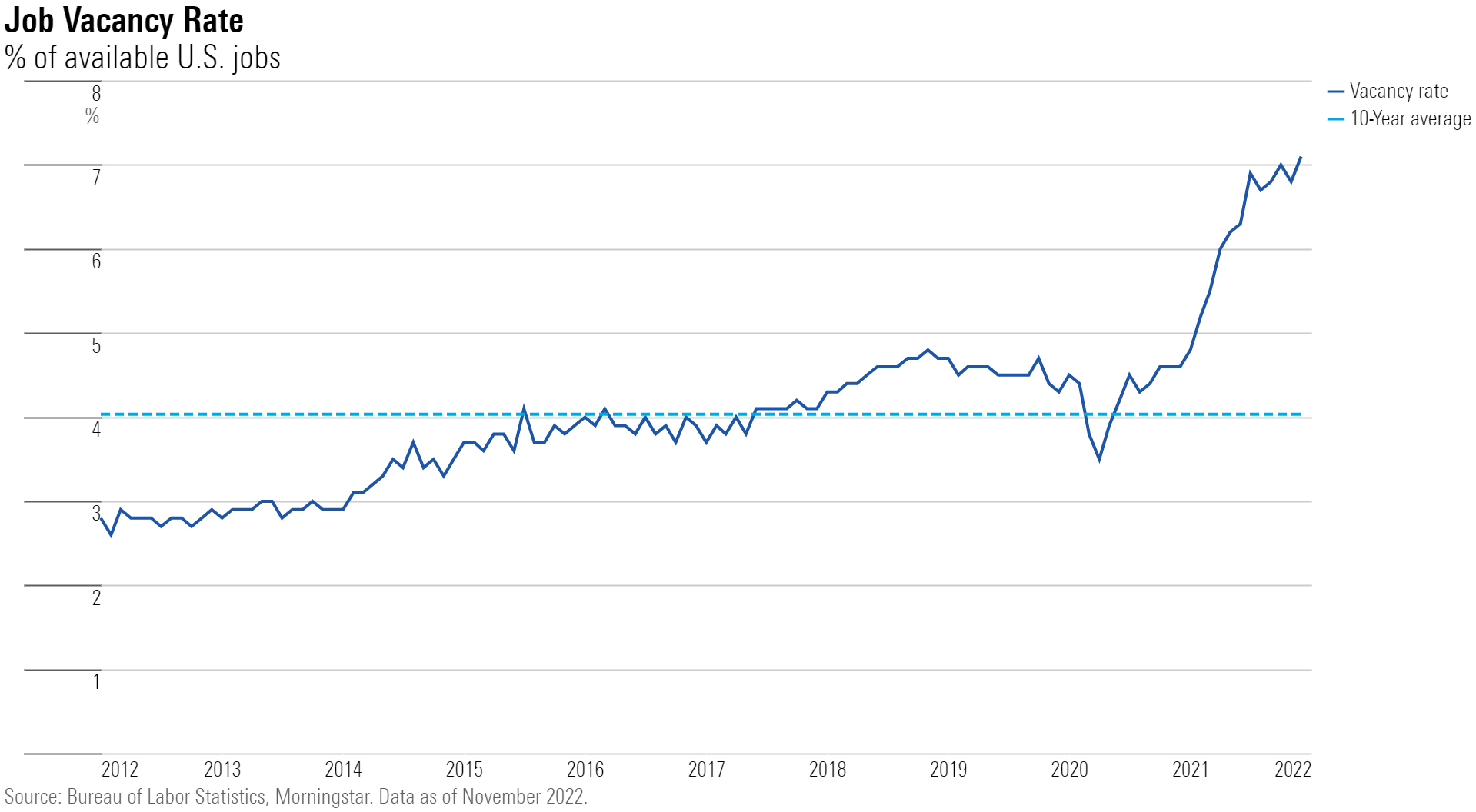
“Job openings remain sky high at 6.4{515baef3fee8ea94d67a98a2b336e0215adf67d225b0e21a4f5c9b13e8fbd502} in November, compared to 4.5{515baef3fee8ea94d67a98a2b336e0215adf67d225b0e21a4f5c9b13e8fbd502} prior to the pandemic,” Caldwell says. “However, employers don’t appear willing to fill these openings at any cost, limiting the impact of openings on wage inflation.”
Some Signs of Cooling
Caldwell does see signs that labor demand is cooling. Employment in the “temporary help services” industry has declined 3{515baef3fee8ea94d67a98a2b336e0215adf67d225b0e21a4f5c9b13e8fbd502} in the last three months. “This category is a leading indicator because employers tend to hire or layoff temporary employees prior to doing so with permanent ones.”
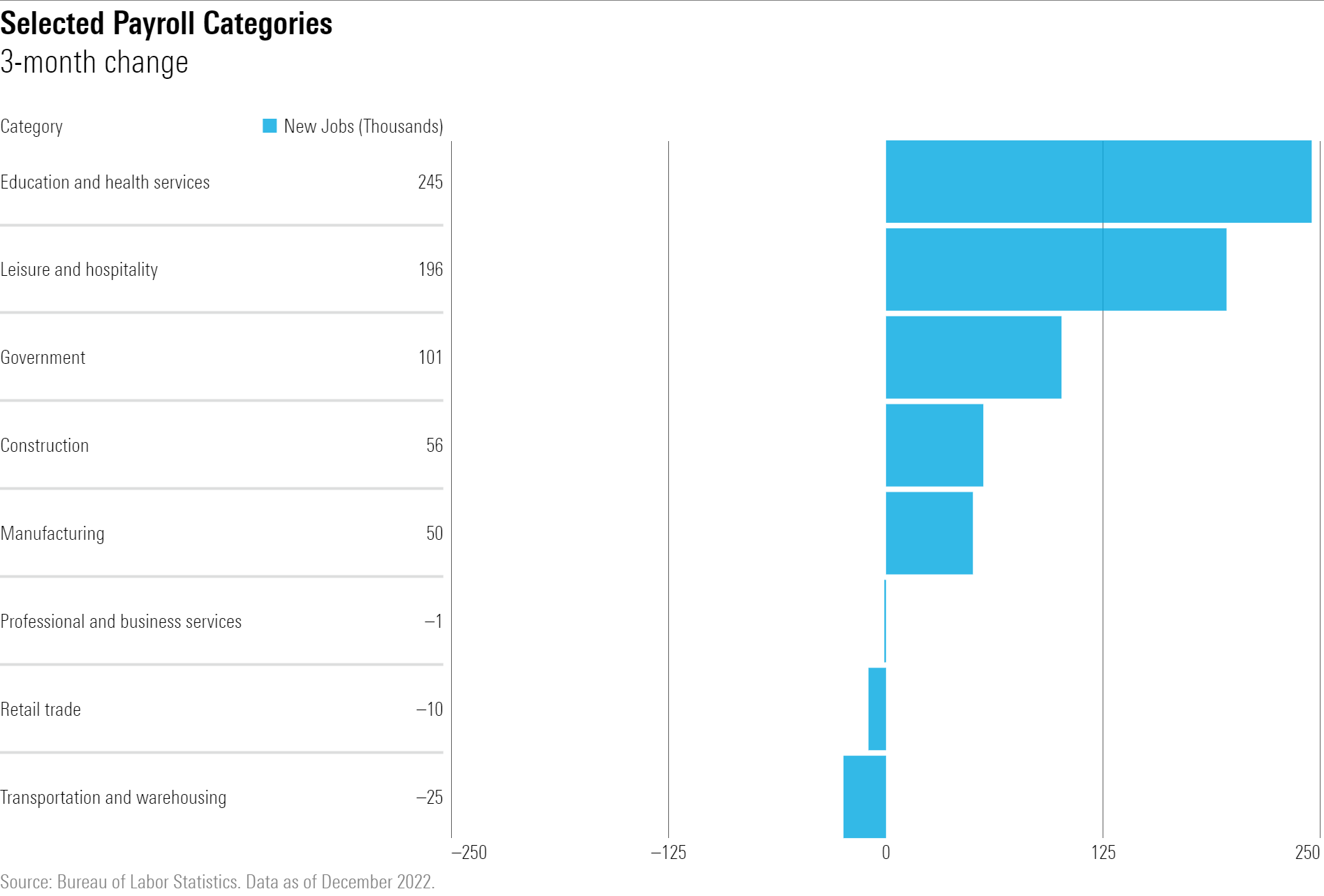
Among other job categories, hiring was led by employment in leisure and hospitality, which rose by 67,000 in December. Healthcare employment increased by 55,000, and employment in construction increased by 28,000 in December, as specialty trade contractors added 17,000 jobs.
The Labor Department noted that construction employment increased by an average of 19,000 per month in 2022, little different than the average of 16,000 per month recorded in 2021.
“It’s surprising to still see growth in construction jobs, given the slowdown in the housing market from higher interest rates.” Caldwell says that this is one indicator that the impact of Fed tightening in 2022 has yet to play out in terms of the job market.
At the same time, job losses are materializing in some industries, such as retail trade and transportation and warehousing, he says.
Wage Pressures Ease
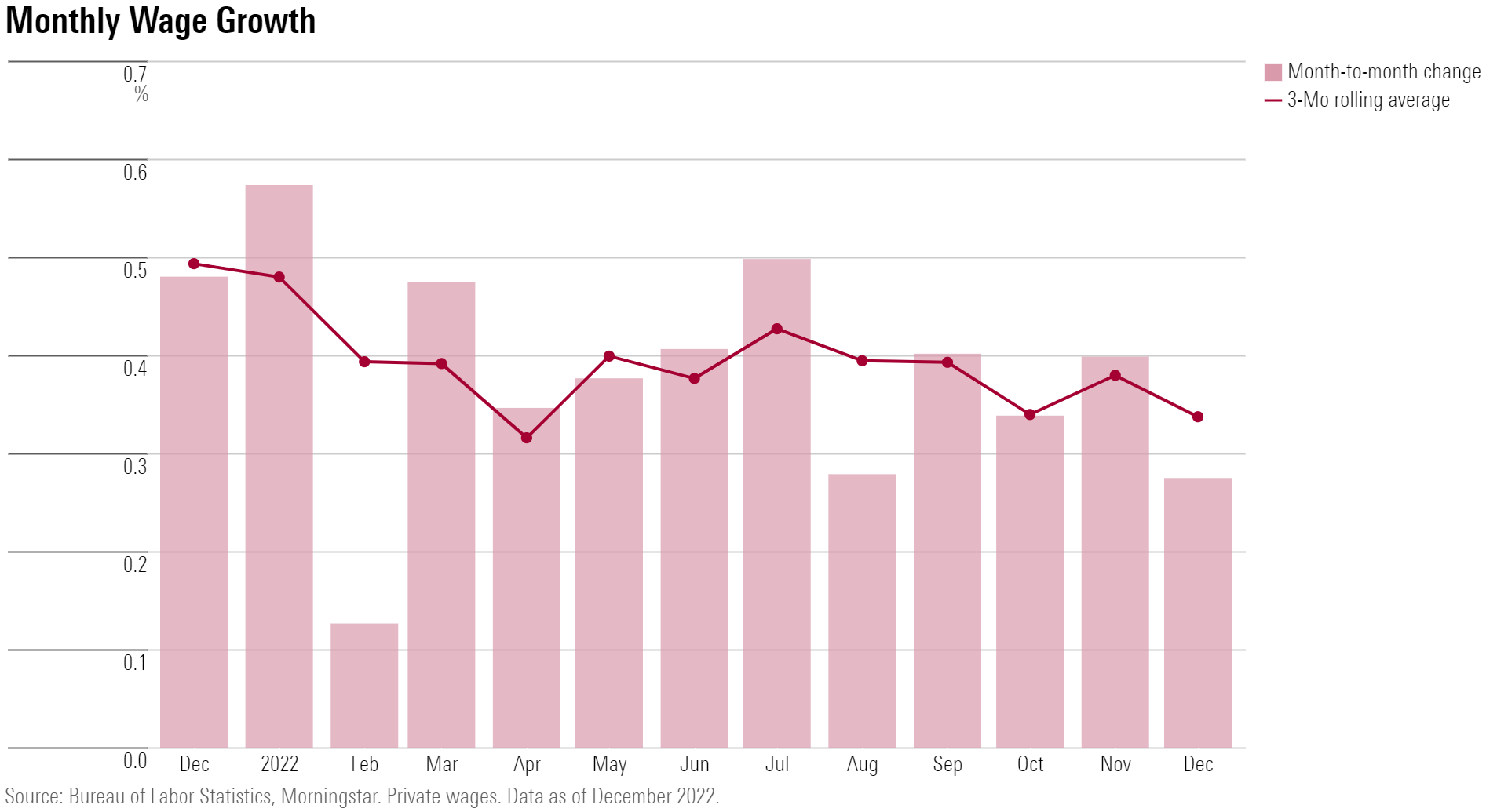
Subsiding wage growth also shows a job market that is returning to normal after the excesses of the past two years. Private wage growth averaged just a 4.1{515baef3fee8ea94d67a98a2b336e0215adf67d225b0e21a4f5c9b13e8fbd502} annual rate in the last three months thanks to downward revisions to prior months’ data. “This is a fairly benign rate of wage growth—roughly consistent with the Fed’s inflation target.” Before the revisions, wage growth appeared to be growing at a 5.8{515baef3fee8ea94d67a98a2b336e0215adf67d225b0e21a4f5c9b13e8fbd502} annual rate.
December’s report showed wage gains moderated slightly, up 0.27{515baef3fee8ea94d67a98a2b336e0215adf67d225b0e21a4f5c9b13e8fbd502} from month-ago levels. In November, wage gains had gone up 0.40{515baef3fee8ea94d67a98a2b336e0215adf67d225b0e21a4f5c9b13e8fbd502}.
Fed Rate Outlook Unchanged by Jobs Report
“Today’s report doesn’t shift the Fed’s decision-making in a major way,” Caldwell says. That lower wage growth should provide comfort for the Fed in its battle against inflation, he says.
At the same time, there remains a lack of clarity from the data. “Wage growth data has been noisy recently—and subject to large revisions, which diminishes confidence in the signal provided from this data.”
Job growth is still far above recessionary levels, Caldwell says, “so there’s no alarm signal for the Fed to cease hiking interest rates for now.”
After the report’s release, expectations for a 0.25-percentage-point increase in the federal-funds rate at the February Fed meeting rose. According to the CME FedWatch Tool, a quarter-point increase in the funds rate target from 4.25{515baef3fee8ea94d67a98a2b336e0215adf67d225b0e21a4f5c9b13e8fbd502}-4.50{515baef3fee8ea94d67a98a2b336e0215adf67d225b0e21a4f5c9b13e8fbd502} is given a 77{515baef3fee8ea94d67a98a2b336e0215adf67d225b0e21a4f5c9b13e8fbd502} chance, while a 0.50-percentage-point hike is seen as having 23{515baef3fee8ea94d67a98a2b336e0215adf67d225b0e21a4f5c9b13e8fbd502} odds. A month ago, most expected the Fed to raise rates by the more aggressive half a percentage point amount.
Expectations for where the federal-funds rate will be months down the road also rose following the release of the report. The majority of market participants now see the federal-funds effective rate reaching 5.25{515baef3fee8ea94d67a98a2b336e0215adf67d225b0e21a4f5c9b13e8fbd502} at the May meeting. A month ago, most expected that the rate wouldn’t reach 5.25{515baef3fee8ea94d67a98a2b336e0215adf67d225b0e21a4f5c9b13e8fbd502} until later in the summer.
Purchasers go to a marketplace in Lahore, Pakistan, January 4, 2023.
K.M. Chaudary/AP
Islamabad, Pakistan — It’s a element of Pakistani urban existence that bemuses several Western site visitors to the region: Suppliers and malls remain open up late, and usually keep active properly into the evening.
Need to have a hand-woven carpet at 9:30 p.m.? Not a issue. A bespoke three-piece fit at 10? The area tailor is continue to whirring absent on his stitching machine. Some spicy samosa treats and a cooling kulfi ice product after midnight? The shop upcoming doorway is, of training course, however cranking them out.
But it appears this late-night shopper society might soon turn out to be a detail of the past, as the desperately hard cash-strapped Pakistani govt has purchased all malls and markets to near by the unheard of early hour of 8:30 p.m.
Folks walk through a procuring mall in Peshawar, Pakistan, January 4, 2023.
Muhammad Sajjad/AP
It can be 1 of a handful of new measures introduced recently in a bid to preserve electrical power — not for the reason that Pakistan is seeking to go green, automatically, but for the reason that it only can’t manage to retain the lights on.
The country’s defense minister, Khawaja Asif, apprised journalists of the cabinet-accepted prepare to near marketplaces, together with places to eat, which is supposed to preserve the region about 62 billion Pakistani rupees, or $273 million, each year.
More instant actions incorporated closing marriage halls by 10 p.m. each individual working day — at which hour some friends wouldn’t even have arrived at a classic Pakistani wedding.
The strength conservation prepare also includes banning the production of inefficient mild bulbs and lovers from February and July respectively.
Cooks fry fish at a restaurant in Rawalpindi, Pakistan, January 2, 2023.
FAROOQ NAEEM/AFP/Getty
Asif also mentioned Prime Minister Shehbaz Sharif experienced purchased all federal government departments to decrease electrical energy usage by 30{515baef3fee8ea94d67a98a2b336e0215adf67d225b0e21a4f5c9b13e8fbd502}.
50 {515baef3fee8ea94d67a98a2b336e0215adf67d225b0e21a4f5c9b13e8fbd502} of the street lights across the nation will also stay switched off, as a “gesture,” he additional.
The actions ended up prompted by the dire straits in which Pakistan’s financial state has been mired for many years. International markets anxiety the place of 230 million persons could be poised to default on its countrywide financial debt repayments for the initial time in decades. If that occurs, there is problem it could result in a complete economic collapse of the national economy, and even huge-scale social unrest.
A $1.1 billion bailout from the Worldwide Financial Fund remains caught owing to disagreements with Pakistan’s govt around belt-tightening measures the worldwide finance firm has demanded. Negotiations should have been concluded in November.
Most of Pakistan’s electrical energy is created using imported fossil fuels, together with liquefied organic gas, the selling prices of which have sky-rocketed in new months.
Cooks fry fish at a cafe in Rawalpindi, Pakistan, January 2, 2023.
FAROOQ NAEEM/AFP/Getty
The government has attempted to stabilize the economy by reining-in imports and decades-superior inflation. But speedy-depreciating currency has manufactured imports more high-priced, whilst consumer costs noticed a 25{515baef3fee8ea94d67a98a2b336e0215adf67d225b0e21a4f5c9b13e8fbd502} 12 months-on-12 months increase in the first fifty percent of the recent fiscal yr.
Whilst the financial state desperately wants balance, enterprise groups have been sad with the plan announced by the government.
The principal organization affiliation for modest to medium traders, the All Pakistan Anjuman-i-Tajiran, insisted that stores would stay open until at minimum 10 p.m. and eating places right up until 11. Conserving electrical power by curbing economic action was not a intelligent technique, the group claimed.
As a substitute, it proposed conserving energy by reducing down on the use of air conditioners and heaters in govt structures and limiting gas and energy privileges for bureaucrats and government officers.
The enterprise local community should really be offered an uninterrupted ability supply to continue to keep the financial state going, it insisted.
The impasses, equally internally among organization leaders and the govt, and concerning the authorities and the IMF, obviously never bode nicely for Pakistan’s economy as the state settles into a new year.