Student teachers should spend more time on practical skills and less time on the history and philosophy of education, an expert panel has recommended.
The teacher education expert panel, set up by the federal government to improve teaching courses and address workforce shortages, released its discussion paper on Thursday, outlining plans to radically reform degrees.
It proposed strengthening standards for initial teacher education (ITE) programs and placing greater accountability on universities to prove their success rates.
The chair of the panel, the University of Sydney vice-chancellor, Mark Scott, said teaching degrees should be geared towards evidence-based, practical outcomes to best prepare teachers for the demands of the job.
“We need to make teachers’ lives easier and make sure they spend their time doing what they came into the profession for – teaching,” he said.
“Initial teacher education can play a significant role in making sure our future teachers are properly prepared for the classroom and that they are spending time on the things that will improve student learning.
“Teachers will spend their careers dealing with complex and diverse classrooms so they need better support to effectively teach in all environments.”
Scott saidincreasing the number of mid-career entrants into teaching would also be key to addressing shortages hitting the sector.
In a major shake-up, the paper also recommended luring mid-career entrants to postgraduate teaching courses with shorter degrees, paid employment opportunities and part-time study options.
“We know mid-career entrants generally have greater personal and financial responsibilities and the loss of income during study, the length of an ITE program and competing commitments … can be significant barriers to making the switch,” Scott said.
“The panel has identified opportunities … to support mid-career entrants into teaching by getting them into the classroom sooner and improving the flexibility of available postgraduate ITE programs.”
The panel suggested funding could be tied to individual program performance, requiring universities to disclose dropout rates and publicly report on how well prepared its students were to enter the classroom.
Dropout rates in teaching degrees are among the highest industry-wide, sitting at about 50{515baef3fee8ea94d67a98a2b336e0215adf67d225b0e21a4f5c9b13e8fbd502}.
Reports would increase the accountability of universities and provide students with more publicly available information to choose providers. High performers would then be rewarded with additional federal government funding.
“In the first few months in this job I have got a better insight into how hard and complex the work of being a teacher is,” Clare said.
“The work of the expert panel will be important in helping us to strengthen initial teacher education, increase completion rates and deliver more classroom ready graduates.”
The University of Sydney deputy vice-chancellor, Prof Joanne Wright, said initial teacher education was the starting point of the system and a “significant part” of the solution to workforce shortages.
“The review is a welcome opportunity to reshape courses so they address the complex challenges that teachers are facing today,” she said.
“Initial teacher education plays a significant role in making sure our future teachers are properly prepared for the classroom and that they are spending time on the things that will improve student learning.”
The Australian Education Union’s president, Correna Haythorpe, said many of the issues raised in the paper directly reflected the experiences of its members and a discussion about the quality of courses was “long overdue”.
“The AEU’s early service teaching members regularly report feeling inadequately prepared for the reality of the classroom when they graduate,” she said.
“Inadequate support and inequitable school funding contributes to escalating teacher workloads and to the high turnover of teachers leaving the profession after just a few short years in the classroom.”
Haythorpe also welcomed the recognition that income loss during lengthy unpaid placements, as reported by Guardian Australia, was a “major hurdle” for students.
“The AEU has been calling for paid placements and will highlight this need in our response to the discussion paper,” she said.
And so his mother and father were being stunned when, months in advance of graduation, they learned their son would acquire a “certificate of completion” rather than a diploma. The aide assigned by his small Michigan school district, it turned out, did not know indication language. Just after 12 decades in school, with no other incapacity, Perez was studying at a 3rd-grade amount.
It could also shift the harmony of electrical power among parents and universities as they steer as a result of what can be a contentious negotiation more than the education of unique disabled students, industry experts say. A ruling for Perez, in other words, could give mom and dad more leverage.
“There was a person other deaf university student, but we could not talk with just about every other. Nobody interpreted for me,” Perez, now 27, recalled in a statement offered by his attorney with the assistance of various interpreters. “I never have a work, but I want to have one. I want to make my have choices.”
The situation, Perez v. Sturgis General public Educational facilities, consists of the interplay amongst two federal laws, the Individuals with Disabilities Schooling Act, or Idea, and the People with Disabilities Act. At challenge is no matter if a pupil may well sue a faculty for damages below the ADA when he or she has not completed the administrative system demanded by the Idea.
Settled but not resolved
Perez’s journey by way of the 3,000-scholar college district in southern Michigan underscores the worries confronted by a lot of students who have disabilities.
His household alleges school officials misrepresented the qualifications of his aide. They say that aide, in later on decades, was assigned to other responsibilities, leaving Perez unable to converse with any one for several hours each individual day. And Perez was promoted through each and every quality level inspite of not having a grasp of the curriculum, his attorneys say.
His difficulties have been compounded by the point that his family emigrated from Mexico when Perez was 9 decades aged. His dad and mom spoke only Spanish.
By the time the dad and mom of distinctive schooling students like Perez get into courtroom they have presently engaged with the district for years to produce what’s recognized as an Individualized Education Software, an personal program for their student’s education and learning essential by the Notion. That approach involves a negotiation amongst dad and mom, who are attempting to get as much as they can for their youngsters, and districts, which are needed by legislation to present a “free appropriate training” but will have to also weigh the fees.
Faculties and mothers and fathers negotiate IEPs for a vast assortment of disabilities, including dyslexia, clinical challenges, speech or language impairments and autism.
Perez submitted a grievance with Michigan officers in 2017 alleging his faculty violated state and federal regulations, which include the Plan. Right before that criticism was solved, the district presented to settle, agreeing to pay out for Perez to show up at the Michigan College for the Deaf.
His family members then sued the district beneath the Individuals with Disability Act for discrimination, searching for unspecified monetary damages. A federal district court dismissed the lawsuit, ruling that Perez had not fatigued the necessary Idea process mainly because he recognized the settlement. A divided panel of the U.S. Court of Appeals for the 6th Circuit agreed. Perez appealed to the Supreme Court in late 2021.
Art Ebert, the district’s superintendent, declined to address the statements lifted in the fit – he wasn’t major the district when Perez attended Sturgis – but he explained in an e mail that because of the working experience the district would “get knowledge, insight, and comprehension that will assist us improve just about every student’s genuine possible.”
A ruling for the district, incapacity advocates say, could possibly discourage parents from settling with universities if executing so suggests providing up the ideal to sue for damages later.
“College students with disabilities and their families are by now struggling with enormous hurdles in finding the training they need to have,” reported Shira Wakschlag, senior director of legal advocacy at The Arc, a disability advocacy organization. A ruling in opposition to Perez, she mentioned, would insert “to the load of family members who are presently immensely burdened.”
But a ruling for Perez may modify the way universities tactic exclusive training, said Malhar Shah, an attorney with the Incapacity Legal rights Schooling and Defense Fund. Districts would be on see, he reported, that “they can no extended immunize on their own as conveniently as they could formerly from people funds damages.”
Schools say that argument is backward: If mom and dad could far more quickly sue for damages it would inject a authorized struggle in excess of cash into the Notion course of action, which is meant to speedily address students’ wants. University districts may well be pressured to approach that procedure otherwise if their actions could be made use of against them in a fit for damages.
“The primary issue of the university district is performing with mother and father,” stated Francisco Negrón, chief legal officer at the Countrywide Faculty Boards Affiliation. “It would be a disgrace if the courtroom principles in a way that offers a disincentive to that process.”
Sasha Pudelski, advocacy director of the College Superintendents Association, stated she anxieties this kind of a ruling would lead parents “to prioritize income from the districts above educational expert services” and build “a society of litigation.”
Perry Zirkel, a professor emeritus of legislation and schooling at Lehigh University, framed the dispute in terms of leverage. Attorneys symbolizing a pupil, he mentioned, could possibly argue they want “the probability of a million-greenback judgement for the reason that that will trigger districts to do the ideal issue.”
But Zirkel cautioned towards expecting way too considerably to alter because of the court’s determination. Which is for the reason that, he reported, most people suing a faculty for damages underneath the ADA shed.
“It is by significantly the exception to the rule that a spouse and children would earn funds,” he said.
Company dog potential customers
The Supreme Courtroom previous waded into these challenges in 2017 in a circumstance called Fry v. Napoleon Group Educational institutions. A student with cerebral palsy sued for damages right after the faculty barred her support pet, Speculate, from the classroom. The college argued the university student didn’t exhaust the course of action expected below the Idea in advance of submitting her suit.
In Perez, the school district relies heavily on the Fry selection. Following all, its attorneys argue, Perez’s complaint is additional squarely about schooling. But during a 90-minute oral argument in January, a the vast majority of justices nevertheless signaled assistance for Perez.
As the justices debated, Perez sat quietly in the ornate courtroom. He afterwards stated he was impressed by the “attractive setting up” and grateful that all nine justices ended up engaged.
“It felt to me that they seriously listened very well to the attorneys. I appreciated that,” he mentioned in a assertion to Usa Today. “I want to gain and hope that many others like me get interpreters.”
The Alaska Point out Board of Education and learning unanimously authorised a resolution Thursday urging the condition to only allow for organic girls to take part in girls’ sporting activities – recommending a individual league for athletes who will not discover with their start sexual intercourse.
The resolution, which was included to the board’s agenda at the final moment, advises the Alaska Department of Training and Early Advancement to produce the different divisions. All 8 users supported it whilst the university student adviser abstained.
A duplicate of the resolution received by the Anchorage Each day News confirmed wherever board customers identified the “integrity of middle and significant faculty girls’ sporting activities should be preserved.”
“We’re creating a assertion of retaining girls’ sports activities safe and aggressive and reasonable, that’s all,” board chair James Fields told the Each day News by using The Affiliated Press.
FEDERAL Choose UPHOLDS WEST VIRGINIA ‘SAVE WOMEN’S SPORTS’ Regulation BARRING TRANS ATHLETES FROM GIRLS’ Sporting activities Groups
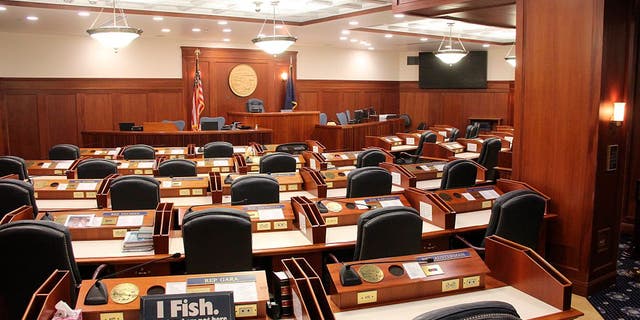
Alaska Point out Capitol Creating, Juneau, interior legislature home.(Schooling Visuals/Universal Photos Group by means of Getty Photos)
Billy Strickland, the director of the Alaska College Functions Affiliation, stated the resolution is identical to what has been proposed to him in earlier discussions by members of Republican Gov. Mike Dunleavy’s administration.
Strickland reported they preferred to make three divisions – boys, women and a co-ed division that would allow for transgender athletes – but he claimed Alaska isn’t going to have plenty of transgender athletes to accommodate a third division. He also stated he was only knowledgeable of 1 in the nine several years he has led the ASAA.
A statement from Dunleavy’s workplace to The AP on Friday emphasized girls actively playing in solitary-sexual intercourse leagues must be playing versus other women.
“If a man or woman who was born a male but feels out of area participating in a sport in a league with boys only because of to their gender identification, the answer isn’t to permit them to contend from girls, but to improve co-ed possibilities,” the statement stated. “It is time to critically take into consideration co-ed interscholastic sports activities so that all learners can compete at their optimum amount.”
Woman FIGHTS FOR FAIRNESS, Upcoming OF WOMEN’S Sports activities In opposition to TRANS ATHLETES: ‘INHERENT Organic DIFFERENCES’
Demonstrators listen to the talking program in the course of an “Our Bodies, Our Sports” rally for the 50th anniversary of Title IX at Independence Plaza on June 23, 2022, in Washington, D.C.(Anna Moneymaker/Getty Visuals)
Strickland explained college boards and districts established their own insurance policies, and the Matanuska-Sasitna Borough School Board is the only team to restrict the participation of trans athletes in Alaska at this time. Most other folks have not addressed the difficulty, however girls are allowed to play along with boys on some soccer and hockey groups.
Senate Education and learning Committee chair Sen. Löki Tobin, a Democrat from Anchorage, expressed concerns that the board violated its necessity to allow for the general public to weigh in on resolutions before a vote, The AP described.
She was also concerned the resolution could violate the correct-to-privacy clause of the point out Constitution.
“I am involved primarily for the reason that I am the chair of the condition coverage committee for training in the Senate,” explained Tobin. “I am involved that the method just was not adopted, and that we weren’t ready to supply our public comment on this issue.”
The AP included that the legislature has the skill to revoke proposed regulations for any point out office.
Michael Dunleavy, governor of Alaska, speaks throughout the Conservative Political Motion Conference (CPAC) in Orlando, Florida, U.S., on Friday, Feb. 25, 2022.(Tristan Wheelock/Bloomberg by using Getty Illustrations or photos)
Earlier in March, the governor proposed a invoice requiring pupils to use bathrooms and locker rooms in accordance to their organic sex. The bill would also have to have parental approval if learners needed to modify their title or pronouns made use of in school. Lawmakers have not but voted on this invoice.
Yet another monthly bill that would generate a co-ed athletics division different from the boys’ and girls’ leagues also has not been heard.
The Alaska state Senate has reported it would steer distinct of divisive issues this session, which contains any laws relevant to LGBTQ+ men and women.
Daniel A. Varela / Miami Herald / Tribune News Service via Getty Images
Florida’s legislative session may have just gotten underway, but lawmakers there already have plenty to do. That’s, in part, because Republicans there have presented a flurry of bills that would transform K-12 and higher education in the state — from forcing state colleges and universities to shut down any diversity, equity and inclusion programs and eliminating college majors and minors in “critical race theory, gender studies, or intersectionality,” to boosting oversight of school libraries.
The lawmaking session will be guided by Gov. Ron DeSantis’s priorities — but as he teases a run at the national level, DeSantis appears more focused on appealing to the broader, national GOP electorate than to the average Floridian. In fact, his continued attacks on so-called “woke” ideology — especially as it pertains to the public school system, which he’s previously said is “indoctrinating kids” — is one of the strongest signals that if DeSantis does run for president, he’ll seek the nomination by stoking some of the same cultural grievances that Republicans have stressed for years.
This approach could work — at least in a GOP primary. After all, those messages helped enable former President Donald Trump’s ascent to power. But if DeSantis manages to actually clinch the nomination, his tactics could come at the price of repelling general election voters — especially suburbanites and independent voters.
First things first, though. If DeSantis wants to win the Republican nomination (assuming he does decide to throw his hat in the ring), his focus on race and education makes a lot of sense. That’s because GOP primary voters — particularly social conservatives — who have long lamented their supposed waning lack of clout in American society are likely to be quite receptive to these messages. Case in point: In a joint survey with FiveThirtyEight, the nonpartisan research firm PerryUndem found that support — or a lack thereof — for the Black Lives Matter movement was the No. 1 attitudinal predictor of 2022 vote choice and a number of policy positions. As Tresa Undem, co-founder of PerryUndem, told me, racial resentment is powerful and might land differently than, say, bills targeted toward LGBTQ students.
“Our data shows that views toward race and racial ideology are the biggest predictors of voting Republican. So any measures that address race explicitly are going to appeal to the vast majority of Republican voters,” Undem said. “It’s a mobilizing issue. There’s a great deal of racial resentment right now among Republicans, and that is mobilizing them in ways that other issues aren’t — or can’t.”
Other surveys suggest that Republicans are particularly less likely than the general public to support the discussion of various issues surrounding race in K-12 schools. A February Data for Progress poll, for instance, found that while just over half of likely voters (52 percent) believe the Black Lives Matter movement should be taught in an age-appropriate manner, the share of Republicans who support this was decidedly lower (26 percent). Republicans were also less likely than all likely voters (48 percent versus 69 percent, respectively) to support age-appropriate discussions of modern-day racism and racial equality in the classroom. Meanwhile, a February survey of Americans from YouGov/Economist found that about one-quarter of Republicans (23 percent) and voters who supported Trump in the 2020 election (25 percent) thought K-12 schools taught “too much” about the history of Black Americans. Only 14 percent of Americans — and 6 percent of Democrats — felt the same.
These data points might be one reason why Republicans appear confident that DeSantis’s focus on race in education can attract socially conservative voters in a GOP primary. During a phone call with me, Republican pollster Whit Ayres pointed to Glenn Youngkin’s victory in the 2021 Virginia gubernatorial race — after he stressed “parental rights” in the classroom — as proof for GOP candidates and strategists that certain issues surrounding education have appeal.
“Savvy Republican presidential candidates have historically made good use of education issues,” Ayres said. “Good Republican candidates have seen the potential in education issues for many years.”
Notably, it’s not just DeSantis beating this drum. Though they’ve been stingy in their definitions of what exactly they consider critical race theory to be, former South Carolina Gov. and Ambassador to the United Nations Nikki Haley, who announced her presidential bid last month, recently tweeted that it was “un-American.” Trump, meanwhile, has been sounding the alarm on critical race theory in schools since at least 2020. But DeSantis has arguably acted most aggressively on education. Last year, he made waves after signing the controversial “Stop WOKE Act,” which regulates how race is taught in schools and workplaces in Florida. More recently, his administration blocked the teaching of an Advanced Placement African American Studies course for high school students throughout the state — saying that it “significantly lacks educational value” — and later threatened to sever ties with the College Board altogether.
DeSantis’s efforts to control what Florida students are taught seems to have found a receptive audience in other Republican-controlled states, too. An analysis by FiveThirtyEight identified at least five pieces of copycat bills across the U.S. related to race in education that have made it out of committee — many of them moving forward in states where there’s a Republican state-government trifecta.
“All politicians look to what has been successful in similar states as models for their own,” Ayres said. That makes sense, he added, particularly because “DeSantis has given his own twist on the education issue.”
The rapid replication of these ideas across red states indeed signals the potential power of DeSantis’s agenda in a Republican presidential primary. But if he snags the nomination, it’s possible that DeSantis overplayed his hand in just how much these moves will appeal to the broader public. While proposals targeting LGBTQ-related issues in schools could have a broader general appeal, culture war messaging concerning race specifically have a decidedly mixed track record among general election voters. It’s clear that some Republicans believe that attacking race-related teachings can win over certain coveted voting blocs, especially white parents, but last year’s midterm elections showed that belief doesn’t always translate to reality. Of course, DeSantis’s overwhelming victory was a big conversation-starter post-Election Day, but a number of other Republicans who hadhardline educationstances on these issues losttheir respective races. It also might be hard for DeSantis to move to the middle on these issues the closer we get to 2024 — especially if he’s facing a number of Republican challengers who push him further to the right (as he’s arguably already experiencing with both Trump and Haley.)
“Because Florida is so successful economically and so many people are moving here, I think DeSantis thinks that — along with his hardline education stance — is going to work for him,” said Sharon D. Wright Austin, a professor of political science at the University of Florida. But, she added, that message might not resonate beyond a GOP primary base. “It’s clear that he’s trying to appeal to these suburban voters — white women in particular — but, in doing so, he’s also offended so many other constituencies, like Black and LGBTQ voters. He’s also alienating independents and he’d definitely need their support to win a general election,” she said.
This lines up with my recent reporting, which pointed to polls suggesting that voters overall have become increasingly wary of moves to ban critical race theory and other discussions of race in schools. That February Data for Progress poll, for instance, found that an overwhelming majority of respondents were in favor of teaching issues like racism and slavery, among other things, in K-12 schools. Among likely voters, 83 percent said that slavery should be discussed “in an age-appropriate manner,” compared with 11 percent of respondents who said it shouldn’t be taught at all. Teaching about the American history of racism and racial equality, meanwhile, had similarly high support (79 percent) among those surveyed — as did discussions of modern-day racism and racial equality (69 percent) and social and political activism (66 percent).
Data for Progress also asked voters whether they supported Florida’s push against the AP African American Studies course, and two-thirds of likely voters said they would support this class being taught at high schools in their own communities. Of course, there were racial and partisan fissures when it came to just how much voters supported this curriculum — but an overwhelming majority of Democrats (89 percent), a sizable majority of independent voters (69 percent) and just under half of Republicans (44 percent) said they were in favor.
But even if targeting race in education isn’t the best general election strategy — as the party itself predicted would be the case ahead of last November’s midterm elections — it’s possible that DeSantis could find easy victories through a bevy of other channels related to education. In Florida and various other states, lawmakers also have their eyes on a number of bills targeting transgender students. According to Undem, bills targeting LGBTQ rights are less salient to voters than racial issues. And framing debates around education as an attempt to empower parents could appeal to voters of all political stripes, she said.
“Suburban voters and swing voters are more likely to oppose these racially motivated policies. But there’s a lot of misinformation when it comes to legislation around gender identity and kids, and I think there’s some segments of the population who may be more receptive to these bills,” she said. “The country is largely still learning about gender identity, so that makes it ripe for some groups to attack. Race is more blatant.”
Of course, this year’s legislative session might be far enough in the rearview mirror by the time the Republican nomination is settled that whatever DeSantis does this year won’t really matter. But in the meantime, and especially before he’s an actual presidential candidate, DeSantis likely won’t slow his crusade against race and education. That’s because, at this point in the process, it’s more about establishing himself as the heir to Trumpism than challenging President Biden.That itself raises an interesting question regarding DeSantis’ impending presidential candidacy, though: Will GOP primary voters accept thinly veiled Trumpism if it’s not coming from Trump himself?
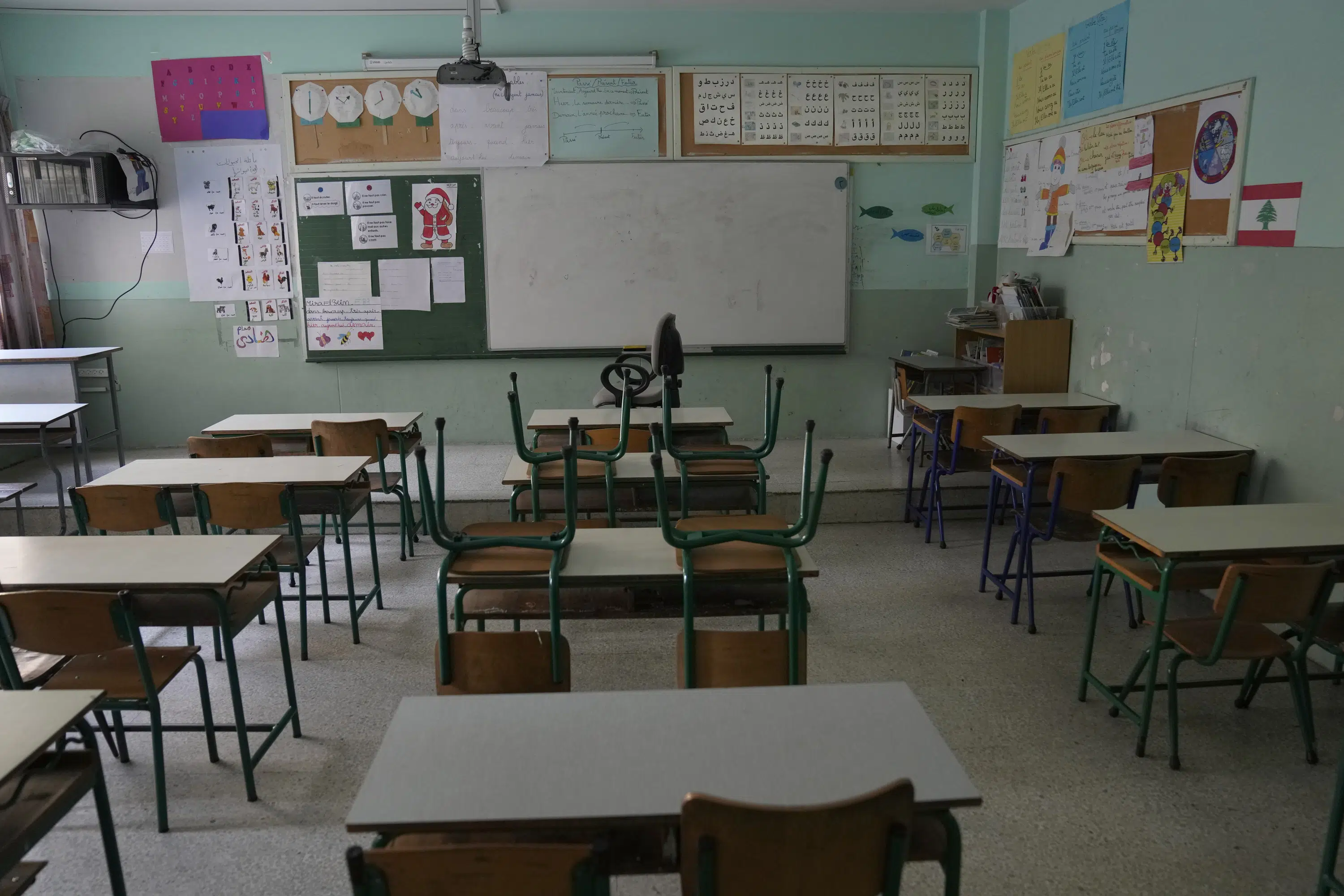
BEIRUT (AP) — On a recent school day, the Rene Mouawad High School in Beirut was empty, its classrooms dark, just like all of Lebanon’s public schools have been for most of the past three months. Its striking teachers were protesting in front of the Education Ministry, not far away.
About a hundred teachers joined the demonstration outside the ministry, blocking traffic and holding placards demanding pay raises. “We are done with charity,” said Nisreen Chahine, the head of the union for contractor teachers. “We are not negotiating anymore. They should either rightfully pay us or go home.”
The teachers gave speeches demanding officials come out and talk to them. But as usual in these regular protests, no one from the ministry emerged. After several hours, the teachers packed up and went home.
Lebanon’s schools are crumbling under the weight of the country’s economic collapse as the political leadership — which caused the crisis through decades of corruption and mismanagement — balks at taking any measures to resolve it. Since the meltdown began in late 2019, over three-quarters of Lebanon’s 6 million people have been plunged into poverty, their assets evaporating as the currency’s value shrivels and inflation rises at one of the world’s highest rates.
Most of the country’s children have not been in school for months — many since even before teachers, who say they can no longer live on their salaries, went on strike in December. Lebanon was once known for producing a highly skilled, educated work force. But now an entire generation is missing out on schooling, wreaking long-term damage on prospects for the country’s economy and future.
Teachers called their strike because their salaries, in Lebanese pounds, have became too low to cover rent and other basic expenses. The pound has gone from 1,500 to the dollar before the crisis to 100,000 to the dollar currently. Most teachers are now paid the equivalent of about $1 an hour, even after several raises since 2019. Grocery stores and other businesses now usually price their goods in dollars.
Teachers are demanding adjusted salaries, a transportation stipend, and health benefits. The government only offered to partially cover transportation, saying it didn’t have the budget for more. Though schools partially reopened last week after some teachers returned to work, most chose to continue striking.
Even before the crisis, Lebanon’s investment in public schools was limited. In 2020, the government’s spending on education was equivalent only to 1.7{515baef3fee8ea94d67a98a2b336e0215adf67d225b0e21a4f5c9b13e8fbd502} of Lebanon’s GDP, one of the lowest rates in the world, according to the World Bank. The 2022 budget allocated 3.6 trillion Lebanese lira for education — the equivalent of around $90 million at the time the budget was passed in October, less than half the $182 million budget on education from a donor-funded humanitarian program.
Instead, the government has relied for years on private and charity schools to educate children. Humanitarian agencies paid to cover salaries and keep decrepit infrastructure functioning. Two-thirds of Lebanese children once went to private schools, but hundreds of thousands dropped out in recent years because private schools have had to increase tuition to cover soaring costs. Public and private schools struggle to keep lights on as fuel costs mount.
Even before the strike, more than 700,000 children in Lebanon, many of them Syrian refugees, were not in school because of the economic crisis. With the strike, an additional 500,000 joined their ranks, according to UNICEF.
“It means we now see children ages 10, 12, 14 and they are not able to even write their own names or write basic sentences,” Ettie Higgins, UNICEF deputy representative for Lebanon, told the The Associated Press. UNICEF said that last week it gave almost $14 million to help more than 1,000 public schools pay staff.
Rana Ghalib, a mother of four, said it makes her anxious to see her children at home when they should be in school. Her 14-year-old son had to repeat the 6th grade because he has fallen behind during previous disruptions.
“The classrooms are basically empty because teachers are demanding their rights and they’re dark because there is no fuel,” Ghalib told the AP.
The international community has been pushing Lebanon’s leaders to carry out wide-ranging reforms in the economy, financial system and governance in order to receive a $3 billion bailout package from the International Monetary Fund and unlock development aid. The political elite, which has run the country since 1990, has stalled — because, critics say, reforms would undermine its grip on power and wealth. Amid political deadlock, there hasn’t been a president for months, and the government only functions in a limited caretaker capacity.
Education, meanwhile, is joining banks, medicine and electricity in the ranks of Lebanon’s failing institutions. That could cause long-term damage: Lebanon has traditionally relied on its educated and skilled diaspora population abroad to send remittances back home to support families, invest and feed dollars into the banking system. The exodus of skilled people skyrocketed during the economic crisis, leaving remittances as Lebanon’s last economic lifeline.
Hussein Cheaito, an economist and nonresident fellow at The Tahrir Institute for Middle East Policy, a Washington-based think tank, says the crippled education system will further “deteriorate the social fabric” of Lebanon and deepen poverty.
“This will have a effect on the longer-term growth of the economy,” he told the AP. “This means there will be less access to jobs in the future … (and) weaken the labor market in general.”
Ghalib, meanwhile, checks on her children, who are watching TV and playing with their cellphones at a time when they would usually be studying. Even her 9-year-old daughter is aware that her future is in jeopardy, she said.
“My youngest daughter tells me, ‘I want to be a doctor, but how can I do that if I’m sitting at home?’” Ghalib said. “I don’t know what to tell her.”
Sign up for The Short, The Texas Tribune’s everyday publication that retains visitors up to velocity on the most important Texas news.
Documents observed on the Texas Education and learning Agency’s website display that the point out is ready to appoint new leaders to consider charge of the Houston Independent College District.
A job putting up searching for candidates to utilize for a new board of administrators to oversee the state’s greatest faculty district and a slideshow detailing the tasks of the entire body could be observed in the TEA’s internet site in advance of they have been taken down Tuesday night time. The Texas Tribune saved copies of each files.
The TEA has not announced a takeover but. The agency did not answer to a request for comment Tuesday night.
The slideshow mentioned the TEA is appointing the new board in response to many years of inadequate tutorial results at a single higher school in the district, “requiring motion to possibly near the campus or appoint a Board of Professionals to govern the district.”
The TEA, tasked with overseeing and supporting about 1,200 college districts in the point out, will start out to job interview candidates for the board of managers with the aim of positioning them in charge by June 1, according to the paperwork. People today trying to get to be on the board of professionals ought to be eligible voters living in just the Houston ISD boundaries. The TEA commissioner decides how very long the board is in location.
Houston ISD would turn into the major district the agency has taken above due to the fact 2000.
TEA Commissioner Mike Morath and the agency very first moved to pressure out the district’s college board in 2019 in reaction to allegations of misconduct by trustees and years of minimal scholar general performance at Phillis Wheatley High School.
Houston ISD sued, and in 2020, a Travis County district choose halted Morath’s plan by granting a temporary injunction. The scenario eventually arrived at the Texas Supreme Court very last October, when the agency’s attorneys argued that a 2021 regulation — which went into effect immediately after the situation was to start with taken to court — permits the TEA commissioner to exchange a university board and its superintendent if one particular of its universities gets consecutive yrs of failing grades.
The Texas Supreme Courtroom threw out the injunction in January and formalized its decision March 1, clearing the route for the TEA to place in put new university board members, who could then vote to stop the lawsuit.
Houston ISD has 276 universities and an enrollment of just about 200,000 students.
Student results have improved at both Phillis Wheatley and the district at large since Morath initially announced a possible takeover. The TEA, which grades faculties and districts each and every yr centered on their tutorial achievement, gave the high college a grade of F in 2019. Last year, Phillis Wheatley obtained a C, and Houston ISD as a full obtained a B. In the previous 19 months, HISD has designed strides in lowering the variety of its campuses with a D or F ranking from 50 to 10. Ninety-4 {515baef3fee8ea94d67a98a2b336e0215adf67d225b0e21a4f5c9b13e8fbd502} of HISD schools now get paid a quality of A, B or C.
The TEA has taken over 15 school districts. It however manages Marlin ISD, exterior of Waco, and Shepherd ISD, east of Conroe. The agency gave again manage of eight districts to their area faculty boards in other scenarios, it has shut them down or annexed them to other districts.
Supporters of the state’s takeover of Houston ISD would be a way to get faltering school districts again on track. Critics say it undermines the community’s will by getting rid of the district’s elected faculty board members, and they stress the move could guide to layoffs. Days prior to the TEA confirmed the takeover, parents and teachers at HISD’s State of the Faculties luncheon on March 3 termed the approach an insult right after the district’s improvements and an avoidable disruption in the center of the spring semester.










:focal(0x0:2999x2000)/static.texastribune.org/media/files/94c33dff50d1b573e29e6db13296f2f4/0303{515baef3fee8ea94d67a98a2b336e0215adf67d225b0e21a4f5c9b13e8fbd502}20HISD{515baef3fee8ea94d67a98a2b336e0215adf67d225b0e21a4f5c9b13e8fbd502}20SOTS{515baef3fee8ea94d67a98a2b336e0215adf67d225b0e21a4f5c9b13e8fbd502}20JB{515baef3fee8ea94d67a98a2b336e0215adf67d225b0e21a4f5c9b13e8fbd502}20TT{515baef3fee8ea94d67a98a2b336e0215adf67d225b0e21a4f5c9b13e8fbd502}2011.jpg "Texas education agency is ready to take over Houston ISD, documents show")