Public Health Agencies Try to Restore Trust as They Fight Misinformation

Public Health Agencies Try to Restore Trust as They Fight Misinformation

OKLAHOMA CITY — By the summer of 2021, Phil Maytubby, deputy CEO of the health department here, was concerned to see the numbers of people getting vaccinated against covid-19 slipping after an initially robust response. With doubt, fear, and misinformation running rampant nationwide — both online and offline — he knew the agency needed to rethink its messaging strategy.

So, the health department conducted something called an online “sentiment search,” which gauges how certain words are perceived on social media. The tool found that many people in Oklahoma City didn’t like the word “vaccinate” — a term featured prominently in the health department’s marketing campaign.

“If you don’t know how your message is resonating with the public,” Maytubby said, “you’re shooting in the dark.”

Across the country, health officials have been trying to combat misinformation and restore trust within their communities these past few years, a period when many people haven’t put full faith in their state and local health departments. Agencies are using Twitter, for example, to appeal to niche audiences, such as NFL fans in Kansas City and Star Wars enthusiasts in Alabama. They’re collaborating with influencers and celebrities such as Stephen Colbert and Akbar Gbajabiamila to extend their reach.

Some of these efforts have paid off. By now, more than 80{515baef3fee8ea94d67a98a2b336e0215adf67d225b0e21a4f5c9b13e8fbd502} of U.S. residents have received at least one shot of a covid vaccine.

But data suggests that the skepticism and misinformation surrounding covid vaccines now threatens other public health priorities. Flu vaccine coverage among children in mid-December was about the same as December 2021, but it was 3.7 percentage points lower compared with late 2020, according to the Centers for Disease Control and Prevention. The decrease in flu vaccination coverage among pregnant women was even more dramatic over the last two years: 18 percentage points lower.

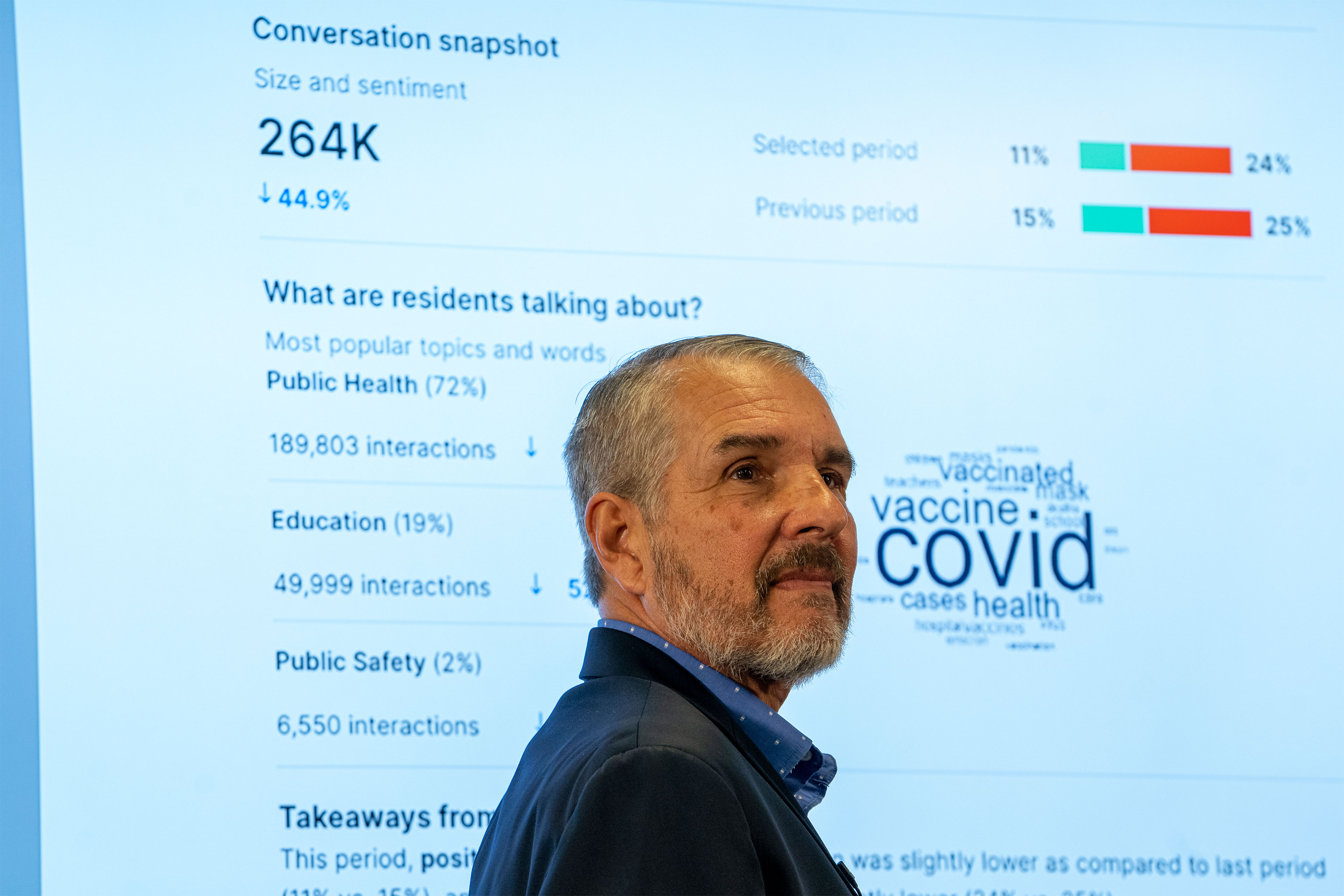
The command center in the basement of the Oklahoma City County Health Department features a large digital display that allows staff members to review covid case numbers and other important data, such as overall childhood vaccine rates, during their morning meeting. (Nick Oxford for KHN)

Phil Maytubby (center), deputy CEO of the Oklahoma City County Health Department, meets with staff in the agency’s command center to review the latest information on covid case numbers and hospitalizations. (Nick Oxford for KHN)

Other common childhood vaccination rates are down, too, compared with pre-pandemic levels. Nationally, 35{515baef3fee8ea94d67a98a2b336e0215adf67d225b0e21a4f5c9b13e8fbd502} of all American parents oppose requiring children to be vaccinated for measles, mumps, and rubella before entering school, up from 23{515baef3fee8ea94d67a98a2b336e0215adf67d225b0e21a4f5c9b13e8fbd502} in 2019, according to a KFF survey released Dec. 16. Suspicion swirling around once-trusted vaccines, as well as fatigue from so many shots, is likely to blame.

Part of the problem comes down to a lack of investment that eroded the public health system before the pandemic began. An analysis conducted by KHN and The Associated Press found local health department spending dropped by 18{515baef3fee8ea94d67a98a2b336e0215adf67d225b0e21a4f5c9b13e8fbd502} per capita between 2010 and 2020. State and local health agencies also lost nearly 40,000 jobs between the 2008 recession and the emergence of the pandemic.

This made their response to a once-in-a-century public health crisis challenging and often inadequate. For example, during covid’s early days, many local health departments used fax machines to report covid case counts.

“We were not as flexible as we are now,” said Dr. Brannon Traxler, director of public health at the South Carolina Department of Health and Environmental Control.

At the start of the pandemic, Traxler said, only two people worked on the media relations and public outreach team at South Carolina’s health department. Now, the team has eight.

The agency has changed its communication strategies in other ways, too. Last year was the first year, for example, that South Carolina published data on flu vaccinations every two weeks, with the goal of raising awareness about the effectiveness of the shots. In South Carolina, not even one-quarter of adults and children eligible for a flu shot had been vaccinated by early December, even as flu cases and hospitalizations climbed. The flu vaccine rate across all age groups in the U.S. was 51.4{515baef3fee8ea94d67a98a2b336e0215adf67d225b0e21a4f5c9b13e8fbd502} last season.

Those who have opted out of both the covid and flu shots seem to be correlated, Traxler said.

“We’re really just trying to dispel misinformation that’s out there,” Traxler said. To that end, the health department has partnered with local leaders and groups to encourage vaccinations. Agency staffers have also become more comfortable talking to the press, she said, to better communicate with the public.

But some public health experts argue that agencies are still failing on messaging. Scientific words such as “mRNA technology,” “bivalent vaccine,” and “monoclonal antibodies” are used a lot in public health even though many people find them difficult to understand.

A study published by JAMA found that covid-related language used by state-level agencies was often more complex than an eighth-grade reading level and harder to understand than the language commonly used by the CDC.

“We have to communicate complex ideas to the public, and this is where we fail,” said Brian Castrucci, CEO of the de Beaumont Foundation, a charitable group focused on strengthening public health. “We have to own the fact that our communication missteps created the environment where disinformation flourished.”

Most Americans support public health, Castrucci said. At the same time, a small but vocal minority pushes an anti-science agenda and has been effective in sowing seeds of distrust, he said.

The more than 3,000 public health departments nationwide stand to benefit from a unified message, he said. In late 2020, the foundation, working with other public health groups, established the Public Health Communications Collaborative to amplify easy-to-understand information about vaccines.

“The good guys need to be just as well organized as those who seek to do harm to the nation,” he said. “One would think we would learn from this.”

Meanwhile, a report published in October by the Pew Research Center found 57{515baef3fee8ea94d67a98a2b336e0215adf67d225b0e21a4f5c9b13e8fbd502} of U.S. adults believe “false and misleading information about the coronavirus and vaccines has contributed a lot to problems the country” has faced amid the pandemic.

Davie Baker, who lives in Oklahoma City, says she was initially reluctant to get the covid vaccine, then a pharmacist at Sam’s Club helped change her mind. “She cleared some things up for me,” Baker says. (Nick Oxford for KHN)

“I was leery like everyone else,” said Davie Baker, 61, an Oklahoma City woman who owns a business that sells window treatments. When the shots became widely available in 2021, she thought they had been developed too quickly, and she worried about some of the things she’d read online about side effects. A pharmacist at Sam’s Club changed her mind.

“She just kind of educated me on what the shot was really about,” Baker said. “She cleared up some things for me.”

Baker signed up for her first covid shot in May 2021, around the same time the health department in Oklahoma City noticed the number of vaccines administered daily was starting to decline.

The department updated its marketing campaign in early 2022. Instead of using the word “vaccinate” to encourage more people to get their covid shots — the term the agency’s social media analytics revealed people didn’t like — the new campaign urged people to “Choose Today!”

“People don’t trust like they used to,” Maytubby said. “They want to make up their own minds and make their own decisions.” The word “choose” acknowledged this preference, he said.

Maytubby thinks the “Choose Today!” campaign worked. A survey of 502 adults in Oklahoma City conducted during the first half of 2022 found fewer than 20{515baef3fee8ea94d67a98a2b336e0215adf67d225b0e21a4f5c9b13e8fbd502} of respondents reacted negatively or very negatively to a sample of “Choose Today!” advertisements. And an estimated 86.5{515baef3fee8ea94d67a98a2b336e0215adf67d225b0e21a4f5c9b13e8fbd502} of adults in Oklahoma City have received at least one dose of a covid vaccine — a rate higher than the state average of about 73{515baef3fee8ea94d67a98a2b336e0215adf67d225b0e21a4f5c9b13e8fbd502}.

Other factors are likely at play that have helped bolster Oklahoma City’s vaccine numbers. In the same survey of Oklahoma City adults, some people who were recently vaccinated said family members or church leaders urged them to get the vaccine, or they knew someone who had died from covid. One person said money was the motivation — they received $900 from their employer for getting the covid vaccine.

Meanwhile, the war against misinformation and disinformation wages on. Childhood vaccination rates for the immunizations students typically need to enter kindergarten are down 4.5{515baef3fee8ea94d67a98a2b336e0215adf67d225b0e21a4f5c9b13e8fbd502} in Oklahoma County since the 2017-18 academic year as parents increasingly seek exemptions to the requirements.

That worries Maytubby. He said the primary tactic among those trying to sow distrust about vaccinations has been to cast doubt — about everything from the science to their safety.

“In that aspect, they’ve been pretty successful,” Maytubby said. “Misinformation has changed everything.”

Related Topics

Contact Us

Submit a Story Tip

Web3 projects aim to create engagement between fans and sports leagues

Web3 projects aim to create engagement between fans and sports leagues

The multi-billion-greenback sporting activities industry is going through a digital transformation and Internet3 factors are probably to enjoy a main position. This idea was highlighted in Deloitte’s “2022 Sports Market Outlook” report, which predicts an acceleration in the blending of serious and digital worlds, together with escalating markets for nonfungible tokens (NFTs) and immersive technologies. 

According to the report, this sort of innovations may well direct to a considerable raise in lover engagement. This is an critical point to look at, specified that lover engagement has lengthy served as the spine for guaranteeing sponsor income, ticket and goods product sales, along with the overall reputation of a sports activities league.

Still as technological innovation advances, athletics admirers have expressed desire in forming deeper associations with athletics leagues. For occasion, the “Stats Accomplish 2021 Enthusiast Engagement” report notes that sports activities followers are not only targeted on viewing sporting activities now but that they also intention to “live” encounters by way of technological breakthroughs.

Direct relationships with sports leagues

Eyal Donath Zafir, trader and crypto lead at Liberty World wide Ventures, informed Cointelegraph that Net3 will likely be a recreation changer when it comes to making better fan engagement for sporting activities leagues:

“Web3 is the world wide web with correct ownership, as it supplies a developed-in layer that can make it effortless to maintain and transfer value. For sporting activities leagues and their enthusiasts, Web3 can be a match changer in creating direct relationships, aligning incentives and enabling genuine possession and impact.”

Zafir added that World wide web3 assignments employing decentralized autonomous firm (DAO) versions, NFTs and cryptocurrency can exhibit how proprietors of a sports residence can use know-how to complete profits shares, open up mental property licensing or just take admirer votes into thing to consider.

Although these concepts are continue to nascent, a handful of athletics leagues have started out checking out this kind of models. For example, Karate Fight — a total-speak to martial arts athletics league — not too long ago introduced that it will type a DAO to transition its governance to its followers and athletes.

Rob Bryan, founder of Karate Overcome, explained to Cointelegraph that through the summer of 2022, the total league — like fighter contracts, copyrights, written content, intellectual residence and additional — was offered to a basis that serves as a lawful wrapper for a DAO.

In turn, Bryan described that there are no extended fairness holders of Karate Beat but that the martial arts sporting activities league will be ruled and managed by enthusiasts that keep the league’s token.

Recent: Users need to go under the engine in Net3 — HashEx CEO

“Token holders will have the most command around the direction of the league from listed here,” he reported. Bryan elaborated that a DAO infrastructure will in the long run permit tokenholders to do matters like vote on DAO suppliers that work league features, set token incentives and make a decision — within constraints established by the Struggle Functions DAO provider — who should really fight versus whom.

Impression from a Karate Combat match. Resource: Karate Combat

Adam Kovacs, league president of Karate Combat, even more instructed Cointelegraph that these a model goes past common Internet3 elements like NFTs for sporting leagues. He claimed:

“Web3 desires to satisfy enthusiasts in which they are and only then make use of incentivization. We do not imagine fans want to select out jersey colours. They want to support their favored athletes, make predictions on who is heading to win, established matchups and potentially land a career with their favorite sports league.”

Echoing Kovacs, “Commodore,” the pseudonymous co-founder at Krause Residence — a worldwide local community of basketball fans want to run the Countrywide Basketball Association (NBA) as a DAO — thinks that sports activities fans require to be ready to vote on sure factors to truly feel included with a sports league.

As of today, Commodore stated that NBA admirers are not engaged on the concentrations that they should be. “One interesting point to think about is that just about every NBA group seriously lacks a direct marriage with their fan foundation by carrying out items this kind of as barring year ticket holders on an email listing. Twitter, YouTube, TikTok, Instagram, Bleacher Report, ESPN and more all sit right in between the supporter and the team,” he pointed out.

In get to alter this, Commodore explained that Krause Property is giving an NFT-dependent membership model, which effectively serves as a ticket into its community. Local community members are then able to use a governance token that has no fiscal worth to make selections pertaining to their organization’s gatherings and strategy.

In accordance to Commodore, this approach is internal, but he observed that Krause House aims to deliver this design to the NBA. “We are in discussions with NBA teams from an possession viewpoint. This implies that we are hoping to obtain into a workforce and then a crew can associate with us on lover engagement.”

Flex Chapman, co-founder at Krause Residence, added that for a very long time, enthusiasts have served as the fundamental device of sporting activities leagues. Yet he thinks that Net3 features will sooner or later enable fans have far more say and entry. “This design allows low-threat conclusions to supporters so that they can feel much more linked to NBA teams although owning a larger influence. This is an avenue to develop new supporter activities in approaches we have not found right before,” he remarked.

While DAO versions are commencing to pique the curiosity of specified sports activities leagues, gamified activities in Metaverse environments are also attaining traction. Dirk Lueth, co-founder and co-chief executive officer of Upland — a metaverse mapped to the genuine world — instructed Cointelegraph that the sports business is on the lookout for techniques to improved have interaction with their youthful audience and global admirer foundation. Thus he believes that experimenting with World-wide-web3 projects to gamify standard lover ordeals is the initially action sporting activities groups and leagues are taking:

“As much more and more of our identity is represented practically, so is our fandom. If a great deal of the way we convey ourselves is on on the net platforms and digital worlds, it is pure for our sports teams to satisfy us there.”

Most lately, Upland partnered with FIFA — the worldwide governing entire body of affiliation football — to let admirers to participate in gamified activities in the Metaverse. While such a design does not allow admirers to vote on specific choices, Lueth explained that a Metaverse method permits athletics fans to enhance ownership of property inside of a reasonable visible natural environment.

“Digitizing and gamifying a similar notion is boosting this encounter. Equally, just as fans wear their group colours proudly, in Internet3 platforms like Upland, they can ‘wear’ their fandom as a block explorer (game avatar) or enhance and personalize their metaverse houses,” he mentioned.

Photos from Upland’s partnership with FIFA. Supply: Upland

Indeed, these kinds of a notion might be key for sporting activities leagues going ahead. Centered on the accomplishment of Upland’s partnership with FIFA, Lueth stated that Upland has partnered with the Argentine Soccer Affiliation to create supporter engagement within just its metaverse platform. 

“Many golf equipment and leagues have attained out to us immediately after the productive FIFA Earth Cup Qatar 2022 collaboration. There are lots of issues about how to experiment with these models given that it is all progressive. What very easily resonates are not making an attempt to change ordeals, but acquiring the ones you can improve with real possession of assets and a visual layer these kinds of as the metaverse,” he explained.

Will sporting activities leagues be swift to undertake Net3 versions?

Although a handful of sports activities leagues have started off experimenting with World wide web3 products, a selection of issues may perhaps hamper adoption. For occasion, developing an quick-to-use platform for the mainstream is crucial in buy for these principles to capture on.

In accordance to Zafir, mainstream adoption will only choose off with authentic-entire world utility, alongside with crypto complexities abstracted absent from the conclude people. “I consider that two issues need to have to occur for adoption. Very first, Internet3 requires to be definitely simple to use. Next, we have to have to generate terrific use conditions.” Zafir extra that Net3 at present has a restricted number of customers leveraging things like crypto wallets. Offered this, a DAO design might be elaborate for Net2 buyers, in particular all those who are unfamiliar with concepts this kind of as storing tokens within digital wallets.

To set this in perspective, Bryan described that Karate Battle supporters will ultimately be airdropped tokens that can be held in third-bash wallets or the Karate Overcome wallet constructed inside of the league’s cell app. “Fans must be ready to cast votes there. The consumer expertise will be pretty basic inside of the app,” he claimed. Bryan further observed that the tokens will presumably be stated on crypto exchanges.

Such a design could also produce further risks over and above accessibility. Margaret Rosenfeld, chief govt officer of Zukunft — an advisory company for Web3 engineering company models — explained to Cointelegraph that prior to sporting activities leagues come to a decision to use any blockchain tokens as portion of a new supporter engagement model, they ought to do a comprehensive investigation of the securities, gaming, commodities and payments laws in the various jurisdictions in which it operates.

“Any style of token that is ‘earned’ or employed as a ‘reward’ can effortlessly cross the line and get regulator scrutiny if not correctly structured,” she claimed.

Recent: The ‘godfather of crypto’ desires to generate a privateness-concentrated CBDC: Here’s how

Relating to a DAO design, Rosenfeld mentioned that a governance token allowing fans to vote need to also be thoroughly viewed as. She noted that the Ooki DAO lawsuit brought by the Commodities Upcoming Trading Commission (CFTC) ought to provide as an example for potential DAOs.

“The CFTC argues that the Ooki DAO is an unincorporated affiliation and everyone who voted as element of the governance design should be held individually liable for alleged illegal activities of the DAO.” Supplied this, Rosenfeld believes that standard industries this sort of as athletics may perhaps want to go absent from DAOs in their Website3 engagement designs if the CFTC prevails in its argument in opposition to Ooki.