Berlin fashion spoof causes chaos as Adidas denies involvement | Fashion industry

Berlin fashion spoof causes chaos as Adidas denies involvement | Fashion industry

Adidas has had to deny it appointed a former Cambodian union chief as its new co-CEO and introduced a Derelicte-fashion selection of garments pre-worn by factory personnel, as a spoof start celebration at Berlin fashion 7 days sent confusion about the trend world.

A spoof push release, prepared by society jamming activist duo The Sure Guys and despatched to trend bloggers from a pretend Adidas electronic mail handle, declared a “revolutionary plan” for the German sportswear organization, made to “own the reality” of working disorders in the south-east Asian factories where quite a few of its clothes are created.

Vay Ya Nak Phoan.
Vay Ya Nak Phoan, a previous garment worker and union chief, was named as a upcoming ‘co-CEO’ of the firm. Photograph: Realitywear

Cambodian previous garment employee and trade union chief Vay Ya Nak Phoan was announced as a foreseeable future co-CEO along with Bjørn Gulden, the former Puma government who took above as head of Adidas at the get started of this calendar year.

The new direction for the firm was to be underlined by a new “realitywear” item range, supposedly curated by rapper Pharrell Williams, consisting of “carefully distressed” garments “upcycled from garments worn non-prevent for 6 months by Cambodian workers who are owed wages withheld for the duration of the pandemic”.

Adidas x Philllllthy Realitywear.
Adidas x Philllllthy Realitywear. Photograph: axl_jansen

At a spoof start event in central Berlin, bruised and bloodied models stumbled throughout the catwalk in “realitywear” garments in front of an viewers that appeared to accept the selection as authentic.

A pair of Adidas slippers with spikes pushing by the soles was presented in a glass cage, as an instance of the company’s new ethos.

Adidas x Pharrell Williams Pokey Sliders
Adidas x Pharrell Williams Pokey Sliders. Photograph: Realitywear

By midday, Adidas denied it was at the rear of the launch. “This announcement is not by Adidas and not appropriate,” a spokesperson claimed.

By then, the press release had been picked up by numerous manner news internet sites and bloggers. “Adidas looks to have uncovered from past blunders and looks interested in a serious correction of its course,” wrote news portal FashionUnited, in an report later on taken offline.

Another report, picked up by MSN’s information aggregator, presented the new array as Adidas hoping to “make amends” after getting compelled to cancel its collaboration with Kanye West more than the rapper’s antisemitic comments.

“Adidas is a organization near to my coronary heart,” mentioned Sure Guys co-founder Igor Vamos, who operates under the alias Mike Bananno. “They have this historical past of incredible scandals they have managed to defeat. They are masters of greenwashing.

“Bjørn Gulden has talked a lot about executing the correct thing – most likely today’s stunt will nudge them into in fact doing it.”

Vamos and his co-conspirator Jacques Servin have in the earlier posed as spokespersons for the Environment Trade Business, McDonald’s, Dow Chemical, and the US Office of Housing and Urban Development.

Final summer time there was industrial action at Adidas provider factories in Cambodia, wherever unions said there was a increase in focused sackings of union leaders in the course of the Covid pandemic. Strain groups declare that around 30,000 personnel in eight factories that deliver Adidas apparel across Cambodia are owed $11.7m (£9.6m).

How McCarthy survived House chaos and won over Matt Gaetz to clinch the speaker’s gavel

How McCarthy survived House chaos and won over Matt Gaetz to clinch the speaker’s gavel


CNN
 — 

Florida Rep. Matt Gaetz strode into House GOP Leader Kevin McCarthy’s office on Monday night with a list of demands. Among them: The chairmanship of a key House Armed Services subcommittee.

McCarthy rejected the offer. That decision set in motion a chain of events that left Gaetz and McCarthy locked in open confrontation on the House floor late Friday night. Gaetz, McCarthy’s staunchest opponent, dramatically denied McCarthy the final vote he needed to become speaker – then Gaetz and the last holdouts abruptly changed course allowing McCarthy to win the speaker’s gavel on his 15th attempt.

Rep. Kevin McCarthy, R-Calif., is congratulated after winning the 15th vote in the House chamber as the House enters the fifth day trying to elect a speaker and convene the 118th Congress in Washington, early Saturday, Jan. 7, 2023. (AP Photo/Alex Brandon)

See the moment Rep. Kevin McCarthy was elected House speaker

Before the final vote, pandemonium erupted on the House floor after Gaetz waited until the very end of the 14th ballot to vote “present” when McCarthy needed one more “yes” vote. Stunned after believing he had the votes, McCarthy faced his most embarrassing defeat yet. McCarthy’s allies encircled Gaetz to try to find a way forward. McCarthy soon made a bee-line for discussion and started engaging Gaetz, too.

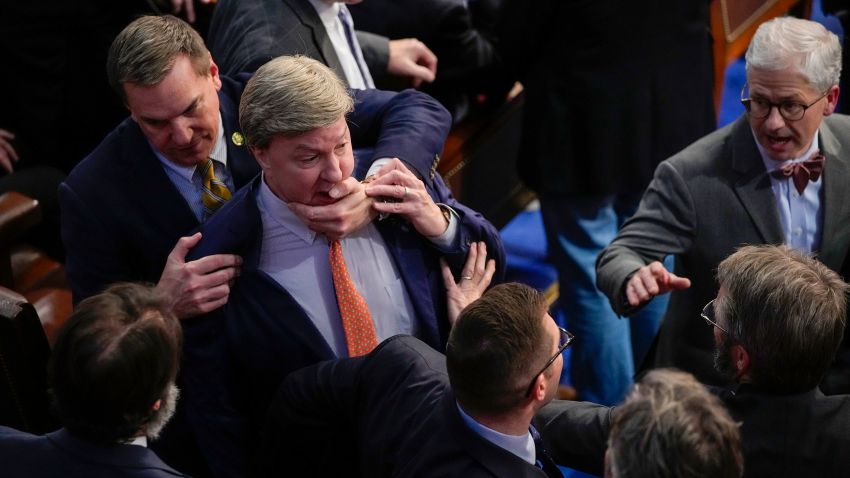
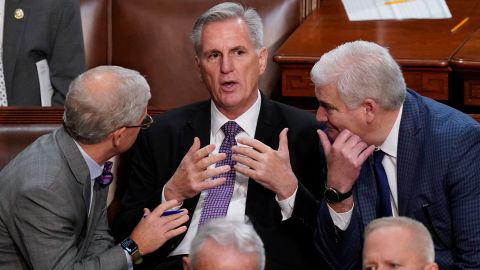
After McCarthy walked away from Gaetz, looking dejected, Armed Services Chairman Mike Rogers moved toward the conversation and lunged at Gaetz, having to be physically restrained by Republican Rep. Richard Hudson of North Carolina. Rogers, a Republican from Alabama who earlier in the week warned the GOP dissidents they would lose their committee assignments, told Gaetz he would be “finished” for continuing to wreck the speaker’s vote.

Nearby, Rep. Marjorie Taylor Greene of Georgia was trying to convince Rep. Matt Rosendale of Montana, another McCarthy holdout, to take her cell phone and speak to former President Donald Trump, who was on the line.

Finally, the House clerk announced for the 14th time that no one had the votes to be speaker. Republicans moved to adjourn the chamber until Monday. As the vote timer counted down, 218 Republicans had voted yes, a majority that would have sent McCarthy home for the weekend and left the House in paralysis at the hands of Gaetz and his allies.

The sign at McCarthy's office is installed on Capitol Hill in Washington, early Saturday on January 7, 2023.

But with less than a minute left to go in the vote, Gaetz moved toward the front of the chamber, grabbing a red index card to change his vote on adjournment. Gaetz walked toward McCarthy, and the two briefly exchanged words. McCarthy then raised his hand and yelled out, “One more!” as he triumphantly walked toward the front of the chamber to change his vote, too. It was the GOP leader’s final negotiation capping an emotional roller coaster over the course of four days as he was held hostage by a narrow faction of his conference. Dozens of Republicans followed McCarthy and Gaetz to defeat the adjournment measure, and McCarthy’s victory, at last, was at hand.

The six Republican holdouts all voted present on the 15th ballot, giving McCarthy a 216-212 victory to end the longest speaker’s race since 1859. Rep. Tom Emmer, one of McCarthy’s top deputies, went up and down the aisles telling Republicans on the House floor not to clap for Gaetz or Rep. Lauren Boebert when they announced their votes, like they had for other holdouts who had flipped to McCarthy earlier in the day.

Asked why he reversed course on McCarthy, Gaetz said, “I ran out of things I could even imagine to ask for.”

McCarthy expressed relief as he left the floor: “I’m glad it’s over.”

McCarthy denied Gaetz was offered the subcommittee gavel he had sought earlier in the week in exchange for his vote. “No one gets promised anything,” McCarthy said.

Rep. Richard Hudson, R-N.C., left, pulls Rep. Mike Rogers, R-Ala., back as they talk with Rep. Matt Gaetz, R-Fla., and other during the 14th round of voting for speaker as the House meets for the fourth day to try and elect a speaker and convene the 118th Congress in Washington, Friday, Jan. 6, 2023. At right is Rep. Patrick McHenry, R-N.C. (AP Photo/Andrew Harnik)

GOP lawmaker had to be restrained while confronting Gaetz. Hear what he told him

The chaotic scramble to the speakership came after days of marathon negotiations that exposed deep divides within the GOP and threw into question their ability to govern effectively in the 118th Congress. But McCarthy’s victory after facing 20 defectors on Tuesday also highlighted the successful strategy concocted by McCarthy and his top lieutenants to defeat the self-proclaimed “Never Kevin” movement led by Gaetz.

McCarthy’s strategy led to a breakthrough over two votes Friday afternoon, when McCarthy flipped 14 Republicans who had voted against him following marathon talks over House rules – setting the stage for the 11th-hour chaos with the final six holdouts.

It’s too soon to say whether the four-day speaker drama will become little more than an historical footnote for the 118th Congress, or if it’s an early indicator of even more bruising fights to come. But the fight over the speaker’s gavel exposed the bitter fault lines bubbling up in the Republican Party for the better course of a decade that will hover over the House for the next two years.

McCarthy’s concessions to the GOP dissidents are significant and could ultimately cut his tenure as speaker short. Among the rules changes: McCarthy agreed to restore a rule allowing a single Republican member to call for a vote to depose him as speaker, the same rule that led to John Boehner’s decision to resign as speaker in 2015.

Still, McCarthy’s victory Friday now gives him the long-sought speaker’s gavel and the chance to lead a House that will quickly turn its focus to investigating President Joe Biden, his administration and his family. More challenging for McCarthy and his conference are the looming fights later this year over government spending and the debt ceiling, where McCarthy cut deals on spending during this week’s negotiations likely to be unacceptable both to Democrats and the White House as well as Senate Republicans.

This account of how McCarthy finally won the fifth longest speaker’s fight in history is based on dozens of interviews throughout the week as the drama played out on and off the House floor with the fate of McCarthy’s political career and the legislative body itself hanging in the balance.

WASHINGTON, DC - JANUARY 06: U.S. Rep.-elect Marjorie Taylor Greene (R-GA) offers a phone to Rep.-elect Matt Rosendale (R-MT) in the House Chamber during the fourth day of voting for Speaker of the House at the U.S. Capitol Building on January 06, 2023 in Washington, DC. The House of Representatives is meeting to vote for the next Speaker after House Republican Leader Kevin McCarthy (R-CA) failed to earn more than 218 votes on several ballots; the first time in 100 years that the Speaker was not elected on the first ballot. (Photo by Chip Somodevilla/Getty Images)

Analysis: Dana Bash reacts to McCarthy thanking Trump for speaker role

The morning following McCarthy’s Monday meeting with Gaetz, things got even worse for the GOP leader.

In a tense meeting in the basement of the Capitol with the full House GOP Conference, McCarthy and Gaetz got into a screaming match. McCarthy called out his detractors for asking for personal favors, including Gaetz, whom he said informed him he didn’t care if Democrat Hakeem Jeffries was elected speaker so long as he didn’t get the job.

Afterward, the Florida Republican accused McCarthy of acting in bad faith by asking him for a list of demands – and then by later berating him over it.

“It was very unseemly,” Rep. Dan Bishop of North Carolina, one of the 20 who initially opposed McCarthy.

That meeting – where Rep. Lauren Boebert of Colorado called out “bulls**t” on McCarthy and where the GOP leader engaged in heated exchanges with Reps. Chip Roy of Texas and Scott Perry of Pennsylvania – set the stage for the furious four-day battle.

Afterward, McCarthy and his allies knew they had a problem. They saw his opposition growing amid anger over McCarthy’s threats and tough talk. So they began to work on a strategy: Take the temperature down and divide the opponents away from Gaetz and provide concessions to far-right members of the conference who want more say in the legislative process.

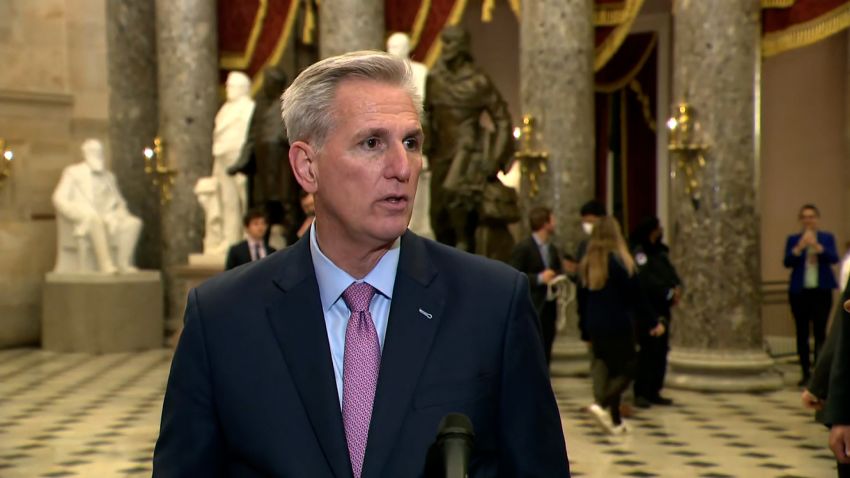
mccarthy statuary hall

McCarthy explains tense House floor discussion with Gaetz

At noon, the House gaveled in the 118th Congress, and lawmakers swarmed the House floor, children in tow, for what was supposed to begin a day of pageantry. In a sign of the new Republican rules, the magnetometers installed by outgoing Speaker Nancy Pelosi in the wake of the January 6, 2021, attack on the Capitol were removed from the doors to the House floor.

The first order of business quickly revealed the depth of the GOP opposition to McCarthy’s speakership bid.

McCarthy needed 218 votes, a majority of the House, meaning he could only lose four of the 222 Republicans as long as all Democrats voted for Jeffries. The clerk called out the names of all 434 members to vote in alphabetical order. McCarthy was denied a majority before the House clerk was through the “C’s,” and 19 Republicans voted for someone other than McCarthy – leaving him 15 votes short.

Jeffries, the new Democratic leader, got the most votes with 212.

McCarthy’s camp hunkered down, preparing to go through multiple votes for speaker for the first time in a century. “We’re going to war,” a senior GOP source told CNN.

McCarthy’s opponents were just as dug in. “We will never cave,” said Rep. Bob Good of Virginia.

On the second ballot, Rep. Jim Jordan of Ohio – the Republican rabble-rouser turned McCarthy ally – rose to nominate McCarthy, after he had received six votes from the holdouts. Gaetz followed Jordan by nominating the Ohio Republican himself as a candidate. All 19 Republicans holdouts consolidated around Jordan, and the count ended in the same place as the first ballot.

Before the third vote, Rep. Byron Donalds of Florida, who had voted for McCarthy on the first two ballots, told CNN that McCarthy failed to “close the deal.” When his name was called minutes later, Donalds announced he was voting for Jordan, McCarthy’s first defection.

The list of McCarthy’s opponents grew to 20 when the third vote was announced, and the House adjourned for the day.

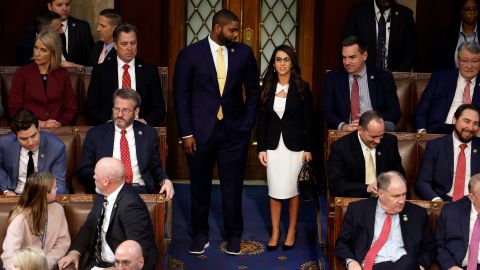
Rep. Lauren Boebert stands next to Rep. Byron Donalds as she casts her vote in the House chamber during the second day of elections for speaker at the US Capitol on January 4, 2023.

After the Tuesday’s three failed votes, McCarthy had debated having another GOP conference meeting. But the California Republican was advised not to, worried it would not be productive and would lead to another heated venting session that was leaked to the press in real time.

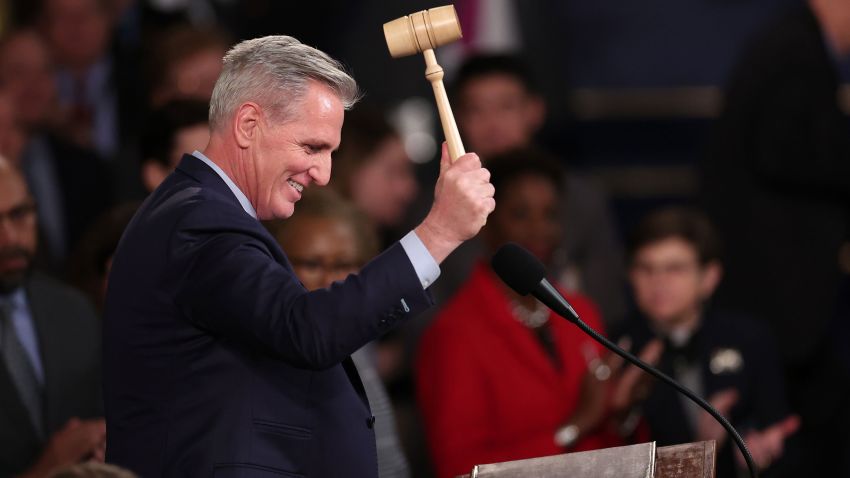
WASHINGTON, DC - JANUARY 07: U.S. Speaker of the House Kevin McCarthy (D-CA) celebrates with the gavel after being elected in the House Chamber at the U.S. Capitol Building on January 07, 2023 in Washington, DC. After four days of voting and 15 ballots McCarthy secured enough votes to become Speaker of the House for the 118th Congress. (Photo by Win McNamee/Getty Images)

Hear Kevin McCarthy’s first speech as House speaker

Instead, McCarthy’s camp ultimately decided small meetings would be more fruitful after the two factions retreated to their corners. McCarthy made his own round of calls Tuesday evening, including to former President Donald Trump. Before leaving the Capitol, McCarthy claimed to reporters he believed he was “not that far away” from the votes he needed.

McCarthy said that the former president “reiterated support” for his speaker bid.

The day before the vote for speaker, the former president had declined to issue a statement reiterating his endorsement of McCarthy despite a behind-the-scenes effort from several McCarthy allies to get Trump to do so.

Finally, on Wednesday morning, Trump did release a statement on his social media site urging the House GOP to “VOTE FOR KEVIN.”

The former president’s message had little effect.

“I disagree with Trump. This is our fight. This isn’t Trump’s,” said South Carolina GOP Rep. Ralph Norman, one of the McCarthy dissenters.

Trump continued to keep the House drama at arms’ length until Friday, when he made calls to Gaetz and Rep. Andy Biggs of Arizona while they were on the House floor. After McCarthy won the speakership, Trump congratulated him on his social media site.

Rep. Patrick McHenry, left, and Rep. Tom Emmer speak with McCarthy in the House chamber on January 4, 2023, as lawmakers meet for a second day to elect a speaker and convene the 118th Congress.

When the House gaveled back into session Wednesday, McCarthy lacked the votes to adjourn the session, as some of his allies had wanted in order to keep negotiating. So McCarthy headed toward a fourth ballot.

Jordan urged McCarthy’s opponents not to nominate him again. Instead, Rep. Chip Roy of Texas stood instead to nominate Donalds – the very Republican who had defected the day prior.

While the McCarthy opponents did not grow their ranks – a sigh of relief for McCarthy – the California Republican still lost one vote: Rep. Victoria Spartz, an Indiana Republican, who voted present. Spartz told reporters her vote was intended to encourage the two sides to get back to the negotiating table.

There were other signs that some of McCarthy’s backers weren’t willing to stick by him forever. Rep. Ken Buck, a Colorado Republican and House Freedom Caucus member, told CNN that “at some point” McCarthy needed to step aside and let now-Majority Leader Steve Scalise run. “What I’ve asked is that if Kevin can’t get there, that he step aside and give Steve a chance to do it,” Buck said.

The atmosphere on the House floor on Wednesday was buzzing by the second vote. While Tuesday’s session was relatively calm, the opposing factions gathered on the floor to hold talks in real time in between the speaker votes.

At the same time the House was taking vote after vote for speaker, Biden was speaking in Kentucky at an event with Senate GOP Leader Mitch McConnell promoting the 2021 infrastructure bill McConnell helped pass. Biden’s speech gave the White House – and Senate Republicans – a split screen that laid bare the vast contrast with the House Republican infighting.

“It’s embarrassing for the country,” Biden said of the House chaos.

President Joe Biden greets Senate Minority Leader Mitch McConnell on arrival at Cincinnati Northern Kentucky International Airport in Hebron, Kentucky, on January 4, 2023.

After the sixth vote ended with an identical outcome as the fifth, the House adjourned for several hours. The break gave the two sides more time to negotiate, and some of the hardliners said they saw some progress.

A group of Republicans decamped to the office of Minnesota Rep. Tom Emmer, the new House majority whip. Bishop said things had changed over the past couple of hours and he was “encouraged” by the talks.

But it wasn’t clear that the meeting would lead to a breakthrough. Gaetz pledged that the McCarthy dissenters could continue to hold votes “until the cherry blossoms fall off the trees.” Boebert said the “boats are burned” when it comes to any future negotiations with McCarthy.

When the House gaveled back into session, Republicans moved to adjourn for the night rather than take another failed speaker vote. GOP leaders were hopeful that the ongoing talks would convince McCarthy’s opponents to vote for adjournment, but with just four votes to spare, the roll-call vote was tight.

All Democrats and four McCarthy opponents voted against adjourning, and the motion was in danger of failing – which would have forced the House to keep voting for speaker. But two Democrats weren’t in attendance, and the House clerk gaveled an end to the vote, 216 to 214.

McCarthy had at least one more day to try to get his detractors to yes.

Rep. Jim Jordan talks with  McCarthy in the House chamber as the House meets on January 4, 2023, to elect a speaker.

On Wednesday evening, McCarthy agreed to several key concessions to try to flip at least some of his opponents.

McCarthy had been in talks with Roy, who told GOP leaders he thought he could get 10 holdouts to come along with him. McCarthy also met separately Wednesday evening with freshman members who voted against him.

In perhaps the biggest concession, McCarthy agreed to allow just one member to call for a vote to oust a sitting speaker. McCarthy had initially proposed a five-member threshold, down from current conference rules that require half of the GOP to call for such a vote.

McCarthy also pledged to allow more members of the Freedom Caucus to serve on the Rules Committee and to hold votes for bills that were priorities for the holdouts, including on border security and term limits.

In another sign of a breakthrough, a McCarthy-aligned super PAC, the Congressional Leadership Fund, agreed to not get involved in open primaries in safe seats – one of the demands conservatives had asked for but McCarthy had resisted.

“I think we’re making progress,” McCarthy said Thursday morning as he arrived at the Capitol for a third day of votes.

The GOP dissidents also sounded a positive note. “We’re making some progress,” Bishop told CNN as he was walking into a meeting Thursday morning with other GOP hardliners.

McCarthy leaves a private meeting room off the floor at the US Capitol on January 5, 2023, as he negotiates with lawmakers in his own party to become the speaker of the House.

Despite the optimistic chatter Thursday morning, the House gaveled into session at noon without a deal. And while McCarthy’s allies had considered trying to postpone additional votes so a deal could be finalized, McCarthy lacked the votes to adjourn.

Instead, lawmakers followed two tracks into the evening: taking vote after vote on the House floor for speaker, while negotiations continued behind closed doors.

The outcome did not change with each floor vote. While the GOP holdouts shifted who received their anti-McCarthy votes – Boebert nominated Rep. Kevin Hern of Oklahoma on vote No. 9, and Gaetz nominated Trump on the 11th ballot – none shifted to McCarthy’s side.

Twenty-one Republicans didn’t support McCarthy on ballot number seven. Same with eight, nine, 10 and 11.

Behind the scenes, however, the holdouts who weren’t in the “never Kevin” camp continued talking with McCarthy and his allies, inching closer to a deal.

By the early evening Thursday, there was an offer “on paper.” Three of the key negotiators – Emmer, Roy and Donalds – huddled with McCarthy in his ceremonial office, following a session in Emmer’s office for one group to review the written agreement to break the stalemate. Another group huddled in the member’s dining room on the first floor of the Capitol to discuss a separate part of the written deal.

“We’re still working through it,” Roy said leaving Emmer’s office.

“Each meeting is more positive than the last. And that’s a very nice sign,” Rep. Patrick McHenry, a key negotiator on McCarthy’s side, told reporters.

The discussions in Emmer’s office continued late into the evening Thursday in an attempt to get to yes. Chipotle was wheeled in for dinner.

One factor complicating the talks was a handful Republicans were expected to leave Washington due to various family issues. Buck left Thursday afternoon for a planned medical procedure. Rep. Wesley Hunt flew back to Texas to be with his wife and newborn, who had to spend some time in the neonatal intensive care unit.

McCarthy reacts after losing the 14th vote in the House chamber as the House meets on January 6, 2023, for the fourth day to elect a speaker and convene the 118th Congress.

On Friday morning, House Democrats marked the second anniversary of the January 6, 2021, attack on the steps of the Capitol. Just one Republican attended: Rep. Brian Fitzpatrick of Pennsylvania.

Republicans huddled once again as a conference for the first time since the heated Tuesday meeting. This time, McCarthy organized a conference call, which could be more easily managed, rather than an in-person session. On the call, McCarthy told his conference that a deal had not yet been finalized but that progress had been made. He specifically thanked Roy, a key holdout, for his role.

Before the House gaveled back into session, McCarthy predicted he would win over some holdovers, though there were still reasons for him to be pessimistic the finish line was in sight.

“I’ll be voting for Byron Donalds,” Norman told CNN on his way to the floor, saying he was still reviewing the emerging agreement.

The 12th vote for speaker began the same as the 11 before it. Rep. Andy Biggs of Arizona was the first Republican to vote against McCarthy. Then Bishop, the next McCarthy opponent in the roll call, rose to cast his vote.

“McCarthy,” Bishop said, prompting his fellow Republicans to leap from their seats with a standing ovation.

Freshman Rep. John Brecheen of Oklahoma was the next to flip, prompting another round of Republican cheers. By the end of the roll call, 14 holdouts, including Norman, had called McCarthy’s name. He was still short of the votes he needed for speaker, but the tide had turned. Only seven McCarthy opponents remained.

On the 13th vote, the GOP leader peeled off one more detractor, Rep. Andy Harris of Maryland. The House voted to adjourn until 10 p.m. ET – providing time both for the two missing McCarthy supporters time to return to Washington and for McCarthy’s allies to turn up the heat on the remaining holdouts.

McCarthy needed two more votes. McCarthy and his allies focused on Rep. Matt Rosendale of Montana and freshman Rep. Eli Crane of Arizona either to support McCarthy or vote present, lowering the vote threshold to win a majority.

There were multiple avenues to a majority and the speakership for McCarthy. The simplest path was to peel off two more votes and hit 218. But if McCarthy’s remaining GOP opponents would not vote for him, the California could still obtain a majority if three of the six detractors voted “present.” In addition to Rosendale and Crane, McCarthy’s allies looked to Boebert as a potential present vote.

Gaetz and Boebert appeared to acknowledge the end of the speaker fight was near before the House returned to session, sitting for a joint interview with Fox’s Sean Hannity and expressing vague optimisms for the rules changes the holdouts had won.

But as the House gaveled back into session, Gaetz went to McCarthy’s senior aide and asked whether the House could adjourn until Monday. Gaetz offer was rejected, leading to the final chaos over the course of the 14th and 15th votes for speaker.

Early Saturday morning, following 14 losses and more than 84 hours after the beginning of the 118th Congress, the House clerk finally announced McCarthy was elected House speaker.

Before the chaos over the final vote, McCarthy earlier Friday had sounded an optimistic note that the lengthy fight over the gavel would actually help Republicans. “So this is the great part. Because it took this long, now we’ve learned how to govern,” McCarthy said. “So now we’ll be able to get the job done.”

Gaetz, however, suggested the historic fight would have a different impact on McCarthy’s speakership. Due to the concessions, Gaetz argued, McCarthy will be governing in a “straitjacket.”


The chaos theory of Gen Z fashion

The chaos theory of Gen Z fashion

In 2022, as America emerged from the pandemic, we got a glimpse at the wild energy of the next generational aesthetic

Alici Sol, 23, wears loose-fitting jeans and a white shirt (her post-pandemic go-to ensemble) with her favorite jacket. It was once her friend’s, she says, “and she got it from another girl who got in L.A. at a vintage market.” All photos were taken in Manhattan in November, unless marked otherwise. (Calla Kessler for The Washington Post)

Comment

The big mystery of “The White Lotus’s” second season was supposed to be who died at the end. But all season long, it was continually upstaged by a more urgent one: What the hell was Portia wearing?

Haley Lu Richardson’s fresh-out-of-undergrad character first appeared on-screen wearing a chartreuse-and-aquamarine patterned sweater vest with a choker; later, her cropped Tommy Hilfiger rugby shirt clashed spectacularly with her drawstring linen pants. Then she wore a … zebra-print bikini top? With a rainbow sweater-shrug over it? By the time she appeared on-screen in a Lee Pipes shirt — directly after a cosmic-psychedelic bandeau-and-flares set befitting of a Spice Girl — Twitter users were all-capsing about it. And what was the crocheted bucket hat about?

Younger and more fashion-conscious viewers insisted the outfits worked; older viewers’ brains broke. “Portia Is TV’s Best-Dressed Character,” declared Harper’s Bazaar, while the New York Times proclaimed “The Misfires Are the Point.” The show’s costume designer defended her style choices thusly in an interview with “W”: “Portia is consumed by TikTok and ‘the discourse.’ … So we thought it would make sense that she is trying hard, and that she follows the mish-mash trends.”

What much of America was seeing for the first time on-screen, Johnny Cirillo — the street-style photographer behind the popular @watchingnewyork Instagram account — had been seeing on young people in New York’s most stylish neighborhoods for months. “Pre-pandemic, I noticed a lot more monochrome. Top-and-bottom beige, top-and-bottom white, top-and-bottom black. After the pandemic, things got very loud,” Cirillo says. But his photos lately, he says, have been a parade of pleats and ’90s-style pattern-clashing, “an explosion of hot pinks and electric blues and bright reds” — not to mention more skin. Before, “you didn’t see as many bras as tops, or sheer clothing,” he says.

Portia, in other words, was many Americans’ first glimpse of a Gen Z aesthetic. When society got abruptly sucked into the covid-19 tunnel in 2020, millennials were still the dominant force in fashion; the oldest members of Generation Z were barely 23, fledgling independent consumers. Now, as many Americans stumble out into the light at the other end, their blinking, squinting eyes are adjusting to the sight of Gen Z assuming authority and relaxing the rules of presentable adult attire, smushing together discordant patterns and colors and silhouettes into chaotic combinations and putting lately-unseen body parts once again on display. On city streets all over the United States, the trendy young people look different; Kylie Jenner wannabes have ceded the habitat to Ella Emhoff disciples. They’ve emerged from the pandemic era simultaneously euphoric and world-weary, ready to both participate again in the world as they knew it before and burn it all down. As Cirillo puts it, “I think people have busted out of their shell.”

Maybe some people quietly felt it happen, the subtle change in the air. But it bowled over Emma McClendon like a gust of wind. McClendon is one of America’s few true authorities on cool pants; she literally wrote the book on them, “Denim: Fashion’s Frontier,” in 2016. So you can imagine McClendon’s dismay this fall when she emerged from her upstate pandemic hideaway, started a new job teaching fashion studies at St. John’s University in Queens and discovered her pants were uncool.

The 36-year-old former curator at the Museum of the Fashion Institute of Technology began class by engaging her students on the subject of denim. Immediately, the ooof of it all set in. Baggy fits, they said, were the ideal; flares, low waistbands, wide legs. And most importantly, enough length to send fabric cascading down and stacking on top of the shoes. Clearly, McClendon’s slim, tailored, cropped-at-the-ankle trousers, her go-to professional look, had been eclipsed by … well, a multitude of decidedly weirder and more theatrical styles. Listening to her students and looking at their clothes, “I was thinking” — McClendon falls silent for a moment, remembering it — “‘Wow, my pants are just not in.’”

Soon, she saw curated chaos all around her. Her students’ clothing choices were harsh, loud, strange; their outfits insouciantly casual, often juxtaposing the skimpy and delicate with the comically oversized. To McClendon, the student body — sometimes even the individual student — looked like a loud pastiche of late-20th century styles. There were miniskirts. Slip dresses. Bra tops, especially paired with gigantic blazers. Towering, chunky lug-sole boots and loafers. Skirts on men, cargo pockets on women. Thrifted items of every color, shape and era. “It’s like a costume for ‘Clueless’ meets a construction worker. In, like, ‘Working Girl.’ And then there’s also a grunge ’90s aspect,” McClendon says. “It’s a lot of stuff that, a few years ago, if you’d asked me, I would have been like, ‘That stuff’s never coming back.’ ”

Back in the monochrome before-times — the era of “mom jeans,” turtlenecks, androgynous straight-cut silhouettes and an overall convergence between menswear and womenswear — modest was, for a time, hottest. Even the crop tops were demure. Thanks to that era’s sky-high waistlines, “all you got was that sliver of the upper [midriff], rib-cage area,” McClendon says.

Post-pandemic, it is once again open season on belly buttons. And other body parts. Sex is back in style, and so is gender: Menswear and womenswear have diverged once again, though who wears which can no longer be safely assumed. “What we’re seeing are clothes that typically we would consider hyper-gendered,” McClendon says. “But they’re being played with in a way to eschew gender.” (See: Steve Lacy and Lil Nas X’s love of dresses. Emma Chamberlain’s baggy “dad jeans.” Bella Hadid and Kaia Gerber’s cargo pants.)

Many young people’s everyday styles are put together a la carte from both ends of the gender buffet. “When I wake up in the morning and I’m feeling … like, provocative or sexy and confident, I would want to wear something more feminine,” says Brenna Gentner, an 18-year-old from Chandler, Ariz., and a first-year student at the Parsons School of Design. When she’s feeling more casual, she gravitates toward more masculine styles for comfort.

On the day Gentner spoke to The Post, she was wearing a red lace lingerie top over a thrifted Ed Hardy shirt. “I definitely wanted to take those lingerie pieces and kind of like, give them a new meaning,” Gentner says. “And be sexy without having to be, you know, secluded to a sacred space.”

Cirillo posits that young adults in America’s urban centers got restless and started taking new risks during the pandemic. “People were revealing a little bit more when they had their masks on,” he says. “It was almost like this secret identity: Well, I’ve always wanted to do this, but I haven’t had the confidence to pull it off.” Then they ditched their streamlined, optimized, safe-for-work silhouettes in favor of daring, one-of-a-kind pieces, often found through thrifting. Which, perhaps not coincidentally, is a practice Gen Z has handily revitalized.

Dressing for exhilaration or to boost confidence — or, hell, just to feel something again — has lately been dubbed “dopamine dressing,” notes Rachel Tashjian, the fashion news director at Harper’s Bazaar and author of the popular newsletter Opulent Tips (as well as the Harper’s Bazaar story calling Portia the best-dressed character on TV). Or as Ditte Reffstrup, creative director of the Danish luxury brand Ganni, calls it, “covid revenge dressing.” Ganni has been working to keep up with a demand for “a sexier look,” Reffstrup says. “So many have a major urge to go a little wild because they have missed out on so much.”

Brands, to their credit, have done their best to keep up with dramatic changes in what consumers want: Ganni announced collaborations with popular ’90s and 2000s names like Levi’s, New Balance and Juicy Couture. At the first sign of a pendulum-swing back to baggy pants, J. Crew introduced its instantly beloved Giant Chino (made for men but beloved by everyone); Everlane began selling a casual Drape Pant for women (or as Vogue calls it, a “puddle pant”). Both brands confirm that they’ve had trouble keeping the styles in stock; Everlane’s waitlist has sometimes been 6,000 consumers long.

In short, after the pandemic, “A lot of people started dressing in this kind of exuberant and expressive way. Which is how I would very broadly define Gen Z style,” Tashjian says. “Now, even the minimalism is so freaky,” she adds with a laugh; it’s undulating, eccentric, personality-driven. “It’s gone from, like, Le Corbusier to Brancusi!”

Maybe this is how you dress when you’ve just emerged from a true fashion-inspo vacuum — the likes of which have been unprecedented in the modern era. As fashion historian Kimberly Chrisman-Campbell, the author of “Skirts: Fashioning Modern Femininity in the Twentieth Century,” points out, 2020 wiped out many of the pipelines between designers’ imaginations and consumers’ shopping carts. Fashion shows were off-limits for a while; then, Chrisman-Campbell says, they became prohibitively expensive for some of the brands that survived. Magazines shuttered. Red carpets disappeared when awards shows were canceled. “A lot of traditional arbiters of fashion went away,” or went missing for a while, she says. “So people were looking in new places for inspiration.”

Wandering in the fashion desert, Gentner, the 18-year-old from Arizona, spent the long, lonely stretches of 2020 thinking philosophically about her wardrobe. Now, “I look toward a lot of my clothing as, like, a collection of pieces,” says Gentner, a seasoned thrifter. “I’ve recently been enjoying not only choosing one aesthetic that people prescribe to ‘fashion’ … but mixing them all together, creating a different persona and experience every single day.”

Manhattan-based musician and model Alici Sol, 23, used to be an impulse shopper. In 2020, with nowhere to go and no one else to take cues from or impress, she became acutely aware that many of her purchases were sitting in her closet unworn while just a handful went into regular rotation. “Now I feel like I’ve found my personal style,” Sol says. In thrift shops especially, “I’ve found pieces that, like, whenever I put them on, I’ll feel good in them.”

Sean Monahan, a writer and co-founder of the now-defunct trend forecasting group K-HOLE, sees a lot of people making the same reevaluation. “What I notice about young people today is an interest in small things or secret things again,” Monahan says. Indeed, even Vogue recently extolled the experience of carrying an “anti-It Bag” — a nod to the notion that young people are once again asking, as Monahan puts it, “What’s something I can buy that no one’s gonna know where I got it, but it’s going to look really cool, and it’ll be unidentifiable, but uniquely mine?” (Earlier this year, to much fanfare, Monahan predicted a coming “vibe shift” in New York Magazine — away from the brand-conscious, performatively progressive attitude that dominated the late 2010s and toward … well, it wasn’t clear at the time. The vibe, he confirms, has now shifted.)

Or maybe this is how you dress when you and your peers have known your whole lives that the planet is boiling toward uninhabitability, and that thrift-shopping reduces the need for fast fashion. Thrifting is “usually very cheap and helps keep perfectly fine clothes out of landfills!” one high-schooler told the New York Times last fall. “Buying from your local thrift-store is not only environmentally and budget-friendly, but it is also how I avoid being ‘basic,’” said another.

That said: “Gen Z is absolutely the driving force behind companies like Shein, which is, like, fast fashion on a scale we’ve never seen before,” McClendon says. “So it’s really full of contradictions.”

Maybe this is simply how you dress when you were raised by Generation X — the generation that canonized the skirt-wearing, thrift-shopping Nirvana frontman Kurt Cobain, and channeled its burned-out, over-it worldview into chunky shoes, skimpy slip dresses, loosefitting pants and the “willful disharmony of the grunge style,” as FIT curator Colleen Hill describes it in her book “Reinvention & Restlessness: Fashion in the Nineties.”

“Gen X politics are so clearly a kind of slightly cynical take on the failures of boomer politics to achieve what it had set out to,” says Monahan. “I think similarly, Gen Z kind of looks at millennials and the politics that were surrounding them and are perhaps a little bit skeptical about the authenticity of everything behind it.”

McClendon has said before that in the back half of the 2010s, when America was reeling from a reckoning with sexism and harassment of women, Americans’ fashion sense tempered itself accordingly — and helped cement what’s now arguably seen as the millennial aesthetic.

“It was this period where there was an attempt to sort of perfect and polish the lines and edges off things. And, yes, be quite sober,” Tashjian says, pointing to the retailer Everlane as a near-perfect distillation: “That brand, that sort of look, was really dominant in a lot of offices: a smooth-lined pair of slacks and a tasteful cashmere sweater. Tastefulness — that was really kind of the dominant sense.” In the future, the late 2010s may be remembered as an era of lowest-common-denominator fashion; of mass-market athleisure, of hygge and Scandi-chic; of gentle neutrals like greige and oatmeal, optimal for long hours at the jobs where millennials diligently devoted themselves to finding meaning.

Indeed, Gen Z’s skepticism (to put it mildly) toward millennials is well-documented; they took aim at skinny jeans and side parts, they torched the unironic use of the cry-laughing emoji. “[Millennials] like Hamilton and Hogwarts houses. They’re #GirlBosses who wear ‘Nasty Woman’ T-shirts and stan establishment Democrats,” Jude Ellison S. Doyle wrote in Gen in 2021, in an essay explaining what exactly Gen Z loathes about their immediate elders. “And they do all these things earnestly, without any of the irony or nihilism or ennui required to make them cool.”

Similarly, Hill writes, grunge was in part a result of Generation X’s eye-rolling at the decadence, jingoism and preppy elitism of the ’80s. Joan Juliet Buck, then the editor of Vogue Paris, described the style as “a deliberate refusal of beauty, form, line.” Is it any wonder, then, that Gen Z — the born-skeptical children of Gen X — has similarly made “weird” its whole aesthetic? What was grunge, after all, if not freaky and exuberant and ironic and nihilistic? What were the many clashing, splintering youth styles of the 1960s if not a reaction to a fracturing society?

2022′s freaky exuberance is arguably the kind born of grief, despair, exhaustion, the bottom falling out of things. As Gen Z looks back on the pandemic that took away crucial years of their youth and simultaneously stare down a future on a planet that’s rapidly deteriorating, their noisy, sexy, provocative signature style looks like the sort of hysterical ecstasy born of impending doom. It’s manic-laughter-at-a-funeral wear. End-of-the-world chic. Entropycore.

Or, look. Maybe they’re just wearing what they see on TikTok.

China’s Covid ‘chaos’: How a shortage of fever drugs is sparking a global run on medicines

China’s Covid ‘chaos’: How a shortage of fever drugs is sparking a global run on medicines


Hong Kong/Taipei
CNN
 — 

An unparalleled wave of Covid infections in China has activated common drug shortages, as individuals scramble to buy fever medications and painkillers to ease flu-like indicators.

The stress obtaining has spread outdoors mainland China’s borders, with the generic variations of Tylenol and Advil offered out at drugstores in Hong Kong, Macao, Taiwan and as considerably afield as Australia, prompting some nearby pharmacies to restrict product sales. Even house remedies these types of as canned peaches are staying snapped up by individuals searching for strategies to battle Covid.

The condition mirrors shortages witnessed in the United States and Canada around children’s painkillers, which are in significant demand from customers for the reason that of the proliferation of respiratory viruses.

The health and fitness main of Hong Kong, a exclusive administrative region with a individual technique of govt from the Chinese mainland, urged the public to chorus from hoarding chilly medicines, inquiring them “not to overact.”

At five drugstores in the business district of Wan Chai, the drug Panadol, the area manufacturer title for Tylenol, has been bought out for two months, salespersons advised CNN. One particular salesman, who gave his title as Simon, reported the scarcity was because of to purchasers buying in bulk to send out to their mates and family members in the mainland.

When his retailer does regulate to get keep of some offer, he is in a position to offer supply to longstanding shoppers in China through a complex method that takes about two months, costing in between HK$150 ($19) to HK$200 ($26) for every 2 kilograms (4.4 lbs .).

“We send the medicine by mail to Macao, in which our agents pick it up and then hand supply it throughout the border to Zhuhai,” he claimed, adding that the couriers ought to quarantine after they get there on the mainland. Macao is a different particular administrative location of China, even though Zhuhai is a southern mainland Chinese town which it borders.

Recent procedures don’t make it possible for medicines to be mailed immediately from Hong Kong to mainland China, according to the salespersons. Sending agents straight from Hong Kong, which also shares a land border with the mainland, is not possible thanks to a deficiency of accessible agents, Simon mentioned.

In Macao, the drug regulator ordered pharmacies past week to limit buys of agony relievers, fever medicines and antigen exam kits. The buy came following inhabitants complained about vacant cabinets when they have been searching for cold and fever medications, in accordance to Exmoo Information, a nearby newspaper.

China is grappling with its worst outbreak because the start of the pandemic, with analysts from expense lender Nomura describing the scenario as “nationwide chaos.”

“In all of this, one large query is whether or not the present-day reopening was prepared,” claimed analysts from Funds Economics in a independent note. “It appears that the wider state apparatus had not seen a shift coming.”

On Monday, national authorities commenced saying the first Covid-linked deaths considering that the easing of pandemic limitations on December 7. Only a handful of fatalities have been claimed, even as social media posts have pointed to a surge in demand from customers at Beijing’s funeral residences and prolonged strains at the city’s hospitals and fever clinics.

With wellbeing expert services confused, Chinese citizens have turned to private networks all around the entire world to protected Covid provides.

A CNN journalist visited a dozen drugstores in different districts throughout Taipei on Tuesday night time, devoid of taking care of to locate a one box of Panadol. Mr Lin, a store assistant at the Kawaki Drug Retail store in the middle of the metropolis, claimed demand surged about the past two months.

“We have normally faced a supply lack of Panadol given that the Covid-19 outbreak, but the situation has come to be a whole lot far more acute,” he stated. “Some buyers informed us that they required to send out the drugs to their relatives and buddies in China, offered the condition there.”

I Li-chen, a pharmacist in Taipei’s Xinyi district, mentioned her drugstore experienced received many thoughts about Panadol products recently.

“Some folks desired to get the drugs due to the fact they needed to deliver them to relatives in China, though many others wanted them due to the fact they experienced to check out China shortly,” she claimed.

Even as considerably as Australia, which has metropolitan areas with big populations of ethnic Chinese inhabitants, some worried Chinese Australians have started sending over-the-counter cold and flu medications to household members again in China, in accordance to ABC Information.