Washington
CNN
—
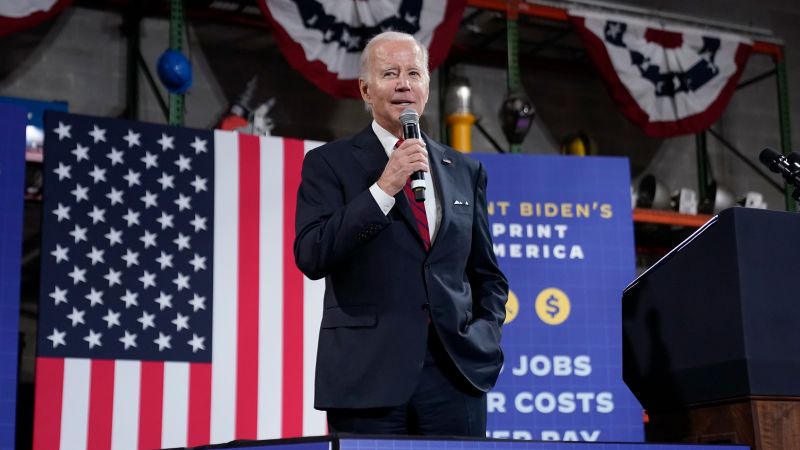
President Joe Biden delivered a Thursday speech to hail economic progress during his administration and to attack congressional Republicans for their proposals on the economy and the social safety net.
Some of Biden’s claims in the speech were false, misleading or lacking critical context, though others were correct. Here’s a breakdown of the 14 claims CNN fact-checked.
Touting the bipartisan infrastructure law he signed in 2021, Biden said, “Last year, we funded 700,000 major construction projects – 700,000 all across America. From highways to airports to bridges to tunnels to broadband.”
Facts First: Biden’s “700,000” figure is wildly inaccurate; it adds an extra two zeros to the correct figure Biden used in a speech last week and the White House has also used before: 7,000 projects. The White House acknowledged his misstatement later on Thursday by correcting the official transcript to say 7,000 rather than 700,000.
Biden said, “Well, here’s the deal: I put a – we put a cap, and it’s now in effect – now in effect, as of January 1 – of $2,000 a year on prescription drug costs for seniors.”
Facts First: Biden’s claims that this cap is now in effect and that it came into effect on January 1 are false. The $2,000 annual cap contained in the Inflation Reduction Act that Biden signed last year – on Medicare Part D enrollees’ out-of-pocket spending on covered prescription drugs – takes effect in 2025. The maximum may be higher than $2,000 in subsequent years, since it is tied to Medicare Part D’s per capita costs.
Asked for comment, a White House official noted that other Inflation Reduction Act health care provisions that will save Americans money did indeed come into effect on January 1, 2023.
– CNN’s Tami Luhby contributed to this item.
Criticizing former President Donald Trump over his handling of the Covid-19 pandemic, Biden said, “Back then, only 3.5 million people had been – even had their first vaccination, because the other guy and the other team didn’t think it mattered a whole lot.”
Facts First: Biden is free to criticize Trump’s vaccine rollout, but his “only 3.5 million” figure is misleading at best. As of the day Trump left office in January 2021, about 19 million people had received a first shot of a Covid-19 vaccine, according to figures published by the Centers for Disease Control and Prevention. The “3.5 million” figure Biden cited is, in reality, the number of people at the time who had received two shots to complete their primary vaccination series.
Someone could perhaps try to argue that completing a primary series is what Biden meant by “had their first vaccination” – but he used a different term, “fully vaccinated,” to refer to the roughly 230 million people in that very same group today. His contrasting language made it sound like there are 230 million people with at least two shots today versus 3.5 million people with just one shot when he took office. That isn’t true.
Biden said Republicans want to cut taxes for billionaires, “who pay virtually only 3{515baef3fee8ea94d67a98a2b336e0215adf67d225b0e21a4f5c9b13e8fbd502} of their income now – 3{515baef3fee8ea94d67a98a2b336e0215adf67d225b0e21a4f5c9b13e8fbd502}, they pay.”
Facts First: Biden’s “3{515baef3fee8ea94d67a98a2b336e0215adf67d225b0e21a4f5c9b13e8fbd502}” claim is incorrect. For the second time in less than a week, Biden inaccurately described a 2021 finding from economists in his administration that the wealthiest 400 billionaire families paid an average of 8.2{515baef3fee8ea94d67a98a2b336e0215adf67d225b0e21a4f5c9b13e8fbd502} of their income in federal individual income taxes between 2010 and 2018; after CNN inquired about Biden’s “3{515baef3fee8ea94d67a98a2b336e0215adf67d225b0e21a4f5c9b13e8fbd502}” claim on Thursday, the White House published a corrected official transcript that uses “8{515baef3fee8ea94d67a98a2b336e0215adf67d225b0e21a4f5c9b13e8fbd502}” instead. Also, it’s important to note that even that 8{515baef3fee8ea94d67a98a2b336e0215adf67d225b0e21a4f5c9b13e8fbd502} number is contested, since it is an alternative calculation that includes unrealized capital gains that are not treated as taxable income under federal law.
“Biden’s numbers are way too low,” said Howard Gleckman, senior fellow at the Urban-Brookings Tax Policy Center at the Urban Institute think tank, though Gleckman also said we don’t know precisely what tax rates billionaires do pay. Gleckman wrote in an email: “In 2019, Berkeley economists Emmanuel Saez and Gabe Zucman estimated the top 400 households paid an average effective tax rate of about 23 percent in 2018. They got a lot of attention at the time because that rate was lower than the average rate of 24 percent for the bottom half of the income distribution. But it still was way more than 2 or 3, or even 8 percent.”
Biden has cited the 8{515baef3fee8ea94d67a98a2b336e0215adf67d225b0e21a4f5c9b13e8fbd502} statistic in various other speeches, but unlike the administration economists who came up with it, he tends not to explain that it doesn’t describe tax rates in a conventional way. And regardless, he said “3{515baef3fee8ea94d67a98a2b336e0215adf67d225b0e21a4f5c9b13e8fbd502}” in this speech and “2{515baef3fee8ea94d67a98a2b336e0215adf67d225b0e21a4f5c9b13e8fbd502}” in a speech last week.
Biden cited a 2021 report from the Institute on Taxation and Economic Policy think tank that found that 55 of the country’s largest corporations had made $40 billion in profit in their previous fiscal year but not paid any federal corporate income taxes. Before touting the 15{515baef3fee8ea94d67a98a2b336e0215adf67d225b0e21a4f5c9b13e8fbd502} alternative corporate minimum tax he signed into law in last year’s Inflation Reduction Act, Biden said, “The days are over when corporations are paying zero in federal taxes.”
Facts First: Biden exaggerated. The new minimum tax will reduce the number of companies that don’t pay any federal taxes, but it’s not true that the days of companies paying zero are “over.” That’s because the minimum tax, on the “book income” companies report to investors, only applies to companies with at least $1 billion in average annual income. According to the Institute on Taxation and Economic Policy, only 14 of the companies on its 2021 list of 55 non-payers reported having US pre-tax income of at least $1 billion.
In other words, there will clearly still be some large and profitable corporations paying no federal income tax even after the minimum tax takes effect this year. The exact number is not yet known.
Matthew Gardner, a senior fellow at the Institute on Taxation and Economic Policy, told CNN in the fall that the new tax is “an important step forward from the status quo” and that it will raise substantial revenue, but he also said: “I wouldn’t want to assert that the minimum tax will end the phenomenon of zero-tax profitable corporations. A more accurate phrasing would be to say that the minimum tax will *help* ensure that *the most profitable* corporations pay at least some federal income tax.”
There are lots of nuances to the tax; you can read more specifics here. Asked for comment on Thursday, a White House official told CNN: “The Inflation Reduction Act ensures the wealthiest corporations pay a 15{515baef3fee8ea94d67a98a2b336e0215adf67d225b0e21a4f5c9b13e8fbd502} minimum tax, precisely the corporations the President focused on during the campaign and in office. The President’s full Made in America tax plan would ensure all corporations pay a 15{515baef3fee8ea94d67a98a2b336e0215adf67d225b0e21a4f5c9b13e8fbd502} minimum tax, and the President has called on Congress to pass that plan.”
Noting the big increase in the federal debt under Trump, Biden said that his administration has taken a “different path” and boasted: “As a result, the last two years – my administration – we cut the deficit by $1.7 trillion, the largest reduction in debt in American history.”
Facts First: Biden’s boast leaves out important context. It is true that the federal deficit fell by a total of $1.7 trillion under Biden in the 2021 and 2022 fiscal years, including a record $1.4 trillion drop in 2022 – but it is highly questionable how much credit Biden deserves for this reduction. Biden did not mention that the primary reason the deficit fell so substantially was that it had skyrocketed to a record high under Trump in 2020 because of bipartisan emergency pandemic relief spending, then fell as expected as the spending expired as planned. Independent analysts say Biden’s own actions, including his laws and executive orders, have had the overall effect of adding to current and projected future deficits, not reducing those deficits.
Dan White, senior director of economic research at Moody’s Analytics – an economics firm whose assessments Biden has repeatedly cited during his presidency – told CNN’s Matt Egan in October: “On net, the policies of the administration have increased the deficit, not reduced it.” The Committee for a Responsible Federal Budget, an advocacy group, wrote in September that Biden’s actions will add more than $4.8 trillion to deficits from 2021 through 2031, or $2.5 trillion if you don’t count the American Rescue Plan pandemic relief bill of 2021.
National Economic Council director Brian Deese wrote on the White House website last week that the American Rescue Plan pandemic relief bill “facilitated a strong economic recovery and enabled the responsible wind-down of emergency spending programs,” thereby reducing the deficit; David Kelly, chief global strategist at J.P. Morgan Funds, told Egan in October that the Biden administration does deserve credit for the recovery that has pushed the deficit downward. And Deese correctly noted that Biden’s signature legislation, last year’s Inflation Reduction Act, is expected to bring down deficits by more than $200 billion over the next decade.
Still, the deficit-reducing impact of that one bill is expected to be swamped by the deficit-increasing impact of various additional bills and policies Biden has approved.
Biden said, “Wages are up, and they’re growing faster than inflation. Over the past six months, inflation has gone down every month and, God willing, will continue to do that.”
Facts First: Biden’s claim that wages are up and growing faster than inflation is true if you start the calculation seven months ago; “real” wages, which take inflation into account, started rising in mid-2022 as inflation slowed. (Biden is right that inflation has declined, on an annual basis, every month for the last six months.) However, real wages are lower today than they were both a full year ago and at the beginning of Biden’s presidency in January 2021. That’s because inflation was so high in 2021 and the beginning of 2022.
There are various ways to measure real wages. Real average hourly earnings declined 1.7{515baef3fee8ea94d67a98a2b336e0215adf67d225b0e21a4f5c9b13e8fbd502} between December 2021 and December 2022, while real average weekly earnings (which factors in the number of hours people worked) declined 3.1{515baef3fee8ea94d67a98a2b336e0215adf67d225b0e21a4f5c9b13e8fbd502} over that period.
Biden said he was disappointed that the first bill passed by the new Republican majority in the House of Representatives “added $114 billion to the deficit.”
Facts First: Biden is correct about how the bill would affect the deficit if it became law. He accurately cited an estimate from the government’s nonpartisan Congressional Budget Office.
The bill would eliminate more than $71 billion of the $80 billion in additional funding for the Internal Revenue Service (IRS) that Biden signed into law in the Inflation Reduction Act. The Congressional Budget Office found that taking away this funding – some of which the Biden administration said will go toward increased audits of high-income individuals and large corporations – would result in a loss of nearly $186 billion in government revenue between 2023 and 2032, for a net increase to the deficit of about $114 billion.
The Republican bill has no chance of becoming law under Biden, who has vowed to veto it in the highly unlikely event it got through the Democratic-controlled Senate.
Biden said that “MAGA Republicans” in the House “want to impose a 30 percent national sales tax on everything from food, clothing, school supplies, housing, cars – a whole deal.” He said they want to do that because “they want to eliminate the income tax system.”
Facts First: This is a fair description of the Republicans’ “FairTax” bill. The bill would eliminate federal income taxes, plus the payroll tax, capital gains tax and estate tax, and replace it with a national sales tax. The bill describes a rate of 23{515baef3fee8ea94d67a98a2b336e0215adf67d225b0e21a4f5c9b13e8fbd502} on the “gross payments” on a product or service, but when the tax rate is described in the way consumers are used to sales taxes being described, it’s actually right around 30{515baef3fee8ea94d67a98a2b336e0215adf67d225b0e21a4f5c9b13e8fbd502}, as a pro-FairTax website acknowledges.
It is not clear how much support the bill currently has among the House Republican caucus. Notably, House Speaker Kevin McCarthy told CNN’s Manu Raju this week that he opposes the bill – though, while seeking right-wing votes for his bid for speaker in early January, he promised its supporters that it would be considered in committee. Biden wryly said in his speech, “The Republican speaker says he’s not so sure he’s for it.”
Biden claimed the unemployment rate “is the lowest it’s been in 50 years.”
Facts First: This is true. The unemployment rate was just below 3.5{515baef3fee8ea94d67a98a2b336e0215adf67d225b0e21a4f5c9b13e8fbd502} in December, the lowest figure since 1969.
The headline monthly rate, which is rounded to a single decimal place, was reported as 3.5{515baef3fee8ea94d67a98a2b336e0215adf67d225b0e21a4f5c9b13e8fbd502} in December and also reported as 3.5{515baef3fee8ea94d67a98a2b336e0215adf67d225b0e21a4f5c9b13e8fbd502} in three months of President Donald Trump’s tenure, in late 2019 and in early 2020. But if you look at more precise figures, December was indeed the lowest since 1969 – 3.47{515baef3fee8ea94d67a98a2b336e0215adf67d225b0e21a4f5c9b13e8fbd502} – just below the figures for February 2020, January 2020 and September 2019.
Biden said that the unemployment rates for Black and Hispanic Americans are “near record lows” and that the unemployment rate for people with disabilities is “the lowest ever recorded” and the “lowest ever in history.”
Facts First: Biden’s claims are accurate, though it’s worth noting that the unemployment rate for people with disabilities has only been released by the government since 2008.
The Black or African American unemployment rate was 5.7{515baef3fee8ea94d67a98a2b336e0215adf67d225b0e21a4f5c9b13e8fbd502} in December, not far from the record low of 5.3{515baef3fee8ea94d67a98a2b336e0215adf67d225b0e21a4f5c9b13e8fbd502} that was set in August 2019. (This data series goes back to 1972.) The rate was 9.2{515baef3fee8ea94d67a98a2b336e0215adf67d225b0e21a4f5c9b13e8fbd502} in January 2021, the month Biden became president. The Hispanic or Latino unemployment rate was 4.1{515baef3fee8ea94d67a98a2b336e0215adf67d225b0e21a4f5c9b13e8fbd502} in December, just above the record low of 4.0{515baef3fee8ea94d67a98a2b336e0215adf67d225b0e21a4f5c9b13e8fbd502} that was set in September 2019. (This data series goes back to 1973.) The rate was 8.5{515baef3fee8ea94d67a98a2b336e0215adf67d225b0e21a4f5c9b13e8fbd502} in January 2021.
The unemployment rate for people with disabilities was 5.0{515baef3fee8ea94d67a98a2b336e0215adf67d225b0e21a4f5c9b13e8fbd502} in December, the lowest since the beginning of the data series in 2008. The rate was 12.0{515baef3fee8ea94d67a98a2b336e0215adf67d225b0e21a4f5c9b13e8fbd502} in January 2021.
Biden said that fewer families are facing foreclosure than before the pandemic.
Facts First: Biden is correct. According to a report published by the Federal Reserve Bank of New York, about 28,500 people had new foreclosure notations on their credit reports in the third quarter of 2022, the most recent quarter for which data is available; that was down from about 71,420 people with new foreclosure notations in the fourth quarter of 2019 and 74,860 people in the first quarter of 2020.
Foreclosures plummeted in the second quarter of 2020 because of government moratoriums put in place because of the Covid-19 pandemic. Foreclosures spiked in 2022, relative to 2020-2021 levels, after the expiry of these moratoriums, but they remained very low by historical standards.
Biden said, “More American families have health insurance today than any time in American history.”
Facts First: Biden’s claim is accurate. An analysis provided to CNN by the Kaiser Family Foundation, which studies US health care, found that about 295 million US residents had health insurance in 2021, the highest on record – and Jennifer Tolbert, the foundation’s director for state health reform, told CNN this week that “I expect the number of people with insurance continued to increase in 2022.”
Tolbert noted that the number of insured residents generally rises over time because of population growth, but she added that “it is not a given” that there will be an increase in the number of insured residents every year – the number declined slightly under Trump from 2018 to 2019, for example – and that “policy changes as well as economic factors also affect these numbers.”
As CNN’s Tami Luhby has reported, sign-ups on the federal insurance exchange created by the Affordable Care Act, also known as Obamacare, have spiked nearly 50{515baef3fee8ea94d67a98a2b336e0215adf67d225b0e21a4f5c9b13e8fbd502} under Biden. Biden’s 2021 American Rescue Plan pandemic relief law and then the 2022 Inflation Reduction Act temporarily boosted federal premium subsidies for exchange enrollees, and the Biden administration has also taken various other steps to get people to sign up on the exchanges. In addition, enrollment in Medicaid health insurance has increased significantly during the Covid-19 pandemic, in part because of a bipartisan 2020 law that temporarily prevented people from being disenrolled from the program.
The percentage of residents without health insurance fell to an all-time low of 8.0{515baef3fee8ea94d67a98a2b336e0215adf67d225b0e21a4f5c9b13e8fbd502} in the first quarter of 2022, according to an analysis published last summer by the federal government’s Department of Health and Human Services. That meant there were 26.4 million people without health insurance, down from 48.3 million in 2010, the year Obamacare was signed into law.
Biden said, “And over the last two years, more than 10 million people have applied to start a small business. That’s more than any two years in all of recorded American history.”
Facts First: This is true. There were about 5.4 million business applications in 2021, the highest since 2005 (the first year for which the federal government released this data for a full year), and about 5.1 million business applications in 2022. Not every application turns into a real business, but the number of “high-propensity” business applications – those deemed to have a high likelihood of turning into a business with a payroll – also hit a record in 2021 and saw its second-highest total in 2022.
Trump’s last full year in office, 2020, also set a then-record for total and high-propensity applications. There are various reasons for the pandemic-era boom in entrepreneurship, which began after millions of Americans lost their jobs in early 2020. Among them: some newly unemployed workers seized the moment to start their own enterprises; Americans had extra money from stimulus bills signed by Trump and Biden; interest rates were particularly low until a series of rate hikes that began in the spring of 2022.