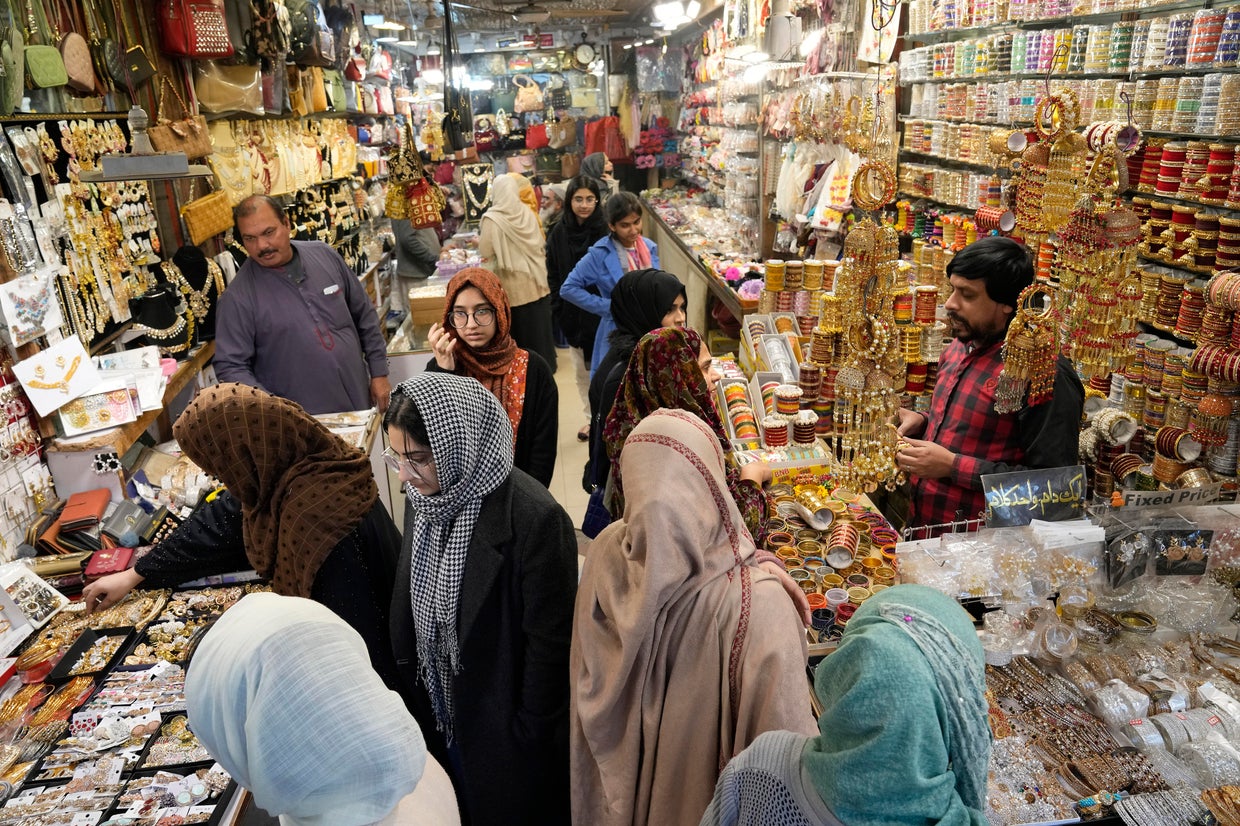
Purchasers go to a marketplace in Lahore, Pakistan, January 4, 2023.
K.M. Chaudary/AP
Islamabad, Pakistan — It’s a element of Pakistani urban existence that bemuses several Western site visitors to the region: Suppliers and malls remain open up late, and usually keep active properly into the evening.
Need to have a hand-woven carpet at 9:30 p.m.? Not a issue. A bespoke three-piece fit at 10? The area tailor is continue to whirring absent on his stitching machine. Some spicy samosa treats and a cooling kulfi ice product after midnight? The shop upcoming doorway is, of training course, however cranking them out.
But it appears this late-night shopper society might soon turn out to be a detail of the past, as the desperately hard cash-strapped Pakistani govt has purchased all malls and markets to near by the unheard of early hour of 8:30 p.m.
Folks walk through a procuring mall in Peshawar, Pakistan, January 4, 2023.
Muhammad Sajjad/AP
It can be 1 of a handful of new measures introduced recently in a bid to preserve electrical power — not for the reason that Pakistan is seeking to go green, automatically, but for the reason that it only can’t manage to retain the lights on.
The country’s defense minister, Khawaja Asif, apprised journalists of the cabinet-accepted prepare to near marketplaces, together with places to eat, which is supposed to preserve the region about 62 billion Pakistani rupees, or $273 million, each year.
More instant actions incorporated closing marriage halls by 10 p.m. each individual working day — at which hour some friends wouldn’t even have arrived at a classic Pakistani wedding.
The strength conservation prepare also includes banning the production of inefficient mild bulbs and lovers from February and July respectively.
Cooks fry fish at a restaurant in Rawalpindi, Pakistan, January 2, 2023.
FAROOQ NAEEM/AFP/Getty
Asif also mentioned Prime Minister Shehbaz Sharif experienced purchased all federal government departments to decrease electrical energy usage by 30{515baef3fee8ea94d67a98a2b336e0215adf67d225b0e21a4f5c9b13e8fbd502}.
50 {515baef3fee8ea94d67a98a2b336e0215adf67d225b0e21a4f5c9b13e8fbd502} of the street lights across the nation will also stay switched off, as a “gesture,” he additional.
The actions ended up prompted by the dire straits in which Pakistan’s financial state has been mired for many years. International markets anxiety the place of 230 million persons could be poised to default on its countrywide financial debt repayments for the initial time in decades. If that occurs, there is problem it could result in a complete economic collapse of the national economy, and even huge-scale social unrest.
A $1.1 billion bailout from the Worldwide Financial Fund remains caught owing to disagreements with Pakistan’s govt around belt-tightening measures the worldwide finance firm has demanded. Negotiations should have been concluded in November.
Most of Pakistan’s electrical energy is created using imported fossil fuels, together with liquefied organic gas, the selling prices of which have sky-rocketed in new months.
Cooks fry fish at a cafe in Rawalpindi, Pakistan, January 2, 2023.
FAROOQ NAEEM/AFP/Getty
The government has attempted to stabilize the economy by reining-in imports and decades-superior inflation. But speedy-depreciating currency has manufactured imports more high-priced, whilst consumer costs noticed a 25{515baef3fee8ea94d67a98a2b336e0215adf67d225b0e21a4f5c9b13e8fbd502} 12 months-on-12 months increase in the first fifty percent of the recent fiscal yr.
Whilst the financial state desperately wants balance, enterprise groups have been sad with the plan announced by the government.
The principal organization affiliation for modest to medium traders, the All Pakistan Anjuman-i-Tajiran, insisted that stores would stay open until at minimum 10 p.m. and eating places right up until 11. Conserving electrical power by curbing economic action was not a intelligent technique, the group claimed.
As a substitute, it proposed conserving energy by reducing down on the use of air conditioners and heaters in govt structures and limiting gas and energy privileges for bureaucrats and government officers.
The enterprise local community should really be offered an uninterrupted ability supply to continue to keep the financial state going, it insisted.
The impasses, equally internally among organization leaders and the govt, and concerning the authorities and the IMF, obviously never bode nicely for Pakistan’s economy as the state settles into a new year.
In this Oct. 9, 1999, file photo, a cross made of stones rests below the fence in Laramie, Wyoming, where a year earlier, University of Wyoming student Matthew Shepard was tied and pistol whipped into a coma. He later died. “The Laramie Project,” a play and film about the incident, was part of a curriculum removed from Lansing classrooms.
Ed Andrieski, File
AP Photo
Going against a district recommendation, the Lansing school board removed high school English curriculum after a parent complained that her daughter’s course had been “hijacked by a social-political agenda” and was “representative of critical race theory.”
The school board in Leavenworth County last week voted 4-3 to remove certain materials included in Senior Composition and Senior Literature courses, despite the objections of several other parents and students. That decision went against a district committee’s recommendation stating that the content as used in class is “appropriate for the age of students and learning objectives.”
Parent Kirsten Workman successfully challenged materials in a social justice unit, where students explored different topics and wrote expository essays. As a result, the classes will no longer include the video “Oscar Wilde Biography: His ‘Wild’ Life,” the films “The Laramie Project” and “13th,” and the essays “We Should All be Feminists” by Nigerian author Chimamanda Ngozi Adichie and “Willing to Be Disturbed” by Margaret J. Wheatley.
“My opinion is that my daughter’s writing course has been hijacked by a social-political agenda where she is force-fed ideas that are completely homogeneous and ignore other perspectives,” Workman wrote in her objection.
Several other parents and students urged the school board to dismiss the complaint, arguing that they should not bend to the will of “extreme radical parents.”
“There are extreme forces trying to denigrate quality public education in Lansing. These individuals couch this effort with words meant to scare, like ‘Marxism,’ ‘indoctrination’ and ‘propaganda,’” parent Nicole Yedlinsky told the school board.
“There are some individuals who mistakenly believe they can raise children in a vacuum. They believe high school students are not capable of complex thought. These parents should be having open conversations with their children regarding their own viewpoints, not disrupting the well-balanced, moderate education my children currently receive.”
The Lansing school board removed social justice curriculum in a high school English class, including the showing of the documentary “13th,” which features professor and activist Angela Davis. Netflix
Curriculum challenge
Workman called the five-week unit “indoctrination,” arguing that it taught students critical race theory, or CRT, an academic concept that explores the role of American institutions in perpetuating racial inequality.
CRT is not taught in K-12 schools, but has become a target of conservative parents and politicians and a catchall term for schools’ teachings on race, diversity and equity.
“My daughter is seventeen years old, and has not fully formed her own ideas yet. She is not a college student. This reading, presented in this context, does not serve as encouragement for a young mind to do the intellectual work required to support her own ideas, but rather to try on others’ ideas to see how they feel and whether that brings harmony to society,” Workman wrote in her objection.
Students told the school board that the course taught them to identify biases and consider a variety of perspectives to make informed opinions. One student said at last week’s meeting that, “listening to another person’s perspective is not indoctrinating.”
The debate in Lansing comes amid a nationwide push by some conservative parents and politicians to ban from schools certain books that deal with gender and sexual identity, as well as diversity and equity initiatives and curriculum on race.
Workman argued that the documentary “13th” was a direct example of CRT. The title refers to the 13th Amendment abolishing slavery and, according to Netflix, analyzes “the criminalization of African Americans and the U.S. prison boom.” The committee that reviewed the curriculum — made up of subject area experts, library specialists, parents and a student — reported that only clips of the documentary were shown to classes, and that the teacher stopped the film multiple times to point out biases.
The curriculum is designed to hone expository writing skills, having students explain facts.
“For a student to be able to master this type of writing, readers should be given a variety of alternating views and controversial material to ascertain biases and inaccuracies on their own. This is how they improve as critical thinkers, writers, and learners,” a committee member wrote.
The essay “Willing to Be Disturbed” encourages readers to be willing to have their beliefs challenged. “We Should All be Feminists” is a personal essay that explores how women are marginalized around the world and offers a unique definition of feminism, according to the author’s website.
“The Laramie Project” is a play and HBO film about the reaction to the 1998 murder of gay University of Wyoming student Matthew Shepard in Laramie, Wyoming.
Workman said she objects “to my child’s exposure to literary themes which are heavily centered on sexuality, religion, morality, brutal murder and death,” adding that she does not want the course “to give my child the impression that hate crimes are even a remotely prevalent social issue in the U.S.”
The committee that reviewed the curriculum argued that the video shown in class is rated TV-14, “is factual, tells both sides of the story, and did happen.”
Student Brooke Worrall, who served on the committee, argued that the curriculum is valuable and helped teach students critical thinking skills.
“Not only did we learn how to analyze facts during these lessons but also how to spot bias and/or propaganda,” Worrall said. “The information was presented to us by the teachers very well. The teachers presented to us this information in a neutral manner without suggesting an opinion in any way. Typically, after these lessons the students were given the chance to discuss with classmates and do our own research to form our own opinions.”
Workman first met with Principal Alan Penrose in September, saying that her daughter was instructed in class to analyze literature using a “Marxist lens” and other social-political theories, according to district documents. She continued discussing her concerns about classwork with the principal, who in October allowed her daughter to work from the library and complete alternate assignments.
She then submitted a challenge to the curriculum. The principal gave her daughter several options, according to the committee report, including returning to class, completing a class online or enrolling in a new literature class for college credit. Workman reportedly rejected those ideas and argued for her daughter to stay in class and for the content to change.
Last month, the school board directed the superintendent to form a committee to review the curriculum.
‘Disrupting the classroom’
Students pleaded with the school board to allow teachers to continue offering safe spaces in class to discuss difficult topics.
“Disrupting the classroom like this is hurting the teachers’ right to teach and the students’ right to learn,” student Alexis Perry told the school board. “…There is a teacher shortage in America, and having attacks like this on our teachers and their ability to teach is driving that number up.”
Perry said the curriculum challenge already is “affecting my fellow classmates in other classes, with the fear that their teaching environment is going to be disrupted. … I used to want to be a teacher. And things like this, where I’m seeing teachers losing their ability and their right to teach and my right as a student to learn, doesn’t make me want to do that.”
This past spring, the Lansing school board voted 4-3 to approve a parents bill of rights, modeled after Republican-supported legislation that Democratic Gov. Laura Kelly vetoed, calling the measure a “teacher demoralization act.” The Kansas House failed to override the veto, but Republicans made it a hallmark of campaigns this fall. The parents bill of rights outlines ways parents can oversee their child’s education, including reviewing and objecting to books and curriculum.
Across the country, Republican lawmakers have pushed for such “curriculum transparency” measures, arguing that schools needed to increase transparency and parent involvement.
Many public school advocates and teachers fought back against the proposed parents bill of rights in Kansas, arguing that parents were already afforded the rights spelled out in the legislation. Some teachers told The Star that they already provide parents with learning materials and are happy to address complaints as they arise. They worried that such legislation would have a chilling effect on open and flexible classroom instruction.
This story was originally published December 21, 2022 5:30 AM.
Related stories from Kansas City Star
Sarah Ritter covers K-12 education for The Kansas City Star. Formerly a reporter for the Quad-City Times, Sarah is a graduate of Augustana College.