

Fed’s Powell says SVB collapse may slow the economy through tighter credit

Fed’s Powell says SVB collapse may slow the economy through tighter credit

Federal Reserve Board Chair Jerome Powell speaks through a news conference at the Federal Reserve in Washington, DC, on March 22, 2023.

Olivier Douliery | AFP | Getty Pictures

Federal Reserve Chair Jerome Powell reported Wednesday that the U.S. banking sector is powerful but that the current failure of some regional financial institutions could cause ripple effects that gradual down the financial state.

At a press meeting right after the most recent Federal Open Marketplaces Committee meeting, Powell described the banking technique as “audio and resilient” but said the central bank was monitoring a improve in the availability of credit score for customers and organizations.

“Monetary problems appear to have tightened, and possibly by a lot more than the regular indexes say. … The query for us although is how substantial will that be — what will be the extent of it, and what will be the period of it,” Powell explained.

“We are going to be looking to see how serious is this and does it glimpse like it is really likely to be sustained. And if it is, it could conveniently have a significant macroeconomic impact, and we would element that into our plan selections,” he extra.
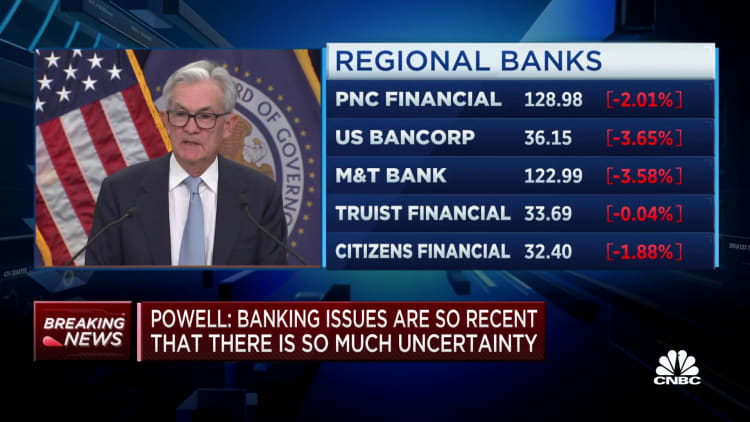
Our response was how did this happen, says Fed Chair Powell of SVB failure

The Fed hiked its benchmark desire charge by a quarter of a percentage stage on Wednesday, but its projections referred to as for just just one extra hike above the relaxation of the 12 months. The central bank chief mentioned that tighter monetary conditions induced by more stringent lending choices from banking companies could have a very similar effects as further more hikes from the Fed.

Powell’s responses appear after regional financial institutions have appear less than significant tension this thirty day period. Silicon Valley Financial institution collapsed, making it the next premier failure in U.S. heritage, in part simply because the speedy increase in desire costs devalued its bond portfolio and designed significant paper losses for the financial institution.

SVB’s administration “unsuccessful poorly” in handling its desire amount dangers, even though other financial institutions have managed to deal with the hikes, Powell reported.

Other banking institutions like Very first Republic and PacWest have witnessed considerable outflows of deposits. The Fed set up a new Financial institution Phrase Funding Software to aid financial institutions entry funds, but the stocks for regional financial institutions have fallen in volatile buying and selling given that the facility was created on March 12.

Powell explained that deposit flows have stabilized more than the previous 7 days and that Americans really should sense confident that their money is harmless, however he stopped quick of explicitly stating that all deposits are now confirmed.

“What I am stating is you’ve got noticed that we have the applications to shield depositors when there is a risk of serious harm to the economy or to the financial technique, and we’re geared up to use individuals applications. I think depositors ought to assume that their deposits are risk-free,” he mentioned.

The collapse of Silicon Valley Financial institution has led to much more scrutiny on the Federal Reserve’s supervisory part in excess of banking companies, in particular from Sen. Elizabeth Warren (D-MA).

The Fed is conducting an internal critique of possible regulatory concerns all around SVB, led by Vice Chair for Supervision Michael Barr, and Powell mentioned he expects investigations from outdoors the central bank as effectively.

SVB Collapse Rattles Travel Startups

SVB Collapse Rattles Travel Startups

As the Biden administration attempts to allay panic in the U.S. banking procedure adhering to final week’s collapse of Silicon Valley Bank, analysts following the vacation tech sector say begin-ups might have some limited-time period money challenges, but the threat of longer-phrase implications has eased.

The next-largest financial institution failure in U.S. background, the Federal Deposit Coverage Corp. took manage of SVB, which performs with a significant part of U.S. and U.K. startups, on Friday adhering to a run on deposits. That led to a “serious scramble” for Silicon Valley companies, Vacation Tech Consulting president and founder Norm Rose explained.

“Any time you won’t be able to withdraw your revenue from an establishment, the cash which is your income or your customers’ income, that is a genuine dilemma, especially on the latter portion,” he claimed.

Several travel tech vendors supplied assurance more than the weekend that their functions would go on. Navan, the recently rebranded TripActions, in a statement claimed that SVP was a “extended-standing fiscal husband or wife and purchaser” given that the company’s inception but that “Navan’s monetary position stays strong” adhering to its closure.

“A lot less than 5 per cent of our liquid property were being held by SVB,” Navan claimed in its assertion. “We have a strong community of money associates, together with Goldman Sachs, Citibank and Bank of America and do not depend entirely on SVB to offer our providers.”

Digital card payment startup Teampay on Friday afternoon said on Twitter that it “sees no possibility to operations” despite its partnership with SVB, as it suppliers its cash in other establishments. 

Sonder Holdings in a assertion stated it was “actively [monitoring] the evolving scenario” with SVB. The brief-phrase lodging supplier claimed as of March 9, it had about $2 million in an working hard cash account and about $20 million in deposit accounts with SVB as properly as a $60 million line of credit rating facility. 

Some firms, like American Specific World Small business Journey and AI computer software supplier Execs, submitted filings with the U.S. Securities and Exchange Commission to advise buyers that they do not have funds deposits or securities with SVB.

Further than the travel tech market, the collapse also hit organizations that relied on accounts with SVB for costs. In its assertion, Navan advised shoppers with payment accounts joined to SVB to switch to a further account to avoid disruptions in bookings. Travel management company startup TakeTwo said its U.S. functions workforce also worked in excess of the weekend to aid customers applying SVB payment instruments, such as wellbeing care management system Intelycare.

IntelyCare company travel supervisor Tricia Jenkins, in a assertion supplied by TakeTwo, claimed the problem disrupted both the firm’s immediate-monthly bill card and person company playing cards but was in a position to update with on line booking device and get alternative payment tools in place “inside hrs” by operating with TakeTwo.

Since Friday’s collapse, the Federal Reserve announced an unexpected emergency lending application, regulators have promised depositors comprehensive compensation and President Joe Biden instructed People to “have self-confidence that our technique is safe and sound” although promising to push for stricter banking laws to reduce long term failures. Even though the FDIC took management of a second financial institution, New York-primarily based Signature Bank, on Sunday, TSI running companion Matt Zito said the actions probable have prevented that “contagion” that would lead to added bank failures.

“Everyone’s likely to get their revenue out of SVB, and the lending facility will backstop just about anything a lot more that arrives down the pike,” he said. “Finally, this will blow by, and in a month we in all probability is not going to even be talking about it.”

Zito, whose current aim is coaching journey CEOs on how to construct sellable business, claimed it need to be a wakeup connect with for travel tech corporations on running banking danger and staying away from having additional than the $250,000 that is FDIC-insured in organization examining accounts. He advises spreading out resources in numerous accounts and certain investments, these types of as four-7 days U.S. treasury costs, a approach he explained that possibly “80 to 90 percent” of startups now are not next. Digital media participant manufacturer Roku, for instance, documented obtaining almost $500 million, about a quarter of all its dollars, in SVB.

Startups currently being in a position to exhibit their capacity to prevail over long run collapse in their pitch could mitigate the get worried they are possible to see from buyers in the small-expression as a final result of the collapse, Zito claimed. In the lengthier expression, investments will keep on being offered to “the best startups and most effective thoughts, and the largest concepts and the ideal teams,” he claimed.

Rose also expressed assurance in the potential of journey tech startup investments.

“Even in the worst of times, investment will come again, and innovation arrives again, and that’s a wonderful testimony in the way of the American economic system,” Rose explained. “If this is pointing to some strain in the small term, in the medium and prolonged time period, things will be fine.”

Pac-12 in danger of eventual collapse as Big Ten considers further expansion, Big 12 interest looms

Pac-12 in danger of eventual collapse as Big Ten considers further expansion, Big 12 interest looms

The Big Ten’s continued pursuit of four Pac-12 schools is leading to concern that another round of expansion could collapse the Pac-12, industry sources tell CBS Sports. This as Big Ten commissioner Kevin Warren continues to seek an offer from Amazon, or potentially another partner, for additional Big Ten football media rights revenue.

An offer deemed substantial enough would likely convince Big Ten presidents that California, Oregon, Stanford and Washington would be valuable additions to the league from the Pac-12. That figure is believed to be less than $100 million annually.

If the Big Ten makes such a move, it would almost certainly increase the likelihood the Big 12 is able to get some combination of Arizona, Arizona State, Colorado and Utah from the Pac-12, thus crushing the Pac-12 and hanging Oregon State and Washington State out to dry.

“If that [Big Ten move] happens, I think the other [four Pac-12] schools will want to jump to our league,” said a Big 12 source familiar with the situation.

Without a clear mandate, Big Ten presidents and athletic directors continue to evaluate whether expansion is “financially viable” and potential candidates are a “cultural fit,” conference sources tell CBS Sports. No vote has been taken on expansion at this time.

The Big Ten completed a historic media rights deal last month worth more than $8 billion over seven years beginning in 2023. Amazon reportedly bid more for the Big Ten’s 3:30 p.m. ET and primetime windows compared to other suitors. Those windows went to CBS and NBC, respectively.

If the Big Ten indeed turned down such an offer, the concerns were likely distribution and visibility. Those same concerns would be in play if the Big Ten accepted the four additional Pac-12 schools.

Industry chatter has Oregon State and Washington State moving to the Mountain West if the Pac-12 collapses. At that point, the MWC would replace the Pac-12 as the largest FBS conference completely located in the Mountain and Pacific Time Zones.

Adding to the intrigue, the Big Ten and Big 12 share the same media rights consultant, Endeavor, a global sports and entertainment company.

CBS Sports reported last month Endeavor was advising the Big 12 about whether it should add Pac-12 programs. Earlier this summer, CBS Sports reported the Big 12 was interested in the aforementioned “Four Corners” programs.

Since then, officials from Oregon and Washington have met with the Big Ten, according to multiple media reports. Earlier this month, Big 12 commissioner Brett Yormark said, for the first time publicly, he was interested in expanding to the Pac-12 footprint.

“Obviously going out west is where I would like to go — entering that fourth time zone,” he told The Athletic.

Whether the Big Ten expands again, the Big 12 is expected to remain interested in either two or four Pac-12 schools.

The potential for further realignment — following the migration of USC and UCLA to the Big Ten — has caused disruption in the industry.

Pac-12 commissioner George Kliavkoff told CBS Sports in July: “Let’s be very clear: No Pac-12 school is joining the Big 12.”

Publicly, the remaining 10 Pac-12 schools have showed a united front. The league moved up negotiations for a new media rights deal in July. The difference is the Big Ten already has its new deal in place. Signed in August, the media rights agreement further solidified the Big Ten’s top spot in earnings. Beginning in 2023, Big Ten schools are expected to earn an average of $75 million annually.

Meanwhile, the current Big 12 deal with Fox and ESPN doesn’t expire until 2025; however, the Big 12 opened media rights discussions with its partners early and hopes to strike a deal earlier and richer than what the Pac-12 can acquire. The conference reported $46.2 million distributed to each of its schools in the last fiscal year. That includes Oklahoma and Texas, which are due to move to the SEC in 2025 at the latest.

Industry sources value a 10-team Pac-12 at $21 million to $30 million per school annually after the loss of USC and UCLA. The Pac-12’s deal with Fox and ESPN expires in 2024.

The possibility of a merger between the Big 12 and Pac-12 was ruled out in July. Any combination of Big 12 and Pac-12 programs would not result in a significant revenue increase compared to those teams remaining with their conferences, multiple industry sources stated repeatedly over the last few months.

Big 12 sources pushed back at that assertion saying the league’s next media rights contract — including newcomers BYU, Cincinnati, Houston and UCF — will reflect an increase from the current deal.

It is believed the Big Ten’s current rightsholders, Fox and ESPN, remain opposed to the conference expanding further. It is in the best interests of both networks for there to be a Pac-12, if for no other reason than cost certainty. After losing out on the new Big Ten deal, ESPN aims to acquire games that can be played in the “fourth window” — after 10 p.m. Fox already has games in that window through its agreement with the Mountain West.

As the Big Ten’s primary partner, Fox would likely consider four additional Pac-12 schools “dilutive” to the Big Ten product. Opponents of Big Ten expansion continue to scratch their heads wondering how Cal, Oregon, Stanford and Washington can bring enough value to the conference.

The answer? They don’t. At least at first glance. However, Warren’s play may be to get in on the ground floor with Amazon during a time in which when streaming is further catching up with linear cable. That hasn’t happened yet despite Amazon’s NFL ratings success this season with “Thursday Night Football.”

Adding four more Pac-12 schools would result in expanded Big Ten content, giving the conference approximately 112 games annually. Amazon, or the newest media partner, would likely get the fifth, sixth or seventh pick of a Big Ten home game each week.

One industry observer compared the level of potentially available content equal to what is currently shown weekly on the Big Ten Network. Think about games like California vs. Rutgers, Northwestern vs. Stanford and Oregon vs. Indiana. (As CBS Sports reported last week, the newest media partner would not get any games involving Michigan, Ohio State or Penn State.)

A different industry critic stressed there is no strategic reason for the Big Ten to expand further. In fact, that person thought expansion might invite lawsuits from slighted programs and possible scrutiny from the federal government.

If the Big Ten and/or Big 12 make a move for Pac-12 programs, the potential collapse of the Pac-12 could come amid FBS commissioners expanding the College Football Playoff. SEC commissioner Greg Sankey is among those who have advocated for CFP expansion to make the sport more of a national game.

The Pac-12 has participated in the CFP only twice in eight years.