

Myanmar coup anniversary: A world looks away from country’s descent into horror

Myanmar coup anniversary: A world looks away from country’s descent into horror


CNN
 — 

Content warning: This story contains descriptions of violence against children and images viewers may find disturbing.

Bhone Tayza had been impatient to start school. A broken arm had kept the 7-year-old home while the other kids began their lessons, but now that his cast was off, he couldn’t wait to join in.

His mother, Thida Win, was still worried. “Just stay home for today,” she recalls telling her son on his third day back at school last September – but he went anyway.

Hours later, the airstrike hit.

Thida Win was home, in the central Sagaing region of Myanmar, when army helicopters began firing “heavy weapons” including machine guns near her house, she said. She took cover until the shooting stopped, then sprinted to the nearby school, frantic. She finally found Bhone in a classroom, barely alive in a pool of blood, next to the bodies of other children.

“He asked me twice, ‘Mom, please just kill me,’” she said. “He was in so much pain.” Surrounded by armed soldiers of Myanmar’s military who had swarmed the school grounds, she pulled Bhone into her lap, praying and doing her best to comfort him until he died.

He was one of at least 13 victims, including seven children, in the September attack – and among the thousands killed nationwide since the military seized power in a coup on February 1, 2021.

The junta ousted democratically elected leader Aung San Suu Kyi, who was later sentenced to 33 years in jail during secretive trials; cracked down on anti-coup protests; arrested journalists and political prisoners; and executed several leading pro-democracy activists, drawing condemnation from the United Nations and rights groups.

Two years on, the Southeast Asian country is being rocked by violence and instability. The economy has collapsed, with shortages of food, fuel and other basic supplies.

Deep in the jungle, rebel groups have taken the fight to the military. Among their number are many teenagers and fresh graduates, whose lives and ambitions have been upended by a war with no end in sight.
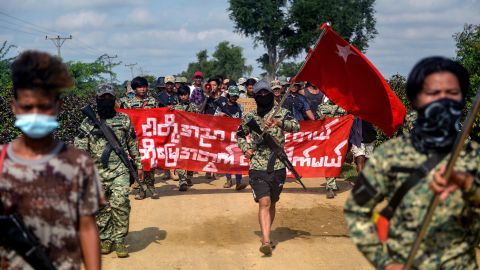
Rebel fighters escort protesters as they take part in a demonstration against the military coup in Sagaing, Myanmar on September 7, 2022.

For months after the coup, millions across Myanmar took part in protests, strikes and other forms of civil disobedience, unwilling to relinquish freedoms won only recently under democratic reforms that followed decades of brutal military rule.

They were met with a bloody crackdown that saw civilians shot in the street, abducted in nighttime raids and allegedly tortured in detention.

CNN has reached out to Myanmar’s military for comment. It has previously claimed in state media it is using the “least force” and is complying with “existing law and international norms.”

Since the coup, at least 2,900 people in Myanmar have been killed by junta troops and over 17,500 arrested, the majority of whom are still in detention, according to advocacy group Assistance Association for Political Prisoners (AAPP).
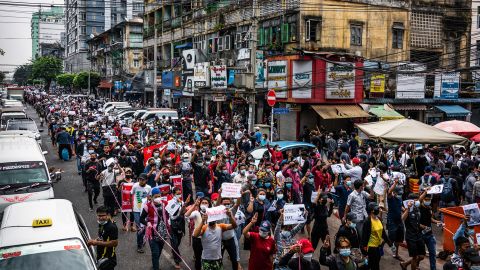
Anti-coup protesters march through a street in Yangon, Myanmar, on February 8, 2021.

Though mass protests have faded, allegations of atrocities by military troops – including the school strike in the village of Let Yet Kone – continue to emerge.

Daw Aye Mar Swe, a teacher at the school, said she ushered students into classrooms as the military helicopters approached, shortly before the horror descended.

The airstrike hit the roof, sending debris falling all around them. The room filled with dark smoke – and then the soldiers arrived.

They began “shooting at the school for an hour nonstop … with the intention to kill us all,” she told CNN.

She shoved her students under beds for cover, but it was of little use. One young girl was shot in the back. As she tried in vain to stem the bleeding, she urged her crying students: “Say a prayer, as only God can save us now.”

When the shooting was over, the soldiers ordered everybody outside, she said. The students huddled together on the school grounds while the soldiers raided the rest of the village and made arrests, said Daw Aye Mar Swe. She recalled seeing Bhone Tayza among the wounded.

The National Unity Government (NUG), Myanmar’s shadow administration of ousted lawmakers, said 20 students and teachers were arrested after the airstrikes.

It’s not clear what happened to them. CNN could not independently verify details of the incident.
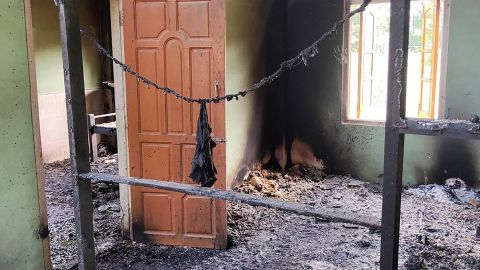
Debris on the floor of a damaged school building in Sagaing, Myanmar after it was attacked by the military, photographed on September 17, 2022.

At the time, a spokesperson for the military said government forces entered the village of Let Yet Kone to clear rebel “terrorists” and accused the Kachin Independence Army, a rebel group, and the People’s Defence Force (PDF), an umbrella organization of armed guerrillas, of using children as “human shields.”

Thida Win and Daw Aye Mar Swe denied these claims. “There is no PDF here, or shooting (done by the PDF),” the teacher said. “(The military) shoot us without any purpose or research.”

For some bereaved parents, the agony of losing their children was compounded by being denied a proper goodbye.

After the strike, two residents, who declined to be identified due to fears for their security, said the military took the bodies away and buried them in another township several miles away.

Thida Win corroborated this account, saying she had cried and begged the soldiers to “let me bury my son on my own … but they took him away.” When she contacted a military commander the next day, he said Bhone had already been cremated. To this day, she has not collected his ashes, saying she would not sign any documents issued by the junta that killed her son.

“There are no words … my heart is broken into pieces,” she said.
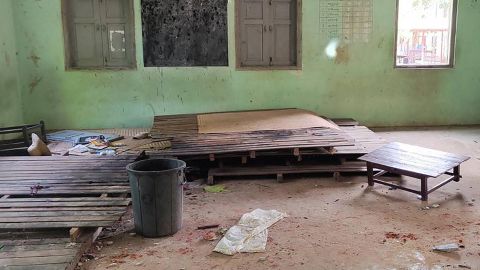
Debris and bloodstains on the floor of a Sagaing school attacked by Myanmar's military, pictured September 17, 2022.

In between these large-scale attacks, smaller battles are unfolding every day between the military and rebel groups that have sprouted up across the country, allying themselves with long-established ethnic militias.

Some of these groups effectively control parts of Myanmar out of the junta’s reach – and many are composed of young volunteers who left behind families and friends, for what they say is the future of their nation.

Shan Lay, 20, was a high school senior when the coup took place. Now, he spends his days on the front lines as a member of the MoeBye PDF Rescue Team, a small group of combat medics that treats and evacuates injured PDF fighters in eastern Myanmar.

It can be a dangerous job; Shan Lay recalled one instance when their vehicle was shot at and destroyed by military soldiers, forcing the team to jump from the car and run to safety.

Another member of the rescue team, Rosalin, a former nurse, described once hiding in what was supposed to be a secret clinic. The building had been surrounded by junta soldiers and aircraft were circling overhead, so the team waited for nightfall so they could escape in the dark. “I thought I was going to die, and I was ready to relinquish my life,” she said.

CNN is referring to Shan Lay and Rosalin by their “revolution names,” aliases many in the resistance movement adopt for their safety.

Videos of their daily operations, shared by the rescue team, reveal improvised tools and treacherous conditions. Often, they wear no helmets or protective gear, ducking gunfire in just flip flops, t-shirts, long pants and backpacks.

The clips show the group carrying injured fighters on rocky dirt paths, and providing medical care during bumpy rides on pickup trucks; sometimes they have nothing more than boiled water to sterilize wounds, Rosalin said.

When the fighting lulls, they treat injured civilians displaced from their homes and distribute food.

Members of a rebel group in Myanmar's eastern Karenni state on a boat, going from the Thai border into Myanmar.

Their jobs are made more difficult by the remote terrain, choppy telecommunications, and unpredictable dangers. When they spoke to CNN over Zoom in January, they had hiked to a higher altitude for better phone service, and were running late after responding to a PDF fighter who had lost his foot after stepping on a land mine.

Rosalin said the junta left them no choice but to fight back after crushing their peaceful protests.

“We know we may have to give up our lives. But if we don’t fight like this, then we know we won’t get democracy, which is what we want,” she said. “As long as this dictatorship is present and we do not have democracy, this revolution will continue.”

Even those not on the front lines have found other ways to resist; there are underground hospitals and schools operating out of the junta’s view, and people have boycotted goods or services related to the junta.

“It’s a remarkable, remarkable show of courage and determination by people,” said Tom Andrews, the UN Special Rapporteur on the situation of human rights in Myanmar.
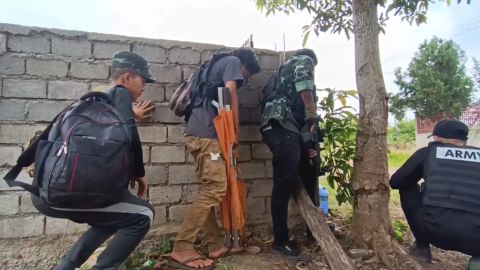
Combat medics from the Moebye PDF Rescue Team hide behind a wall as they prepare to rescue rebel fighters in Moe Bye, Myanmar, on September 9, 2022.

However, despite the rebels’ best efforts, it’s a desperately uneven fight. And after two years of conflict, their funds and resources are dwindling.

“Before, we had our own homes and pots, we had our own rice, we had some of our money,” said Rosalin. “But we had to leave behind our homes and go live in the jungle.” Finding food and accommodation is challenging, she added.

Shan Lay said some people had sold their houses and land to buy weapons and bullets – but it’s still not enough, and a difficult road lies ahead.

The fighting “is more violent” now, he said. “(The junta) are using larger weapons than before.”

Resources are slim in other rebel bases too, with footage from Myanmar’s eastern Karenni state showing uniformed youth training in the mountains, making homemade ammunition in jungle workshops and storing the rounds in refrigerators.

The pictures are a far cry from the military’s powerful arsenal of tanks and warplanes.

The junta demonstrated its devastating firepower just weeks after the school attack with one of its deadliest airstrikes on record.

Crowds had gathered in the A Nang Pa region of Myanmar’s northern Kachin state to celebrate the 62nd anniversary of the Kachin Independence Organization (KIO), the political wing of the rebel Kachin Independence Army (KIA).

Though the event was organized by the KIO, it was aimed at the public, with artists, singers, religious figures and industry leaders invited, according to a businessman who attended. He described a day of festivities, with people bathing in a stream, playing golf and eating noodles under teak trees before watching a musical performance by a famous singer.

When the airstrike happened, “It was like the end of the world,” the businessman said. Footage of the moment of impact, shared with CNN by the KIO, show people sitting around tables facing the stage when there came a dazzling light and loud crash – followed by flashes of orange light, then darkness.

“I heard people crying, speaking and moaning,” said the businessman. “I was standing in a horrific scene.” Bodies appeared to be everywhere; he saw people trapped under debris and some who had lost limbs.

Videos of the aftermath show buildings reduced to rubble and body bags lined up on the ground.

CNN is not naming the businessman for his safety.

The strike killed up to 70 people, according to the KIO. CNN cannot independently verify the number.

When CNN requested comment from the junta regarding the attack, CNN’s email – and an official response – were published in the government-owned Global New Light of Myanmar newspaper. Military spokesperson Maj. Gen. Zaw Min Tun claimed responsibility for the attack, calling it a necessary military operation targeting “a den where enemies and terrorists were hiding.” He also claimed the military had “never attacked civilians,” calling such reports “fake news.”

KIO leaders deny this. They say the venue was a day’s walk from the nearest KIA battalion, and though some KIO members were in uniform at the event, they were not carrying weapons or military equipment.

Andrews, the UN special rapporteur, also cast doubt on the junta’s claim of not striking civilians. “That statement is absurd,” he told CNN in January. “There is clear evidence we have of airstrikes on villages.”

As millions of civilians in Myanmar grapple with their grim post-coup reality, much of the world looks the other way.

“It has been two years of the devastation of the military junta and the military at war with its own people,” Andrews said. “We’ve seen 1.1 million people displaced, more than 28,000 homes destroyed, thousands of people have been killed.”

The economy is in freefall, with Myanmar’s GDP contracting 18{515baef3fee8ea94d67a98a2b336e0215adf67d225b0e21a4f5c9b13e8fbd502} in 2021. While the World Bank forecasts a slight uptick to 3{515baef3fee8ea94d67a98a2b336e0215adf67d225b0e21a4f5c9b13e8fbd502} growth in 2022, some experts say this is “wildly over-optimistic.”

About 40{515baef3fee8ea94d67a98a2b336e0215adf67d225b0e21a4f5c9b13e8fbd502} of the population were living under the poverty line last year, “unwinding nearly a decade of progress on poverty reduction,” the World Bank said last July. Prices for basic goods like food and fuel have skyrocketed.

But little support has come from the outside. The European Parliament passed a motion in 2021 supporting the NUG as “the only legitimate representatives of the democratic wishes of the people of Myanmar,” and it remains one of the few places that has done so. But no military aid has followed.
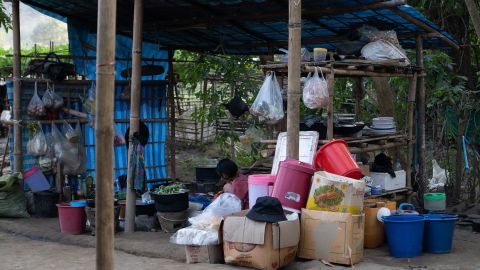
Internally displaced people living in makeshift jungle shelters in Myanmar's Karen state, near the border with Thailand, on January 16, 2023.

Though the European Union and other governments have provided funding for humanitarian aid, relief remains limited. Groups such as the Red Cross say their operations on the ground have been hindered by fighting and financial challenges. In a December report, the UN Office for the Coordination of Humanitarian Affairs (OCHA) said its response plan for Myanmar was “drastically underfunded,” amounting to $290 million out of the $826 million required.

The conflict “has been forgotten,” Andrews said, contrasting the international community’s muted response to Myanmar versus the rush to provide weapons, funding and other assistance to Ukraine in its war against Russia.

The Ukraine model could be applied to Myanmar, he added – not in terms of importing weapons, but in taking “coordinated actions such as economic sanctions that target the junta’s source of revenue, that target their weapons, that target the raw materials that they’re using to build weapons inside the country.”
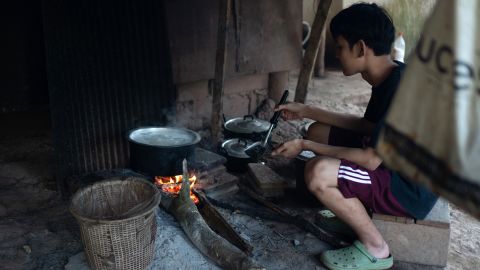
A boy cooks rice in a camp for displaced people in the jungle, in Karen state on January 16, 2023. There is no clean drinking water at the camp, and food is scarce.

Andrews pointed to signs that the junta is struggling too, which makes international aid all the more critical for turning the tide. There are reports the military controls less than half of the country and that its operations are suffering from financial difficulties, thanks in part to sanctions already in place, he said. But more is still needed.

“If (the conflict) remains in the shadows of international attention, then we are providing a death sentence to untold numbers of people,” Andrews warned.

Thida Win, the mother of Bhone Tayza, had a similar plea. She is still grieving the loss of a son she described as studious, intelligent and kind, for whom she “had so much hope.”

“I want to ask the world to support us so our children’s death will not be in vain,” she said. “Will you just look away from us? How many kids have to risk their lives?”

Former January 6 committee staffer says texts show evidence of ‘attempted coup’ – as it happened | US politics

Former January 6 committee staffer says texts show evidence of ‘attempted coup’ – as it happened | US politics

Denver Riggleman’s interview with 60 Minutes is a rare breach in the carefully stage managed presentation the January 6 committee has given Americans over the past months about what happened during the insurrection at the Capitol.

A former Republican congressman who was ousted by a more conservative opponent in 2020 and now considers himself independent, Riggleman acted as a technical adviser for the committee, poring through evidence such as text messages and emails obtained from people thought to have knowledge of the attack. His interview provided a behind-the-scenes look at the investigation, most details about which have come from lawmakers’ comments or the public hearings themselves.

Perhaps his most startling admission is his belief that text messages then-White House chief of staff Mark Meadows voluntarily turned over the committee amounted to a “roadmap to an attempted coup.” But Riggleman shared other disquieting details in the interview, such as that a White House number called one of the rioters who had stormed the Capitol as it was happening.

Then there were the text messages Meadows received containing an array of far-right conspiracy theories from Ginni Thomas, wife of rightwing supreme court justice Clarence Thomas.

“What really shook me was the fact that if Clarence agreed with or was even aware of his wife’s efforts, all three branches of government would be tied to the stop the steal movement,” Riggleman said on 60 Minutes.

Ginni Thomas’s involvement in efforts to overturn the 2020 election results has been well documented in recent months, leading to calls for the January 6 committee to compel her testimony – efforts Riggleman said he supported. Last week, a deal was reached for Thomas to speak to investigators.

Key events

Closing summary

A former staffer for the January 6 committee went public with a claim that someone at the White House called a Capitol rioter on the day of the attack, while warning that evidence obtained from Donald Trump’s chief of staff looked like an “attempted coup”. The committee’s lawmakers downplayed Denver Riggleman’s interview with CBS’s 60 Minutes program, and have been busy themselves, sending a subpoena to the Republican speaker of Wisconsin’s assembly.

Here’s what else happened today:

  • Kyrsten Sinema, a Democratic senator known for bucking the party’s priorities, offered few reasons for her mysterious politics in a speech alongside the chamber’s top Republican.

  • Joe Biden’s student loan relief plan will cost $400 billion, if not more, the independent Congressional Budget Office said, prompting criticism from budget hawks as well as defense from Democrats.

  • Doug Mastriano, a Trump-backed 2020 election denier standing as the GOP’s gubernatorial candidate in Pennsylvania, appears to be lagging on the campaign trail.

  • Trump’s former chief of staff Mark Meadows exchanged texts with another conspiracy theorist and 2020 election denier.

Democratic senators hit back at claims student debt relief too expensive

The Senate’s Democratic leader Chuck Schumer along with Wall Street foe Elizabeth Warren have issued a joint statement underlining their support of president Joe Biden’s student debt relief plan, and drawing a contrast with Republican policies that slash taxes for the rich.

The statement came after the independent Congressional Budget Office (CBO) found the plan announced last month would cost a sizable $400 billion or more. The nonpartisan Committee for a Responsible Federal Budget seized on that estimate to say the plan was too expensive, and could push inflation higher.

“Today’s CBO estimate makes clear that millions of middle class Americans have more breathing room thanks to President Biden’s historic decision to cancel student debt,” Schumer, who represents New York, and Warren, who represents Massachusetts, said in their statement.

“In contrast to President Trump and Republicans who gave giant corporations $2 trillion in tax breaks, President Biden delivered transformative middle class relief by cancelling student debt for working people who need it most — nearly 90{515baef3fee8ea94d67a98a2b336e0215adf67d225b0e21a4f5c9b13e8fbd502} of relief dollars will go to those earning less than $75,000 a year. We don’t agree with all of CBO’s assumptions that underlie this analysis, but it is clear the pandemic payment pause and student debt cancellation are policies that demonstrate how government can and should invest in working people, not the wealthy and billionaire corporations.”

Idaho’s abortion law is being challenged in federal court, but The Washington Post reports that the impact of the strict measure is already being felt by the state’s universities.

The University of Idaho has advised employees that because the law is not written clearly, it may prohibit employees from offering birth control, and thus they should refrain from doing so:

University of Idaho employees were warned Friday that they could be charged with a felony for talking about abortion, because of the state’s new abortion law.

They were also told *they could no longer provide birth control.*

Not just Plan B, but regular birth control. pic.twitter.com/qHJoDRzMc2

— Caroline Kitchener (@CAKitchener) September 26, 2022

The fiscal hawks at the independent Congressional Budget Office have released their cost estimate for the student loan relief plan president Joe Biden announced last month, and found it comes in at $400 billion, but could vary.

The plan partially satisfied Biden’s campaign pledge to provide relief for Americans struggling with loans from higher education, but was criticized both for not being generous enough, and for adding on to the country’s already mammoth federal budget deficit:

CBO estimates that the cost of outstanding student loans to the federal government will increase by about $400 billion because of an executive action canceling some debt. https://t.co/FgEHBn2XP6

— U.S. CBO (@USCBO) September 26, 2022

The Committee for a Responsible Federal Budget, which advocates for restraint in federal spending, criticized the plan as simply too expensive:

“.@USCBO’s new estimate confirms the outrageous cost of the White House plan to cancel large amounts of student debt, by executive order, to nearly all borrowers almost regardless of need.” https://t.co/KFs9DQ8KYp

— CRFB.org (@BudgetHawks) September 26, 2022

“The debt cancellation and pause alone will cost $420 billion – a bit more than we previously thought – and costs could reach $510 to $610 billion with their IDR changes. The Biden Administration’s failure to release their own cost estimate should have been a red flag.”

— CRFB.org (@BudgetHawks) September 26, 2022

“As @USCBO’s estimates help confirm, the President’s student debt plan would wipe out the ten-year savings from the #InflationReductionAct twice over, worsen inflationary pressures, and deliver benefits to millions of Americans with advanced degrees in upper-income households.”

— CRFB.org (@BudgetHawks) September 26, 2022

“This might be the most costly executive action in history. It’s unacceptable that the President would implement it without offsets and without Congressional approval. Including these actions, the President has now added nearly $4.9 trillion to ten-year federal deficits…”

— CRFB.org (@BudgetHawks) September 26, 2022

The Biden administration is generally keeping mum about Russia’s decision to grant citizenship to Edward Snowden, who leaked National Security Agency documents and fled the United States.

Here’s the little state department spokesman Ned Price had to say about it:

State Department Spokesperson Ned Price reacts to NSA whistleblower Edward Snowden being granted Russian citizenship:

“Perhaps the only thing that has changed is … apparently now he may well be conscripted to fight in the reckless war in Ukraine.” pic.twitter.com/ZemSN8CVur

— The Recount (@therecount) September 26, 2022

January 6 committee member says DoJ investigation proceeding, but slowly

A Democratic member of the January 6 committee revealed details of the department of justice’s investigation into the attack and its interaction with the congressional inquiry, describing the government’s effort as plodding, thorough and bolstered by evidence the lawmakers had uncovered.

“They have been very slow, though, on the much more comprehensive, and I believe, even more significant investigation of January 6,” California congressman Adam Schiff said of the justice department during an interview at the Texas Tribune Festival, according to CNN. However, he thought it was a mistake for the justice department to start their investigation with the individual rioters and proceed from there.

“That works when you have one plot, one conspiracy. It doesn’t work when there are multiple lines of effort to overturn an election, multiple plots, that may be all part of the same whole, but nonetheless each operating independently,” Schiff said.

The Democrat acknowledged federal investigators are matching the work of the January 6 committee, saying, “It does appear now that they have interviewed many of the same significant witnesses that we have.” He did note that the justice department had requested much of the committee’s materials, which he found “breathtaking”.

“My first reaction when we got the request – ‘Turn over all your files to us’ – was: ‘Why don’t you have your own damn files? Why haven’t you been conducting your own investigation? Why do you need us to do it?” Schiff said.

The lawmaker also found it strange that a district attorney in Georgia had been left to singlehandedly investigate Donald Trump and his allies’ involvement in trying to overturn the election there, but noted that situation might not last much longer. “That may be changing too, but it’s a long time coming,” Schiff said.

The day so far

A former staffer for the January 6 committee went public with a claim that someone at the White House called a Capitol rioter on the day of the attack, while warning that evidence obtained from Donald Trump’s chief of staff looked like an “attempted coup”. The committee’s lawmakers downplayed Denver Riggleman’s interview with CBS’s 60 Minutes program, and have been busy themselves, sending a subpoena to the Republican speaker of Wisconsin’s assembly.

Here’s what else happened today:

  • Kyrsten Sinema, a Democratic senator known for bucking the party’s priorities, offered few reasons for her mysterious politics in a speech alongside the chamber’s top Republican.

  • Doug Mastriano, a Trump-backed 2020 election denier standing as the GOP’s gubernatorial candidate in Pennsylvania, appears to be trailing on the campaign trail.

  • Trump’s former chief of staff Mark Meadows exchanged texts with another conspiracy theorist and 2020 election denier.

There are few mysteries in Congress bigger than Kyrsten Sinema.

Once a member of the Green Party, the Democratic senator from Arizona has seized on the party’s one-vote majority in the Senate to act a spoiler for progressive proposals, including changing the filibuster to get voting rights legislation passed, raising the national minimum wage to $15 per-hour and closing a tax loophole that benefited private equity firms. Unlike with Joe Manchin, the fellow Democratic senator and frequent holdout vote who already had a reputation for conservatism and support for the fossil fuel industry, Sinema’s reasons for acting this way aren’t quite clear, and somewhat inexplicable given her left-wing activism earlier in her career. The tactic doesn’t appear to have paid off, either. An AARP poll released last week showed that independents, Republicans and, most of all, Democrats in Arizona viewed Sinema unfavorably.

The senator appeared today alongside the chamber’s top Republican Mitch McConnell for a speech in Kentucky, where she extolled the virtues of bipartisanship. While it certainly does not clear up the senator’s mysterious approach to politics, her comments here may give some hints as to why she does what she does in Washington:

Sen. Kyrsten Sinema (D-AZ), speaking at the McConnell Center, describes her “friendship” with Senate Minority Leader McConnell (R-KY):

“While we may not agree on every issue, we do share the same values.” pic.twitter.com/2vz5ioNFeA

— The Recount (@therecount) September 26, 2022

“Not everyone likes me.”

— Sen. Kyrsten Sinema (D-AZ) jokes with the audience at the McConnell Center, after saying Democrats will “likely” lose some control of Congress after the midterms. pic.twitter.com/naEjHhKO5D

— The Recount (@therecount) September 26, 2022

“I signed a permission slip for a College and Career Day. What I got was indoctrination and trauma.” That sums up the experience of some of the more than 2,100 high school seniors bussed to a church in Louisiana last week on what was billed as a college fair but, as Maya Yang reports, turned into something else:

More than 2,000 public school students in Louisiana were told earlier this week that they were going to a college fair. They were then shuttled to what parents later deemed a sexist and transphobic church event which left many of the students traumatized.

On Tuesday, more than 2,100 high school seniors from the East Baton Rouge Parish School System – which serves residents of Louisiana’s capital – were taken to the local Living Faith Christian Center under the promise that they would receive college and career advice, as well as free food.

The Christian nonprofit organization 29:11 Mentoring Program organized the event, calling it “Day of Hope,” the Baton Rouge Advocate reported. The permission slips distributed to students promised “free food”, “fun and games”, “college fair” and “special guest”.

The New York Times sent a reporter to Pennsylvania to check on how the Republican candidate for governor is doing, and the verdict seems to be: not that well.

Doug Mastriano is a Donald Trump-endorsed, 2020 election denier who chartered busses to Washington on January 6 and has pledged to completely ban abortion in the state if elected. However, he’s well behind in the polls, and as the Times reports, has shunned much of what amounts to modern campaign tactics.

Here’s more from their report:

There is little indication that he has built a campaign infrastructure beyond the Facebook videos that propelled him to stardom in right-wing circles and to the vanguard of Christian nationalist politics.

“I can’t even assess things because I don’t see a campaign,” said Matt Brouillette, the president of Commonwealth Partners Chamber of Entrepreneurs, an advocacy group that is a major player in Pennsylvania Republican politics. “I’ve not seen anything that is even a semblance of a campaign.”

Mr. Brouillette, who backed one of Mr. Mastriano’s rivals in the G.O.P. primary, added: “Now, maybe he knows something we don’t on how you can win in the fifth-largest state without doing TV or mail. But I guess we’re going to have to wait until Nov. 8 to see whether you can pull something like that off.”

“The New York from which Trump emerged was its own morass of corruption and dysfunction, stretching from seats of executive power to portions of the media to the real-estate industry in which his family found its wealth,” writes Maggie Haberman in The Atlantic. “But Trump nevertheless stood out to the journalists covering him as particularly brazen.”

Haberman, a reporter for The New York Times and longtime watcher of Donald Trump, is one of the best-known chroniclers of his presidency, and the Atlantic article is a good read for those who want to better understand what drives Trump. Adapted from her soon-to-be-released book “Confidence Man: The Making of Donald Trump and the Breaking of America”, the piece touches on some of the drivers of his inexplicable behavior, such as his insistence that the election was stolen, and that he could even return to office in August 2021.

It also shows how Trump viewed the people around him, particularly his supporters, whose ardency appeared to take him by surprise. For more on that, take a look at how the piece starts:

Can you believe these are my customers?” Donald Trump once asked while surveying the crowd in the Taj Mahal casino’s poker room. “Look at those losers,” he said to his consultant Tom O’Neil, of people spending money on the floor of the Trump Plaza casino. Visiting the Iowa State Fair as a presidential candidate in 2015, he was astounded that locals fell in line to support him because of a few free rides in his branded helicopter. In the White House, he was sometimes stunned at his own backers’ fervor, telling aides, “They’re fucking crazy.” Yet they loved him and wanted to own a piece of him, and that was what mattered most.