Moldova’s professional-Western government has resigned right after a turbulent 18 months in ability marked by financial turmoil and the spillover effects of Russia’s war in neighbouring Ukraine.
In the most recent tensions with Moscow over the war, the governing administration mentioned shortly before Key Minister Natalia Gavrilita introduced her resignation that a Russian missile experienced violated Moldovan airspace, and summoned Russia’s ambassador to protest.
President Maia Sandu approved Gavrilita’s decision on Friday and nominated her defence adviser Dorin Recean to be prime minister. She gave no indicator of abandoning her pro-Western guidelines that incorporate in search of European Union accession.
“Thank you so a lot for your huge sacrifice and initiatives to lead the place in a time of so a lot of crises,” Sandu wrote on Fb.
“In spite of unprecedented issues, the nation was governed responsibly, with a ton of awareness and committed get the job done. We have balance, peace and development – the place other folks wanted war and bankruptcy.”
Sandu reported she needs to aim on revamping important parts these types of as Moldova’s economy and the justice sector.
“I know that we have to have unity and a whole lot of operate to get by the difficult period of time we are experiencing,” she mentioned. “The issues of 2022 postponed some of our designs, but they did not stop us.”
Recean, a 48-12 months-outdated economist who served as inside minister concerning 2012-2015, will have 15 days to sort a new government to existing to parliament for a vote.
He explained he prepared to carry on to pursue membership in the EU and that his government’s priorities would be get and willpower, breathing new lifestyle into the financial system, and peace and balance.
Vitality blackmail, soaring inflation
Gavrilita’s reign as key minister was marked by a extensive string of difficulties, several of which stem from Russia’s invasion of Ukraine. These contain an acute strength disaster after Moscow radically decreased provides to Moldova and skyrocketing inflation.
The former Soviet republic of 2.5 million also saw an inflow of Ukrainian refugees last year. It has suffered energy cuts next Russian air attacks on Ukrainian electrical power infrastructure, has struggled to split its dependence on Russian gasoline, and has, most not too long ago, noticed a Russian missile from the war traversing its skies.
Gavrilita mentioned that no a single anticipated that her government “would have to manage so numerous crises caused by Russian aggression in Ukraine”.
“I took above the governing administration with an anti-corruption, pro-enhancement and pro-European mandate at a time when corruption strategies had captured all the establishments and the oligarchs felt untouchable,” Gavrilita claimed. “We ended up right away faced with strength blackmail, and these who did this hoped that we would give in.”
“The wager of the enemies of our nation was that we would act like former governments, who gave up vitality passions, who betrayed the nationwide interest in trade for brief-expression rewards,” she additional.
The steep selling price increases, particularly for Russian gasoline, led to street protests final calendar year in which demonstrators named for the federal government and Sandu to resign.
The protests, organised by the celebration of exiled opposition politician Ilan Shor, marked the most severe political problem to Sandu since her landslide election gain in 2020 on a pro-European and anti-corruption system.
Chisinau has described the protests as aspect of a Kremlin-sponsored marketing campaign to destabilise the govt.
“I feel in the Moldovan people. I think in Moldova,” Gavrilita mentioned. “I feel that we will be able to make it by all the problems and difficulties.”
Gavrilita became key minister in August 2021 right after her professional-European Social gathering of Motion and Solidarity (PAS) secured a the greater part in parliament with a mandate to thoroughly clean up corruption.
EU leaders approved Moldova as a membership applicant last calendar year in a diplomatic triumph for Sandu. The government experienced been mapping out reforms to accelerate accession to the 27-nation bloc and operating on diversifying its electrical power supply.
Russia, which has troops in Moldova’s breakaway area of Transdniestria, has bristled at the possibility of previous Soviet republics signing up for the EU, and Moldova’s intelligence service verified allegations by Ukrainian President Volodymyr Zelenskyy on Thursday that Russia has acted to destabilise Moldova.
The Moldovan foreign ministry criticised Moscow strongly soon after summoning its ambassador above the Russian missile, which it mentioned had flown via Moldovan airspace before entering Ukrainian airspace on Friday.
“We resolutely reject the hottest unfriendly actions and statements versus Moldova, which is unquestionably unacceptable for our folks,” the ministry explained in a statement.
“We simply call on the Russian Federation to prevent navy aggression in opposition to a neighbouring nation, leading to numerous human casualties and substance hurt.”
Stocks declined, with the S&P 500 falling 1.1{515baef3fee8ea94d67a98a2b336e0215adf67d225b0e21a4f5c9b13e8fbd502} last week. The index is now up 6.5{515baef3fee8ea94d67a98a2b336e0215adf67d225b0e21a4f5c9b13e8fbd502} year to date, up 14.4{515baef3fee8ea94d67a98a2b336e0215adf67d225b0e21a4f5c9b13e8fbd502} from its October 12 closing low of 3,577.03, and down 14.7{515baef3fee8ea94d67a98a2b336e0215adf67d225b0e21a4f5c9b13e8fbd502} from its January 3, 2022 closing high of 4,796.56.
Over the past two weeks or so, it seems attitudes have begun to shift favorably regarding monetary policy, economic growth, and the trajectory of stock prices.
1. The Fed acknowledges inflation is coming down 🦅
In May of last year, Fed Chair Jerome Powell warned “there could be some pain involved in restoring price stability.” A month later, we learned inflation was unexpectedly heating up again. And then on June 15, the Fed announced an eye-popping 75-basis-point interest rate hike, the largest increase the central bank made in a single announcement since 1994.
Fast forward to February 1, following several months of cooling inflation data, when Powell said at the conclusion of the Fed’s monetary policy meeting: “We can now say, I think, for the first time that the disinflationary process has started. We can see that.“ (Emphasis added.)
The consumer price index has cooled significantly, signaling disinflation. (Source: BLS via FRED)
“Powell cited the word ‘disinflation’ 13 times in this press conference,” Tom Lee, head of research at Fundstrat Global Advisors, wrote that day in a note to clients. “This is a major change in language and tone and shows that the Fed is now officially recognizing the growing disinflation forces underway. In [the December press conference], ‘disinflation’ was used ZERO times by Powell.”
“In our view, Chair Powell is placing more weight on an ‘immaculate disinflation’ scenario, where inflation pressures subside without some softening in labor market conditions, including higher unemployment,” Michael Gapen, U.S. economist at BofA, wrote on Tuesday. “This stands in contrast to the Powell from Jackson Hole, Wyoming, last August, who leaned strongly into doing whatever it takes to bring inflation down and emphasized that inflation was unlikely to subside without some ‘pain’ in labor markets.”
As long as the inflation numbers continue to trend on the cooler side, the Fed seems likely to keep its less hawkish tone.
2. The economy is less likely to go into recession 💪
I can’t pinpoint exactly when the consensus among economists was that the U.S. was due for a recession. The worries certainly intensified after we learned GDP growth was negative in Q1 of last year, and they got a whole lot worse when we learned growth was negative in Q2 as well.
On Monday, Goldman Sachs economist Jan Hatzius published a note titled, “Receding Recession Risk,“ in which he lowered the odds of the U.S. entering a recession in the next 12 months to 25{515baef3fee8ea94d67a98a2b336e0215adf67d225b0e21a4f5c9b13e8fbd502} from 35{515baef3fee8ea94d67a98a2b336e0215adf67d225b0e21a4f5c9b13e8fbd502}.
“Continued strength in the labor market and early signs of improvement in the business surveys suggest that the risk of a near-term slump has diminished notably,“ Hatzius wrote.
The S&P 500 is up 6.5{515baef3fee8ea94d67a98a2b336e0215adf67d225b0e21a4f5c9b13e8fbd502} in 2023 so far, and the index has spent much of this period higher than where it started the year.
At least one top strategist has abandoned his call for an early sell-off. Here’s Goldman Sachs’ David Kostin in a Feb. 3 note to clients (emphasis added):
Recent macro developments have strengthened our economists’ confidence in a soft landing and reduced equity downside risk in the near term. Outside the US, the growth picture in China has brightened following an earlier-than-expected reopening and Europe is now on track to avoid a recession following a warmer-than-expected winter. In addition, Fed Chair Powell this week did little to push back on the easing of financial conditions. Our rates strategists’ expected path of Treasuries suggest little near-term upside to yields. We therefore believe the risk of a substantial drawdown in the near term has diminished, barring unforeseen data surprises. We raise our 3-month S&P 500 price target to 4,000 (-3{515baef3fee8ea94d67a98a2b336e0215adf67d225b0e21a4f5c9b13e8fbd502} from today) from 3,600. As shown this week, still-light institutional investor positioning points to the risk of a chase that would see the market temporarily overshoot our S&P 500 target of 4,000.
Most of the S&P 500 have announced quarterly financial results in recent weeks, and based on what they’ve revealed, it looks like the outlook for earnings may not be as grim as previously anticipated.
“[W]e see no recession ahead in the broad economy — or in earnings — but a soft landing,” Ed Yardeni, president of Yardeni Research, said on Tuesday (h/t Carl Quintanilla). “We are currently estimating that S&P 500 operating earnings will be up 4.7{515baef3fee8ea94d67a98a2b336e0215adf67d225b0e21a4f5c9b13e8fbd502} this year to $225 per share and 11.1{515baef3fee8ea94d67a98a2b336e0215adf67d225b0e21a4f5c9b13e8fbd502} next year to $250.”
S&P 500 earnings are expected to grow in 2023 and 2024. (Source: Yardeni Research via @CarlQuintanilla)
The S&P 500 is currently trading above most strategists’ year-end target for the index. Should these gains hold and perhaps improve, we could soon see some strategists revise up their targets.
Not everyone thinks resilient economic growth is unambiguously good news.
“With very strong job growth, a higher labor force participation rate, and a decline in the unemployment rate to the lowest level since 1969, it is beginning to look more like a ‘no landing’ scenario,” Apollo’s Torsten Slok wrote in a February 4 note. “Under the no landing scenario the economy does not slow down, and upside risks to inflation are coming back after the initial decline in inflation driven by supply chain improvements.”
But if there’s one thing we’ve learned in recent months, it’s that we can simultaneously have consecutive months of healthy job growth and inflation readings that come in cool. For more on this dynamic, read:The bullish ‘goldilocks’ soft landing scenario that everyone wants 😀.
As always, time will tell what actually happens. But for the time being, the optimists appear to be triumphing over the pessimists as inflation, economic growth, and stock prices have been trending favorably in recent months.
Did you know cricket is the second most watched sport in the world? And it’s emerging in the U.S. in a big way. From JohnWallStreet:
…American Cricket Enterprises (ACE), the entity operating Major League Cricket (MLC), has raised more than $100 million. ACE founders Sameer Mehta, Vijay Srinivasan, Satyan Gajwani and Vineet Jain — and the balance of company investors — are betting the league will be able to draw the sport’s top players and attract interest from fans around the globe, becoming a staple of the cricket calendar in the process. If it can, club valuations will “grow like a hockey stick,” Sanjay Govil (chairman, Infinite Computer Solutions and CEO, Zyter Inc.) said. Govil owns the team in Washington D.C. Dallas, San Francisco, Los Angeles, New York City and Seattle will also have clubs playing in the inaugural ’23 season, which is slated to take place from June 13-30.
Reviewing the macro crosscurrents 🔀
There were a few notable data points from last week to consider:
— a composite of various supply chain indicators — fell in January and is hovering at levels seen in late 2020. It’s way down from its December 2021 supply chain crisis high.
📈 Inventory levels are up. According to Census Bureau data released Tuesday, wholesale inventories climbed 0.1{515baef3fee8ea94d67a98a2b336e0215adf67d225b0e21a4f5c9b13e8fbd502} to $932.9 billion in December. The inventories/sales ratio was 1.36, up significantly from 1.24 the previous year.
👍 Consumer sentiment is improving. From the University of Michigan February Survey of Consumers: “After three consecutive months of increases, sentiment is now 6{515baef3fee8ea94d67a98a2b336e0215adf67d225b0e21a4f5c9b13e8fbd502} above a year ago but still 14{515baef3fee8ea94d67a98a2b336e0215adf67d225b0e21a4f5c9b13e8fbd502} below two years ago, prior to the current inflationary episode. Overall, high prices continue to weigh on consumers despite the recent moderation in inflation, and sentiment remains more than 22{515baef3fee8ea94d67a98a2b336e0215adf67d225b0e21a4f5c9b13e8fbd502} below its historical average since 1978.“
🛍️ Consumers are spending. From BofA: “We saw signs of strengthening in consumer spending in both retail and services in January, accelerating from December. Total Bank of America credit and debit card spending per household was up 5.1{515baef3fee8ea94d67a98a2b336e0215adf67d225b0e21a4f5c9b13e8fbd502} YoY in January, vs. 2.2{515baef3fee8ea94d67a98a2b336e0215adf67d225b0e21a4f5c9b13e8fbd502} YoY in December. On a month-over-month (MoM) seasonally adjusted (SA) basis, total card spending per household was up 1.7{515baef3fee8ea94d67a98a2b336e0215adf67d225b0e21a4f5c9b13e8fbd502}, more than reversing the 1.4{515baef3fee8ea94d67a98a2b336e0215adf67d225b0e21a4f5c9b13e8fbd502} MoM decline in December.“
🍻 They’re buying cheap beer. From FreightWaves’ Rachel Premack: “…Beer became suddenly pricey at the end of last year. Beer prices at retail, which doesn’t include bars or restaurants, popped 7{515baef3fee8ea94d67a98a2b336e0215adf67d225b0e21a4f5c9b13e8fbd502} during the last 13 weeks of 2022… That price increase is showing up in how people are buying brews, said Dave Williams, vice president of Bump Williams Consulting. People are increasingly buying, say, 12-packs over 30-packs or even single servings of beer. They’re trading down too — snagging the more economic Keystone over comparatively pricey Coors. That explains why the “below premium” segment was the only one to see an increase in demand in January compared to January 2022, according to the National Beer Wholesalers Association’s Beer Purchasers’ Index…”
💳 Consumers are taking on more debt, but levels are manageable. According to Federal Reserve data, total revolving consumer credit outstanding increased to $1.196 trillion in December. Revolving credit consists mostly of credit card loans.
While the aggregate borrowing seems high, they’re much more reasonable when you look at consumer finances more holistically. From BofA: “On the savings side, Bank of America internal data suggests median household savings and checking balances across income groups have been trending down since April 2022, with the lowest income group (<$50k) seeing the steepest drawdown. But deposits remain above 2019 levels (Exhibit 6) for all income cohorts.“
💳 No, they are not maxing out their credit cards. From BofA: “Lower income consumers appear to still have some level of comfort in terms of their financial constraints. On the one hand, the ratio of median household card spending to median deposit balances (spending-to-savings ratio) remained lower than in 2019 for households with an annual income of less than <$150k (Exhibit 7). This suggests this cohort’s spending would not need to be reduced too much for the spending-to-savings ratio to return to 2019 levels. On the other hand, the Bank of America credit card utilization rate also remained lower than in 2019 across income groups (Exhibit 8).“
💵 Consumers are getting more on their savings accounts. From Semafor’s Liz Hoffman: “The average savings account rate has quintupled since last January to 0.33{515baef3fee8ea94d67a98a2b336e0215adf67d225b0e21a4f5c9b13e8fbd502}, according to data from the U.S. Federal Deposit Insurance Corporation…“
🤔 Low union participation helps explain low wage growth. From UBS: ““Wage growth is slowing noticeably along multiple measures even with a decades low unemployment rate. Why? … One reason could be low bargaining power for workers… The share of unionized workers among private employees fell to 6{515baef3fee8ea94d67a98a2b336e0215adf67d225b0e21a4f5c9b13e8fbd502} in 2022, according to the BLS.”
💰 Wall Street is busy. From Bloomberg on Tuesday: “About seven IPOs are expected to raise a combined $900 million and begin trading by Friday [Feb. 10], making for the busiest week since October’s $990 million listing by Intel Corp.’s self-driving technology unit Mobileye Global Inc., according to data compiled by Bloomberg. [Last] week’s debuts include solar power equipment maker Nextracker Inc., which plans to raise as much as $535 million in what would be the year’s biggest deal yet. Enlight Renewable Energy Ltd., which is already public in Israel, plans to add a listing on the Nasdaq.“
And it’s not just IPOs. There were numerous reports of dealmaking activity last week involving some big names (link).
📉 👎 Big companies announce layoffs. On Monday, Bloomberg reported that Dell Technologies would be “eliminating about 6,650.“ On Tuesday, Zoom announced it would “say goodbye to around 1,300 hardworking, talented colleagues.“ On Wednesday, Disney announced it would be “reducing our workforce by approximately 7,000 jobs.“ On Thursday, News Corp announced “an expected 5{515baef3fee8ea94d67a98a2b336e0215adf67d225b0e21a4f5c9b13e8fbd502} headcount reduction, or around 1,250 positions,” and Axios reported that Yahoo would lay off “more than 1,600 people.”
Here’s UBS economist Paul Donovan offering some perspective: “Another company—Disney this time — has announced headcount reductions. We get US initial jobless claims data [Thursday], and the macroeconomic data does not match the high profile press releases of job losses. A major reason is that large companies are not that important economically — smaller businesses matter most to labor markets. Smaller businesses tend to have underemployment rather than unemployment. It is quite hard to fire 10{515baef3fee8ea94d67a98a2b336e0215adf67d225b0e21a4f5c9b13e8fbd502} of a three-person company.“
⚠️ More big layoff announcements to come? Goldman Sachs economists think it’s possible. From a research note published Monday: “…on the negative side, there could be additional layoff announcements yet to come from other large companies, as roughly 15{515baef3fee8ea94d67a98a2b336e0215adf67d225b0e21a4f5c9b13e8fbd502} of companies in the S&P 500 have seen headcount increases of 40{515baef3fee8ea94d67a98a2b336e0215adf67d225b0e21a4f5c9b13e8fbd502} or more since the start of the pandemic (Exhibit 4), and only one-fifth of them have announced layoffs so far.“
(Source: Goldman Sachs)
But: “…on the positive side, similar to the rebalancing seen so far in the broader labor market, even these companies that have announced layoffs have reduced their total demand for workers overwhelmingly by reducing job openings rather than by conducting layoffs.“ For more on job openings, read:How job openings explain everything in the economy and the markets right now 📋.
Also: “…Exhibit 7 shows that most industries (8 out of 11) have reemployment rates above pre-pandemic levels, including the information sector (the sector of most major tech companies), and that all of them have reemployment rates that are above the recent expansion average.”
(Source: Goldman Sachs)
I’ve started an informal thread on Twitter tracking anecdotes of companies hiring (Link).
💼 Unemployment claims remain low.Initial claims for unemployment benefits climbed to 196,000 during the week ending Feb. 4, up from 183,000 the week prior. While the number is up from its six-decade low of 166,000 in March, it remains near levels seen during periods of economic expansion.
🏠 On work from home #WFH. From Stanford professor Nick Bloom: “Data on 4,000 U.S. firms #WFH policies: 1) 50{515baef3fee8ea94d67a98a2b336e0215adf67d225b0e21a4f5c9b13e8fbd502} of firms are fully on-site, like food-service, accommodation and retail, 2) 40{515baef3fee8ea94d67a98a2b336e0215adf67d225b0e21a4f5c9b13e8fbd502} combine #WFH and in person days in various ways: min-days, anchor days, employee choice etc, 3) 8{515baef3fee8ea94d67a98a2b336e0215adf67d225b0e21a4f5c9b13e8fbd502} are fully remote“
Putting it all together 🤔
We’re getting a lot of evidence that we may get the bullish “Goldilocks” soft landing scenario where inflation cools to manageable levels without the economy having to sink into recession.
And the Federal Reserve has recently adopted a less hawkish tone, acknowledging on February 1 that “for the first time that the disinflationary process has started.“
Nevertheless, inflation still has to come down more before the Fed is comfortable with price levels. So we should expect the central bank to continue to tighten monetary policy, which means we should be prepared for tighter financial conditions (e.g. higher interest rates, tighter lending standards, and lower stock valuations). All of this means the market beatings may continue and the risk the economy sinks into a recession will be elevated.
FRANKFURT, Germany — Europe’s economy scraped out meager gains at the close of past 12 months as galloping inflation fed by significant energy prices and Russia’s invasion of Ukraine deterred people from expending in stores and restaurants.
Economic output crept .1{515baef3fee8ea94d67a98a2b336e0215adf67d225b0e21a4f5c9b13e8fbd502} higher in the very last three months of 2022 from the prior quarter, European Union statistics company Eurostat noted Tuesday, staying away from an outright downturn as hotter-than-typical winter season weather shelved fears of strength rationing.
For all of 2022, the overall economy grew 3.5{515baef3fee8ea94d67a98a2b336e0215adf67d225b0e21a4f5c9b13e8fbd502}, outpacing the 2.1{515baef3fee8ea94d67a98a2b336e0215adf67d225b0e21a4f5c9b13e8fbd502} growth in the U.S. and China’s 3{515baef3fee8ea94d67a98a2b336e0215adf67d225b0e21a4f5c9b13e8fbd502} expansion past yr.
The countries that share the euro forex — 19 in 2022, now 20 just after Croatia joined the eurozone in the new yr — appeared to have avoided the worst circumstance state of affairs: compelled industrial shutdowns from managing out of purely natural fuel soon after Russia halted most provides. Warmer weather and endeavours to discover new source that arrives by ship in its place of pipeline from Russia have eased that worry for now.
However, pure gasoline rates are continue to three instances higher than before Russia started out massing troops on Ukraine’s border, following soaring to a history of 18 periods that level in August. All those rates are hitting utility bills and major firms to go on costs to customers by charging more for products and food items.
“Growth was however pretty weak,” said Rory Fennessy, European economist at Oxford Economics. He extra that “the positive reading could mask fundamental weakness in domestic demand” and that “private consumption is most likely to have contracted.”
“The main reason” pushing Europe into good territory was powerful development of 3.5{515baef3fee8ea94d67a98a2b336e0215adf67d225b0e21a4f5c9b13e8fbd502} in Eire — a figure ordinarily “distorted” by the massive number of international companies positioned there for tax motives, stated Martin Moryson, main economist for Europe at asset supervisor DWS. Major economies Germany and Italy shrank, by .2{515baef3fee8ea94d67a98a2b336e0215adf67d225b0e21a4f5c9b13e8fbd502} and .1{515baef3fee8ea94d67a98a2b336e0215adf67d225b0e21a4f5c9b13e8fbd502}, respectively.
Progress also faced headwinds from lessened action in China, a key trade spouse, due to the serious COVID-19 restrictions that have due to the fact been lifted. A doable economic rebound there is a crucial concern for Europe and the world-wide economy this yr, offered China’s earlier part as a motor of world wide expansion.
When underwhelming, Europe’s progress figure at minimum raises the opportunity it will scrape by devoid of a complex economic downturn even if financial growth is detrimental in the initial a few months of this 12 months. Two straight quarters of slipping output is just one definition of economic downturn, even though the economists on the eurozone company cycle relationship committee use a broader vary of facts these kinds of as unemployment and the depth of the downturn.
The news comes as the Global Financial Fund elevated its forecast for international economic expansion this 12 months to 2.9{515baef3fee8ea94d67a98a2b336e0215adf67d225b0e21a4f5c9b13e8fbd502} from 2.7{515baef3fee8ea94d67a98a2b336e0215adf67d225b0e21a4f5c9b13e8fbd502} — not great but an improvement dependent partly on hopes for China. A much better world wide overall economy is essential for Europe given its considerable trade hyperlinks.
Fears of lagging financial development so much have not deterred the European Central Bank from its series of desire rate raises, which are sharply raising the value of borrowing for corporations and buyers in an endeavor to cool off inflation.
Customer costs jumped 9.2{515baef3fee8ea94d67a98a2b336e0215adf67d225b0e21a4f5c9b13e8fbd502} in December from a 12 months earlier, considerably over the central bank’s aim of 2{515baef3fee8ea94d67a98a2b336e0215adf67d225b0e21a4f5c9b13e8fbd502}. Price increases are the main antidote to excessive inflation but can slow the financial system by making it extra highly-priced to acquire a household or a motor vehicle on credit score or borrow to grow a organization.
The central bank’s governing council is anticipated to increase a different half-percentage issue rate hike at its assembly Thursday.
Amount increases by other central banking companies close to the world, such as the U.S. Federal Reserve and the Bank of England, also have extra pressure to the world financial system. ECB officers say that boosting prices now and capping inflation right before it receives baked into the financial state avoids the require for far more drastic action later.
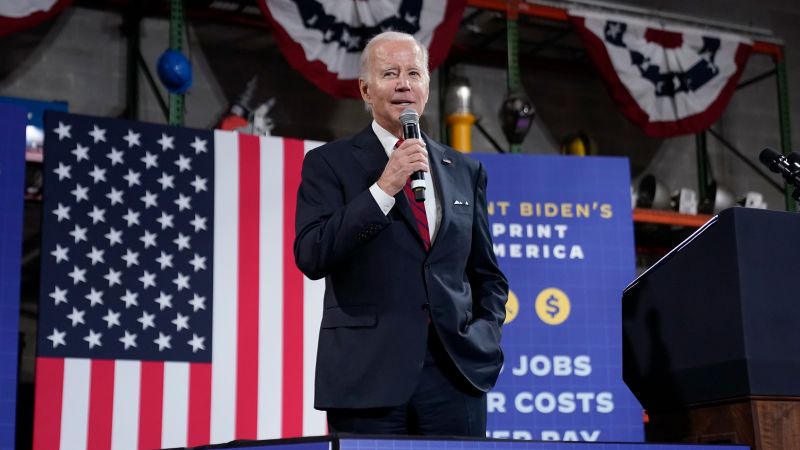
President Joe Biden delivered a Thursday speech to hail economic progress during his administration and to attack congressional Republicans for their proposals on the economy and the social safety net.
Some of Biden’s claims in the speech were false, misleading or lacking critical context, though others were correct. Here’s a breakdown of the 14 claims CNN fact-checked.
Touting the bipartisan infrastructure law he signed in 2021, Biden said, “Last year, we funded 700,000 major construction projects – 700,000 all across America. From highways to airports to bridges to tunnels to broadband.”
Facts First: Biden’s “700,000” figure is wildly inaccurate; it adds an extra two zeros to the correct figure Biden used in a speech last week and the White House has also used before: 7,000 projects. The White House acknowledged his misstatement later on Thursday by correcting the official transcript to say 7,000 rather than 700,000.
Biden said, “Well, here’s the deal: I put a – we put a cap, and it’s now in effect – now in effect, as of January 1 – of $2,000 a year on prescription drug costs for seniors.”
Facts First: Biden’s claims that this cap is now in effect and that it came into effect on January 1 are false. The $2,000 annual cap contained in the Inflation Reduction Act that Biden signed last year – on Medicare Part D enrollees’ out-of-pocket spending on covered prescription drugs – takes effect in 2025. The maximum may be higher than $2,000 in subsequent years, since it is tied to Medicare Part D’s per capita costs.
Asked for comment, a White House official noted that other Inflation Reduction Act health care provisions that will save Americans money did indeed come into effect on January 1, 2023.
– CNN’s Tami Luhby contributed to this item.
Criticizing former President Donald Trump over his handling of the Covid-19 pandemic, Biden said, “Back then, only 3.5 million people had been – even had their first vaccination, because the other guy and the other team didn’t think it mattered a whole lot.”
Facts First: Biden is free to criticize Trump’s vaccine rollout, but his “only 3.5 million” figure is misleading at best. As of the day Trump left office in January 2021, about 19 million people had received a first shot of a Covid-19 vaccine, according to figures published by the Centers for Disease Control and Prevention. The “3.5 million” figure Biden cited is, in reality, the number of people at the time who had received two shots to complete their primary vaccination series.
Someone could perhaps try to argue that completing a primary series is what Biden meant by “had their first vaccination” – but he used a different term, “fully vaccinated,” to refer to the roughly 230 million people in that very same group today. His contrasting language made it sound like there are 230 million people with at least two shots today versus 3.5 million people with just one shot when he took office. That isn’t true.
Biden said Republicans want to cut taxes for billionaires, “who pay virtually only 3{515baef3fee8ea94d67a98a2b336e0215adf67d225b0e21a4f5c9b13e8fbd502} of their income now – 3{515baef3fee8ea94d67a98a2b336e0215adf67d225b0e21a4f5c9b13e8fbd502}, they pay.”
Facts First: Biden’s “3{515baef3fee8ea94d67a98a2b336e0215adf67d225b0e21a4f5c9b13e8fbd502}” claim is incorrect. For the second time in less than a week, Biden inaccurately described a 2021 finding from economists in his administration that the wealthiest 400 billionaire families paid an average of 8.2{515baef3fee8ea94d67a98a2b336e0215adf67d225b0e21a4f5c9b13e8fbd502} of their income in federal individual income taxes between 2010 and 2018; after CNN inquired about Biden’s “3{515baef3fee8ea94d67a98a2b336e0215adf67d225b0e21a4f5c9b13e8fbd502}” claim on Thursday, the White House published a corrected official transcript that uses “8{515baef3fee8ea94d67a98a2b336e0215adf67d225b0e21a4f5c9b13e8fbd502}” instead. Also, it’s important to note that even that 8{515baef3fee8ea94d67a98a2b336e0215adf67d225b0e21a4f5c9b13e8fbd502} number is contested, since it is an alternative calculation that includes unrealized capital gains that are not treated as taxable income under federal law.
“Biden’s numbers are way too low,” said Howard Gleckman, senior fellow at the Urban-Brookings Tax Policy Center at the Urban Institute think tank, though Gleckman also said we don’t know precisely what tax rates billionaires do pay. Gleckman wrote in an email: “In 2019, Berkeley economists Emmanuel Saez and Gabe Zucman estimated the top 400 households paid an average effective tax rate of about 23 percent in 2018. They got a lot of attention at the time because that rate was lower than the average rate of 24 percent for the bottom half of the income distribution. But it still was way more than 2 or 3, or even 8 percent.”
Biden has cited the 8{515baef3fee8ea94d67a98a2b336e0215adf67d225b0e21a4f5c9b13e8fbd502} statistic in various other speeches, but unlike the administration economists who came up with it, he tends not to explain that it doesn’t describe tax rates in a conventional way. And regardless, he said “3{515baef3fee8ea94d67a98a2b336e0215adf67d225b0e21a4f5c9b13e8fbd502}” in this speech and “2{515baef3fee8ea94d67a98a2b336e0215adf67d225b0e21a4f5c9b13e8fbd502}” in a speech last week.
Biden cited a 2021 report from the Institute on Taxation and Economic Policy think tank that found that 55 of the country’s largest corporations had made $40 billion in profit in their previous fiscal year but not paid any federal corporate income taxes. Before touting the 15{515baef3fee8ea94d67a98a2b336e0215adf67d225b0e21a4f5c9b13e8fbd502} alternative corporate minimum tax he signed into law in last year’s Inflation Reduction Act, Biden said, “The days are over when corporations are paying zero in federal taxes.”
Facts First: Biden exaggerated. The new minimum tax will reduce the number of companies that don’t pay any federal taxes, but it’s not true that the days of companies paying zero are “over.” That’s because the minimum tax, on the “book income” companies report to investors, only applies to companies with at least $1 billion in average annual income. According to the Institute on Taxation and Economic Policy, only 14 of the companies on its 2021 list of 55 non-payers reported having US pre-tax income of at least $1 billion.
In other words, there will clearly still be some large and profitable corporations paying no federal income tax even after the minimum tax takes effect this year. The exact number is not yet known.
Matthew Gardner, a senior fellow at the Institute on Taxation and Economic Policy, told CNN in the fall that the new tax is “an important step forward from the status quo” and that it will raise substantial revenue, but he also said: “I wouldn’t want to assert that the minimum tax will end the phenomenon of zero-tax profitable corporations. A more accurate phrasing would be to say that the minimum tax will *help* ensure that *the most profitable* corporations pay at least some federal income tax.”
There are lots of nuances to the tax; you can read more specifics here. Asked for comment on Thursday, a White House official told CNN: “The Inflation Reduction Act ensures the wealthiest corporations pay a 15{515baef3fee8ea94d67a98a2b336e0215adf67d225b0e21a4f5c9b13e8fbd502} minimum tax, precisely the corporations the President focused on during the campaign and in office. The President’s full Made in America tax plan would ensure all corporations pay a 15{515baef3fee8ea94d67a98a2b336e0215adf67d225b0e21a4f5c9b13e8fbd502} minimum tax, and the President has called on Congress to pass that plan.”
Noting the big increase in the federal debt under Trump, Biden said that his administration has taken a “different path” and boasted: “As a result, the last two years – my administration – we cut the deficit by $1.7 trillion, the largest reduction in debt in American history.”
Facts First: Biden’s boast leaves out important context. It is true that the federal deficit fell by a total of $1.7 trillion under Biden in the 2021 and 2022 fiscal years, including a record $1.4 trillion drop in 2022 – but it is highly questionable how much credit Biden deserves for this reduction. Biden did not mention that the primary reason the deficit fell so substantially was that it had skyrocketed to a record high under Trump in 2020 because of bipartisan emergency pandemic relief spending, then fell as expected as the spending expired as planned. Independent analysts say Biden’s own actions, including his laws and executive orders, have had the overall effect of adding to current and projected future deficits, not reducing those deficits.
Dan White, senior director of economic research at Moody’s Analytics – an economics firm whose assessments Biden has repeatedly cited during his presidency – told CNN’s Matt Egan in October: “On net, the policies of the administration have increased the deficit, not reduced it.” The Committee for a Responsible Federal Budget, an advocacy group, wrote in September that Biden’s actions will add more than $4.8 trillion to deficits from 2021 through 2031, or $2.5 trillion if you don’t count the American Rescue Plan pandemic relief bill of 2021.
National Economic Council director Brian Deese wrote on the White House website last week that the American Rescue Plan pandemic relief bill “facilitated a strong economic recovery and enabled the responsible wind-down of emergency spending programs,” thereby reducing the deficit; David Kelly, chief global strategist at J.P. Morgan Funds, told Egan in October that the Biden administration does deserve credit for the recovery that has pushed the deficit downward. And Deese correctly noted that Biden’s signature legislation, last year’s Inflation Reduction Act, is expected to bring down deficits by more than $200 billion over the next decade.
Still, the deficit-reducing impact of that one bill is expected to be swamped by the deficit-increasing impact of various additional bills and policies Biden has approved.
Biden said, “Wages are up, and they’re growing faster than inflation. Over the past six months, inflation has gone down every month and, God willing, will continue to do that.”
Facts First: Biden’s claim that wages are up and growing faster than inflation is true if you start the calculation seven months ago; “real” wages, which take inflation into account, started rising in mid-2022 as inflation slowed. (Biden is right that inflation has declined, on an annual basis, every month for the last six months.) However, real wages are lower today than they were both a full year ago and at the beginning of Biden’s presidency in January 2021. That’s because inflation was so high in 2021 and the beginning of 2022.
There are various ways to measure real wages. Real average hourly earnings declined 1.7{515baef3fee8ea94d67a98a2b336e0215adf67d225b0e21a4f5c9b13e8fbd502} between December 2021 and December 2022, while real average weekly earnings (which factors in the number of hours people worked) declined 3.1{515baef3fee8ea94d67a98a2b336e0215adf67d225b0e21a4f5c9b13e8fbd502} over that period.
Biden said he was disappointed that the first bill passed by the new Republican majority in the House of Representatives “added $114 billion to the deficit.”
Facts First: Biden is correct about how the bill would affect the deficit if it became law. He accurately cited an estimate from the government’s nonpartisan Congressional Budget Office.
The bill would eliminate more than $71 billion of the $80 billion in additional funding for the Internal Revenue Service (IRS) that Biden signed into law in the Inflation Reduction Act. The Congressional Budget Office found that taking away this funding – some of which the Biden administration said will go toward increased audits of high-income individuals and large corporations – would result in a loss of nearly $186 billion in government revenue between 2023 and 2032, for a net increase to the deficit of about $114 billion.
The Republican bill has no chance of becoming law under Biden, who has vowed to veto it in the highly unlikely event it got through the Democratic-controlled Senate.
Biden said that “MAGA Republicans” in the House “want to impose a 30 percent national sales tax on everything from food, clothing, school supplies, housing, cars – a whole deal.” He said they want to do that because “they want to eliminate the income tax system.”
Facts First: This is a fair description of the Republicans’ “FairTax” bill. The bill would eliminate federal income taxes, plus the payroll tax, capital gains tax and estate tax, and replace it with a national sales tax. The bill describes a rate of 23{515baef3fee8ea94d67a98a2b336e0215adf67d225b0e21a4f5c9b13e8fbd502} on the “gross payments” on a product or service, but when the tax rate is described in the way consumers are used to sales taxes being described, it’s actually right around 30{515baef3fee8ea94d67a98a2b336e0215adf67d225b0e21a4f5c9b13e8fbd502}, as a pro-FairTax website acknowledges.
It is not clear how much support the bill currently has among the House Republican caucus. Notably, House Speaker Kevin McCarthy told CNN’s Manu Raju this week that he opposes the bill – though, while seeking right-wing votes for his bid for speaker in early January, he promised its supporters that it would be considered in committee. Biden wryly said in his speech, “The Republican speaker says he’s not so sure he’s for it.”
Facts First: This is true. The unemployment rate was just below 3.5{515baef3fee8ea94d67a98a2b336e0215adf67d225b0e21a4f5c9b13e8fbd502} in December, the lowest figure since 1969.
The headline monthly rate, which is rounded to a single decimal place, was reported as 3.5{515baef3fee8ea94d67a98a2b336e0215adf67d225b0e21a4f5c9b13e8fbd502} in December and also reported as 3.5{515baef3fee8ea94d67a98a2b336e0215adf67d225b0e21a4f5c9b13e8fbd502} in three months of President Donald Trump’s tenure, in late 2019 and in early 2020. But if you look at more precise figures, December was indeed the lowest since 1969 – 3.47{515baef3fee8ea94d67a98a2b336e0215adf67d225b0e21a4f5c9b13e8fbd502} – just below the figures for February 2020, January 2020 and September 2019.
Biden said that the unemployment rates for Black and Hispanic Americans are “near record lows” and that the unemployment rate for people with disabilities is “the lowest ever recorded” and the “lowest ever in history.”
The Black or African American unemployment rate was 5.7{515baef3fee8ea94d67a98a2b336e0215adf67d225b0e21a4f5c9b13e8fbd502} in December, not far from the record low of 5.3{515baef3fee8ea94d67a98a2b336e0215adf67d225b0e21a4f5c9b13e8fbd502} that was set in August 2019. (This data series goes back to 1972.) The rate was 9.2{515baef3fee8ea94d67a98a2b336e0215adf67d225b0e21a4f5c9b13e8fbd502} in January 2021, the month Biden became president. The Hispanic or Latino unemployment rate was 4.1{515baef3fee8ea94d67a98a2b336e0215adf67d225b0e21a4f5c9b13e8fbd502} in December, just above the record low of 4.0{515baef3fee8ea94d67a98a2b336e0215adf67d225b0e21a4f5c9b13e8fbd502} that was set in September 2019. (This data series goes back to 1973.) The rate was 8.5{515baef3fee8ea94d67a98a2b336e0215adf67d225b0e21a4f5c9b13e8fbd502} in January 2021.
The unemployment rate for people with disabilities was 5.0{515baef3fee8ea94d67a98a2b336e0215adf67d225b0e21a4f5c9b13e8fbd502} in December, the lowest since the beginning of the data series in 2008. The rate was 12.0{515baef3fee8ea94d67a98a2b336e0215adf67d225b0e21a4f5c9b13e8fbd502} in January 2021.
Biden said that fewer families are facing foreclosure than before the pandemic.
Facts First: Biden is correct. According to a report published by the Federal Reserve Bank of New York, about 28,500 people had new foreclosure notations on their credit reports in the third quarter of 2022, the most recent quarter for which data is available; that was down from about 71,420 people with new foreclosure notations in the fourth quarter of 2019 and 74,860 people in the first quarter of 2020.
Foreclosures plummeted in the second quarter of 2020 because of government moratoriums put in place because of the Covid-19 pandemic. Foreclosures spiked in 2022, relative to 2020-2021 levels, after the expiry of these moratoriums, but they remained very low by historical standards.
Biden said, “More American families have health insurance today than any time in American history.”
Facts First: Biden’s claim is accurate. An analysis provided to CNN by the Kaiser Family Foundation, which studies US health care, found that about 295 million US residents had health insurance in 2021, the highest on record – and Jennifer Tolbert, the foundation’s director for state health reform, told CNN this week that “I expect the number of people with insurance continued to increase in 2022.”
Tolbert noted that the number of insured residents generally rises over time because of population growth, but she added that “it is not a given” that there will be an increase in the number of insured residents every year – the number declined slightly under Trump from 2018 to 2019, for example – and that “policy changes as well as economic factors also affect these numbers.”
As CNN’s Tami Luhby has reported, sign-ups on the federal insurance exchange created by the Affordable Care Act, also known as Obamacare, have spiked nearly 50{515baef3fee8ea94d67a98a2b336e0215adf67d225b0e21a4f5c9b13e8fbd502} under Biden. Biden’s 2021 American Rescue Plan pandemic relief law and then the 2022 Inflation Reduction Act temporarily boosted federal premium subsidies for exchange enrollees, and the Biden administration has also taken various other steps to get people to sign up on the exchanges. In addition, enrollment in Medicaid health insurance has increased significantly during the Covid-19 pandemic, in part because of a bipartisan 2020 law that temporarily prevented people from being disenrolled from the program.
The percentage of residents without health insurance fell to an all-time low of 8.0{515baef3fee8ea94d67a98a2b336e0215adf67d225b0e21a4f5c9b13e8fbd502} in the first quarter of 2022, according to an analysis published last summer by the federal government’s Department of Health and Human Services. That meant there were 26.4 million people without health insurance, down from 48.3 million in 2010, the year Obamacare was signed into law.
Biden said, “And over the last two years, more than 10 million people have applied to start a small business. That’s more than any two years in all of recorded American history.”
Facts First: This is true. There were about 5.4 million business applications in 2021, the highest since 2005 (the first year for which the federal government released this data for a full year), and about 5.1 million business applications in 2022. Not every application turns into a real business, but the number of “high-propensity” business applications – those deemed to have a high likelihood of turning into a business with a payroll – also hit a record in 2021 and saw its second-highest total in 2022.
Trump’s last full year in office, 2020, also set a then-record for total and high-propensity applications. There are various reasons for the pandemic-era boom in entrepreneurship, which began after millions of Americans lost their jobs in early 2020. Among them: some newly unemployed workers seized the moment to start their own enterprises; Americans had extra money from stimulus bills signed by Trump and Biden; interest rates were particularly low until a series of rate hikes that began in the spring of 2022.
The spotlight is on numerous of the business world’s leaders this week as they congregate in the Swiss mountaintop city of Davos to attend the annual Globe Financial Discussion board. And they are not in a excellent way. Their souring outlook on their own companies’ long run prospective buyers paints a dire photo for the relaxation of the planet overall economy. But there’s just a single factor: A whole lot of economic information these days is very, pretty good.
The theme of this year’s occasion is a foreboding phrase from academia: polycrisis. Manufactured famous by probably the internet’s biggest wonk, Columbia professor Adam Tooze, and amplified by Nouriel “Dr. Doom” Roubini, it refers to when the world does not have just a single crisis but lots of impacting upon just one another, with extraordinary economic effects. The WEF cautioned in a report previous 7 days that an period of polycrisis could start off inside of the subsequent decade. The report essentially located that the latest time period, characterised by local weather adjust, the war in Ukraine, and persistent inflation, are just the very first seedlings of even better crises to come. The CEOs collected in Davos appear to be unaware, nevertheless, that the earth is showing signs of dodging a economic downturn, permit by yourself a polycrisis.
In the U.S., rising fears of a looming economic downturn have already prompted waves of layoffs influencing tech and banking employees, when a lot more and extra organizations are trying to get approaches to downsize or slash back on paying. Nonetheless several economists and small business leaders say the U.S. is very likely to prevent a comprehensive-blown economic downturn, including Moody’s main economist Mark Zandi, though they concede that an extended interval of gradual to no economic development could perfectly be in the playing cards.
So considerably, the details suggests that a prolonged economic downturn is not likely. In the U.S., even though some sectors have begun resorting to layoffs, a solid labor market combined with quickly declining inflation counsel quite a few Us residents are continue to very well off, dashing the prospects of a extreme and extended recession. Even in Europe, wherever the financial exposure to the Ukraine war is substantially increased, a severe economic downturn may well have been at least delayed as the continent seems to be staying away from a massive energy disaster this wintertime. Goldman Sachs recently revised its financial forecasts for Europe in a good way, pointing to slipping vitality rates and China’s quicker-than-predicted reopening.
Even at gloomy Davos, lots of CEOs pointed to China’s extended-awaited lifting of COVID-zero guidelines in December and reopening to the globe previously this month as a prospective tailwind for the global economy as soon as the country’s predicted wave of infections passes.
Mathias Cormann, secretary-standard of the OECD, explained his group “very much welcome[s]” China’s lifting of COVID-zero policies in an interview with CNBC from Davos on Monday, incorporating that the reopening could be “overwhelmingly positive” for the rest of the planet as central financial institutions endeavor to convey down inflation.
“Over the brief expression, it will come with worries, and we’re looking at heightened amounts of infection which are very likely to have some shorter-time period impacts,” he stated. “But in excess of the medium to for a longer period phrase, this is a pretty a great deal a favourable in terms of producing certain that the offer chains perform much more efficiently and more effectively, building sure that desire in China and in truth trade much more usually resumes in a much more beneficial pattern.”
But by and significant, the CEOs attending Davos are picking to see the glass as 50 percent vacant. As Fortune’s Alan Murray wrote in CEO Everyday on Tuesday, a whopping 40{515baef3fee8ea94d67a98a2b336e0215adf67d225b0e21a4f5c9b13e8fbd502} of CEOs surveyed by PwC are pessimistic about their own companies’ chances of survival a 10 years from now.
The C-suite just is not purchasing the (excellent financial) hoopla.
Juggling pitfalls
At Davos, conversations with leaders have so much been comprehensive of unfavorable sights for the coming calendar year, as the barriers to financial advancement appear not likely to generate shortly.
“The temper is somber,” Nick Studer, CEO of the Oliver Wyman Team consultancy, told the Wall Avenue Journalat the meeting. “At the exact same time, you have received a whole lot of persons hoping that the U.S. and the U.K. environment—if it is recessionary—is possibly small or shallow.”
While organizers and activists at Davos are urging small business leaders to start off weighing long-time period threats extra greatly, many still have to take care of short-phrase developments in global economic advancement, and most of them expect a reversal this 12 months. Around 70{515baef3fee8ea94d67a98a2b336e0215adf67d225b0e21a4f5c9b13e8fbd502} of CEOs surveyed by PwC predicted an financial decrease in the yr forward.
“I am pessimistic about the near upcoming and quite optimistic about what we can do to enable that,” Alex Karp, CEO of details analytics agency Palantir Systems, explained to CNBC at Davos on Tuesday.
“We are just finding out, as environment businesses, that we are living in a environment that is extremely different than we imagined,” he mentioned, incorporating that some elements dragging down the world overall economy, like the Ukraine war, are not likely to dissipate anytime soon.
A further variable that has impaired world-wide expansion is inflation, which has been managing at its optimum charge in a long time in a lot of nations around the world above the past 12 months and hurting the funds of many center-course households in the U.S. Inflation in the U.S. has recently appear down steeply and many economists have even recommended U.S. inflation is previous its peak, but some CEOs at Davos remain cagey on the prospects of inflationary pressures easing at any time soon for people.
“We may well be, at the instant, all around peak inflation, but possibly not peak selling prices,” Alan Jope, CEO of buyer products behemoth Unilever, advised CNBC at Davos. “There’s more pricing to appear by, but the level of cost raises is possibly peaking all-around now.”
Numerous CEOs cited the unpredictability of the current second, as today’s enterprise leaders grapple with how to handle a escalating selection of intersecting world crises.
“Nobody operating a company at the second has genuinely lived via global inflation it’s a prolonged time considering that we have experienced worldwide inflation,” Jope claimed. Palantir’s Karp also claimed the key issue hurting the economy now is that business is in an “unknown zone where by items are occurring we did not program, like wars, trying to offer with the wars, and inflation.”
Even though most CEOs are pessimistic, some argued age and encounter in business enterprise is an vital element, one thing quite a few younger leaders currently do not have.
“If you communicate to men and women on Wall Road who are 35 a long time and youthful, they believe it is the conclude of the world,” Steven Bergman, CEO of dental products and solutions supplier Henry Schein, advised the Journal at Davos. “You discuss to individuals 50 and above, we’ve been by way of this a lot of moments.”
Master how to navigate and reinforce have confidence in in your enterprise with The Trust Element, a weekly e-newsletter examining what leaders have to have to realize success. Indication up below.
It was an in-house award from The Drum presented at the Christmas party: Patron Saint of Doomsday – for always reminding us that a financial crisis is nigh.
All jokes aside, we do live in a troubled world.
Last year saw an escalation of the climate change crisis, a war in Ukraine, soaring inflation, further phases of a global pandemic, the Bank of England rescue Britain from a major financial crisis, and the death of Queen Elizabeth II – to name but a few moments.
A turbulent year saw a number of major events occur, such as Queen Elizabeth II’s death. (Reuters: Tom Nicholson )
Aside from the pandemic, the inflation (or “cost of living”) crisis also troubled just about every single Australian.
They exposed our weaknesses, too.
We’re miles behind on the transition to renewable energy power generation, the federal government’s books will take over a decade to be brought back under control, too many Australians can’t afford a home or put food on the table, and women, particularly in the care sectors, are given a raw deal in terms of pay and working conditions.
But let’s take a breath here – a deep breath.
We also need to remember that Australia, as a country, does really well – relatively speaking.
We can still be proud of where we are as a nation. Here’s why.
Australia has a strong economy
Australia is one of the world’s best-performing developed economies.
As at the time of writing, the nation’s economy was growing at 5.9 per cent, supporting an unemployment rate of 3.4 per cent and enjoying a relatively stable currency.
Space to play or pause, M to mute, left and right arrows to seek, up and down arrows for volume.
Australia’s unemployment rate holds steady at 3.4 per cent
As of 2021, Australia had the second-highest amount of wealth per adult after Luxembourg, and the 13th-highest financial assets per capita.
At the onset of the pandemic, the government was able to use funds it had collected from taxpayers over the years to support households and businesses, and it did just that.
Fast forward to 2022 and households have amassed roughly $260 billion in savings.
Record low interest rates and booming property and share markets left middle- and upper-income families with unusually high levels of personal wealth.
Australians, by and large, are healthy and wealthy, especially when compared internationally
Australia is ranked eighth in its Human Development Index, which is a measure of a nation’s longevity, education, and income.
Australia plays a key role on the global stage
Prime Minister Anthony Albanese has been keen to make his mark on the international political scene and, in turn, promote Australia’s interests.
He travelled to the US, Tokyo, Indonesia, Spain, France, Ukraine, Fiji, and Britain – to name a handful of destinations.
He reinforced Australia’s “friendships” with key trading and strategic allies.
Anthony Albanese has met with a number of world leaders including Prime Minister of Japan Fumio Kishida.(Richard Wainwright: AAP)
Crucially, he had the attentive ears of all major global leaders. Other prime ministers who have gone before him enjoyed similar welcomes.
Why? Australia is a geographically large and strategically positioned nation in the Asia-Pacific.
Our natural wealth, developed economy, and stable political system makes us a credible and trustworthy economic and political partner on the world stage.
We can be proud of that.
But the gap is widening
Of course, there are key areas which need addressing.
For decades, governments have tried – and largely failed – to improve outcomes for Indigenous people.
In 2023 Australia will hold a referendum on a constitutionally-enshrined Indigenous Voice to Parliament.
Space to play or pause, M to mute, left and right arrows to seek, up and down arrows for volume.
Minister for Indigenous Affairs applauded in Parliament
There will be resistance.
The federal National Party says it will oppose a constitutionally-enshrined Indigenous Voice to Parliament because it will not “genuinely close the gap”.
The gap between economic and health outcomes for Indigenous and non-Indigenous Australians needs to be closed, but in fact it’s widening.
The data shows the gap is worsening across adult imprisonment rates, deaths by suicide, out of home care rates, and children being developmentally ready once they reach school age.
More broadly, according to the Australian Council of Social Service, the poverty rate of Australia exceeds 13 per cent of the population.
It means over 3 million Australians suffer through poverty every single day.
Space to play or pause, M to mute, left and right arrows to seek, up and down arrows for volume.
Rates, Russia and recession fears: 2022 in business news(Rachel Pupazzoni)
It also estimates that roughly 17 per cent of children under the age of 15 live in relative poverty.
Australians can dare to aspire
I’m as guilty as the next journalist for focusing on the “negatives”.
But there’s method behind the madness: the truth can often be inconvenient or uncomfortable to hear or read.
But there’s always hope, and on the road to hope you’ll find aspiration.
Former prime minister Paul Keating touched on this point in October, in the wake of Queen Elizabeth II’s death, during an online event hosted by La Trobe University.
“Who in their right mind could believe that the monarch of Great Britain could represent our aspirations here?
“We occupy one of the oldest land masses, the oldest continents on Earth, perhaps the oldest societies on Earth – it’s so pathetic. [Becoming a republic] barely [needs] an argument.”
There won’t be a referendum on an Australian republic during this term of parliament, and who knows if there will be one for the next? It’s unpredictable.
But Australia, for all its faults – and we have our fair share – can stand proud and strong.
We work hard, support each other and contribute meaningfully to the global political conversation.
It’s been said we punch above our weight, but why not say we stand tall with our global partners?
Because we do.
This country is capable of great things. How many of us truly believe that?