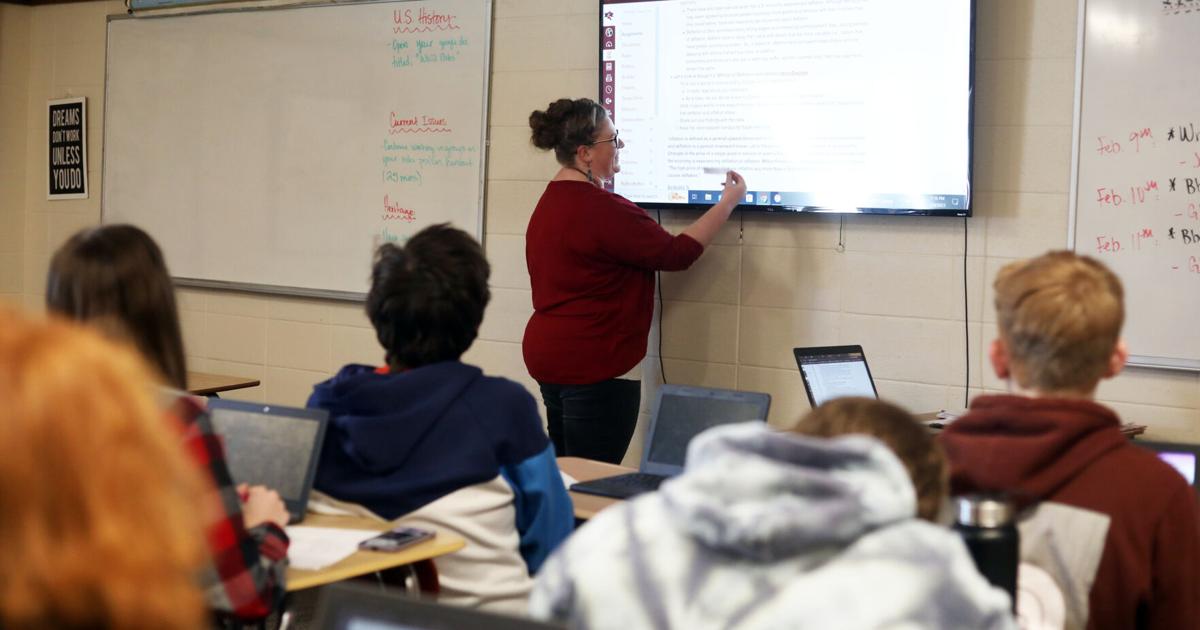
Wyoming school leaders agree to ‘monumental’ remake of K-12 education

Wyoming school leaders agree to ‘monumental’ remake of K-12 education

Wyoming’s top education leaders have agreed to collaborate on pilot projects that could kickstart the remaking of the state’s K-12 education system.

In a first, a formal partnership will unite the Wyoming State Board of Education, Wyoming Department of Education, University of Wyoming and Gov. Mark Gordon’s office and their educational initiatives to put all of the state’s power behind transitioning education in Wyoming toward a system that’s center on individual student progress rather than seat time.

“Our listening carefully to educators across Wyoming reveals a hunger for student-centered innovation and competency-based approaches to teaching and learning,” Scott Thomas, the dean of UW’s College of Education, said in a statement. “This deliberate collaboration represents a signal moment for innovating education and advancing children’s learning throughout the state.”

People are also reading…


Riverton High School

Desks at Riverton High School are pictured on Feb. 9. 


The State Board of Education, which includes Thomas and State Superintendent of Public Instruction Megan Degenfelder, voted Thursday at a meeting in Riverton to formalize their cooperation and start on pilot projects that will move some schools toward competency-based learning, allowing them to focus more on the individual learning of students.

The pilots will be voluntary for schools, but those that join will change how they instruct and assess students.

Two paths forward

Diana Clapp, the coordinator for the Wyoming State Board of Education, presented members of the State Board of Education with two options.

In the first, the group will collaborate with schools and communities to expand on the work that they are already doing around competency-based learning. Schools would “mainstream” the programs they already have in place, such as career readiness and technical training programs, so that they reach more students.


Gordon initiative calls for remaking of Wyoming's education system

The group would guide the schools through the transition, helping them with planning and giving them the support that they need to scale competency-based education. The Wyoming School-University Partnership, an alliance between school districts, community colleges, UW and state education organizations, would serve as a hub, acting as a facilitator so that schools could share their work and learn from one another.

The second option would involve starting from scratch. It would include the complete reorientation of pilot schools and pave the way for “systemic change” in Wyoming education.

The state would place pilot schools into small groups, which would then work together with the Department of Education, State Board of Education and the others to transform how they teach students. The schools and their communities would focus on the “application and transference of learning, personalized learning experiences, and alternative demonstrations of competency,” moving students away from seat time and traditional testing and assignments, according to a State Board of Education memo.

Outside experts would help the schools, which would open up their graduation requirements so that students could earn credits for educational opportunities outside of school. For example, instead of requiring a student to take a biology or environmental science course with exams, they may earn credit by working with the Wyoming Game and Fish Department on research. 

In both pilots, schools would reconsider course and graduation requirements, give more weight to opportunities such as internships, capstones and work-based learning opportunities, and would allow students more flexibility to work at their own pace and follow their interests. The schools would also emphasize learning through projects.

“The willingness of the Governor, State Board and University to partner with us on this call for innovation is the key to our state achieving student centered education that best prepares students for the workforce,” Degenfelder said in a statement.


Megan Degenfelder

Martin Carman, 12, shows now Wyoming Superintendent of Public Instruction Megan Degenfelder how to fly a drone on Aug. 11 at Code Ninjas in Casper. Degenfelder is a former Department of Education administrator and worked for an energy company before taking office.


The state’s education leaders have yet to decide on a particular direction and have yet to select schools, but they will begin to outline plans for the pilots in the coming weeks, said Linda Finnerty, a spokesperson for the Department of Education.

Degenfelder said during the board’s meeting that the goal is to begin the pilots next fall.


Degenfelder prioritizes teacher retention, school choice in first 90 days

An audible excitement swept those at the State Board of Education as they discussed the pilot projects and the shift toward competency-based learning.

“You’re talking about changing the bedrock essentially of education,” Lachelle Brant, Gordon’s education policy adviser, told the State Board of Education.

The board’s members acknowledged that the pilot schools could be the start of a monumental shift for Wyoming’s K-12 education.

“Sometimes a person gets on a board and you don’t really know what you’re supposed to be doing or what you’re accomplishing,” said Ellen Creagar, a member of the board and a social science and business professor at Eastern Wyoming College. “This isn’t that board folks. This is a board that’s really moving, shaking and making big, important, positive change for students and changing the face of education in Wyoming. It’s exciting.”

Bringing together initiatives

Competency-based education essentially means moving from a system in which students mold to education to one in which education molds to individual students.

It’s going from school desks lined up in rows, students listening to a PowerPoint lecture, to tests that ask a student to successfully perform a science experiment. It’s students taking the knowledge and skills that they build and applying them to the world outside of the classroom.

Competency-based education is premised on the “mastery” of a subject, not a test score or the time spent in a classroom.

Each of the four state bodies has led their own push toward competency-based education.

US Reading and Math Scores , Fell Sharply During Pandemic, , New Data Reveals. National Assessment of Educational Progress scores of fourth-grade students were released by the Education Department on Sept. 1. The scores reveal the most significant drop in math and reading scores for nine-year-olds in decades. The age of students is considered developmentally crucial. The scores are considered a prominent indicator of educational performance and economic outlook. Education scholars lamented the news, saying it is unlikely that the students affected by the pandemic will be able to catch up in the coming years. I don’t think we can expect to see these 9-year-olds catch up by the time they leave high school, Dr. Aaron Pallas, Teachers College Columbia University, via ‘The Wall Street Journal’. This is not something that is going to disappear quickly, Dr. Aaron Pallas, Teachers College Columbia University, via ‘The Wall Street Journal’. According to ‘The Wall Street Journal,’ . some scholars believe it could take decades for many students to return to pre-pandemic academic performance levels. COVID-19 shocked American education and stunted the academic growth [of students], Peggy G. Carr, National Center for Education Statistics Commissioner, via ‘The Wall Street Journal’. Average scores for math fell seven points from their pre-pandemic levels. Average scores for reading fell five points from their pre-pandemic levels. The numbers are the steepest decline in scores since 1990


The Department of Education and UW’s College of Education have focused on teachers, using the approach as a new way to train and certify educators. For Wyoming students, the most notable steps have come from Gordon’s office and the State Board of Education.

Gordon announced the creation of his Reimagining and Innovating the Delivery of Education (RIDE) initiative in May 2021. He asked the advisory group to broadly study how Wyoming could better prepare its K-12 students amid concerns about state funding for schools.

The group started a public input process to hear what Wyoming’s “consumers” – students, parents, businesses and educators – wanted from schools. It released a survey and held more than a dozen listening sessions across the state, producing a report in December that called for the remaking of Wyoming’s education system to focus on individualized learning for students.

In its report, the advisory group recommended the state strengthen career-connected education and change its K-12 system so that students progress through school based on academic mastery of subjects.

Gordon’s RIDE initiative paralleled an ongoing effort from the State Board of Education triggered several years before when the addition of computer science standards for K-12 raised questions about graduation requirements.

The State Board of Education started public outreach for its Profile of a Graduate initiative in March 2021 as it looked to shape Wyoming’s high school graduation requirements. The board asked Wyomingites to share the skills and knowledge that they wanted to see from the state’s graduates.

A survey and dozens of listening sessions revealed that the state’s residents wanted graduates to have seven key competencies, including mastering, applying and transferring foundational knowledge and skills, communicating effectively, and thinking critically.

While the State Board of Education and Gordon’s RIDE advisory group communicated with one another, their work was siloed – even as they found the same appeal of competency-based learning.

The vote Thursday at the State Board of Education marks the first time that all four state bodies have agreed to work together to advance competency-based learning in Wyoming.

“It is an honoring of the voices of the people of Wyoming,” Clapp told the board.

But while the board, UW, Department of Education and Gordon have bonded together, they still face a challenging road ahead.

A transition to competency-based learning is an enormous task and will not happen overnight. Board members acknowledged that the most significant obstacle will be educating parents, schools and communities about what may seem like a radical change.

Yet, they shared resolve that competency-based learning is the future of K-12 education in Wyoming.

“We’re all really in this together,” Degenfelder said.

Higher education enrollment dropping in Michigan

Higher education enrollment dropping in Michigan

GRAND RAPIDS, Mich. (Wooden) — Bigger education institutions in Michigan proceed to encounter challenges with enrollment.

Western Michigan University’s Cooley Law Faculty stated it will not enroll an incoming 2023 summer season class. Having said that, it will carry on to hold courses in the summer time at its Michigan and Florida campuses and new students will be enrolled in the slide and spring.

In accordance to knowledge from the American Bar Association, Cooley Legislation College had much more than 3,600 learners in the tumble of 2011. As of Oct. 2022, that range has fallen to all around 500.

Ryan Fewins-Bliss, govt director of the Michigan College Accessibility Community, reported enrollment in the state is a quite severe challenge that a lot of in larger instruction are facing.

“There’s about 52,000 less higher education students in the state write-up-pandemic, than there was pre-pandemic, and frankly we ended up headed in the mistaken direction pre-pandemic previously,” Fewins-Bliss stated.

Because of to COVID-19, Fewins-Bliss stated lots of college students became disconnected with establishments like larger education.

“Our complete lives transformed throughout that time time period and it’s really hard to get back into the swing of issues,” Fewins-Bliss claimed.

He also feels that the discussion bordering higher education has been shifting for the final decade.

“Parents made use of to be definitely proud when their university student was heading off to Harvard or Northwestern or College of Michigan, and now men and women appear to be significantly less probable to brag about their students going to a fantastic school,” Fewins-Bliss said.

Fewins-Bliss mentioned that numbers present that the worth of an instruction over and above high university has not gone absent.

“All of the details throughout in Michigan and across the condition claims you will make additional with an associates diploma or bachelor’s degree or outside of, you are going to have job stability and be up for more promoitions,” Fewins-Bliss stated.

According to details from the National Pupil Clearinghouse Exploration Center, Michigan local community schools have also witnessed a sharp fall in enrollment. From the fall of 2017 to 2022, full enrollment fell by about 31{515baef3fee8ea94d67a98a2b336e0215adf67d225b0e21a4f5c9b13e8fbd502}.

“Community university enrollment traditionally has been truly tied to the labor industry and I feel a great deal of persons know there are good work opportunities suitable now and pupils are typically earning option between finding a occupation and going to university,” mentioned Erica Orians, vice president of Michigan Neighborhood College or university Association.

Orians mentioned prices are also a barrier and a new condition scholarship should really present substantially wanted assist.

“The new Michigan Accomplishment Scholarship is offered to the course of 2023 which can deliver tuition guidance to some learners who are enrolling in college,” Orians reported.

The Michigan Accomplishment Scholarship makes it possible for college students to get up to $5,500 for every 12 months, based on the form of university a person attends.

Fewins-Bliss reported increased education is receiving inventive to boost enrollment and it’s vital for Michigan’s overall economy.

“Because if we really do not, possibly our corporations will leave the point out to uncover that workforce or they’ll begin to important educated personnel in from other states or nations,” Fewins-Bliss claimed.

Governor Gretchen Whitmer has set a target of 60{515baef3fee8ea94d67a98a2b336e0215adf67d225b0e21a4f5c9b13e8fbd502} of the state’s functioning-age older people getting a university diploma or techniques certification by 2030. In accordance to the Lumina Basis, Michigan is at the moment just above 50{515baef3fee8ea94d67a98a2b336e0215adf67d225b0e21a4f5c9b13e8fbd502}.

First STAAR test in 2023 | Texas education news

First STAAR test in 2023 | Texas education news

TEA Deputy Commissioner of School Programs Lily Laux claimed college students shouldn’t worry in excess of the STAAR test, even with new alterations in place.

HOUSTON — The initial STAAR examination of the year will be on Tuesday, and this year, the tests will glance a little distinct: They’ll be solely on-line.

The Texas Education and learning Company has some recommendations for dad and mom to know. They are stressing that it really is not a higher-stakes exam for students and they’re self-assured with the on the internet structure.

“We’re hunting ahead to looking at how it goes,” TEA Deputy Commissioner of University Packages Lily Laux claimed.

The exam is the TEA’s way of testing the state’s instruction.

“So the take a look at is an crucial knowledge place for us to know … how we’re accomplishing as a state and gives wonderful personal information for pupils. But it’s never ever intended to be the photograph of every little thing about a college student and it is not a thing they really should strain as they get ready for the assessment this spring,” Laux reported.

In 2019, the Texas Legislature built adjustments to the STAAR check. Section of all those alterations was going it 100{515baef3fee8ea94d67a98a2b336e0215adf67d225b0e21a4f5c9b13e8fbd502} on the net.

https://www.youtube.com/view?v=JQndK6bEh9w

“A person of the other benchmarks that make us truly feel really assured heading into this spring is that very last 12 months when it was optional to be totally on the net, we had practically 80{515baef3fee8ea94d67a98a2b336e0215adf67d225b0e21a4f5c9b13e8fbd502} of pupils nonetheless pick to test absolutely on the net,” Laux claimed.

There are backup plans in spot in circumstance technical difficulties occur through testing.

“We have backup plans on backup designs. I should really know,” Laux claimed. “If we have some variety of technological concern or a little something, it’s a massive condition, a lot transpires during screening so our workforce is constantly out there and we respond to calls from districts on any form of difficulty and we help them trouble resolve.”

The actual exam will be different, also. Various-decision queries will be no much more than 75{515baef3fee8ea94d67a98a2b336e0215adf67d225b0e21a4f5c9b13e8fbd502} of the examination and all quality ranges will see creating issues.

“A little something that we’re hoping appears a good deal a lot more like classroom instruction … contains non-various option items, has crafting at just about every grade and is fully on line,” Laux reported.

Dad and mom can help their kids put together for the check.

“The primary one (suggestion) is just remind (them), you can find no tension on this for their college student. This is not some thing which is significant-stakes and this is a thing the place they really should actually just take a deep breath and do their greatest,” Laux explained.

After the exams are carried out, mom and dad can go on the web to see how their children did.

Janelle Bludau on social media: Fb | Twitter | Instagram

Florida Students Plan Walkout to Protest Education Restrictions Next Friday

Florida Students Plan Walkout to Protest Education Restrictions Next Friday

In reaction to what advocates have known as an growing amount of anti-LGBTQ+ and anti-schooling moves by the Florida state federal government, college students across the Sunshine Condition will participate in the Walk Out To Master venture.

Superior university and college or university pupils are setting up to depart class on April 21 to protest what they say is Gov. Ron DeSantis’s stranglehold on mastering.

Students from a lot more than 300 significant schools and faculties in Florida are anticipated to participate in the mass walkout at midday on Friday, April 21, Zander Moricz, 1 of the principal organizers, tells The Advocate. In the evening, rallies with speakers will be held.

The Walkout to Understand task seeks to create shorter-term methods and applications although setting up very long-phrase electrical power to retake the Florida legislature, Moricz suggests.

As element of the task, students will take part in walkouts and rallies, sign an energetic voter pledge, acquire a 5-minute lesson on banned guidelines, and sign up for a digital African-American heritage system. All those who just take the historical past training course will qualify for a certificate.

“What this pledge does is it solves the two core challenges that generally come about with social justice pledges, which are that ordinarily when they’re signed, they both sit on the net and go nowhere or if they are established to a politician, they are disregarded mainly because you can see that they’re not signed by people today who vote,” Moricz suggests. “So what this does is you’ll sign and say, ‘I’ll never ever aid anyone who doesn’t aid students’ legal rights.’”

Moricz adds, “Then it automatically asks you to connect a voter registration standing. So if you’re not registered to vote, you can do that on the platform in 90 seconds. Then it offers all of that up and sends it to just about every elected formal from faculty board to Senate.”

He claims which is why the instrument operates very well for civic engagement.

“Then you will sit for a five-minute banned-plan historical past lesson, which focuses on the procedures at engage in and for all those legislatures that are harming distinct marginalized communities and its influence,” he suggests.

Moricz explains that then college students may “register for a digital faculty-stage African American background study course that is being established by some of the exact professors who made the banned AP African American heritage training course, effectively circumventing our governor’s ban completely and allowing us to give this useful resource and schooling to anybody in the point out of Florida with out the permission of the governor at the conclusion of this summer.”

By means of their advocacy do the job with the Social Fairness and Schooling (SEE) Alliance, wherever Moricz is govt director, he and his team of activists have encouraged other youthful persons to get associated with immediate action initiatives, with quite a few team associates joining through social media. He suggests that youthful individuals are worn out of looking at the similar struggles constantly discussed but only a minimal motion staying executed.

Moricz states his group has realized from the tech house to beat this. For instance, incubators of individuals collaborating toward a typical purpose to get their startup off the ground are standard procedures.

“Tech startups scale and increase and alter the society additional correctly than almost any other style of group,” Moricz says. “So a great deal of the way that we’re building and strategizing is centered on [that model].”

Moricz anticipates opening a community centre named SEE Area in Sarasota this summer time. The spot will serve as a hub for youthful folks to get and discuss activism possibilities encompassing education and learning and students’ rights. SEE Area will also make out there to college students an innovative study course on African American heritage in the U.S., which will include many of the writers and ideas banned by the DeSantis Division of Training, which blocked the College Board’s Highly developed Placement African American Research training course simply because it was considered too “woke.”

Younger men and women will be brought jointly to strategize, manage, operate door-knocking strategies, established up phone financial institutions, build voter registration strategies, and learn from each individual other.

“A great deal of group centers are centered on defensive work, and they need to be, and they have to be for the reason that safe and sound areas are remaining wrecked, but while our community heart will be a risk-free area, it will also be centered on offense,” Moricz suggests.

Moricz attained countrywide interest final year when he was forbidden from mentioning his sexual orientation in a graduation speech. For the duration of the oration, the incoming Harvard very first-calendar year student made use of his “curly hair” as a euphemism for “gay” with a speech that received a lot of attention.

Past calendar year, Moricz was named one particular of The Advocate’s “Advocates for Transform.”

How ChatGPT and similar AI will disrupt education

How ChatGPT and similar AI will disrupt education

“We need to talk,” Brett Vogelsinger said. A student had just asked for feedback on an essay. One paragraph stood out. Vogelsinger, a ninth grade English teacher in Doylestown, Pa., realized that the student hadn’t written the piece himself. He had used ChatGPT.

The artificial intelligence tool, made available for free late last year by the company OpenAI, can reply to simple prompts and generate essays and stories. It can also write code.

Within a week, it had more than a million users. As of early 2023, Microsoft planned to invest $10 billion into OpenAI, and OpenAI’s value had been put at $29 billion, more than double what it was in 2021.

It’s no wonder other tech companies have been racing to put out competing tools. Anthropic, an AI company founded by former OpenAI employees, is testing a new chatbot called Claude. Google launched Bard in early February, and the Chinese search company Baidu released Ernie Bot in March.

A lot of people have been using ChatGPT out of curiosity or for entertainment. I asked it to invent a silly excuse for not doing homework in the style of a medieval proclamation. In less than a second, it offered me: “Hark! Thy servant was beset by a horde of mischievous leprechauns, who didst steal mine quill and parchment, rendering me unable to complete mine homework.”

But students can also use it to cheat. ChatGPT marks the beginning of a new wave of AI, a wave that’s poised to disrupt education.

When Stanford University’s student-run newspaper polled students at the university, 17 percent said they had used ChatGPT on assignments or exams at the end of 2022. Some admitted to submitting the chatbot’s writing as their own. For now, these students and others are probably getting away with it. That’s because ChatGPT often does an excellent job.

“It can outperform a lot of middle school kids,” Vogelsinger says. He might not have known his student had used it, except for one thing: “He copied and pasted the prompt.”

The essay was still a work in progress, so Vogelsinger didn’t see it as cheating. Instead, he saw an opportunity. Now, the student and AI are working together. ChatGPT is helping the student with his writing and research skills.

“[We’re] color-coding,” Vogelsinger says. The parts the student writes are in green. The parts from ChatGPT are in blue. Vogelsinger is helping the student pick and choose a few sentences from the AI to expand on — and allowing other students to collaborate with the tool as well. Most aren’t turning to it regularly, but a few kids really like it. Vogelsinger thinks the tool has helped them focus their ideas and get started.

This story had a happy ending. But at many schools and universities, educators are struggling with how to handle ChatGPT and other AI tools.

In early January, New York City public schools banned ChatGPT on their devices and networks. Educators were worried that students who turned to it wouldn’t learn critical-thinking and problem-solving skills. They also were concerned that the tool’s answers might not be accurate or safe. Many other school systems in the United States and around the world have imposed similar bans.

Keith Schwarz, who teaches computer science at Stanford, said he had “switched back to pencil-and-paper exams,” so students couldn’t use ChatGPT, according to the Stanford Daily.

Yet ChatGPT and its kin could also be a great service to learners everywhere. Like calculators for math or Google for facts, AI can make writing that often takes time and effort much faster. With these tools, anyone can generate well-formed sentences and paragraphs. How could this change the way we teach and learn?

The good, bad and weird of ChatGPT

ChatGPT has wowed its users. “It’s so much more realistic than I thought a robot could be,” says Avani Rao, a sophomore in high school in California. She hasn’t used the bot to do homework. But for fun, she’s prompted it to say creative or silly things. She asked it to explain addition, for instance, in the voice of an evil villain.

Given how well it performs, there are plenty of ways that ChatGPT could level the playing field for students and others working in a second language or struggling with composing sentences. Since ChatGPT generates new, original material, its text is not technically plagiarism.

Students could use ChatGPT like a coach to help improve their writing and grammar, or even to explain subjects they find challenging. “It really will tutor you,” says Vogelsinger, who had one student come to him excited that ChatGPT had clearly outlined a concept from science class.

Educators could use ChatGPT to help generate lesson plans, activities or assessments — perhaps even personalized to address the needs or goals of specific students.

Xiaoming Zhai, an expert in science education at the University of Georgia in Athens, tested ChatGPT to see if it could write an academic paper. He was impressed with how easy it was to summarize knowledge and generate good writing using the tool. “It’s really amazing,” he says.

All of this sounds wonderful, but really big problems exist. Most worrying, ChatGPT and other similar tools can often get things very wrong. They don’t pull facts from databases. Rather, they are trained to generate new text that sounds natural. They remix language without understanding it, which can lead to glaring mistakes.

The news website CNET came under fire earlier this year for using AI to churn out dozens of articles, many of them packed with errors. In an early advertisement for the Bard chatbot, it made a factual error about the James Webb Space Telescope, incorrectly claiming that it had taken the very first picture of an exoplanet. And ChatGPT said in a conversation posted on Twitter that the fastest marine mammal was the peregrine falcon. A falcon, of course, is a bird and doesn’t live in the ocean.

ChatGPT is “confidently wrong,” says Casey Fiesler, an expert in the ethics of technology at the University of Colorado Boulder. “There are mistakes and bad information.” She has made multiple TikTok videos about the pitfalls of ChatGPT.

Most of ChatGPT’s training data come from before September 2021, and it does not provide sources for its information. If asked for sources, it makes them up, Fiesler revealed in one video. Zhai, who sees the tool as an assistant, discovered the exact same thing. When he asked ChatGPT for citations, it gave him sources that looked correct. But they didn’t actually exist.

How ChatGPT works

ChatGPT’s mistakes make sense if you know how it works. “It doesn’t reason. It doesn’t have ideas. It doesn’t have thoughts,” explains Emily M. Bender, a computational linguist at the University of Washington in Seattle.

ChatGPT was developed using at least two types of machine learning. The primary type is a large language model based on an artificial neural network. Loosely inspired by how neurons in the brain interact, this computing architecture finds statistical patterns in vast amounts of data.

A language model learns to predict what words will come next in a sentence or phrase by churning through vast amounts of text. It places words and phrases into a multidimensional map that represents their relationships to one another. Words that tend to come together, like peanut butter and jelly, end up closer together in this map.

The size of an artificial neural network is measured in parameters. These internal values get tweaked as the model learns. In 2020, OpenAI released GPT-3. At the time, it was the biggest language model ever, containing 175 billion parameters. It had trained on text from the internet as well as digitized books and academic journals. Training text also included transcripts of dialog, essays, exams and more, says Sasha Luccioni, a Montreal-based researcher at Hugging Face, a company that builds AI tools.

OpenAI improved upon GPT-3 to create GPT-3.5. In early 2022, the company released a fine-tuned version of GPT-3.5 called InstructGPT. This time, OpenAI added a new type of machine learning. Called reinforcement learning with human feedback, it puts people into the training process. These workers check the AI’s output. Responses that people like get rewarded. Human feedback can also help reduce hurtful, biased or inappropriate responses. This fine-tuned language model powers freely available ChatGPT. As of March, paying users receive answers powered by GPT-4, a bigger language model.

During ChatGPT’s development, OpenAI added extra safety rules to the model. It will refuse to answer certain sensitive prompts or provide harmful information. But this step raises another issue: Whose values are programmed into the bot, including what it is — or is not — allowed to talk about?

OpenAI is not offering exact details about how it developed and trained ChatGPT. The company has not released its code or training data. This disappoints Luccioni because it means the tool can’t benefit from the perspectives of the larger AI community. “I’d like to know how it works so I can understand how to make it better,” she says.

When asked to comment on this story, OpenAI provided a statement from an unnamed spokesperson. “We made ChatGPT available as a research preview to learn from real-world use, which we believe is a critical part of developing and deploying capable, safe AI systems,” the statement said. “We are constantly incorporating feedback and lessons learned.” Indeed, some experimenters have gotten the bot to say biased or inappropriate things despite the safety rules. OpenAI has been patching the tool as these problems come up.

ChatGPT is not a finished product. OpenAI needs data from the real world. The people who are using it are the guinea pigs. Notes Bender: “You are working for OpenAI for free.”

ChatGPT’s academic performance

How good is ChatGPT in an academic setting? Catherine Gao, a doctor and medical researcher at Northwestern University’s Feinberg School of Medicine in Chicago, is part of one team of researchers that is putting the tool to the test.

Gao and her colleagues gathered 50 real abstracts from research papers in medical journals and then, after providing the titles of the papers and the journal names, asked ChatGPT to generate 50 fake abstracts. The team asked people familiar with reading and writing these types of research papers to identify which were which.

“I was surprised by how realistic and convincing the generated abstracts were,” Gao says. The reviewers mistook roughly one-third of the AI-generated abstracts as human-generated.

In another study, Will Yeadon and colleagues tested whether AI tools could pass a college exam. Yeadon, a physics instructor at Durham University in England, picked an exam from a course that he teaches. The test asks students to write five short essays about physics and its history. Students have an average score of 71 percent, which he says is equivalent to an A in the United States.

Yeadon used the tool davinci-003, a close cousin of ChatGPT. It generated 10 sets of exam answers. Then Yeadon and four other teachers graded the answers using their typical standards. The AI also scored an average of 71 percent. Unlike the human students, though, it had no very low or very high marks. It consistently wrote well, but not excellently. For students who regularly get bad grades in writing, Yeadon says, it “will write a better essay than you.”

These graders knew they were looking at AI work. In a follow-up study, Yeadon plans to use work from the AI and students and not tell the graders whose is whose.

Tools to check for cheating

When it’s unclear whether ChatGPT wrote something or not, other AI tools may help. These tools typically train on AI-generated text and sometimes human-generated text as well. They can tell you how likely it is that text was composed by an AI. Many of the existing tools were trained on older language models, but developers are working quickly to put out new, improved tools.

A company called Originality.ai sells access to a tool that trained on GPT-3. Founder Jon Gillham says that in a test of 10,000 samples of texts composed by models based on GPT-3, the tool tagged 94 percent of them correctly as AI-generated. When ChatGPT came out, his team tested a smaller set of 20 samples. Each only 500 words in length, these had been created by ChatGPT and other models based on GPT-3 and GPT-3.5. Here, Gillham says, the tool correctly identified 97 percent of them as AI-generated.

In late January 2023, OpenAI released its own free tool for spotting AI writing, cautioning that the tool was “not fully reliable.” The company is working to add watermarks to its AI text, which would tag the output as machine-generated, but doesn’t give details on how. Gillham describes one possible approach: Whenever it generates text, the AI ranks many different possible words for each position. If its developers told it to always choose the word ranked in third place rather than first place at specific points in its output, those words could act as a fingerprint, he says.

As AI writing tools improve, the tools to sniff them out will need to improve as well. Eventually, some sort of watermark might be the only way to sort out true authorship.

ChatGPT and the future of writing

There’s no doubt we will soon have to adjust to a world in which computers can write for us. But educators have made these sorts of adjustments before. As high school student Rao points out, Google was once seen as a threat to education because it made it possible to look up facts instantly. Teachers adapted by coming up with teaching and testing materials that don’t depend as heavily on memorization.

Now that AI can generate essays and stories, teachers may once again have to rethink how they teach and test. Rao says: “We might have to shift our point of view about what’s cheating and what isn’t.”

Some teachers will prevent students from using AI by limiting access to technology. Right now, Vogelsinger says, teachers regularly ask students to write out answers or essays at home. “I think those assignments will have to change,” he says. But he hopes that doesn’t mean kids do less writing.

Teaching students to write without AI’s help will remain essential, agrees Zhai. That’s because “we really care about a student’s thinking,” he stresses. And writing is a great way to demonstrate thinking. Though ChatGPT can help a student organize their thoughts, it can’t think for them, he says.

Kids still learn to do basic math even though they have calculators (which are often on the phones they never leave home without), Zhai acknowledges. Once students have learned basic math, they can lean on a calculator for help with more complex problems.

In the same way, once students have learned to compose their thoughts, they could turn to a tool like ChatGPT for assistance with crafting an essay or story. Vogelsinger doesn’t expect writing classes to become editing classes, where students brush up AI content. He instead imagines students doing prewriting or brainstorming, then using AI to generate parts of a draft, and working back and forth to revise and refine from there.

Though he’s overwhelmed about the prospect of having to adapt his teaching to another new technology, he says he is “having fun” figuring out how to navigate the new tech with his students.

Rao doesn’t see AI ever replacing stories and other texts generated by humans. Why? “The reason those things exist is not only because we want to read it but because we want to write it,” she says. People will always want to make their voices heard.

Nearly three-quarters of Vermont’s school districts are under scrutiny for special education. What’s going wrong?

Nearly three-quarters of Vermont’s school districts are under scrutiny for special education. What’s going wrong?
A classroom. Photo through Adobe Stock

30-8 Vermont college districts and supervisory unions — just about 3-quarters of the overall — are underneath point out scrutiny for their specific education and learning procedures, according to a listing provided in reaction to a general public documents request. 

At initially glance, that amount appears to be a sign of alarming deficiencies in the state’s distinctive education methods and raises thoughts about whether Vermont’s pupils are obtaining the products and services they want — and are legally entitled to.

“It is significant,” said Rachel Seelig, Vermont Authorized Aid’s Disability Regulation Venture director. “I do consider that the state demands to be putting a good deal of time and effort into having learners the companies and assistance they have to have.”

But Seelig, as effectively as many superintendents interviewed by VTDigger, observed that the distinctive training compliance principles are really strict. Even tiny issues — a doc submitted just a working day late or a wrongly employed phrase — can land a district below condition scrutiny, they say.

And some superintendents expressed annoyance at the condition Agency of Education and learning, indicating they have struggled to obtain distinct communication about exclusive instruction prerequisites from the state. 

“I don’t consider we have ever read outcry about checking like this, at any time, in our entire professions,” reported Julie Regimbal, the superintendent of the Missisquoi Valley School District, which seems on the agency’s listing.  

“It’s really hard to appropriate a approach if they never convey to you what you are undertaking improperly,” she included.

What is focused monitoring?

As a result of a course of action acknowledged as “cyclic monitoring,” Vermont education and learning officials evaluate districts and supervisory unions as soon as every three yrs for compliance with condition and federal specific education laws.

If, for the duration of cyclic monitoring, the state finds a district to be out of compliance with individuals guidelines, the district enters “selective checking,” in which local directors are demanded to present that they have corrected those people deficiencies. 

If a district nonetheless fails to arrive into compliance with laws even right after selective checking, it is positioned below the best level of scrutiny, named “targeted checking.”

In accordance to a listing supplied in reaction to a general public documents ask for, 38 districts and supervisory unions were being positioned in “targeted monitoring”— 74.5{515baef3fee8ea94d67a98a2b336e0215adf67d225b0e21a4f5c9b13e8fbd502} of the state’s full, not counting occupation and tech centre districts.

The listing was initial obtained by means of a information request by Mill Moore, the govt director of the Vermont Independent Educational institutions Affiliation, and delivered to VTDigger. 

Moore declined to remark on the school districts on the record but said he was knowledgeable that many educational institutions, the two community and private, have struggled to seek the services of particular training staff members. 

Lindsey Hedges, a spokesperson for the Agency of Instruction, declined multiple requests to make condition education and learning officers obtainable for an interview. 

In emailed responses to concerns, Hedges mentioned that districts could be put in targeted checking “to handle issues pertaining to details integrity, precision, and the moral necessities involved with facts submission.”

Districts could also encounter scrutiny for “dispute resolution requests, administrative problems, conversation disclosing non-compliance, and/or important and/or particular investigative audits and conclusions similar to unique instruction,” she claimed.

‘Needs assistance’

Each and every 12 months, the U.S. Division of Schooling assesses every single state to decide whether or not it is complying with the People today with Disabilities Instruction Act, a federal regulation that lays the foundation for special education throughout the nation.

In 2020, U.S. Division of Education officers ranked Vermont as “needs intervention,” the next-most significant classification. Vermont learners with disabilities executed poorly on standardized tests and obtained insufficient help when leaving superior college, according to the federal government. The state was also dinged for getting far too very long to tackle complaints. 

Only 1 other state, New York, was rated at these kinds of a significant level of concern that calendar year.

In 2021 and 2022, Vermont was categorised as “needs guidance,” a classification that indicators significantly less issue but suggests a state is however not conference federal needs. Around 50 {515baef3fee8ea94d67a98a2b336e0215adf67d225b0e21a4f5c9b13e8fbd502} of U.S. states have been positioned in that category for the past two decades. 

Federal officials, on the other hand, declined to problem conclusions of much more serious noncompliance for the past two many years due to Covid-19. 

It is unclear how considerably, if any, of Vermont’s targeted checking plan is because of to its federal classification.

“Everything the Company of Schooling does has some connection to equally federal and condition education legislation, regulations, and restrictions,” Hedges, the state spokesperson, stated in her e mail. 

‘A paperwork oversight’

Children across the state are battling with what specialists have called a psychological health crisis, one particular exacerbated by the upheaval induced by Covid-19.

That has coincided with a prevalent lack of mental overall health and specific training personnel, which has left some school districts battling to provide solutions to their college students. 

But around a dozen superintendents or directors whose districts ended up on the specific monitoring checklist mentioned they ended up there for minor good reasons: lacking a deadline by just times, or building small paperwork problems. 

A lot of noted that some exclusive training laws expected 100{515baef3fee8ea94d67a98a2b336e0215adf67d225b0e21a4f5c9b13e8fbd502} compliance, this means even a smaller error could land them on the checklist. 

Jay Badams, the superintendent of SAU 70, a cross-border district that consists of colleges in the Higher Valley region of Vermont and New Hampshire, said that his district was on the list for the reason that administrators had filed paperwork just days after a deadline. 

“In this particular scenario it was a paperwork oversight,” he reported in an interview.

But Badams acknowledged that the stringent laws all over distinctive education and learning documentation ended up crucial. 

“These learners are vulnerable, and they have privacy legal rights that we need to be pretty thorough with,” he explained. “I never disagree with checking at all. I assume it is pretty crucial.”

Pamela Reed, Rutland Metropolis General public Schools’ director of guidance products and services equity and inclusion, said the district experienced landed on the targeted monitoring listing for problems in transition arranging, a method via which academics and directors established aims for exclusive training learners just after graduation from high faculty. 

“Unfortunately, a very smaller proportion of objectives in the reviewed designs contained errors,” Reed said in an electronic mail, citing an illustration in which one student’s program was lacking a day.

The mistakes are not an sign of the high quality of the district’s distinctive education and learning methods, she claimed. “However simply because we did not have 100{515baef3fee8ea94d67a98a2b336e0215adf67d225b0e21a4f5c9b13e8fbd502} compliance, as demanded, we have landed in the focused category of monitoring.”

Sean McMannon, the superintendent of the Winooski University District, reported that his district was below scrutiny since one student’s specific education analysis — an assessment to ascertain whether a baby qualifies for particular instruction — was a few days late, “due to some conditions all over staffing and conversation with parents.”

Staying put underneath specific monitoring “feels punitive,” McMannon explained in an interview. “It feels like it can be not weighted appropriately for what we did reach.”

Previously this calendar year, news shops documented that the Springfield Faculty District was less than focused checking in excess of distinctive schooling violations. At the time, state officials did not reply to queries from VTDigger about how numerous other districts ended up beneath the very same designation.

It’s unclear how quite a few districts or supervisory unions on the checklist are getting monitored for extra critical violations, if any. 

“At this time, no corrective steps, sanctions, or enforcement actions have been utilized,” Hedges reported in her e-mail Friday. 

‘It is pretty relating to for us’

Some superintendents contacted by VTDigger said that they ended up unaware that their districts had been on the qualified checking listing. One — Amy Insignificant, the superintendent of the Colchester College District — stated that her district had given that been cleared by state officials and should be taken off the list.

A lot of superintendents interviewed expressed frustration with the all round method, declaring the needs are extremely bureaucratic and usually unclear.  

Some chalked up the confusion to the actuality that Vermont has invested months without the need of a condition exclusive education director, who could coordinate communication and oversight for area districts. 

A career listing posted on the state’s internet site seeks applicants to “lead a robust staff of 8-10 personnel” to oversee the state’s distinctive training courses. Applicants must have, at minimal, a bachelor’s degree and five decades of encounter. 

The posted starting wage is $31.70 an hour — which, assuming the director is operating or on paid out vacation for 52 weeks a yr, comes out to just below $66,000 per year.

That sum has established troublingly minimal for some community school directors. 

“A master’s degree teacher, who is effective 185 times and who has a decent volume of working experience, would be making additional than the special ed director, who (has) a yr-round place and is the alleged skilled for special education and learning from the point out of Vermont,” said Sherry Sousa, the superintendent of Windsor Central Supervisory Union. “It is pretty concerning for us.”

Hedges, the point out spokesperson, observed in an e-mail Tuesday that the stated pay back amount is only the beginning salary for the situation. In accordance to a condition pay out scale, an employee in the position could finally make up to around $103,000 a yr. 

Asked about confusion in excess of the requirements for compliance with particular education and learning legal guidelines, Hedges mentioned that the point out gives 2 times-a-week digital “open workplace hour sessions” and officials are open up for appointments.

“Additionally, we give guidance by means of electronic mail on a common foundation, and publish files that define the checking system,” she mentioned. 

But workers in districts under focused checking are expected to complete training and submit even much more paperwork to the point out. Amid a prevalent faculty staffing scarcity, all those bureaucratic tasks try to eat up cherished workers time, school administrators said.

Jennifer Botzojorns, the superintendent of the Kingdom East School District, reported exclusive training team want to operate straight with learners who want assistance. But when a district is remaining monitored by the state, personnel sometimes should complete “a significant extensive record of trainings and checklists mainly because two deadlines had been skipped by a person day.”

“Which is heading to be far better for the results of our children, and which is time that could be improved properly spent?” she asked.

If you want to continue to keep tabs on Vermont’s education and learning news, indication up right here to get a weekly e mail with all of VTDigger’s reporting on larger education and learning, early childhood programs and K-12 schooling coverage.