In 2024, Republicans may complete a historic foreign policy reversal

In 2024, Republicans may complete a historic foreign policy reversal


CNN
 — 

The GOP in 2024 is moving toward a reprise of its most consequential foreign policy debate ever in a presidential primary. Only this time, the results may be reversed.

The 1952 GOP presidential nomination fight proved a turning point in the party’s history, when Dwight Eisenhower, a champion of internationalism and alliance with Europe to contain the Soviet Union, defeated Sen. Robert Taft, a skeptic of international alliances who wanted to shift America’s focus from defending Europe toward confronting communist China.

A similar divide is opening within the GOP now. In a distant echo of Taft, former President Donald Trump and Florida Gov. Ron DeSantis, the race’s two front-runners have both declared that defending Ukraine against Russia is not an American “vital interest” and “distracts” (as DeSantis put it) from the more important challenge of confronting China. Other likely 2024 candidates, such as former Vice President Mike Pence and former UN Ambassador Nikki Haley, come closer to upholding the Eisenhower position that the US must remain steadfast in protecting Europe against Russian aggression – and insisting that abandoning Ukraine would embolden China and other potential US adversaries.
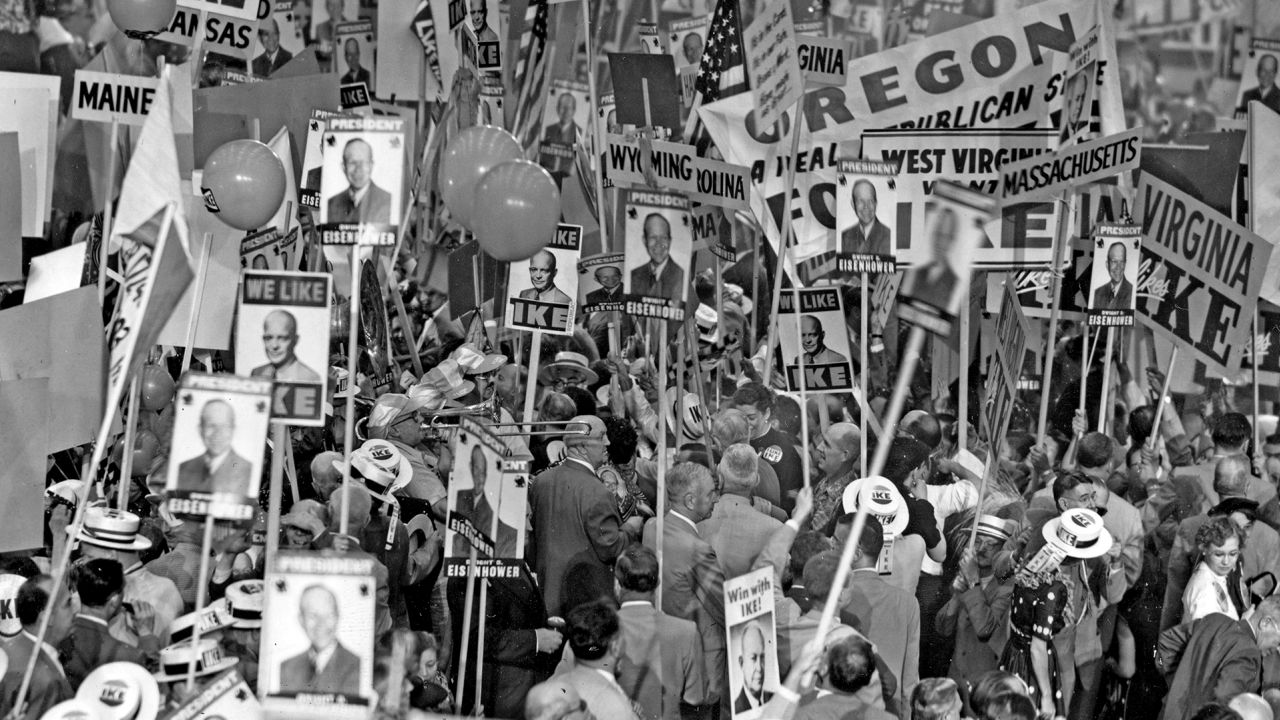
Delegates, many of whom support Dwight David Eisenhower as their candidate for President, gather at the Republican National Convention in Chicago in July 1952.

After Eisenhower’s landmark victory over Taft in 1952, every Republican presidential nominee over the next six decades – a list that extended from Richard Nixon through Ronald Reagan to George W. Bush, John McCain and Mitt Romney – identified more with the internationalist than isolationist wing of the party.

But Trump broke that streak when he won the nomination in 2016 behind a message of brusque economic nationalism and skepticism of international alliances. Now, the GOP appears on track for a 2024 nomination fight which may demonstrate that Trump’s rise has lastingly shifted the party’s balance of power on foreign policy – and ended the long era of GOP internationalism Eisenhower’s victory began.

The fact that DeSantis unveiled his views about Ukraine in a statement to Fox News host Tucker Carlson, a fierce opponent of American engagement with allies, underscored the governor’s determination to court Trump’s base with his provocative remarks. After several days of intense criticism from Republican internationalists, DeSantis retreated last week from his description of the war as a “territorial dispute” and called Russian President Vladimir Putin “a war criminal,” much harsher language than Trump has ever used. But DeSantis, in his interview with British journalist Piers Morgan for another Fox outlet, also reiterated his skepticism of open-ended US support for Ukraine. “I just don’t think that’s a sufficient interest for us to escalate more involvement,” the governor said.
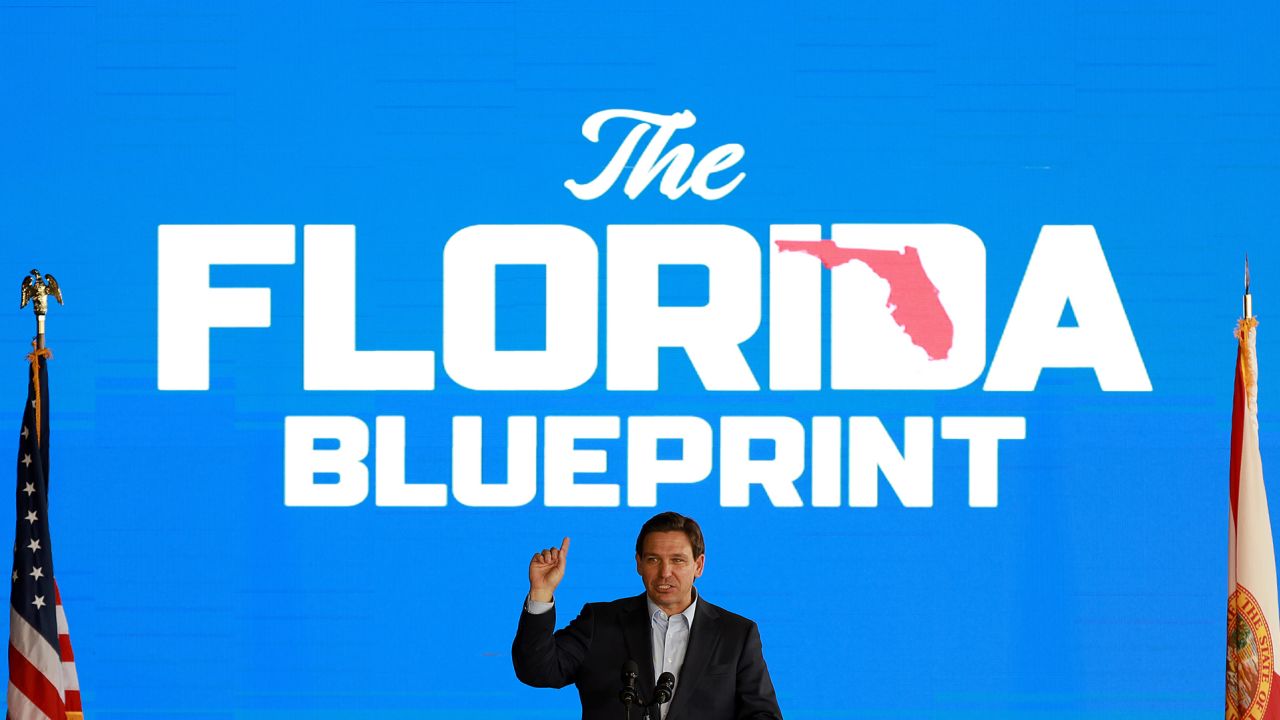
 Florida Gov. Ron DeSantis speaks during an event spotlighting his newly released book,

Even with his qualifying statements last week, DeSantis’ skeptical posture toward Ukraine shows the magnetic pull that Trump has exerted on his party, tugging it away from the Eisenhower tradition.

“Trump-ism is the dominant tendency in Republican foreign policy and it’s isolationist, its unilateralist, its amoral,” said Richard Haass, president of the Council on Foreign Relations and former director of policy planning at the State Department under George W. Bush. The “traditional institutional approach to the world [which was] … the dominant Republican approach since World War II … has clearly been eclipsed for now,” said Haass, who also held foreign policy positions in the Ronald Reagan and George H.W. Bush administrations.

Ivo Daalder, president of the Chicago Council on Global Affairs and former US permanent representative to NATO under Barack Obama, agrees. The fact that both 2024 GOP front-runners are expressing a broad skepticism about US engagement abroad, he said, raises the possibility that Republican “internationalists have not only lost in ’16 and ‘20” when Trump headed the GOP ticket, “but have lost the party forever.”

The 1952 presidential election, by contrast, was the moment when GOP internationalists seemed to win the party forever. Leading into World War II, the party had been closely split between an internationalist wing determined to counter Adolf Hitler and imperial Japan and an isolationist faction resistant to entanglement in the intensifying confrontation with fascism, especially in Europe. The divide was both ideological and geographic, pitting generally more moderate internationalist East Coast Republicans (many of them tied to Wall Street and international finance) against more conservative isolationist forces centered in the small towns and small businesses of the Midwest and the far West.

The Japanese surprise attack that triggered the US entry into World War II ended the political viability of a purely isolationist stance.

“After Pearl Harbor there was no way to be a strict isolationist and a national political [figure],” said Joyce Mao, an associate professor of history at Middlebury College and author of the book “Asia First,” which recounts the GOP foreign policy debates of that era.

After World War II, Republican internationalists joined with Democratic presidents Franklin Roosevelt and Harry Truman to build the international institutions meant to prevent another global war: the United Nations, the Marshall Plan to economically rebuild Europe and the North Atlantic Treaty Organization to militarily defend it from the Soviet Union. Eisenhower, who had organized the Allied invasion of Europe on D-Day in 1944, was firmly in that camp and, in fact, returned to Europe in January 1951 to serve as NATO’s first supreme commander.

But Robert Taft led a block of “old guard” congressional Republicans that remained much more skeptical of European commitments. Taft, a senator from Ohio and the son of former Republican president William Howard Taft, had generally opposed American aid to Europe before Pearl Harbor and even after the war he pushed to reduce the Marshall Plan and voted against the creation of NATO. Like many of the Republicans who initially resisted involvement in World War II, Mao noted, Robert Taft in the post-war period tried to separate himself both from that isolationist past and the contemporary priorities of GOP internationalists like Eisenhower by arguing for an “Asia First” foreign policy that would shift resources and emphasis from defending Europe to confronting the Communists who had seized control of China.

“Eisenhower was viewed by Taft and his colleagues as much too moderate,” Mao said. “His European focus was deemed by that conservative wing of the party as much too similar to the liberal Democrats. If this was going to be a moment for conservatism to reassert itself not only against liberalism but also against the moderates in the Republican Party, China provided an ideal plank” to do so.

All these strains culminated in the landmark battle for the 1952 GOP presidential nomination. Taft, the Republican Senate leader, was a passionate favorite of conservatives. Eisenhower, still in Europe as NATO supreme commander, was in many respects a reluctant candidate. But as Stephen Ambrose showed in his classic biography, Eisenhower felt compelled to run largely from fear that Taft would lead the US out of NATO, while simultaneously risking a catastrophic war in China. (Eisenhower was also deeply disenchanted with Truman’s leadership.) Eisenhower resigned his NATO position, returned to the US, mobilized enough support from the GOP’s internationalist wing to beat Taft at the 1952 Republican convention, and then decisively won the presidency that November. “Eisenhower became president precisely because he did not trust this version of isolationism in Taft,” said Peter Feaver, a Duke University political scientist who served as a senior adviser for strategic planning on the National Security Council under George W. Bush.

Both as a general election candidate and as president, Eisenhower tried to minimize his public conflicts with his party’s “old guard.” But he unmistakably steered the party (and the nation) toward acceptance of American global leadership within a robust international system of alliances. With only modest variation, that became the dominant foreign policy ideology of the GOP for the next 60 years under Presidents Richard Nixon, Gerald Ford, Ronald Reagan and George H.W. Bush. Late in that period, George W. Bush offered a different emphasis by stressing unilateral American action over coordination with allies, but even he emphasized the need for the US to remain engaged with the world. “It’s a pretty unbroken streak,” said Geoffrey Kabaservice, author of “Rule and Ruin,” a history of the struggles between GOP conservatives and moderates.

Taft-like isolationism, coupled with nativist opposition to immigration and protectionist opposition to free trade, first resurfaced as a major force in the GOP with the long-shot presidential campaigns of conservative commentator Patrick J. Buchanan in 1992 and 1996. Two decades later, Trump revived that same triumvirate of isolationism, protectionism and nativism – what scholars sometimes call “defensive nationalism” – in his winning drive for the 2016 GOP nomination.

Though some traditional GOP internationalists had hoped that Trump in office might moderate those impulses, as president he barreled down all those roads, repeatedly clashing with traditional allies. Now, DeSantis’ choice to echo Trump in devaluing Ukraine – following the calls from so many House conservatives to reduce the US commitment there – is deflating another hope of the GOP’s beleaguered internationalist wing: that Trump’s ascent represented a temporary detour and the party would snap back to its traditional support for international engagement once he left office.

“Trump-ism has to be taken seriously,” as a long-term force in GOP thinking about the world, Haass said. The foreign policy center of gravity in the Republican Party, he added, has moved toward “a much more pinched or minimal American relationship with the world, [with] not a lot of interest in contributing to global responses to challenges like climate change or pandemics.”

Even before DeSantis qualified his comments in the interview with Morgan, Feaver believed the Florida governor was trying to find a position on Ukraine somewhere between Trump’s undiluted skepticism and the unreserved support of Sens. Lindsey Graham of South Carolina and Mitch McConnell of Kentucky. But, Feaver said, by including such inflammatory language as “territorial dispute” in his initial comments, DeSantis demonstrated the risks of pursuing such a strategy of “triangulation.”

“Triangulation is a risky game because if you get the language off, you may commit yourself in a campaign to a line that makes no sense when you are governing,” Feaver said. “This is one of the hardest problems for newcomers and challengers when they are campaigning for president. By giving applause lines that work for the narrow segments of ideologically hardened factions that they are trying to win over for the primary, they can lock themselves into policy positions that are not sound when they actually win.”

As an example, Feaver said DeSantis’ insistence that the US should shift more attention from countering Russia to containing China – an argument he repeated with Morgan – was illogical because “abandoning Ukraine assists China’s most significant ally, Russia.” Haley made a similar case in her recent Wall Street Journal article criticizing DeSantis (though not by name) for his comments to Carlson. “It’s naive to think we can counter China by ignoring Russia,” Haley wrote.

Daalder points out another logical flaw in the updated “Asia First” arguments from DeSantis and Trump. “If the US were to abandon its allies in Europe … our allies in Asia are going to ask, ‘What’s to say they are not going to do the same with regards to China?’” Daalder said. “By demonstrating your willingness to stand up to Russia you are also strengthening the view that in Asia that when it comes to it that we will be there to help them.”

But polls leave no doubt that both prongs of the modern Robert Taft position – that the US should reduce its commitment to Europe-focused international alliances and harden its resistance to China – have a substantial base of support in the contemporary Republican coalition. In a Gallup poll released earlier this month, by a lopsided margin of 76{515baef3fee8ea94d67a98a2b336e0215adf67d225b0e21a4f5c9b13e8fbd502} to 12{515baef3fee8ea94d67a98a2b336e0215adf67d225b0e21a4f5c9b13e8fbd502}, Republican voters were more likely to identify China than Russia as the principal US adversary in the world. (More Democrats picked Russia than China.) Polls have also found a steady decline in Republican support for US aid to Ukraine: polls this year by both the Pew Research Center and Quinnipiac University found that the share of GOP voters who believe the US is doing too much now equals the combined percentage who think it is doing too little or the right amount. (Quinnipiac found big majorities of Democrats and independents still believe the US is doing the right amount or not enough.)

The latest Chicago Council on Global Affairs annual survey also tracks a broader retreat from the world among GOP voters. In that poll, conducted last November, the share of Republicans who said the US should take an active role in world affairs fell to 55{515baef3fee8ea94d67a98a2b336e0215adf67d225b0e21a4f5c9b13e8fbd502} – the lowest the survey has ever recorded. Underscoring that erosion, a slight majority of Republicans in the poll said the costs of an active US international role now exceed the benefits.

Opinions in the GOP about whether the US should do more or less in Ukraine don’t vary much along lines of education or age, the Pew poll found. But generally, these surveys show that the turn away from global leadership is most powerful among two distinct groups of Republicans: those who are younger, and those who lack college degrees. While a solid three-fifths of Republicans with a college degree in the Chicago Council poll said the benefits of US leadership exceed the costs, for instance, a majority of non-college Republicans disagreed. Younger Republicans were also much more likely than those over 60 to say the costs exceed the benefits.

It’s probably no coincidence that those two groups – Republicans without a college degree and those who are younger – have consistently registered as Trump’s strongest supporters in early polls about the 2024 race.
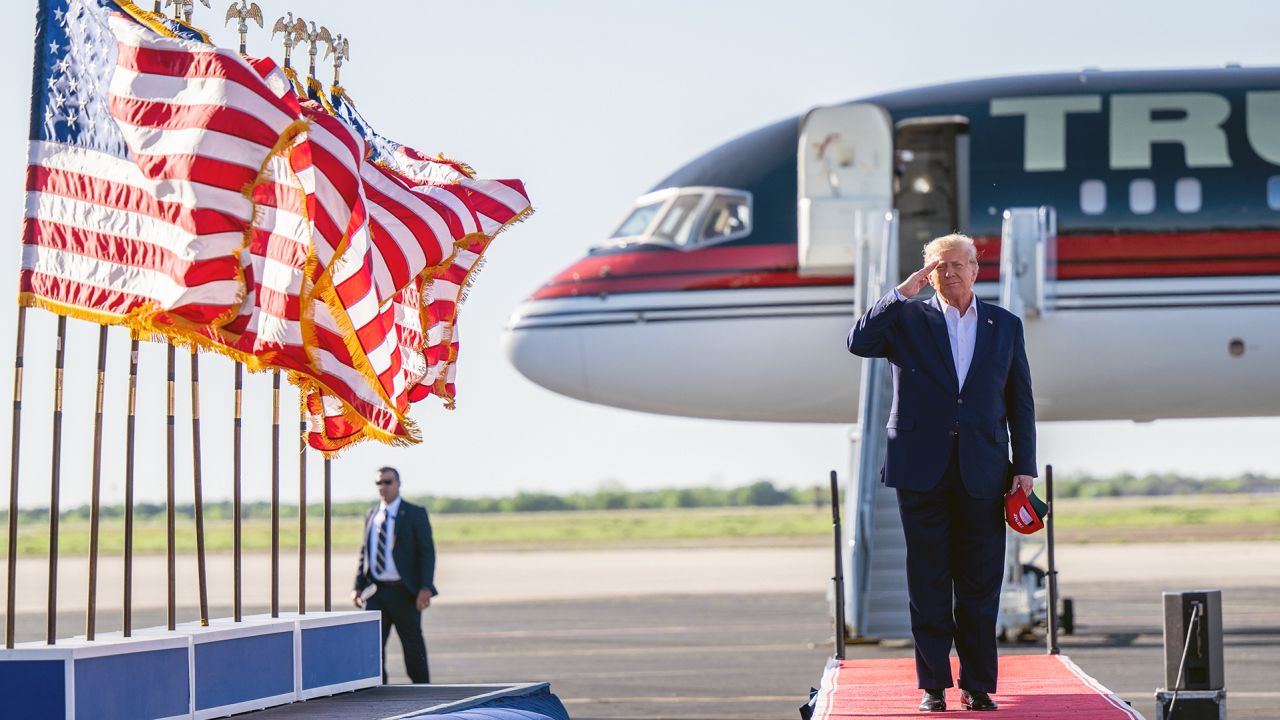
Former President Donald Trump arrives during a rally at the Waco Regional Airport on March 25 in Texas.

Trump is signaling that in a second term he will likely push even further in an isolationist and protectionist direction. John Bolton, Trump’s former national security adviser, has said he believed the former president came close to withdrawing the US from NATO and would likely do so if elected to a second term. Trump certainly hinted at that possibility in a recent campaign video in which he declared, “we have to finish the process we began under my administration of fundamentally reevaluating NATO’s purpose and NATO’s mission.” Trump has also said he would impose a four-year plan “to phase out all Chinese imports of essential goods, everything from electronics to steel to pharmaceuticals.” That would be a wrenching change in the global economy.

In all these ways, Trump is promising to fulfill Robert Taft’s vision from seven decades ago – and to erase Eisenhower’s lasting victory in setting the GOP’s direction. DeSantis does not appear to have decided to jump entirely on that Trump train – but neither is he lying down on the tracks to stop it. With these two men far ahead of any potential rival, it seems highly likely that the GOP in 2024 will continue to move away from Eisenhower-style international cooperation toward a volatile compound of isolationism and unilateralism. And that could generate enormous turbulence across the globe.

Trump’s first term, as Daalder noted, was a chaotic time for the international order and traditional US alliances. But “If an isolationist leader gets elected president in 2024,” Daalder added, “you haven’t seen nothing yet.”

England suffer historic humiliation after France’s Twickenham tour de force | Six Nations 2023

England suffer historic humiliation after France’s Twickenham tour de force | Six Nations 2023

Talk about a guillotine falling with brutal finality. England have endured some chastening days over the years but nothing on the scale of this record thumping by France, who had previously failed to win a Six Nations game in south-west London since 2005. If the home side were nowhere near good enough, Les Bleus were quite outstanding for the majority of a one-sided contest.

By the end even England’s worst ever day at Twickenham, the 42-6 thrashing by South Africa in 2008, was receding in the rear view mirror. Steve Borthwick’s squad had dared to hope this might be the weekend they glimpsed a brighter future coming over the horizon. Instead it proved to be the headlights of a speeding French TGV, smashing aside everything in its path.

The visitors, clearly fuelled by a desire to right a few historic wrongs, scored seven tries in all, with Thibaud Flament, Charles Ollivon and Damian Penaud each bagging two. In many ways this was an even more eye-catching Gallic triumph than their famous 51-0 demolition of Wales at Wembley in 1998 and this autumn’s Rugby World Cup in France cannot now come swiftly enough for them.

But whither England? Where to start. On a damp, rainy evening their ambitions of playing expansive rugby were cruelly exposed by opponents who possessed loads more power and panache. It would be harsh to blame Marcus Smith for all the other glaring deficiencies around him but England’s wet weather tactics were often questionable and their supposed new attacking dawn never remotely materialised.

England’s biggest problem was right in front of their noses. Collision-wise they were blown away and France also looked the fitter side. By the end, with the red rose defence being breached almost at will, the gulf between the teams was embarrassing. One French newspaper described it as “a massive kick up the backside” and that it was.

When paired with Friday night’s 42-7 defeat to France at under-20 level, this result should also finally kill off any lingering English delusions of grandeur. “We know what the reality is now,” muttered Borthwick, making no attempt to gloss over the blatantly obvious. Play as ineffectually as this in Dublin next week and another lower-half championship finish will tell its own stark story.

Thibaud Flament scores his side's fourth try whilst under pressure from England’s Alex Dombrandt during the Guinness Six Nations Rugby match between England and France.
Thibaud Flament scores his side’s fourth try whilst under pressure from England’s Alex Dombrandt. Photograph: Tom Jenkins/The Observer

France, on the other hand, played as if it was Paris in the springtime rather than late winter in south-west London. More effective at the breakdown, more composed when it mattered and stronger in pretty much every other department, rumours of their demise as World Cup favourites have clearly been exaggerated.

They were 10 points up inside the first seven minutes, their young wing Ethan Dumortier intelligently drawing the last defender to allow Thomas Ramos to finish a move he had helped to start. Even before the top scorer in this season’s Six Nations added the conversion and a subsequent penalty it was already clear France were in no-nonsense mood, with the returning Jonathan Danty’s turnover ability among their most conspicuous plusses.

Quick Guide

How do I sign up for sport breaking news alerts?

Show

  • Download the Guardian app from the iOS App Store on iPhone or the Google Play store on Android by searching for ‘The Guardian’.
  • If you already have the Guardian app, make sure you’re on the most recent version.
  • In the Guardian app, tap the Menu button at the bottom right, then go to Settings (the gear icon), then Notifications.
  • Turn on sport notifications.

Thank you for your feedback.

It was no real surprise to anyone when France scored again, the ever-dangerous Antoine Dupont having given them an excellent platform with a sweet left-footed 50-22 kick. The visiting pack immediately scented rosbif blood and Flament, once a fly-half at Loughborough University, galloped unstoppably between both English centres to leave the hosts staring at a 17-0 deficit.

skip past newsletter promotion

Not until the 34th minute did England even make it on to the scoreboard and another in a series of costly knock-ons, this time from Alex Dombrandt, gifted the visitors another try-scoring opportunity on the stroke of half-time. If the dummy run of Penaud played some part in fooling the English blindside defence it was impossible not to admire the strength and skill of Grégory Alldritt as he stormed clear to put the supporting Ollivon over for France’s third try.

England had trailed by more than 24 at the interval only three times in their history, all in the southern hemisphere. At Twickenham in 2006 they trotted back after trailing 28-5 to New Zealand, going on to lose 41-20, but nowhere have they endured a championship humiliation like this.

Something had to change and Borthwick sent on Owen Farrell and Alex Mitchell for Henry Slade and Jack van Poortvliet in a vain attempt to staunch the bleeding. In truth, though, England could have changed half a dozen players without addressing the central issue. France were boulevards ahead in terms of gainline punch and cohesion and, even when Max Malins appeared to have scored from a nice cross-kick from Smith, the officials ruled the ball had not been grounded legally.

Freddie Steward did partially redress the balance with a 48th-minute score that pegged it back to 27-10 but it was to be the high point of England’s evening. First a kind bounce from Dupont’s chip allowed Ramos to put the impressive Flament over for his second try before Smith, under pressure on his own line, was scragged and dragged backwards, with the predatory Ollivon claiming the touchdown. Long before Penaud and friends further twisted the knife, dismayed home supporters could be seen heading for the exits, trying vainly to remember a more savage Twickenham denouement.

Nikki Haley’s South Asian heritage is historic part of her presidential campaign

Nikki Haley’s South Asian heritage is historic part of her presidential campaign

With her announcement this week that she is running for president, Nikki Haley has made a bit of history again — becoming the first prominent woman of color to seek the Republican nomination.

With Vice President Kamala Harris presumed to be President Joe Biden’s running mate if he announces a second run, as he has said he will, it’s possible that both major political parties in America could simultaneously have a woman on their ticket for the first time. And both would be South Asian, specifically of Indian descent — which observers called a massive feat considering the community makes up only about 1{515baef3fee8ea94d67a98a2b336e0215adf67d225b0e21a4f5c9b13e8fbd502} of the country’s population and produced two recent political stars.

“This is absolutely a moment,” Sara Sadhwani, an assistant professor of politics at Pomona College and co-author of the Indian American Election Survey, told ABC News. “We see South Asians who have largely been on the outskirts of American politics in many ways. This is a moment where we’re seeing South Asians step into the limelight.”

That representation began at the national level more than half a century ago, when Dalip Singh Saund led a push to change immigration laws so he and other Indians could become citizens. He then became the first Asian American, first South Asian and first Sikh in Congress, in 1956.

There are now five South Asians in Congress, often referred to as “the Samosa Caucus.”

“Since 2016, we’ve quintupled our representation in Congress and gone from 12 to 43 in state legislatures. Over that same period of time, our population has not multiplied the same way,” said Neil Makhija, the executive director of the Indian American Impact, an organization that helps South Asians run for elected office. “Once people start running, it shows that it’s possible.”

When it comes to world leaders, University of California, Riverside, public policy professor Karthick Ramakrishnan points to Rishi Sunak, whose parents are of Indian descent, as someone who represents how fast a community can advance — considering the British ruled India until 1947. “One generation,” Ramakrishnan said, “Someone who is the child of the empire is now the prime minister of Britain.”

Nearly one-fourth of the world’s population lives in South Asia and many of the countries within it — India, Pakistan, Bangladesh, Nepal and Sri Lanka — have all already had women prime ministers or presidents.

“[Women leading countries] is not something that’s necessarily out of the norm of the cultures from which a lot of these people are coming from,” said Maneesh Arora, an assistant professor of political science at Wellesley College.

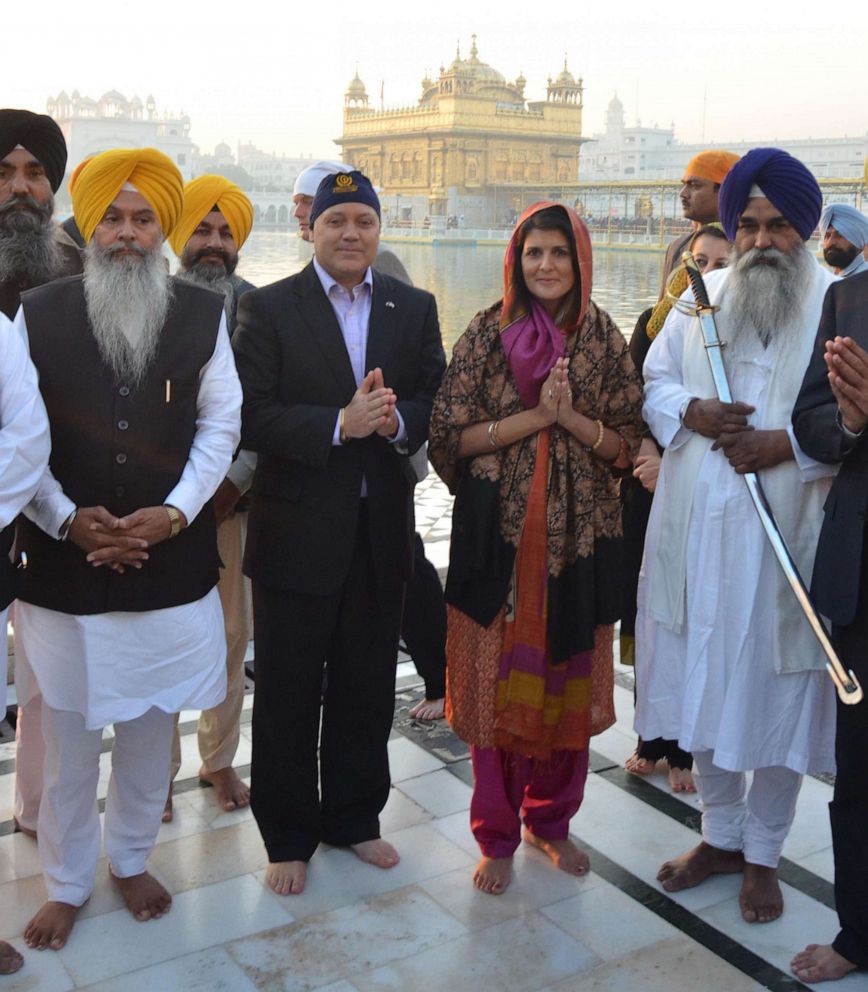
PHOTO: South Carolina Governor Nikki Haley along with her husband Michael Haley at the Golden Temple, Nov. 15, 2014, in Amritsar, India.

South Carolina Governor Nikki Haley along with her husband Michael Haley at the Golden Temple, Nov. 15, 2014, in Amritsar, India.

Hindustan Times via Getty Images

Harris’ maternal grandfather, P.V. Gopalan, worked to fight for the country’s independence from Britain and she’s spoken about her parents taking her in a stroller to political protests in the ’60s. Haley wrote in her autobiography that her mom, Raj Randhawa, studied law and was offered the first female judgeship in India, although Haley said her own family blocked it because she was a woman.

“They grew up in households where public service was not looked down upon. … Plenty of Indian Americans grew up in households where it was about becoming a doctor or engineer,” Ramakrishnan said.

Harris, who ran for president in 2020 before being selected as Biden’s vice president, and now Haley are testing what it means to pursue success at the highest levels of American politics.

Haley is not the first woman of color to seek the GOP nod: Angel Joy Chavis Rocker, a Black school counselor in Florida, ran in the 2000 campaign. But Haley is the most notable non-white conservative woman to ever enter the race.

Her campaign did not comment for this story.

What Haley has said about her heritage

Haley was born Nimrata Nikki Randhawa to Punjabi Sikh parents who emigrated from India in the 1960s. She has said that early on she adopted her middle name, which means “little one” in Punjabi, as her first name and later took on her husband’s last name as her own.

Haley was raised Sikh and has publicly talked about converting to Christianity, once saying the language barrier was what ultimately led to her decision to convert. “At some point, you have to understand the words …. Christianity spoke to me,” she previously said while adding, “It wasn’t political.” She explained to The New York Times in 2012: “We always said ‘no’ when my mom was trying to teach us Punjabi. Now I wish we had learned, but that is why I think I made the transition.”

She joined a Methodist church with her husband but has said she continues visiting the Sikh temple with family.

But for some South Asians, the conversation about Haley rarely gets past her name or religion.

“Her example would reflect the kind of assimilationism that most Indian Americans — most South Asians — actually don’t do. They don’t change their name and they don’t convert their religion,” Ramakrishnan said.

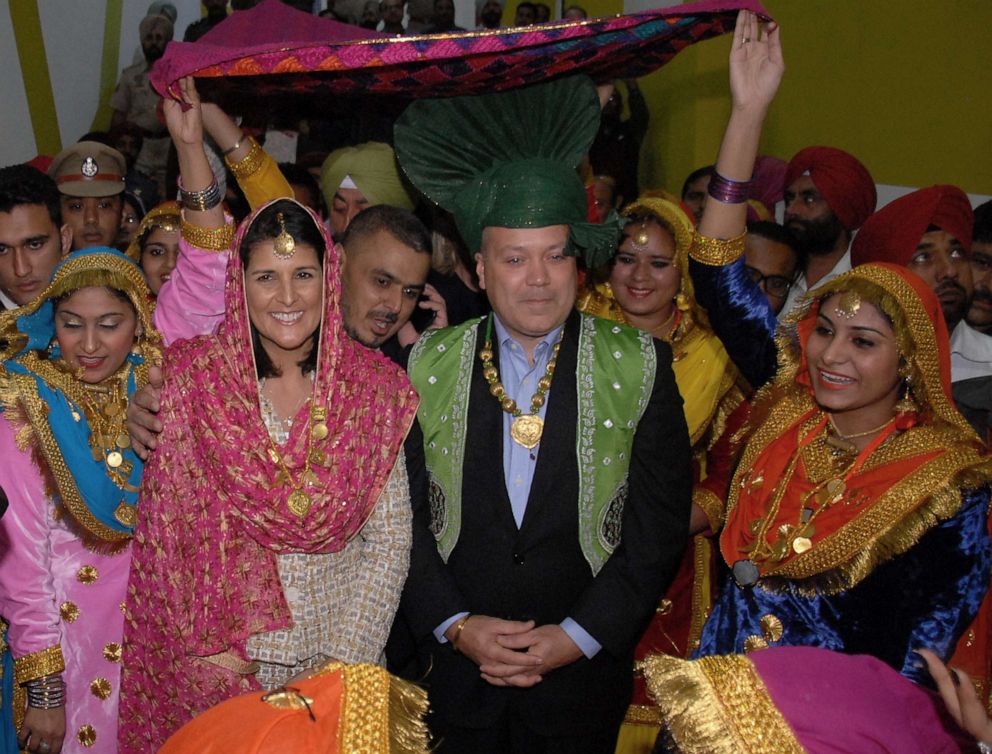
PHOTO: Governor of South Carolina Nikki Haley poses with her husband Michael Haley and traditional Punjabi dancers as she arrives to attend a function at Lovely Professional University LPU in Jalandhar, Nov. 14, 2014.

Governor of South Carolina Nikki Haley poses with her husband Michael Haley and traditional Punjabi dancers as she arrives to attend a function at Lovely Professional University LPU in Jalandhar, Nov. 14, 2014.

Shammi Mehra/AFP via Getty Images

In 2001, Haley also listed her race as “white” on her voter registration card, according to The Post and Courier. At the time, a spokesman for her declined to comment and state Republicans suggested the issue was a stunt because it had been uncovered by Democrats, who criticized her as disingenuous.

Dr. Hajar Yazhida, a University of Southern California assistant professor in sociology and faculty affiliate at their equity research institution, told ABC News that being able to have racial ambiguity has had a massive impact for both the vice president and Haley — especially on Haley’s journey. (Harris’ father is Black, from Jamaica; her mother was born in Chennai, India.)

“We might look at Kamala Harris on one side and Nikki Haley on the other and wonder how it is that two South Asian women ended up as political front-runners? But we have to remember that neither of the candidates are socially read as South Asian women,” Yazhida argued.

But Ramakrishnan said even being able to “claim” an identity is something unique to living in the United States — and something that most politicians do in some way: “We all have different aspects of our identity that we activate. … Given the context, people code-switch all the time.”

Haley has seen prejudice — even from fellow politicians.

During a runoff election for a state legislative seat in South Carolina, an opponent published ads referring to her as “Nimrata N. Randhawa” and sent out mailers with her standing with her dad in his turban.

When she was running for governor in 2010, a South Carolina state senator referred to her and then-President Barack Obama with a racial epithet.

Haley has touched on some of the struggles her family faced. “I am the proud daughter of Indian immigrants. They came to America and settled in a small southern town. My father wore a turban. My mother wore a sari. I was a brown girl in a black and white world,” she said at the 2020 Republican National Convention. “We faced discrimination and hardship, but my parents never gave into grievance and hate.”

The NAACP also pointed to then-Gov. Haley’s heritage in 2011 when criticizing South Carolina for flying the Confederate flag at the Statehouse for nearly half a century. In 2015, in the wake of the fatal shooting of nine Black people at Charleston’s Emanuel African Methodist Episcopal Church, Haley urged the flag to be removed and state Republicans quickly agreed.

Nikki Haley’s South Asian heritage is historic part of her presidential campaign

Former South Carolina Republican Governor Nikki Haley speaks at the Republican Jewish Coalition Annual Leadership Meeting in Las Vegas, Nov. 19, 2022.

Wade Vandervort/AFP via Getty Images

Haley’s politics differ from most in the community

Pomona College professor Sadhwani said South Asians really want to support other South Asians, regardless of party. But the data she has collected on Haley appears to be an exception. “Haley’s unfavorable score is 55{515baef3fee8ea94d67a98a2b336e0215adf67d225b0e21a4f5c9b13e8fbd502} in our sample,” Sadhwani said. This could be in part because many South Asian people identify as Democrats, data shows

Former President Donald Trump wasn’t able to capture the South Asian vote either — but he tried. In 2019, he held a “Howdy Modi!” rally with Indian Prime Minister Narendra Modi that attracted thousands and filmed an ad where he attempted to speak in Hindi.

That got him ahead with the group — but not by enough. “Trump made inroads among Indian American voters between 2016 and 2020. He still lost the Indian American vote,” said professor Ramakrishnan.

Biden and Harris have focused on South Asians and the Indian community as well, with Biden releasing an agenda for the Indian American community prior to the 2020 election and both him and the vice president including cultural celebrations as part of administration events.

Numbers illustrate how Asian American voters, and Indian voters, can be influential. According to AAPI Data, an organization that publishes demographic data and research, in 2018 there were an estimated 161,000 eligible Indian voters in Texas, 87,000 in Florida, 61,000 in Pennsylvania, 57,000 in Georgia and 45,000 in Michigan.

Major contests in those states, including the 2020 and 2016 presidential elections, have all recently been decided by smaller margins.

And the community is fast growing. In the last two decades, for example, the Indian population in the U.S. has doubled to about 4.6 million in 2019, according to the Pew Research Center.

Roughly 70{515baef3fee8ea94d67a98a2b336e0215adf67d225b0e21a4f5c9b13e8fbd502} of Indian voters in America leaned Democratic as of 2022, according to AAPI Data. That’s more than Latinos but less than African Americans. Some of the reasons include religion, extensive training in science and living in a post-9/11 world.

In one of his most notable — and controversial — promises as a presidential candidate, Trump said he would block Muslims from entering the U.S. At the time, Haley appeared to distance herself from such a policy. Delivering the Republicans’ official 2016 State of the Union response, she said that America should resist following the “angriest voices” and welcome “properly vetted legal immigrants, regardless of their race or religion.”

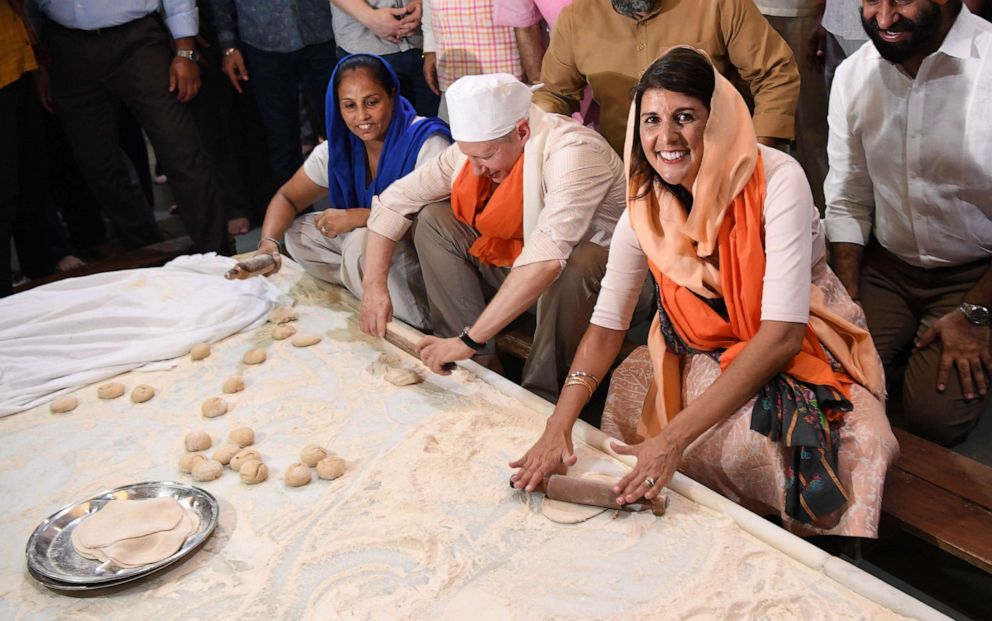
PHOTO: Ambassador to the United Nations Nikki Haley makes Indian bread in the kitchen of the Sis Ganj Gurudwara, a Sikh temple, in New Delhi, June 28, 2018.

Ambassador to the United Nations Nikki Haley makes Indian bread in the kitchen of the Sis Ganj Gurudwara, a Sikh temple, in New Delhi, June 28, 2018.

Prakash Singh/AFP via Getty Images

According to AAPI Data, more than three-fourths of Indians and the majority of Asian voters overall voted for Democratic nominee Hillary Clinton over Trump in 2016, a finding that echoes other exit polling. Haley went on to join Trump’s administration, leaving some in her own community wondering how strongly she felt about what she had said just 12 months before.

Sangay Mishra, an associate professor of political science at Drew University and the author of “Desi’s Divided: The Political Lives of South Asian Americans,” said the vast majority of the South Asian community feels strongly about issues like abortion rights, restricting guns and critical race theory.

“In politics it’s hard to predict how the community will react. But it’s clear it doesn’t align with how she thinks,” Mishra said.

‘An opportunity for Haley’

But can Haley align South Asian donors?

Indian Americans have the highest levels of income in the country, according to the U.S. Bureau of Labor and Statistics, a feat that’s often connected to the 1960s when the U.S. specifically engineered a demographic of highly professional immigrants. (Harris and Haley have something else in common that researchers said is powerful — they are byproducts of this era, with both of their parents coming to America around this time.)

An analysis done by The Los Angeles Times a few months into the 2020 Democratic primary race found that despite Indian Americans being a small demographic, they had donated more than $3 million to presidential campaigns — more than people in Hollywood.

Mishra told ABC News he created a list of major bundlers during the Obama administration and the number of South Asian names was a fairly big list compared to the population. “They were overwhelmingly going for the Democratic Party,” he said.

“What has not been noticed is this growth of a segment of Indian Americans who are affluent, and that goes back to the character of the community,” Mishra said.

Data from FiveThirtyEight details just the donations that South Asians made to other South Asian candidates running for House or Senate seats from 2000-2020. The numbers, especially for Democratic candidates, have exploded.

Haley’s former spokesperson Rob Godfrey said he remembered her being embraced by such donors while running in South Carolina. “Members of the South Asian community, members of the Indian community, have always been traditionally Democratic,” he acknowledged. “But when Nikki ran for governor, there was no shortage of support for her from the South Asian and Indian communities because they had a lot of great pride in her candidacy … she very much enjoyed the support of them within the state and they were very generous contributors to her campaign, from New Jersey to Chicago to California to Texas.”

Sadwani said that when it comes to South Asians though, her research showed that the numbers won’t be enough to tip the scale.

Haley’s announcement video, on Tuesday, highlighted her heritage and her optimistic vision of a society unencumbered by racial division.

“I was the proud daughter of Indian immigrants,” Haley said in her video, adding: “My mom would always say, ‘Your job is not to focus on the differences but the similarities.'”

Sadwani said that message isn’t for the South Asian community — it’s for everyone else.

“We’re talking more conservative-leaning Latinos, other Asian Americans and even plenty of of non-immigrant voters who are completely opposed to the age old story of the United States being a place that welcomes immigrants and might be disenchanted by the overt racial commentary, the negative stereotypes of a Trump administration, even while supporting many of the Trump-based policies,” Sadwani said. “I think this becomes an opportunity for Haley.”

A historic show of Black political unity is light on policy

A historic show of Black political unity is light on policy

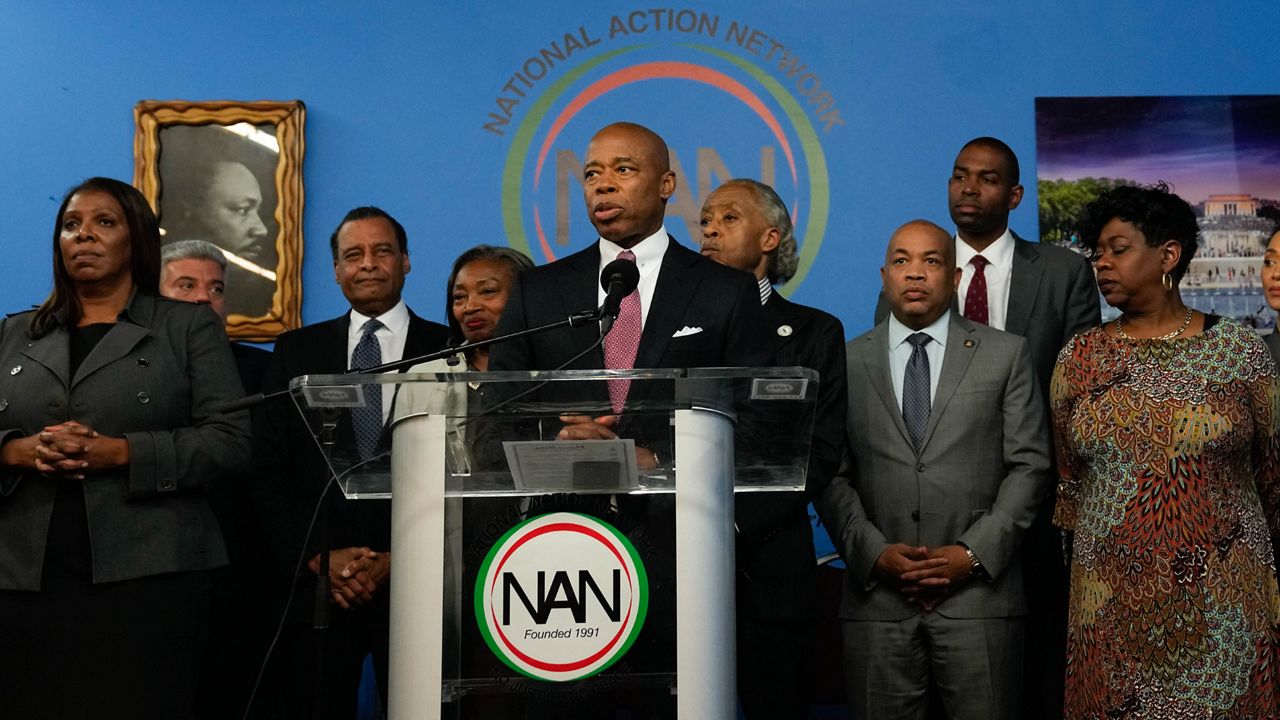
On Thursday, the Rev. Al Sharpton convened what he billed as a historic assembly of New York’s prime Black elected officials — which is also to say a conference of New York’s major elected officials.

Blacks occupy just about every situation of main political affect in New York, from mayor to condition attorney general to the state’s two legislative leaders. And on Thursday they sought to get on the identical web page concerning the concern of community protection.

“Never in advance of in the historical past of this point out have we noticed so several of our major officials come from the Black local community. And it was our concept that we would have these officials sit and focus on community protection,” Sharpton told the media immediately after the private 90 minute meeting.


What You Want To Know

  • New York’s prime Black elected officers collected Thursday evening for a summit on public security
  • The personal assembly was convened by Rev. Al Sharpton at his Nationwide Motion Network headquarters in Harlem
  • Addressing the media later on, participants emphasised the will need to current far more unified messaging but did not discuss coverage
  • “This is what our ancestors prayed for, is standing on this phase correct now,” reported Mayor Eric Adams

This 12 months “will be the 12 months we present this country how to govern,” he said. “And how to govern by men and women that have been still left out of the governing for quite a few yrs, and are now in key positions. We could be on distinctive hymns, but we’re in the exact hymn book. And we’re heading to sing with each other this yr.”

General public security was a divisive difficulty throughout previous year’s midterm elections, one that Republicans utilised to their advantage but also one that made rifts among Democrats. Mayor Eric Adams’ tricky-on-criminal offense strategy and his drive to roll back the state’s bail reform regulations set him at odds with state leaders like Assembly Speaker Carl Heastie, of the Bronx.

But although individuals spoke broadly about the want to realize both of those criminal justice reforms and community security, they made available no details on coverage, instead emphasizing the need to current a unified concept.

Specifics were being mentioned, claimed Legal professional Typical Letitia James, but “none of these concerns will be talked over in this article prior to the media. We will talk about them in non-public, we will arrive forth with a system, we will map out where the issues are, and we will join collectively as a person.”

“We really like the press,” claimed condition Senate The vast majority Chief Andrea Stewart-Cousins, “but you don’t require to talk with each individual other via the push.”

Mayor Adams mentioned legislative successes on the two the city and state ranges had been obscured all through his 1st yr in business, and that the group was united in its endeavours to combat institutional racism.

“This is what our ancestors prayed for, is standing on this stage proper now,” the Mayor stated. “And we’re likely to stay up to individuals prayers, all those sacrifices, all the things they went as a result of.”