


Florida real estate firm accused of ‘equity theft’ by St. Louis homeowners

Florida real estate firm accused of ‘equity theft’ by St. Louis homeowners

ST. LOUIS — Dianne Allen had been ignoring the calls from a number she didn’t recognize. But after so many, she finally relented.

The woman on the other end asked if she was the owner of 8441 Midwood Avenue in Berkeley. “What’s this concerning?” Allen asked. “You could be eligible for up to $2,000 in upfront cash if you agree to use our real estate service,” the woman said.

Allen needed some money to catch up on her truck payments. And before the end of that day in August, a notary was at her house, thumbing through papers for her to sign. They gave her a check for $500.

“I kept saying, ‘what’s the catch?’” Allen said. “If I knew there was gonna be a lien on my house I would have never signed.”

But the company, MV Realty, did record a lien against the house, security for the 40-year agreement Allen signed to use the Florida real estate brokerage firm if she ever sells.

People are also reading…

Now, Allen can’t take out the home equity loan she was hoping to use to remodel her kitchen because of the extra lien on her property. Banks are likely to balk at refinancing. And up to 3{515baef3fee8ea94d67a98a2b336e0215adf67d225b0e21a4f5c9b13e8fbd502} of her home’s value — a value determined by MV Realty — is now due to MV Realty, either from a brokerage commission or a termination fee under a clause that seems almost designed to be triggered, said Rob Swearingen, a lawyer with nonprofit law firm Legal Services of Eastern Missouri representing Allen.

MV Realty says its contracts are only designed to commit homeowners to use its brokers if they ever sell the house, and their 3{515baef3fee8ea94d67a98a2b336e0215adf67d225b0e21a4f5c9b13e8fbd502} commission is in line with industry standards. A contract reviewed by the Post-Dispatch contains a provision spelling out a lien will be recorded against the property.

But, in addition to triggering a penalty worth 3{515baef3fee8ea94d67a98a2b336e0215adf67d225b0e21a4f5c9b13e8fbd502} of the home’s value if the house is sold using a non-MV Realty broker, the 40-year agreement contains an early termination clause triggered if the house is transferred to heirs and they don’t recommit to the contract within a few days.

“It’s like a hidden grenade that everyone’s gonna forget about and the heirs won’t know about,” said Swearingen, who is preparing a lawsuit against MV Realty over its practices. “It’s an equity theft device, is what this is.”

Legal Services estimates MV Realty has entered contracts with at least 100 homeowners in Missouri, about 40 of them in the St. Louis region, according to property records.

The company has recently attracted attention from state attorneys general and members of Congress.

In late November, Ashley Moody, the attorney general of Florida, where the company is based, was the first to file suit against the company, alleging deceptive business practices and telemarketing law violations. The Florida Attorney General lawsuit cites records from one telemarketing service indicating MV Realty left over 6.8 million voicemails advertising their “homeowner benefit agreements.”

“For a company to prey on unsuspecting homeowners in a way that locks them into a 40-year obligation designed to siphon away equity from the property is disgraceful,” Moody said in a Nov. 29 news release announcing the lawsuit.

Last week, both Pennsylvania Attorney General Josh Shapiro and Massachusetts Attorney General Maura Healey filed a similar lawsuits against the company. Shapiro’s office says MV Realty claims it has executed some 32,000 “homeowner benefit agreements” nationwide, up from almost 7,800 in 2021.

“MV Realty is a scam that exploits Pennsylvanians in vulnerable financial situations,” Shapiro said in a statement last week.

In a statement, MV Realty spokeswoman Diana London said it is “committed to working with policymakers, regulators, and attorneys general where needed” and that “we are confident that after a full airing of the facts, these discussions will reinforce how MV Realty’s business transactions are legal and ethical and that our team operates in full compliance with state and federal laws.”

“New and innovative business models, like the (Homeowner Benefit Agreement), can transform established industries and can sometimes draw questions from critics or outright hostility from those whose existing business model is threatened,” London said in a statement. “However, to suggest that MV Realty has engaged in unfair or deceptive practices is simply false.”

On Wednesday, U.S. Sens. Sherrod Brown, D-Ohio, Ron Wyden, D-Oregon, and Tina Smith, D-Minn., sent a letter to the Federal Trade Commission and the U.S. Consumer Financial Protection Bureau citing recent media reports about MV Realty. It urged the regulatory agencies to work with state attorneys general to investigate MV Realty’s business practices and any similar real estate broker listing agreements.

R. Wilson Freyermuth, a real estate law professor at the University of Missouri-Columbia, questions whether the underlying liens are valid if the homeowner has no obligation to sell their house or pay back the upfront cash. The American Land Title Association is already drafting model legislation, he said, to bar tying service contracts of all types, not just real estate brokers, to property titles.

‘Securitization scheme’

Many of the headlines in recent weeks — including one from celebrity news site TMZ — have focused on the face of the company, Amanda Zachman, a contestant (who went by Amanda Zuckerman) in the 2013 season of the “Big Brother” CBS reality TV show.

But the impetus for the idea to use future listing contracts may have come from a New York investment firm looking for ways to securitize assets tied to home values and two Florida financial services veterans who led a company that a decade ago faced federal prosecution over financial products tied to life insurance.

MV Realty’s CEO is Antony Mitchell, who once served as CEO of Florida financial services company Imperial Holdings. He led Imperial Holdings a decade ago with Jonathan Neuman, a minority investor in MV Realty. Neuman stepped down as Imperial Holdings’ president and chief operating officer in 2012 after the FBI raided Imperial Holdings’ Boca Raton office and it was disclosed he was under investigation.

The Justice Department in April 2012 reached a nonprosecution agreement with Imperial Holdings over its marketing of financial products tied to life insurance contracts. The Justice Department agreed to not prosecute the company, citing its cooperation, the termination of the life insurance product business and the departure of employees involved in the conduct. Mitchell, who took over as Imperial’s president after Neuman stepped down, resigned as chairman a few months after the DOJ agreement.

According to court documents, New York investment firm Innovatus Capital claimed it brought the idea for MV Realty’s listing agreements to Mitchell and Neuman. Innovatus CEO David Schiff approached the two, believing they controlled MV Realty, about a way to generate future broker listing agreements as a financial product tied to the value of real estate. The two had “extensive experience originating and securitizing asset classes that had not previously been securitized,” MV Realty claims in its own lawsuit against Innovatus.

The two companies have been in litigation since 2018 over nondisclosure agreements and MV Realty’s use of the broker listing agreements. They settled last week, days after the Pennsylvania and Massachusetts attorney general lawsuits.

A spokesman for Innovatus Capital did not respond to a request for comment.

MV Realty said Neumann is a minority partner in MV and has not been an employee or officer of the company. The lawsuit has been resolved “amicably,” London said.

“It seems as though you are trying to connect past lawsuits that have been resolved with this ongoing conversation MV is having with lawmakers,” she said in an email. “They have nothing to do with each other. The company would appreciate if you stick to current facts and not what it (sic) quite obvious you are being fed.”

London said MV Realty is not securitizing any of its future listing agreements. The Florida attorney general lawsuit says the company’s chief operating officer, David Manchester, is “responsible for securitizing MV Realty’s interests in contracts with consumers.”

The involvement of Innovatus Capital in the idea shows MV’s claims of helping homeowners with some upfront cash is just a front for financial engineers looking to create another Wall Street product, Swearingen said.

“It has nothing to do with any benefit to homeowners,” Swearingen said. “It was a securitization scheme.”


Homeowners targeted with suspect loans

Marcella Jackson poses for a portrait inside her St. Louis home on Wednesday, Dec. 21, 2022. Jackson signed an agreement with a Florida-based real estate firm, MV Realty, about the house that she owns on Miami Street, which could have resulted in a lien against her property.


Back in south St. Louis, Marcella Jackson may be one of the lucky ones. She picked up a cold call from an MV Realty agent while she was at work and was told she could be owed money for agreeing to use MV to list her home. She didn’t understand what the money was for, but she could use the cash. So she didn’t hang up. They moved fast.

“I spoke with them that Friday, she sent me the contract that Friday, and 10 o’clock Monday morning the notary was there,” Jackson said.

She signed an agreement with MV Realty for her two-bedroom, one-bathroom Tower Grove South home, but she felt something wasn’t right. She never cashed the $629 check they gave her. MV hasn’t recorded a lien against her house.

“It felt like something was wrong the whole time,” Jackson said, “but I couldn’t put my finger on it.”

DEMOGRAPHIC CHALLENGE: St. Louis was one of the nation’s slowest-growing metro areas over the past decade. Jim Gallagher argues that we should worry more about quality of life, but David Nicklaus counters that the area can’t prosper without growth.



How homeowners can make sense of the climate finance

How homeowners can make sense of the climate finance

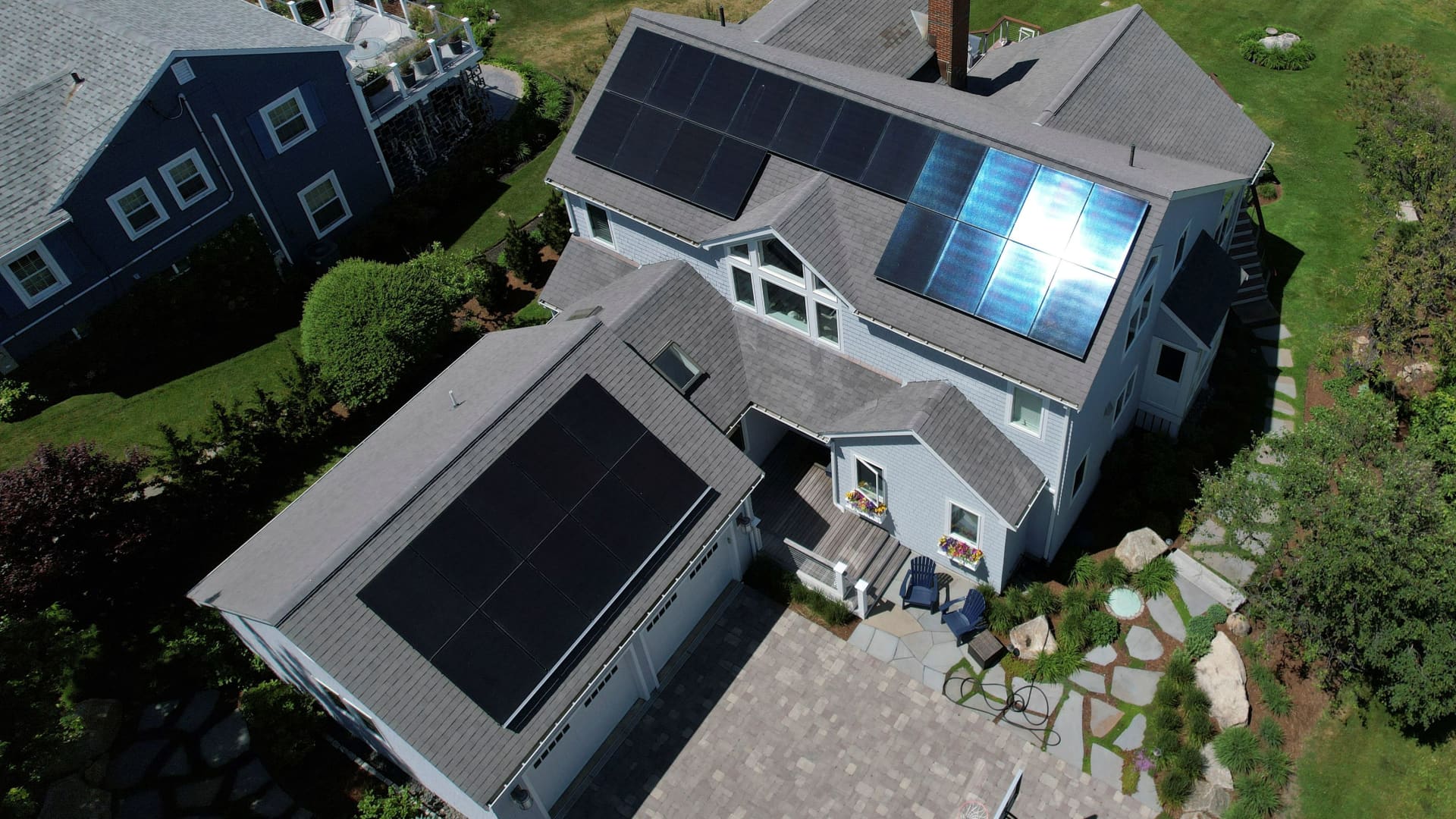
Solar panels create electricity on the roof of a house in Rockport, Massachusetts, U.S., June 6, 2022. Picture taken with a drone. 

Brian Snyder | Reuters

When Josh Hurwitz decided to put solar power on his Connecticut house, he had three big reasons: To cut his carbon footprint, to eventually store electricity in a solar-powered battery in case of blackouts, and – crucially – to save money.

Now he’s on track to pay for his system in six years, then save tens of thousands of dollars in the 15 years after that, while giving himself a hedge against utility-rate inflation. It’s working so well, he’s preparing to add a Tesla-made battery to let him store the power he makes. Central to the deal: Tax credits and other benefits from both the state of Connecticut and from Washington, D.C., he says.

“You have to make the money work,” Hurwitz said. “You can have the best of intentions, but if the numbers don’t work it doesn’t make sense to do it.” 

Hurwitz’s experience points up one benefit of the Inflation Reduction Act that passed in August: Its extension and expansion of tax credits to promote the spread of home-based solar power systems. Adoption is expected to grow 26 percent faster because of the law, which extends tax credits that had been set to expire by 2024 through 2035, says a report by Wood Mackenzie and the Solar Energy Industry Association. 

Those credits will cover 30 percent of the cost of the system – and, for the first time, there’s a 30 percent credit for batteries that can store newly-produced power for use when it’s needed.

“The main thing the law does is give the industry, and consumers, assurance that the tax credits will be there today, tomorrow and for the next 10 years,” said Warren Leon, executive director of the Clean Energy States Alliance, a bipartisan coalition of state government energy agencies. “Rooftop solar is still expensive enough to require some subsidies.”

California’s solar energy net metering decision

Certainty has been the thing that’s hard to come by in solar, where frequent policy changes make the market a “solar coaster,” as one industry executive put it. Just as the expanded federal tax credits were taking effect, California on Dec. 15 slashed another big incentive allowing homeowners to sell excess solar energy generated by their systems back to the grid at attractive rates, scrambling the math anew in the largest U.S. state and its biggest solar-power market — though the changes do not take effect until next April.

Put the state and federal changes together, and Wood Mackenzie thinks the California solar market will actually shrink sharply in 2024, down by as much as 39{515baef3fee8ea94d67a98a2b336e0215adf67d225b0e21a4f5c9b13e8fbd502}. Before the Inflation Reduction Act incentives were factored in, the consulting firm forecast a 50{515baef3fee8ea94d67a98a2b336e0215adf67d225b0e21a4f5c9b13e8fbd502} drop with the California policy shift. Residential solar is coming off a historic quarter, with 1.57 GW installed, a 43{515baef3fee8ea94d67a98a2b336e0215adf67d225b0e21a4f5c9b13e8fbd502} increase year over year, and California a little over one-third of the total, according to Wood Mackenzie.

This roofing company says it's figured out how to make solar shingles affordable

For potential switchers, tax credits can quickly recover part of the up-front cost of going green. Hurwitz took the federal tax credit for his system when he installed it in 2020, and is preparing to add a battery now that it, too, comes with tax credits. Some contractors offer deals where they absorb the upfront cost – and claim the credit – in exchange for agreements to lease back the system. 

Combined with savings on power homeowners don’t  buy from utilities, the tax credits can make rooftop solar systems pay for themselves within as little as five years – and save $25,000 or more, after recovering the initial investment, within two decades.  

“Will this growth have legs? Absolutely,” said Veronica Zhang, portfolio manager of the Van Eck Environmental Sustainability Fund, a green fund not exclusively focused on solar. “With utility rates going up, it’s a good time to move if you were thinking about it in the first place.”

How to calculate installation costs and benefits

Here is how the numbers work.

Nationally, the cost for solar in 2022 ranges from $16,870 to $23,170, after the tax credit, for a 10-kilowatt system, the size for which quotes are sought most often on EnergySage, a Boston-based quote-comparison site for solar panels and batteries. Most households can use a system of six or seven kilowatts, EnergySage spokesman Nick Liberati said. A 10-12 kilowatt battery costs about $13,000 more, he added.

There’s a significant variation in those numbers by region, and by the size and other factors specific to the house, EnergySage CEO Vikram Aggarwal said. In New Jersey, for example, a 7-kilowatt system costs on average $20,510 before the credit and $15,177 after it. In Houston, it’s about $1,000 less. In Chicago, that system is close to $2,000 more than in New Jersey. A more robust 10-kilowatt system costs more than $31,000 before the credit around Chicago, but $26,500 in Tampa, Fla. All of these average prices are as quoted by EnergySage. 

The effectiveness of the system may also vary because of things specific to the house, including the placement of trees on or near the property, as we found out when we asked EnergySage’s online bid-solicitation system to look at specific homes.

The bids for one suburban Chicago house ranged as low as $19,096 after the federal credit and as high as $30,676.

Offsetting those costs are electricity savings and state tax breaks that recover the cost of the system in as little as 4.5 years, according to the bids. Contractors claimed that power savings and state incentives could save as much as another $27,625 over 20 years, on top of the capital cost.

Alternatively, consumers can finance the system but still own it themselves – we were quoted interest rates of 2.99 to 8.99 percent. That eliminates consumers’ up-front cost, but cuts into the savings as some of the avoided utility costs go to pay off interest, Aggarwal said. 

The key to maximizing savings is to know the specific regulations in your state – and get help understanding often-complex contracts, said Hurwitz, who is a physician.

Energy storage and excess power

Some states have more generous subsidies than others, and more pro-consumer rules mandating that utilities pay higher prices for excess power that home solar systems create during peak production hours, or even extract from homeowners’ batteries.

California had among the most generous rules of all until this week. But state utility regulators agreed to let utilities pay much less for excess power they are required to buy, after power companies argued that the rates were too high, and raised power prices for other customers.

Wood Mackenzie said the details of California’s decision made it look less onerous than the firm had expected. EnergySage says the payback period for California systems without a battery will be 10 years instead of six after the new rules take effect in April. Savings in the years afterward will be about 60 percent less, the company estimates. Systems with a battery, which pay for themselves after 10 years, will be little affected because their owners keep most of their excess power instead of selling it to the utility, according to EnergySage. 

“The new [California rules] certainly elongate current payback periods for solar and solar-plus-storage, but not by as much as the previous proposal,” Wood Mackenzie said in the Dec. 16 report. “By 2024, the real impacts of the IRA will begin to come to fruition.”

The more expensive power is from a local utility, the more sense home solar will make. And some contractors will back claims about power savings with agreements to pay part of your utility bill if the systems don’t produce as much energy as promised. 

“You have to do your homework before you sign,” Hurwitz said. “But energy costs always go up. That’s another hidden incentive.”

Opinion: Homeowners should prepare for an ugly 2023, but it’s unlikely we’ll have a repeat of 2008

Opinion: Homeowners should prepare for an ugly 2023, but it’s unlikely we’ll have a repeat of 2008

Editor’s Be aware: Erik Lundh is a principal economist at The Meeting Board. The opinions expressed in this commentary are his individual. Browse far more impression at CNN.

A considerably-feared correction in US residence price ranges is underway. Though this may perhaps feel like déjà vu, the motorists powering the the latest spike in costs and the present-day housing current market downturn are diverse from the ones witnessed in the 2000s. This time all over, the US economic process is far better geared up, and a nationwide crisis is considerably less most likely.

Erik Lundh Conference Board

Courtesy Evercore

It is legitimate that US owners should put together for an unattractive 2023. Immediately after decades of underinvestment and suppressed provide, US household rates rose an eye-popping 45{515baef3fee8ea94d67a98a2b336e0215adf67d225b0e21a4f5c9b13e8fbd502} in between January 2020 and June 2022, as small curiosity rates and the surge in distant operate spurred need. For comparison, in the lead-up to the housing downturn that began 16 several years in the past, prices ended up up by 30{515baef3fee8ea94d67a98a2b336e0215adf67d225b0e21a4f5c9b13e8fbd502} in excess of a equivalent period.

But the housing bubble in the 2000s was underpinned by predatory lending, poor underwriting, adjustable-price mortgages and rampant speculation. People have been confident that housing was a terrific small-expression investment and that prices would only keep on to increase. This famously turned out not to be the case.

As fascination costs rose leading into 2006, costs finally began to slide later on that 12 months, and householders started defaulting on their property finance loan payments. As costs fell additional, householders rushed to dump their attributes, developing a feed-back loop that cascaded all over the overall actual estate marketplace. The subsequent fiscal crisis was induced by mass defaults in low-high quality home loans that had been wrapped up in mortgage-backed securities. These belongings all of a sudden became close to-worthless, which threw the financial program into crisis.

On top of that, many years of rampant need spurred builders to overbuild in the early 2000s, flooding the nation with a residence surplus. As a outcome, subsequent the Terrific Recession, it took several years for demand from customers to work via the large housing inventory that had been amassed. This, in transform, crushed the homebuilding business, causing chronic underbuilding in excess of the subsequent many years.

Quickly forward to right now, and the circumstance is extremely distinct: Dwelling prices are slipping simply because the Federal Reserve is increasing fascination costs to quell inflation. This, in convert, has pushed property finance loan premiums larger. Whilst the ordinary fee on a 30-calendar year property finance loan fell sharply last week, it is even now additional than double what it was a year back (3.10{515baef3fee8ea94d67a98a2b336e0215adf67d225b0e21a4f5c9b13e8fbd502} a year in the past vs. 6.61{515baef3fee8ea94d67a98a2b336e0215adf67d225b0e21a4f5c9b13e8fbd502} right now). These rates make financing new residence purchases unaffordable for quite a few potential buyers, so demand from customers is slowing and prices are slipping.

Thankfully, desire and provide fundamentals could restrict the draw back for US residence price ranges. Millennials, the major generational cohort since the baby boomers, have gotten older and are hunting to obtain their initially households. Regretably for them, there aren’t more than enough to go about. But this implies higher selling prices, even even though they are setting up to fall and will proceed to do so, will very likely be relatively sticky. In essence, demand from customers from Millennials will almost certainly enable preserve prices from moving into freefall – as was the case in 2008. It is extremely not likely this decrease would spark another fiscal crisis.

On top of that, in the several years that followed the 2008 money crisis, new rules were introduced. Banking companies are now required to be much better capitalized lending requirements are significantly extra demanding, leading to greater-good quality financial loans most mortgages are mounted-level and financial derivatives, such as asset-backed securities, are greater controlled. This all buttresses the money process from one more housing downturn.

Other valuable tendencies consist of the spike in refinancing exercise about the very last couple a long time connected with extremely-very low desire premiums. This pushed down regular payments for quite a few homeowners, earning servicing their home loans much easier.

Additionally, Individuals have more fairness in their homes than they did main up to the very last fiscal crisis. Without a doubt, personal loan-to-benefit ratios, which measure the amount of a home finance loan relative to the benefit of a house, for US home loans have fallen to just 42{515baef3fee8ea94d67a98a2b336e0215adf67d225b0e21a4f5c9b13e8fbd502} – a 12-12 months minimal. This creates additional of a “cushion” for charges to decrease ahead of household values tumble down below the financial loans that underpin them. Thus, if a property is marketed at a loss, it’ll most likely strike home owners before it hits the banking institutions.

The ongoing housing cost correction will have implications for the US economy, but lower property rates should aid to quell significant inflation. It will certainly come at the expense of economic progress, as homebuilding activity is presently slowing rapidly and purchaser self esteem (and expending) will probably experience as nicely. But it is not likely we’re heading for a repeat of 2008.