

Wyoming’s top education leaders have agreed to collaborate on pilot projects that could kickstart the remaking of the state’s K-12 education system.
In a first, a formal partnership will unite the Wyoming State Board of Education, Wyoming Department of Education, University of Wyoming and Gov. Mark Gordon’s office and their educational initiatives to put all of the state’s power behind transitioning education in Wyoming toward a system that’s center on individual student progress rather than seat time.
“Our listening carefully to educators across Wyoming reveals a hunger for student-centered innovation and competency-based approaches to teaching and learning,” Scott Thomas, the dean of UW’s College of Education, said in a statement. “This deliberate collaboration represents a signal moment for innovating education and advancing children’s learning throughout the state.”
People are also reading…

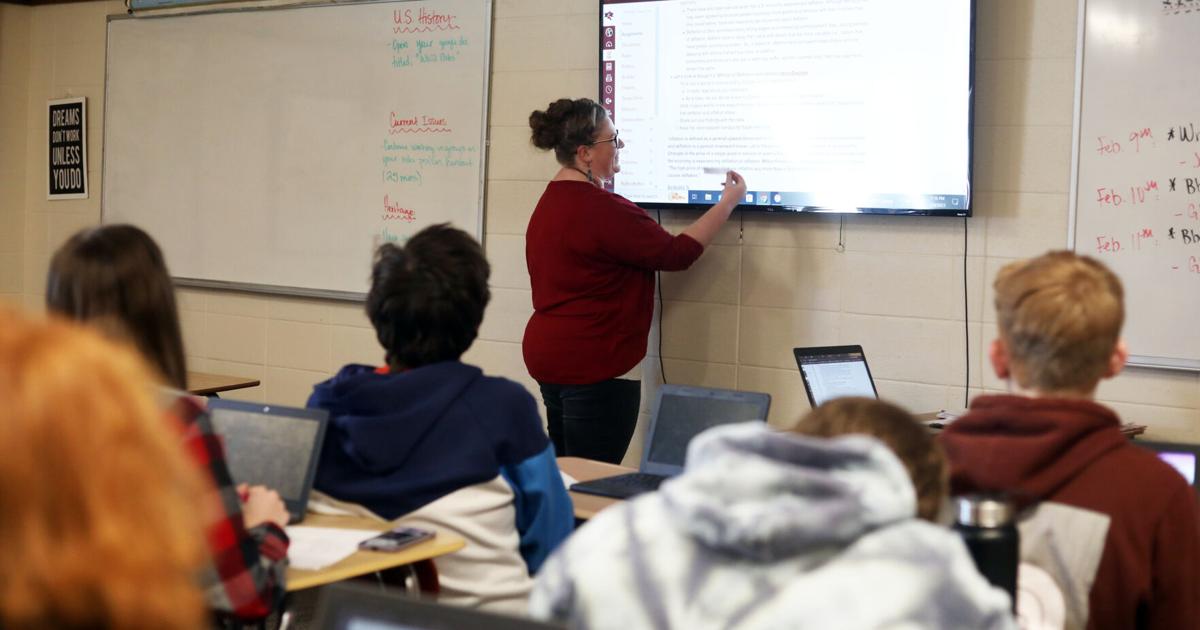
Desks at Riverton High School are pictured on Feb. 9.
The State Board of Education, which includes Thomas and State Superintendent of Public Instruction Megan Degenfelder, voted Thursday at a meeting in Riverton to formalize their cooperation and start on pilot projects that will move some schools toward competency-based learning, allowing them to focus more on the individual learning of students.
The pilots will be voluntary for schools, but those that join will change how they instruct and assess students.
Two paths forward
Diana Clapp, the coordinator for the Wyoming State Board of Education, presented members of the State Board of Education with two options.
In the first, the group will collaborate with schools and communities to expand on the work that they are already doing around competency-based learning. Schools would “mainstream” the programs they already have in place, such as career readiness and technical training programs, so that they reach more students.

The group would guide the schools through the transition, helping them with planning and giving them the support that they need to scale competency-based education. The Wyoming School-University Partnership, an alliance between school districts, community colleges, UW and state education organizations, would serve as a hub, acting as a facilitator so that schools could share their work and learn from one another.
The second option would involve starting from scratch. It would include the complete reorientation of pilot schools and pave the way for “systemic change” in Wyoming education.
The state would place pilot schools into small groups, which would then work together with the Department of Education, State Board of Education and the others to transform how they teach students. The schools and their communities would focus on the “application and transference of learning, personalized learning experiences, and alternative demonstrations of competency,” moving students away from seat time and traditional testing and assignments, according to a State Board of Education memo.
Outside experts would help the schools, which would open up their graduation requirements so that students could earn credits for educational opportunities outside of school. For example, instead of requiring a student to take a biology or environmental science course with exams, they may earn credit by working with the Wyoming Game and Fish Department on research.
In both pilots, schools would reconsider course and graduation requirements, give more weight to opportunities such as internships, capstones and work-based learning opportunities, and would allow students more flexibility to work at their own pace and follow their interests. The schools would also emphasize learning through projects.
“The willingness of the Governor, State Board and University to partner with us on this call for innovation is the key to our state achieving student centered education that best prepares students for the workforce,” Degenfelder said in a statement.

Martin Carman, 12, shows now Wyoming Superintendent of Public Instruction Megan Degenfelder how to fly a drone on Aug. 11 at Code Ninjas in Casper. Degenfelder is a former Department of Education administrator and worked for an energy company before taking office.
The state’s education leaders have yet to decide on a particular direction and have yet to select schools, but they will begin to outline plans for the pilots in the coming weeks, said Linda Finnerty, a spokesperson for the Department of Education.
Degenfelder said during the board’s meeting that the goal is to begin the pilots next fall.
An audible excitement swept those at the State Board of Education as they discussed the pilot projects and the shift toward competency-based learning.
“You’re talking about changing the bedrock essentially of education,” Lachelle Brant, Gordon’s education policy adviser, told the State Board of Education.
The board’s members acknowledged that the pilot schools could be the start of a monumental shift for Wyoming’s K-12 education.
“Sometimes a person gets on a board and you don’t really know what you’re supposed to be doing or what you’re accomplishing,” said Ellen Creagar, a member of the board and a social science and business professor at Eastern Wyoming College. “This isn’t that board folks. This is a board that’s really moving, shaking and making big, important, positive change for students and changing the face of education in Wyoming. It’s exciting.”
Bringing together initiatives
Competency-based education essentially means moving from a system in which students mold to education to one in which education molds to individual students.
It’s going from school desks lined up in rows, students listening to a PowerPoint lecture, to tests that ask a student to successfully perform a science experiment. It’s students taking the knowledge and skills that they build and applying them to the world outside of the classroom.
Competency-based education is premised on the “mastery” of a subject, not a test score or the time spent in a classroom.
Each of the four state bodies has led their own push toward competency-based education.
US Reading and Math Scores , Fell Sharply During Pandemic, , New Data Reveals. National Assessment of Educational Progress scores of fourth-grade students were released by the Education Department on Sept. 1. The scores reveal the most significant drop in math and reading scores for nine-year-olds in decades. The age of students is considered developmentally crucial. The scores are considered a prominent indicator of educational performance and economic outlook. Education scholars lamented the news, saying it is unlikely that the students affected by the pandemic will be able to catch up in the coming years. I don’t think we can expect to see these 9-year-olds catch up by the time they leave high school, Dr. Aaron Pallas, Teachers College Columbia University, via ‘The Wall Street Journal’. This is not something that is going to disappear quickly, Dr. Aaron Pallas, Teachers College Columbia University, via ‘The Wall Street Journal’. According to ‘The Wall Street Journal,’ . some scholars believe it could take decades for many students to return to pre-pandemic academic performance levels. COVID-19 shocked American education and stunted the academic growth [of students], Peggy G. Carr, National Center for Education Statistics Commissioner, via ‘The Wall Street Journal’. Average scores for math fell seven points from their pre-pandemic levels. Average scores for reading fell five points from their pre-pandemic levels. The numbers are the steepest decline in scores since 1990
The Department of Education and UW’s College of Education have focused on teachers, using the approach as a new way to train and certify educators. For Wyoming students, the most notable steps have come from Gordon’s office and the State Board of Education.
Gordon announced the creation of his Reimagining and Innovating the Delivery of Education (RIDE) initiative in May 2021. He asked the advisory group to broadly study how Wyoming could better prepare its K-12 students amid concerns about state funding for schools.
The group started a public input process to hear what Wyoming’s “consumers” – students, parents, businesses and educators – wanted from schools. It released a survey and held more than a dozen listening sessions across the state, producing a report in December that called for the remaking of Wyoming’s education system to focus on individualized learning for students.
In its report, the advisory group recommended the state strengthen career-connected education and change its K-12 system so that students progress through school based on academic mastery of subjects.
Gordon’s RIDE initiative paralleled an ongoing effort from the State Board of Education triggered several years before when the addition of computer science standards for K-12 raised questions about graduation requirements.
The State Board of Education started public outreach for its Profile of a Graduate initiative in March 2021 as it looked to shape Wyoming’s high school graduation requirements. The board asked Wyomingites to share the skills and knowledge that they wanted to see from the state’s graduates.
A survey and dozens of listening sessions revealed that the state’s residents wanted graduates to have seven key competencies, including mastering, applying and transferring foundational knowledge and skills, communicating effectively, and thinking critically.
While the State Board of Education and Gordon’s RIDE advisory group communicated with one another, their work was siloed – even as they found the same appeal of competency-based learning.
The vote Thursday at the State Board of Education marks the first time that all four state bodies have agreed to work together to advance competency-based learning in Wyoming.
“It is an honoring of the voices of the people of Wyoming,” Clapp told the board.
But while the board, UW, Department of Education and Gordon have bonded together, they still face a challenging road ahead.
A transition to competency-based learning is an enormous task and will not happen overnight. Board members acknowledged that the most significant obstacle will be educating parents, schools and communities about what may seem like a radical change.
Yet, they shared resolve that competency-based learning is the future of K-12 education in Wyoming.
“We’re all really in this together,” Degenfelder said.
PHOTOS: The first day of school in Casper
First day of school

Logan Turnbow holds onto his mom before heading into his first day of kindergarten on Tuesday at Lincoln Elementary School in north Casper. Students in the Natrona County School District began the fall semester Tuesday.
First day of school

Logan Turnbow holds onto his dad’s hand as he walks into his first day of kindergarten on Tuesday, September 6, 2022, at Lincoln Elementary School.
First day of school

Phillip Hubert, Lincoln Elementary School principal, welcomes new and returning students back to school on Tuesday, September 6, 2022, at Lincoln Elementary School.
First day of school

Sisters Kynlee and Avyree Bolin hold hands as they cross the street to their first day of school on Tuesday, September 6, 2022, at Lincoln Elementary School.
First day of school

Carissa Hanson puts important papers into her daughter Avyree Bolin’s backpack during the first day of school on Tuesday, September 6, 2022, at Lincoln Elementary School.
First day of school

Phillip Hubert, Lincoln Elementary School principal, welcomes new and returning students back to school on Tuesday, September 6, 2022, at Lincoln Elementary School.
First day of school

Oliver Revere excitedly runs toward his first day of school on Sept. 6 at Lincoln Elementary School in Casper. Wyoming schools have experienced a drop in enrollment, with kindergarten classes seeing the biggest decline.
First day of school

Families walk together to the first day of school on Tuesday, September 6, 2022, at Lincoln Elementary School.
