Hospitals and health care facilities should drop mask requirements, medical experts say

Hospitals and health care facilities should drop mask requirements, medical experts say

Even after mask mandates were dropped across the country amid dwindling COVID-19 cases and deaths, face coverings have still been required in many doctors’ offices, hospitals and other health care settings.

Now, a group of esteemed medical experts is calling for a change.

In an April 18 journal entry in the Annals of Internal Medicine, an academic medical journal, several physicians — including infectious disease specialists — wrote that it’s time to remove masking requirements in health care facilities.

“While critically important in the earlier phases of the pandemic, we’ve entered a more stable phase, with substantial population-level immunity, durable protection against severe disease, a series of less virulent variants, and other important and favorable changes,” said corresponding author Erica S. Shenoy, M.D., PhD, in a press release. 

FACE MASKS MADE ‘LITTLE TO NO DIFFERENCE’ IN PREVENTING SPREAD OF COVID, SCIENTIFIC REVIEW FINDS

She is the medical director of infection control for Mass General Brigham and an infectious diseases physician at Massachusetts General Hospital in Boston. 

“As conditions change, we need to re-evaluate our infection prevention policies, including masking requirements in health care settings, and adapt,” she added.

Patients in masks

Even after mask mandates were dropped across the country amid dwindling COVID-19 cases and deaths, face coverings have still been required in many doctors’ offices, hospitals and other health care settings. Now, a group of doctors is calling for this to end.  (iStock)

Other contributing physicians came from Harvard Medical School, Washington University School of Medicine, University of Iowa College of Medicine, Dartmouth Hitchcock Medical Center, Tufts University School of Medicine and Trinity Health Michigan. 

“Masking requirements in health care have continued longer than in the community because these settings have a higher proportion of individuals at high risk for complications of infection,” the authors wrote in the journal entry.

“However, the context and conditions of the pandemic have changed dramatically and favorably since masking requirements in health care were initially adopted, and evidence-based public health policy should also adapt in response.”

‘Makes complete sense’

Dr. Marc Siegel, a professor of medicine at NYU Langone Medical and a Fox News contributor, agreed with the decision.

“It makes complete sense to remove the universal mask requirements for medical centers — and NYU did it weeks ago,” he told Fox News Digital. “It hasn’t made sense for a while.”

“We should adapt mask policies to reflect this new reality.”

Dr. Shana Johnson, a physical medicine and rehabilitation physician in Scottsdale, Arizona, reviewed the doctors’ recommendations.

“As we transition to the place where SARS-CoV-2 is a constant and stable presence in our community, we should adapt mask policies to reflect this new reality,” she told Fox News Digital. 

Weighing costs, benefits

In the journal entry, the authors pointed out that masking in health care settings was appropriate early in the pandemic as a means of limiting spread among medical personnel, patients and visitors.

Photo shows piles of face masks, including surgical masks and N95 masks

Dr. Marc Siegel of New York City said he continues to wear a KN95 or N95 mask in the room with most patients, especially those with respiratory symptoms. He said, however, that it “makes complete sense to remove the universal mask requirements for medical centers.” (iStock)

But as the population has achieved greater immunity and COVID has entered a “more stable phase” — and as public health agencies and the U.S. government have declared that the public health emergency is over — the physicians stated in the findings that the small benefits of continuing to require masks don’t justify the costs.

“Masks do have downsides, such as impaired communication and disrupted human connection.”

“After three years of universal masking in health care, the risk-benefit calculation has shifted,” said Shira Doron, M.D., chief infection control officer for Tufts Medicine health system and hospital epidemiologist at Tufts Medical Center, in the press release announcing the paper. 

“Masks do have downsides, such as impaired communication and disrupted human connection.  We are at a stage of the pandemic where it now makes sense to end mandatory masking,” she added.

PARENTS NOW QUESTION WHETHER COVID MASK MANDATES DID MORE HARM THAN GOOD

Among the drawbacks of masks, the study authors cited an “increased cognitive load” for doctors who are trying to listen to patients wearing face coverings. 

This is particularly difficult for patients who do not speak fluent English or who are hard of hearing, they added.

“Masks obscure facial expression; contribute to feelings of isolation; and negatively impact human connection, trust and perception of empathy,” the authors wrote.

“Masking is not without its downsides,” Dr. Johnson said. “Masks make it more difficult to hear, understand and communicate with your provider. Some choice makes sense.”

‘Standard precautions’ should be used

In lieu of universal masking, the study authors suggested that health care settings should follow “Standard Precautions and Transmission-Based Precautions,” as outlined by the Centers for Disease Control and Prevention (CDC).

Patients without masks

“Masks obscure facial expression; contribute to feelings of isolation; and negatively impact human connection, trust and perception of empathy,” the authors wrote. (iStock)

Health care personnel should wear masks to prevent exposure as needed, according to those guidelines. 

Also, any people with respiratory symptoms (namely, coughing or sneezing) should use a face covering.

Additionally, if a medical worker is “caring for patients with suspected or confirmed respiratory infection, they should use personal protective equipment and other interventions.”

Rather than having universal masking requirements, Dr. Siegel believes the decision should be “based on individual risk.”

“Universal masking in health care is a policy whose time has come and gone … for now.”

“It should be reserved for patients who are immunocompromised or severely or chronically ill or the doctors that care for them,” he told Fox News Digital. “Patients who are acutely ill and those with chronic lung problems should continue to wear masks.”

The doctor said he continues to wear a KN95 or N95 mask in the room with most patients, especially those with respiratory symptoms.

“Certain health care settings with high-risk patients could still choose to use universal masking, but it would not be required in other areas of normal risk,” added Dr. Johnson.

Reconsidering other early-pandemic precautions

Along with dropping mask requirements in health care settings, the physicians wrote that other protocols should be reconsidered.

COVID testing

The doctors wrote that in addition to universal masking, other early pandemic strategies, such as asymptomatic testing and contact tracing, should also be reconsidered. (AP)

“Moving away from universal masking policies should be accompanied by reconsideration of other pandemic-era strategies (for example, asymptomatic testing, resource-intensive contact tracing), which similarly have experienced a shift in their risk-benefit balance over the course of the pandemic,” they stated in the discussion.

Potential for masking to return

The latest commentary doesn’t mean that masking policies won’t return sometime in the future, the physicians noted.

“Future pandemics or significant localized outbreaks may justify more widespread or targeted masking policies, respectively, as part of a bundled response,” they wrote, noting that it’s important to educate health care personnel and patients as policies change.

COVID-19’S LASTING IMPACT: ‘LESS ATTRACTIVE’ PEOPLE WEAR MASKS MORE OFTEN THAN OTHERS, STUDY FINDS

“Change and adaptation are expected,” said senior author Dr. Westyn Branch-Elliman, an infectious diseases specialist and clinical investigator at VA Boston Healthcare System. 

“That does not mean ‘the science has changed,’ but almost everything around it has.”

The doctors called for “focused research” to “ensure requirements are not maintained longer than necessary and are reinstated when needed.”

Additionally, the authors noted that the Healthcare Infection Control Practices Advisory Committee (HICPAC) at the Centers for Disease Control and Prevention (CDC) “is currently reevaluating existing approaches to Transmission-Based Precautions, which is likely to inform future considerations for health care transmission mitigation strategies.”
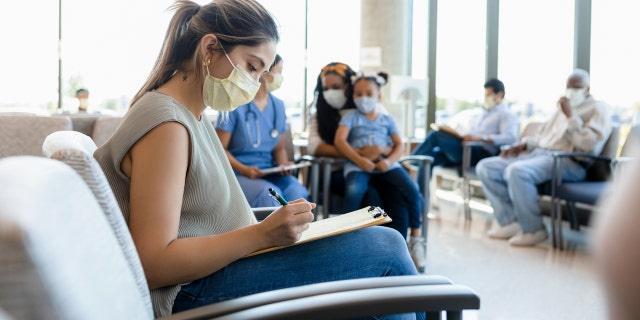
Hospital waiting room

The authors pointed out that masking in health care settings was appropriate early in the pandemic as a means of limiting spread among medical personnel, patients and visitors. Now, however, they said that “universal masking in health care is a policy whose time has come and gone … for now.” (iStock)

“The time has come to de-implement policies that are not appropriate for an endemic pathogen when the expected benefits of such policies are low,” they concluded. 

“Universal masking in health care is a policy whose time has come and gone … for now.”

CLICK HERE TO SIGN UP FOR OUR HEALTH NEWSLETTER

COVID cases and deaths continue to decline. 

As of April 19, the CDC reported 94,142 weekly deaths in the U.S., down from a peak of 5.5 million in January 2022. 

Weekly deaths from COVID were down to 1,160; the highest count was 23,629 in January 2021.

CLICK HERE TO GET THE FOX NEWS APP

The World Health Organization released updated masking guidelines in January 2023. 

Despite the decreasing COVID numbers, the agency stated that “masks are recommended following a recent exposure to COVID-19, when someone has or suspects they have COVID-19, when someone is at high risk of severe COVID-19, and for anyone in a crowded, enclosed or poorly ventilated space.”


DC Health launches pilot program for lifesaving medical vending machines

DC Health launches pilot program for lifesaving medical vending machines

The D.C. governing administration has announced the rollout of harm reduction vending devices that will let people obtain to reside-conserving medication and other wellness merchandise.

The D.C. federal government will roll out damage-reduction vending devices that give  obtain to lifesaving drugs and other wellness products and solutions.

DC Wellbeing, in partnership with the Section of Behavioral Health and fitness and D.C. Fireplace and EMS, claimed that these vending devices will provide lifesaving tools this kind of as naloxone, Narcan and fentanyl take a look at strips, along with hygiene and wellness solutions.

This type of equipment is turning out to be more typical in towns throughout the state due to the increase in opioids usage and overdoses, and their potential to supply accessibility to vital providers that will help the individuals who have to have it most.


In October 2021, DC Well being awarded grants to the Family and Health-related Counseling Companies and HIPS harm reduction companies to start the implementation of the vending equipment in the District.

“This pilot job will examine the utilization styles and constructive effect these goods have on the very well-becoming of vulnerable communities in the place,” DC Health said in a information launch.

4 of the planned 6 machines have been put in parts the department deems as getting “higher than average charges of drug overdose and unhoused populations.” The relaxation will be offered April 10.

DC Wellbeing set up vending equipment containing damage-lessening and other solutions. (Courtesy DC Wellness)

DC Wellness Director Dr. Sharon Lewis claimed the equipment target place most difficult strike by the opioid disaster.

In this article are the places in which D.C. citizens can locate the vending devices:

  • DCFD Engine #7: 1101 50 {515baef3fee8ea94d67a98a2b336e0215adf67d225b0e21a4f5c9b13e8fbd502} St. SW
  • DCFD Engine #27: 4260 Minnesota Ave. NE
  • DCFD Engine #33: 101 Atlantic St. SE
  • Whitman-Walker Overall health Center: 2301 Martin Luther King Jr. Ave. SE

“They will be strategically placed in locations that are not well-resourced,” Lewis claimed.

To get merchandise within, all men and women require to do is call the amount on the front of every equipment for a 1-time totally free access card.

DC Behavioral Wellbeing Director Dr. Barbara Bazron additional that there could be an avenue for people today in large-need places to established up normal accessibility to devices if they call their section.

“Be prepared and remain ready to help you save the existence of a beloved just one, a pal, a neighbor, or even a stranger,” Bazron reported.

DC Wellbeing reported that relying on the numbers, there is probable for the application to broaden in other regions of the District.

WTOP’s Matt Kaufax contributed to this report.

Like WTOP on Fb and comply with WTOP on Twitter and Instagram to have interaction in dialogue about this write-up and other folks.

Get breaking news and everyday headlines delivered to your e mail inbox by signing up right here.

© 2023 WTOP. All Rights Reserved. This web page is not intended for customers found in the European Financial Area.

Medical residents unionize at hospitals around the country : Shots

Medical residents unionize at hospitals around the country : Shots

Dr. Leah Rethy is an internal medicine resident with Penn Medicine.

Kimberly Paynter/WHYY


hide caption

toggle caption

Kimberly Paynter/WHYY


Dr. Leah Rethy is an internal medicine resident with Penn Medicine.

Kimberly Paynter/WHYY

Dr. Leah Rethy was pregnant during the first year of her internal medicine residency at the Hospital of the University of Pennsylvania in Philadelphia. She gave birth during her second year. She worked through her 40th week of pregnancy so she could save her time off and spend more time with her newborn.

Now she’s back at work and needs child care. A lot of child care. Medical residents often work long and irregular hours, sometimes as many as 80 hours a week. And child care is one of the main issues motivating Rethy to push for a union at her hospital.

In February, most residents at two major Penn Medicine hospitals decided to form a union, and the National Labor Relations Board will conduct their election in early May. They join a wave of other residents unionizing at programs around the country, most recently at Montefiore hospital in New York, George Washington University in Washington, DC, and Mass General Brigham in Boston.

If successful, these residents would join the Committee of Interns and Residents, the union for medical residents. According to the union’s figures, the number of campaigns spiked from two in 2021, to eight in 2022, an unprecedented increase.

Child care challenges

Rethy says her problem with child care is not unusual — residency follows undergraduate education, and usually four years of medical school, so it overlaps with childbearing years for most people.

“I know a lot of people who’ve delayed having children,” she says. “And I also have heard a number of stories of people delaying having children and then, ultimately, having real challenges getting pregnant because of being older and various factors.”

Dr. Leah Rethy, an internal medicine resident with Penn Medicine, holds her 17 month-old son, Peter.

Kimberly Paynter/WHYY


hide caption

toggle caption

Kimberly Paynter/WHYY


Dr. Leah Rethy, an internal medicine resident with Penn Medicine, holds her 17 month-old son, Peter.

Kimberly Paynter/WHYY

Rethy laments the waiting lists for child care affiliated with Penn Medicine, and says finding her own child care is prohibitively expensive.

“The cost of day care … in a month is about half of my salary in total, and the cost of a nanny is essentially the entirety of my salary,” says Rethy.

She says this experience led her to believe unionizing is the best way for residents to demand better working conditions and higher pay, which would lead to better patient care.

A workforce that can’t leave

Sunyata Altenor is the communications director of Committee of Interns and Residents, or CIR, as the union is known. She says residents who want to unionize understand the program is supposed to be hard work, with long hours. But they want to be treated fairly for their efforts, at a workplace they cannot just choose to leave, as it’s a required part of their training.

“It’s easy to exploit physicians during this time in their career,” Altenor says. “They’re only going to be there for a few years. It’s sort of expected that you go through this hard, hazing culture, and then you come out at the other end an attending physician.”

Prominently, Stanford Medicine did not include residents in their COVID-19 vaccination plans in 2020, leading to protests, and later, a successful unionization drive.

Dr. Chantal Tapé, a third-year resident in family medicine at Penn Medicine, said residents expect challenging work and long shifts, but they would also like to be able to be healthy and financially stable so they can focus on taking care of patients.

She said it is “frustrating as someone who is a prenatal care provider,” to watch colleagues struggle during pregnancy make it to prenatal care appointments and during early parenthood to afford child care. Her colleagues can’t follow advice she recommends for her patients.

Parking, mice and roaches, too

Penn Medicine residents cite many issues for their decision to form a union, such as: the upcoming loss of parking benefits that would lead to an extra $200 monthly cost for residents; and dirty call rooms, which are rooms where residents stay and rest if they have to work overnight.

Residents say some current call rooms have mice and cockroaches.

Dr. Madison Sharp, a third-year OB-GYN resident, recalls not even having a call room to sleep in during a 24-hour rotation.

“So I tried to sleep in a dialysis chair that didn’t lie flat in a conference room off to the side,” she said. “Two years later, residents on that same rotation still don’t have a place to sleep for a few hours on a 24-hour call shift … keep in mind that Penn just opened a billion-dollar hospital but neglected to create physical space for us.”

Medical residents at Penn Medicine say cockroaches and mice have been seen in the “call rooms” where doctors rest during 24-hour shifts.

Resident at Penn Medicine


hide caption

toggle caption

Resident at Penn Medicine


Medical residents at Penn Medicine say cockroaches and mice have been seen in the “call rooms” where doctors rest during 24-hour shifts.

Resident at Penn Medicine

In a prepared statement, Penn Medicine says it values residents and is “proud of the ways in which we have sought to continually improve resident life and wellness.” The statement maintains it provides benefits and increased salaries to offer competitive working conditions. Starting July 1, resident salaries will start at a little more than $69,000 a year, according to Penn Medicine. They also say “trainees” should bring their concerns to administrators through an existing advisory council.

“I was the president of this council last year, and I can tell you firsthand that the House staff governing council is extremely limited in what we could accomplish,” Sharp said. “It was incredibly frustrating to advocate for residents and fellows and not be heard or have our concerns brushed aside or dismissed.”

Residents at the University of Vermont Medical Center voted to form a union last year. Following the successful union vote for residents, support staff including maintenance workers and technicians are unionizing as well.

The union for residents at Jersey City Medical Center has already argued for a better work environment in the years since they’ve organized, said Dr. Andrea Attenasio, a fourth-year resident in orthopedic surgery. For instance, she said they recently managed to ask the hospital to provide food for residents who work after hours; to provide bedsheets for the rooms where residents stay if they work overnight; and to stop tying salary increases for residents to overall hospital performance, a major concern with rising inflation and cost of living.

Attenasio said the bargaining power and strength in numbers that comes from being a union member makes a difference for residents:.

“It’s an automatic support system and it allows you to go to your hospital administration as a united front.”

Patient advocates push for aggressive crackdown on medical debt : Shots

Patient advocates push for aggressive crackdown on medical debt : Shots

Marcus and Allyson Ward have been spending off a credit card debt dating again to the birth of their twins, Theo and Milo. They are amongst 100 million People with health-related credit card debt, in accordance to a KHN/NPR investigation.

Taylor Glascock for KHN and NPR


hide caption

toggle caption

Taylor Glascock for KHN and NPR


Marcus and Allyson Ward had been shelling out off a personal debt dating back again to the start of their twins, Theo and Milo. They are between 100 million Individuals with health care personal debt, according to a KHN/NPR investigation.

Taylor Glascock for KHN and NPR

Dozens of advocates for clients and individuals, citing common harm brought on by professional medical credit card debt, are pushing the Biden administration to choose more aggressive methods to defend Us citizens from health care bills and personal debt collectors.

In letters to the IRS and the Consumer Money Defense Bureau, the teams phone for new federal procedures that among other matters would prohibit personal debt for medically essential care from appearing on buyer credit rating reviews.

Advocates also want the federal govt to bar nonprofit hospitals from marketing affected person credit card debt or denying clinical treatment to men and women with earlier-because of expenditures, tactics that continue to be popular throughout the U.S., KHN identified.

And the teams are urgent the IRS to crack down on nonprofit clinic programs that withhold economic support from lower-earnings clients or make support cumbersome to get, an additional prevalent impediment KHN documented.

“Every single day men and women are possessing to make alternatives about housing and outfits and food items due to the fact of professional medical financial debt,” claims Emily Stewart, govt director of Group Catalyst, a Boston nonprofit main the exertion. “It’s seriously urgent the Biden administration consider action to set protections in position.”

Amongst the far more than 50 groups supporting the initiative are countrywide advocates these types of as the National Buyer Law Heart, the Arthritis Basis, and the Leukemia & Lymphoma Society.

Nationwide, 100 million persons have wellbeing treatment credit card debt, in accordance to a KHN-NPR investigation, which has documented a disaster that is driving People from their houses, draining their personal savings, and stopping tens of millions from accessing treatment they have to have.

When some of the debt appears on credit score stories, substantially of it is concealed elsewhere as credit rating card balances, financial loans from kin, or payment programs to hospitals and other health care vendors.

The scale of this difficulty and its toll have spurred numerous countrywide and point out endeavours.

Previous spring, the White House directed federal organizations to operate on relieving clinical money owed for veterans and to end contemplating clinical personal debt in assessing eligibility for some federally backed home loans.

California, Colorado, Maryland, New York, and other states have enacted new guidelines to increase client protections and involve hospitals inside their borders to enhance economical help. And the a few greatest credit companies — Equifax, Experian, and Transunion — mentioned they would cease which include some health care credit card debt on credit rating studies as of past July.

But a lot of shopper and patient advocates say the steps, while significant, continue to leave tens of millions of People in america susceptible to fiscal damage if they develop into sick or wounded. “It is vital that the CFPB consider extra action,” the groups write to the federal agency created in 2010 to bolster oversight of client financial merchandise.

The important credit history score providers, for case in point, agreed to exclude only debts that have been paid off and unpaid money owed of significantly less than $500. Patients with greater medical expenditures they can not pay may possibly continue to see their credit scores drop.

The teams also are inquiring the CFPB to do away with deferred fascination on health-related credit score cards. This arrangement is typical for vendors this kind of as CareCredit, whose financial loans carry no interest at first but can exceed 25{515baef3fee8ea94d67a98a2b336e0215adf67d225b0e21a4f5c9b13e8fbd502} if individuals you should not fork out off the bank loan in time.

Collection field officials have lobbied in opposition to broader constraints on credit rating reporting, stating limits would get away an critical tool that hospitals, physicians’ places of work, and other health care providers need to accumulate their cash and stay in business enterprise.

“We value the difficulties, but a wide ban on credit rating reporting could have some unintended effects,” explained Jack Brown III, president of Florida-based Gulf Coast Collection Bureau, citing the prospect of battling hospitals and other companies closing, which would lower care selections.

Brown, a previous president of ACA Global, the collection industry’s main trade affiliation, warned that extra health care vendors would also start out demanding upfront payment, putting supplemental stress on sufferers.

To further more shield sufferers from out-of-pocket costs like these, lots of advocates say hospitals, especially people that are exempt from taxes because they are intended to provide the neighborhood, need to make financial aid additional obtainable, a vital desire in the group’s letters. “For far too very long, nonprofit hospitals have not been behaving like nonprofits,” stated Liz Coyle, govt director of the nonprofit Georgia Observe.

Charity treatment is provided at most U.S. hospitals. And nonprofit professional medical units will have to give support as a affliction of becoming tax-exempt. But at several professional medical facilities, information about this assistance is challenging or not possible to discover.

Specifications also differ greatly, with help at some hospitals restricted to sufferers with money as lower as $13,590 a calendar year. At other hospitals, individuals generating 5 or six occasions that significantly can get support.

The outcome is prevalent confusion that has remaining numerous sufferers who really should have been qualified for assist with massive expenses as a substitute. A 2019 KHN analysis of healthcare facility tax filings identified that just about 50 percent of nonprofit health-related units were being billing clients with incomes minimal ample to qualify for charity treatment.

The teams are asking the IRS to concern regulations that would set prevalent requirements for charity treatment and a uniform software throughout nonprofit hospitals. (Present-day polices for charity treatment do not apply to for-gain or general public hospitals.)

The advocates also want the federal agency to reinforce restrictions on how much nonprofit hospitals can demand and to curtail aggressive selection practices these types of as foreclosing on patients’ residences or denying or deferring medical treatment.

Far more than two-thirds of hospitals sue people or choose other lawful motion in opposition to them, such as garnishing wages or positioning liens on assets, according to a current KHN investigation. A quarter sell patients’ debts to personal debt collectors, who in turn can go after patients for several years for unpaid charges. About 1 in 5 deny nonemergency care to people today with excellent personal debt.

“Charitable establishments, which have other solutions of assortment accessible to them, need to not be permitted to withhold wanted health care care as a means to stress individuals to pay,” the groups wrote.

KHN (Kaiser Health Information) is a nationwide, editorially unbiased plan of KFF (Kaiser Family Foundation).

China Medical University Hospital ranks global third in 2022 HIMSS Digital Health Indicator

China Medical University Hospital ranks global third in 2022 HIMSS Digital Health Indicator

China Professional medical University Medical center in Taichung, Taiwan has established its capability in electronic wellness by scoring very well above the world-wide normal in the most current HIMSS Electronic Wellness Indicator.

The DHI actions an organisation’s development in building a digital health ecosystem in 4 dimensions: predictive analytics, interoperability, predictive analytics, man or woman-enabled wellness and governance and workforce.

Dependent on HIMSS’s assessment, CMUH scored 348/400 for the DHI, which was previously mentioned the worldwide median score of 170 and the Asia-Pacific median rating of 163 in 2022. The clinic did pretty well in enabling interoperability although it proved to be great in the places of man or woman-enabled wellness, predictive analytics, and governance and workforce.

CMUH attributes this achievement to its progress and implementation of 3 good platforms that have led to clinical follow improvements. One of them is the AI-driven Smart Anti-Microbial Method, which helps with the early and fast detection of a causative bacterial strain. Considering the fact that applying this know-how, it has diminished its close to-overlook price in antibiotic prescriptions from 12.1{515baef3fee8ea94d67a98a2b336e0215adf67d225b0e21a4f5c9b13e8fbd502} to {515baef3fee8ea94d67a98a2b336e0215adf67d225b0e21a4f5c9b13e8fbd502}. 

The clinic also credits its two other platforms, the Distant Myocardial Infarction Diagnostic Method and the Integrated Intelligent ARDS Lifesaver, to its large DHI ranking. 

HIMSS also recommended the clinic for its affected individual-centric solutions, such as its sensible wards which have realised performance in patient administration utilizing a solitary observe and the CMUH mobile app that streamlines affected person admission and permits remote care checking. 

WHY IT Issues

CMUH’s goal is to measure its electronic health ability in opposition to worldwide specifications and identify areas for advancement. The hospital views its DHI score as an prospect to partner with HIMSS and other foremost global wellness devices to generate its electronic transformation. 

In addition, CMUH seeks possibilities to boost its digital health ecosystem and acquire aid in building the proper expense conclusions by figuring out precedence regions. 

“We made a decision to go by way of the DHI assessment as we are certain that the scores and rating of intelligent hospitals by HIMSS will be objective and unbiased,” stated CMUH superintendent Professor Der-Yang Cho.

THE More substantial Pattern

A info-pushed treatment product underpins CMUH’s electronic transformation. Since introducing 5G throughout its community, it has been equipped to obtain information from wearable units through the cloud, enabling remote healthcare. It was also equipped to streamline its workflow and give personalised health care.

In 2019, CMUH attained Stage 7 accreditation for the HIMSS Electronic Healthcare Report Adoption Model, which has been a big contributor to its existing DHI ranking.

The healthcare facility has now positioned itself between the course of top world overall health devices – all coming from the Asia-Pacific – that have accomplished higher scores in the DHI. Based mostly on the scores of organisations that underwent the DHI evaluation in 2022, Samsung Health care Middle from South Korea qualified prospects the world wide position at 365/400, followed by Chang Gung Memorial Medical center (349/400), also from Taiwan.

Sharon Osbourne gives health update after medical emergency: ‘Back home and doing great’

Sharon Osbourne gives health update after medical emergency: ‘Back home and doing great’

Sharon Osbourne took to Instagram on Monday to share with her fans that she’s “back home and doing great” after the 70-year-old was rushed to the hospital following a medical emergency.

Osbourne shared an image of her pup sitting in front of a Christmas tree. She also thanked everyone for all the love. 

On Saturday, Santa Paula Police Chief Don Aguilar confirmed to Fox News Digital that Osbourne was rushed to the hospital after a medical emergency Friday evening. 

Ventura County Fire Department told Fox News Digital that their team responded to a “medical call” at Glen Tavern around 6:30 p.m. Friday and transported one patient to Santa Paula Hospital.

WATCH ‘SHARON OSBOURNE TO HELL & BACK’ ON FOX NATION

Following the news, Osbourne’s son Jack Osbourne shared an update on his mother’s condition Saturday. 

The 37-year-old television personality assured fans that the former talk show host was now at home after being “given the all clear from her medical team.” He also addressed reports that Sharon was filming an episode of the Travel Channel’s “Ghost Adventures” when she experienced a medical emergency.

SHARON OSBOURNE SAYS ‘MY HEART BREAKS’ FOR HUSBAND OZZY AFTER PARKINSON’S DIAGNOSIS

“Ok, here is what I’ll say – first things first MY MOTHER WASN’T FILMING AN EPISODE OF @ghostadventures,” Jack wrote in a post on his Instagram story on Saturday. “She was filming an episode of Night of Terror with me. Hahaha.”

He continued, “Now that we have made that clear…She has been given the all clear from her medical team and is now home. Thank you to everyone who has reached out with love and support.”

Sharon’s medical emergency comes on the heels of a challenging year for the Osbournes. Her husband Ozzy, 73, revealed he has Parkinson’s disease in January 2020 and underwent major surgery this past June. 

Sharon’s medical emergency comes on the heels of a challenging year for the Osbournes. Her husband Ozzy, 73, revealed he has Parkinson’s disease in January 2020 and underwent major surgery this past June. 
(Gregg DeGuire/Getty Images for The Recording Academy)

“As to what happened to my mum – I’m gonna leave it to her to share about it when she’s ready.”

Sharon’s medical emergency comes on the heels of a challenging year for the Osbournes. 

Her husband Ozzy, 73, revealed he has Parkinson’s disease in January 2020 and underwent major surgery this past June. 

She spoke out about her husband’s difficult surgery during a recent appearance on her UK chat show Talk TV.

Sharon at the time also revealed that this procedure was “really going to determine the rest of his life.”

Sharon Osbourne also stepped down as host of "The Talk" last year.

Sharon Osbourne also stepped down as host of “The Talk” last year.
(Getty Images)

Luckily, Ozzy expressed that he had made significant improvements in his health since undergoing the major surgery.

CLICK HERE TO SIGN UP FOR THE ENTERTAINMENT NEWSLETTER

Married since 1982, the Osbournes have entered a new phase of their relationship since the former Black Sabbath star has been diagnosed with Parkinson’s disease. In a vulnerable interview on the ITV show “Paxman: Putting Up With Parkinson’s,” Sharon shared, “When I look at my husband, my heart breaks for him.”

She admitted in October, “Suddenly, your life just stops, life as you knew it.”

The Osbournes, who celebrated their 40th wedding anniversary a few months ago, have been candid about the struggles they have faced in the past several years, both professionally and personally. 

Sharon reluctantly left her job last year as a host of “The Talk.”

General views of Glen Tavern Inn in Santa Paula, California where Sharon Osbourne fell ill while filming.

General views of Glen Tavern Inn in Santa Paula, California where Sharon Osbourne fell ill while filming.
(Coleman-Rayner for Fox News Digital)

Ventura County Fire Department told Fox News Digital that their team responded to a "medical call" at Glen Tavern around 6:30 p.m. Friday and transported one patient to Santa Paula Hospital.

Ventura County Fire Department told Fox News Digital that their team responded to a “medical call” at Glen Tavern around 6:30 p.m. Friday and transported one patient to Santa Paula Hospital.
(Coleman-Rayner for Fox News Digital)

In recent years, Ozzy has suffered several health scares due to his condition and has had to significantly alter how he spends his days.

CLICK HERE TO GET THE FOX NEWS APP

In addition to Kelly and Jack, the couple also share daughter Aimee. Ozzy also has Louis and Jessica from his previous marriage to ex-wife Thelma Riley.

Fox News Digital’s Stephanie Giang-Paunon and Ashley Hume contributed to this report