
Secrecy shrouds troubled state psychiatric hospital in Montana : Shots

Secrecy shrouds troubled state psychiatric hospital in Montana : Shots

Jennifer Mitchell thumbs through her husband’s medical records from his time at the Montana State Hospital. Records show doctors took Mitchell’s husband off some of his congestive heart failure medications. Mitchell says she was never consulted.

Aaron Bolton/Montana Public Radio


hide caption

toggle caption

Aaron Bolton/Montana Public Radio


Jennifer Mitchell thumbs through her husband’s medical records from his time at the Montana State Hospital. Records show doctors took Mitchell’s husband off some of his congestive heart failure medications. Mitchell says she was never consulted.

Aaron Bolton/Montana Public Radio

BUTTE, Mont. — Jennifer Mitchell remembered getting a call nearly two years ago that her 69-year-old husband, Bill, had crashed his car and had been committed to the Montana State Hospital, the state-run psychiatric hospital for adults about 20 miles from their home in Butte.

Physicians thought Bill Mitchell had dementia and could be a danger to himself or others, according to medical records. But once he was admitted, his wife really began to worry. She couldn’t visit him because of covid-19 restrictions, and she couldn’t get details about the care or the medicine he was receiving.

“I tried to get an idea of what he was taking, not taking. I could not get answers,” Jennifer said.

When Bill was discharged after 60 days, Jennifer discovered he had been taken off some of his congestive heart failure medications. A month later, he went into cardiac arrest and was moved to hospice care. He died on July 30, 2021, a day after his 70th birthday.

The psychiatric hospital in southwestern Montana has been under scrutiny since the federal Centers for Medicare & Medicaid Services decertified it in April 2022 following investigations into patient deaths and assaults. Federal officials found in the investigations that the hospital had failed to meet Medicare’s “basic health and safety requirements.”

Mitchell said that she was infuriated by the lack of transparency around her husband’s care and that she hoped decertification would force a change for the better. But it’s had the opposite effect. When federal oversight and funding of the Montana State Hospital was removed, so too was the ability of the public to learn details surrounding patient deaths and injuries.

Between April’s decertification and the end of December, five Montana State Hospital patients have experienced severe injuries requiring immediate medical care or hospitalization, and there have been eight substantiated abuse and neglect reports, Montana Department of Public Health and Human Services spokesperson Jon Ebelt said.

Six patients died in that period in the 174-bed hospital, though Ebelt declined to say how many deaths were investigated or if any deaths were deemed preventable.

The Montana State Hospital in Warm Springs, Montana, lost federal funding in April 2022 after an investigation into four patient deaths and a violent patient-on-patient assault.

Aaron Bolton/Montana Public Radio


hide caption

toggle caption

Aaron Bolton/Montana Public Radio
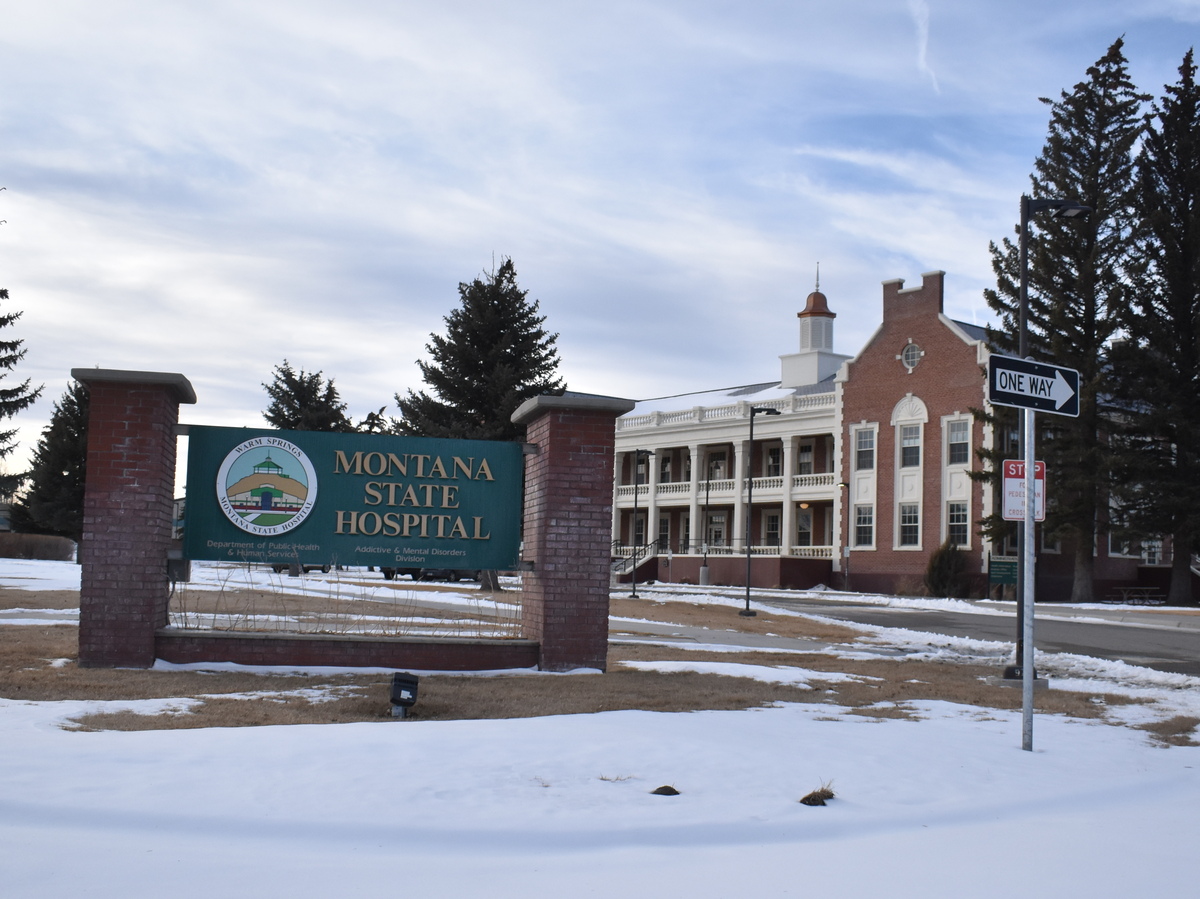

The Montana State Hospital in Warm Springs, Montana, lost federal funding in April 2022 after an investigation into four patient deaths and a violent patient-on-patient assault.

Aaron Bolton/Montana Public Radio

The circumstances surrounding all those incidents are not publicly known. That’s because, unlike federal investigations, state-level investigations are not public record.

The state health department denied a public records request for all investigations into Montana State Hospital patient deaths, injuries, and assaults since losing federal certification. Ebelt cited a Montana law that says any records about providing treatment to the seriously mentally ill are confidential and privileged.

States vary widely in what information about abuse and neglect at state-run medical facilities is made public, said David Hutt, deputy executive director for legal services for the National Disability Rights Network.

Hutt noted that the lack of transparency at the Montana State Hospital is unique because it lost federal certification and oversight, which is extremely rare.

State-hired contractors have produced public reports highlighting improvements at the Montana State Hospital, such as a reduction in falls among geriatric patients. But those reports don’t disclose information related to patient deaths, severe injuries, or substantiated abuse and neglect cases, which had led to decertification in the first place.

The lack of information frustrates some lawmakers as they consider state health officials’ and Republican Gov. Greg Gianforte’s request for a $300 million appropriation to overhaul the state’s mental health system and a nearly $20 million request for capital improvements and CMS recertification efforts at the state hospital.

“We’ve stabilized MSH since that decertification with a change in leadership and with no significant increase in deaths, serious injuries, or substantiated abuse or neglect allegations,” state health department Director Charlie Brereton told state senators during his recent confirmation hearing.

State Democratic Rep. Mary Caferro, who serves on committees considering funding requests and other legislation to reform the state hospital, likened the current level of oversight at the state hospital to the fox watching the henhouse.

“The legislature, when we have good information, thorough information, we make better policy that’s in the best interest of the people we represent,” Caferro said.

Mental health experts agree with Caferro.

“We should know the answers to whether people in the hospital are safe,” said Ben Miller, a clinical psychologist and former president of Well Being Trust, a national foundation focused on mental health care.

A bill that passed through the Montana Senate and is before the House would automatically send all abuse and neglect reports at the state hospital to Disability Rights Montana within five days of an incident. The nonprofit is the federally designated advocacy and watchdog organization for people with disabilities in the state. It recently released a report detailing how some patients were discharged to homeless shelters.

Bernie Franks-Ongoy, the organization’s executive director, said that Disability Rights Montana hopes to be able to share general information from the reports with lawmakers and the public, but noted that state law significantly limits what can be made public. Caferro said she’ll seek to amend the bill to make redacted versions of the reports available to lawmakers and the public.

The Montana Mental Disabilities Board of Visitors also has regular access to the facility and patient records, but its last inspection of the state hospital was in 2019 and the next inspection isn’t expected until next year.

Some lawmakers call the oversight adequate.

“I don’t worry so much about the administration at the hospital hiding anything because they really do have the light shown on them constantly with [Disability Rights Montana] and the Board of Visitors,” said Republican Rep. Bob Keenan, who chairs the committee considering funding requests for the state hospital and the state’s mental health system.

Jennifer Mitchell looks through pictures of travels with her husband, Bill. After Bill was discharged from the Montana State Hospital, Jennifer discovered he was taken off some of his congestive heart failure medications. He later suffered a cardiac arrest and died in hospice care.

Aaron Bolton/Montana Public Radio


hide caption

toggle caption

Aaron Bolton/Montana Public Radio


Jennifer Mitchell looks through pictures of travels with her husband, Bill. After Bill was discharged from the Montana State Hospital, Jennifer discovered he was taken off some of his congestive heart failure medications. He later suffered a cardiac arrest and died in hospice care.

Aaron Bolton/Montana Public Radio

Keenan and Gianforte blame the current conditions at the facility and loss of CMS certification at the state hospital on prior Democratic administrations. Federal officials noted serious deficiencies at the Montana State Hospital in 2017, but federal officials later deemed those issues resolved.

If lawmakers approve the mental health funding requests, the administration plans to open two lower-level mental health facilities in the coming years to reduce demand at the state hospital. However, the hospital would remain a key fixture of Montana’s mental health system, according to state health officials. Mental health advocates and many lawmakers agree the state hospital should be saved.

Jennifer Mitchell, the woman whose husband died shortly after his discharge from the state hospital, thinks the hospital is beyond repair and worries more patients will die at the facility. She reflected on how hospital officials frequently changed her husband’s medication in response to his depression and refusal to eat, and said she believes her husband would still be alive today if he hadn’t been committed there.

“There were just so many little mistakes or little things that could have been different, and it would have been a totally different outcome,” she said.

This story is from of NPR’s partnership with Montana Public Radio and KHN. KHN (Kaiser Health News) is a national newsroom that produces in-depth journalism about health issues.

As States Seek to Limit Abortions, Montana Wants to Redefine What Is Medically Necessary

As States Seek to Limit Abortions, Montana Wants to Redefine What Is Medically Necessary

Montana’s conservative leaders, stymied by the courts from passing guidelines that impose sizeable statewide abortion limits, request to tighten the state’s Medicaid rules to make it far more challenging for small-income females to get abortions.

The Montana Division of Community Wellbeing and Human Solutions is proposing to determine when an abortion is medically needed, restrict who can complete these types of products and services, and require preauthorization for most instances.

The thrust to improve the polices is borne of a perception by Republican Gov. Greg Gianforte’s administration that wellbeing providers are applying current regulations that allow Medicaid reimbursements to address abortions that are not medically important.

“Taxpayers should not foot the invoice for elective abortions,” claimed Gianforte spokesperson Brooke Stroyke.

Medical gurus have said the time period “elective abortions” can misrepresent the advanced causes a person may possibly look for an abortion and constrain wellness suppliers from generating their ideal medical judgment. Laurie Sobel, affiliate director of Women’s Health and fitness Coverage at KFF, reported that appears to be the intention of the Montana proposal’s concentrate on defining medically important abortions.

“It seems like Montana’s seeking to curtail abortion access under Medicaid and acquire the discussion of ‘medically necessary’ away from a health practitioner and a patient,” Sobel mentioned.

Democratic lawmakers and many well being providers have explained present state rules make sure companies contemplate and document why an abortion is necessary to secure a affected person.

Democratic point out Rep. Ed Stafman, who recently chaired the Youngsters, People, Health, and Human Providers Interim Committee, mentioned the proposed variations are avoidable since the point out previously complies with federal Medicaid regulations on abortion.

“It’s obvious that this is element of the anti-abortion agenda,” Stafman explained.

States are barred from making use of federal resources to spend for abortions besides in instances of rape or incest, or when a woman’s daily life is at risk. Even so, states have the option of using their very own revenue to allow reimbursements less than the joint condition-federal Medicaid system in other circumstances.

Montana is a person of 16 states that permit the use of point out Medicaid resources for abortions considered medically required. A review revealed in 2017 in the journal Obstetrics & Gynecology found that states with Medicaid coverage of medically necessary abortions had a decreased threat of critical maternal morbidity for that populace, 16{515baef3fee8ea94d67a98a2b336e0215adf67d225b0e21a4f5c9b13e8fbd502} on regular, when compared with states with no that protection.

Montana’s proposed adjustments are more restrictive than the procedures in several of the other states that allow for medically essential Medicaid abortions. At the very least nine states that use state resources to fork out for Medicaid abortions do not have to have wellbeing vendors to report the instances for an abortion, according to a 2019 U.S. Govt Accountability Business office report on state compliance with abortion protection regulations. For example, California’s Medi-Cal application does not need any healthcare justification for abortions, and needs preauthorization only when the affected person desires to be hospitalized.

Most of the states that permit medically important Medicaid abortions, like Montana, are beneath courtroom orders to fund the process as they would other basic wellness companies for low-money persons.

Montana’s protection is tethered to a 1995 courtroom case that established the state’s Medicaid software was founded to provide “necessary professional medical services” and the point out cannot exclude unique expert services. The state’s existing eligibility principles governing when a Medicaid-funded service is medically important contain when a being pregnant would induce struggling, ache, or a actual physical deformity result in health issues or infirmity or threaten to result in or worsen a incapacity.

Underneath the health department’s new proposal, abortions would be identified to be medically vital only when a doctor — not a further type of supplier — certifies a patient suffers from an illness, problem, or injury that threatens their lifetime or has a bodily or psychological problem that would be “significantly aggravated” by pregnancy.

In other places, courts have turned down some states’ attempts to develop a definition for medically required abortions apart from existing Medicaid standards as constitutional violations of equivalent security. The Alaska Supreme Court docket struck down a 2013 state law transforming the definition of a medically vital abortion for the reason that it treated Medicaid beneficiaries who needed an abortion in another way than these searching for being pregnant-linked treatments like a cesarean part. And New Mexico’s superior court docket reported in 1999 that a state rule limiting Medicaid-funded abortions applied distinct requirements of healthcare necessity to gentlemen and ladies.

Montana opponents of the proposed improvements have threatened to sue if the regulations are adopted.

The state’s Medicaid method handles far more than 153,900 girls. From 2011 as a result of 2021, the application paid out for 5,614 abortion treatments, which typically represents approximately a third of all abortions in the condition, in accordance to condition details.

Now in Montana, medical doctors, doctor assistants, and advanced nurse practitioners are authorized to perform abortions. At minimum just one Montana clinic that offers abortions to Medicaid beneficiaries is run by a nurse practitioner, All People Healthcare’s Helen Weems, who is suing the condition for striving to block nurses from accomplishing abortions.

Health care providers make the conclusion of whether an abortion is medically necessary and post a type afterward to the state wellness office.

The proposed transform would demand vendors to get point out acceptance prior to carrying out an abortion, apart from in emergencies, and post supporting files to justify the professional medical necessity. That preauthorization course of action would entail providing state officers aspects of patients’ health care historical past, such as how quite a few pregnancies a human being has had, the date of their previous menstrual cycle, irrespective of whether they smoke, the benefits of any being pregnant checks, and whether or not they have ever had behavioral wellbeing concerns or substance use problems.

Martha Fuller, president and CEO of Planned Parenthood of Montana, stated suppliers now collect that details but do not ship it to the state. If they are essential to do so, she claimed, that will have a chilling influence that may possibly continue to keep persons from trying to find support or lead them to shell out for it out-of-pocket, if they can.

“Patients could sense like, ‘Oh, and everything that I convey to you, it is likely to be now shared with my insurer for the goal of them creating a selection about whether or not or not I can have an abortion?’” Fuller claimed.

In Montana, a individual seeking an abortion through medication commonly gets that by way of nurse practitioners or health practitioner assistants rather of likely via one of the handful of medical professionals who offer that treatment as a result of Medicaid, Fuller mentioned. She claimed Medicaid sufferers would see for a longer time hold out occasions if the new regulations are set in position as they wait around to see a physician. And waiting for prior authorization would insert to the time in limbo.

Telehealth can help supply accessibility amid scattered assets throughout the massive, rural condition, but Montana’s proposed adjustments would require a actual physical examination.

“Patients may have to make a additional invasive treatment. They may have to vacation. They have to consider more time off from do the job,” Fuller reported. “There will be people who will determine not to seek abortion treatment because they simply cannot pay for it.”

Of the 1,418 abortions included by Montana Medicaid in 2020 and 2021, condition documents clearly show, one was executed since a person’s everyday living was in threat. The relaxation were being carried out beneath the broader medically needed justification, with paperwork about those people conditions which include a brief clarification for why the treatment was desired.

In accordance to the state’s proposed policies, the lack of supporting documentation for the strategies prospects “the department to moderately think that the Medicaid application is paying for abortions that are not truly medically necessary.”

In 2021, condition lawmakers handed and Gianforte signed three laws limiting abortions that a courtroom briefly blocked. The Montana Supreme Courtroom upheld the injunction, arguing that the state constitution’s proper-to-privacy provision extends to abortion.

Gianforte and the condition attorney common have known as on the Montana Supreme Court docket to strike down the two-ten years-aged ruling that tied abortion to the suitable to privacy. Republican lawmakers also have submitted a slew of abortion-related expenditures in the legislative session, such as one proposal to exclude abortion from the state’s proper-to-privacy protections.

Associated Subjects

Make contact with Us

Post a Tale Idea

Montana health officials call out hospitals for too little charity : Shots

Montana health officials call out hospitals for too little charity : Shots

Montana health officials are seeking to increase oversight of nonprofit hospitals amid debate about whether they pay their fair share. The proposal comes nine months after a KHN investigation found that some of Montana’s wealthiest hospitals, such as the Billings Clinic, lag behind state and national averages in community giving.

Lynn Donaldson/Bloomberg via Getty Images


hide caption

toggle caption

Lynn Donaldson/Bloomberg via Getty Images


Montana health officials are seeking to increase oversight of nonprofit hospitals amid debate about whether they pay their fair share. The proposal comes nine months after a KHN investigation found that some of Montana’s wealthiest hospitals, such as the Billings Clinic, lag behind state and national averages in community giving.

Lynn Donaldson/Bloomberg via Getty Images

Montana health officials are proposing to oversee and set standards for the charitable contributions that nonprofit hospitals make in their communities each year to justify their access to millions of dollars in tax exemptions.

The proposal is part of a package of legislation that the state Department of Public Health and Human Services will ask lawmakers to approve when they convene in January. It comes two years after a state audit called on the department to play more of a watchdog role and nine months after a KHN investigation found some of Montana’s wealthiest hospitals lag behind state and national averages in community giving.

A call for more transparency in what counts as charity

Montana state Sen. Bob Keenan, a Republican who has questioned whether nonprofit hospitals deserve their charity status, calls the proposal a start that could be expanded on later.

“Transparency is the name of the game here,” Keenan says.

The IRS requires nonprofit hospitals to tally what they spend to “promote health” to benefit “the community as a whole.” How hospitals count such contributions to justify their tax exemptions is opaque and varies widely. National researchers who study community benefits have called for tightening standards for what counts toward the requirement.

Montana is one of the most recent states to consider imposing new rules or increasing oversight of nonprofit hospitals amid questions about whether they pay their fair share. Dr. Vikas Saini, president of the national health care think tank Lown Institute, says that both at a state and local level, people in California are exploring whether to monitor hospital community benefits and enforce new standards. Last year, Oregon initiated a minimum amount that nonprofit hospitals must spend on community benefits. And Massachusetts has updated its community benefits guidelines in recent years, pushing hospitals to give more detailed assessments of how the spending lines up with identified health needs.

Montana hospital industry officials say they want to work with the state to shape the proposed legislation, which they say the industry would support if it doesn’t conflict with federal rules. Saini says that to have an impact, any legislation would have to go beyond federal requirements.

Major tax breaks are at stake

In recent years, more people, like Keenan and Saini, have questioned whether nonprofit hospitals are contributing enough to their communities to deserve the major tax breaks they get while becoming some of the largest businesses in town.

“The hospitals are sort of the pillars of communities, but people are starting to ask these questions,” Saini says.

Saini’s institute reviews hospitals’ giving each year and has found that the majority of nonprofit systems nationwide spend less on what the institute calls “meaningful” benefits than the estimated value of their tax breaks. Actions the institute counts include financial aid to patients and community investments such as food assistance, health education or services offered at a loss, including addiction treatment.

The 2020 Montana audit found that hospitals in the state report benefits vaguely and inconsistently, making it difficult to determine whether their charity status is justified. However, state lawmakers didn’t address the issue in their 2021 biennial legislative session, and a Legislative Audit Division memorandum issued in June found the state health department had “made no meaningful progress” toward developing oversight of nonprofit hospitals’ charitable giving since then.

KHN found that Montana’s nearly 50 nonprofit hospitals directed roughly 8{515baef3fee8ea94d67a98a2b336e0215adf67d225b0e21a4f5c9b13e8fbd502} of their total annual expenses, on average, toward community benefits in the tax year that ended in 2019. The national average was 10{515baef3fee8ea94d67a98a2b336e0215adf67d225b0e21a4f5c9b13e8fbd502}.

In some cases, hospitals’ giving percentages have declined since then. For example, in the tax year that ended in 2019, Logan Health-Whitefish — a small hospital that’s part of the larger Flathead Valley health system — reported that less than 2{515baef3fee8ea94d67a98a2b336e0215adf67d225b0e21a4f5c9b13e8fbd502} of its overall spending went toward community benefits. In its latest available documents, for the period ending in 2021, the hospital reported spending less than 1{515baef3fee8ea94d67a98a2b336e0215adf67d225b0e21a4f5c9b13e8fbd502} of its expenses on community benefits while it made $15 million more than it spent.

An alternative to oversight?

Logan Health spokesperson Mellody Sharpton says the medical system’s overall community benefit is equal to nearly 9{515baef3fee8ea94d67a98a2b336e0215adf67d225b0e21a4f5c9b13e8fbd502} of its spending, reaching across its six hospitals. It also has clinics throughout the valley. “It’s important to consider our organization’s community benefit as a whole,” Sharpton says, “as our facilities collaborate to ensure the appropriate care is provided at the appropriate facility to meet our patients’ health needs.”

State health officials asked lawmakers to allow the agency to draft a bill that would give the health department clear authority to require hospitals to submit annual reports that include data on community benefit and charity care. The measure also would allow the department to develop standards for that spending on community benefit, according to the department’s description of its proposal.

“We see a great need here to move the ball forward,” state health department leader Charlie Brereton told lawmakers in August.

Montana Hospital Association President Rich Rasmussen says his organization wants to work with the health department in honing the legislation but says the definition of what counts as benefits should remain broad so hospitals can respond to their area’s most pressing needs.

Furthermore, he says, hospitals are already working on their own reporting standards. This year, the association created a handbook for members and set a 2023 goal for hospitals to uniformly report their community benefits, Rasmussen says. The association declined to provide a copy of the handbook, saying it would be available to the public once hospitals are trained on how to use it later this fall.

The association also plans to create a website that will serve as a one-stop shop for people who want to know how hospitals are reporting community benefits and addressing local health concerns, among other things.

Republican state Rep. Jane Gillette says she supports increased health department oversight and the idea behind the association’s website, but doesn’t think the hospital industry should produce that public resource alone. Gillette says she plans to introduce legislation to require hospitals to report community benefits data to a group outside the industry — such as the state — which would then post the information online.

Hospitals have resisted new rules like these in the past

In the past, hospitals have resisted attempts to impose new rules on community benefit spending. In an interview with KHN last year, Jason Smith, then Bozeman Health’s chief advancement officer, said the system supported efforts to improve reporting contributions “outside of new legislation,” adding that hospitals can do better work without “state oversight bodies being placed in the arena with us.”

Asked whether the health system still stands by that statement, Denise Juneau, Bozeman Health’s chief government and community affairs officer, says hospital officials hope any new legislation will align with existing federal guidelines. She says Bozeman Health will continue to work with the Montana Hospital Association to define and provide better information on community benefit, with or without new legislation.

A lawmaker would have to back the state’s proposal by mid-December to keep it alive.

KHN (Kaiser Health News) is a national, editorially independent project of the Kaiser Family Foundation.