There was one location we didn’t talk about, the progress on conventional systems to lower the gas burn off of an airliner.
We now start out a sequence, digging deeper into what we can do with common systems to lower the gasoline burned for every passenger kilometer and, thus, GHG emissions.
Determine 1. Truss braced wing, a way to minimize aircraft drag. Supply: Boeing.
Airliner technologies to reduce fuel burn up and by it emissions
The emissions from burning fossil fuels are at the root of our GHG emissions and, for that reason, local climate issues. In the Sustainable Air Transportation sequence, we protected what new untried procedures could do in addition to Sustainable Aviation Gasoline, SAF, to support decrease GHG emissions.
We located only SAF can give limited-time period reduction. But the continuous operate on reducing gas consumption for every passenger-km also assists, and we didn’t go over this advancement.
Now we go by means of standard places that all goal a additional cost-effective and environmentally friendly foreseeable future airliner. We divide it on the plane-amount into airframe and propulsion enhancements.
Airframe enhancements
We will go over new structural and aerodynamic developments that purpose to decrease mass and drag, hence lessening gasoline use.
Boeing’s truss braced wing function, Figure 1, is an superb case in point of such developments. Why does it lower airplane drag and lower mass? What are the positives and negatives? What are Airbus and other gamers carrying out in these fields?
Propulsion improvements
We also look at developments on the propulsion facet. What’s the edge of the geared turbofan? Can direct travel layouts proceed to evolve?
What about Open Rotor and CFM’s Open Supporter termed Rise? What are the similarities and variations amongst Open Fan and Open up Rotor? Which alternative is improved?
If the Open rotor/Open up supporter is a better way to generate the aircraft forward, why hasn’t it transpired to date? The technological know-how was flight-trialed 35 years in the past! What has adjusted that now can make it much more most likely to come across a business application?
Deeper than standard conversations
We will go through all this in depth. To dig further, we will use the Leeham plane style and design and effectiveness design to analyze the airframe advancements and GasTurb to look at the propulsion developments. We commence with airframe developments subsequent week.
When Florida Republican leaders rolled out their newest prepare for a lot more faculty vouchers in January, they designed absolutely sure that household education people would be provided.
After examining the details, numerous home schooling corporations are indicating many thanks, but no many thanks.
“We want residence instruction packages to be handled individually and not be puzzled with households that opt for to get the instruction financial savings account,” mentioned T.J. Schmidt, senior counsel for the Dwelling College Authorized Protection Association.
The problem facilities on needs the legislation (HB 1 / SB 202) would impose on residence schooling people who settle for the point out money. The payments would present accounts to 10,000 dwelling schoolers the very first 12 months, increasing the variety in subsequent yrs.
Similar: Florida lawmakers search for to expand voucher eligibility to all K-12 students
Family members would receive the equivalent of what the state allots for every scholar in a community faculty and could use it for expenditures this sort of as tutoring, school programs and tutorial components. But to qualify, the students would have to on a yearly basis choose a national norm-referenced exam and meet up with with a “choice navigator.”
House sponsor Rep. Kaylee Tuck, R-Lake Placid, claimed the navigators were proposed exclusively for house education households, “to make sure they have direction.”
Quite a few mother and father do not want to post to those demands, and do not intend to consider any money tied to them, said Brenda Dickinson of Florida’s Residence Education Foundation.
“We’re not striving to remove household schoolers from getting (education financial savings accounts),” Dickinson stated. “What we want is a separation in between the dad and mom that consider income and all those who pick not to just take income.”
She concerned that if the legislation is adopted as-is, schools may possibly lump all home training college students together when looking at items these as accumulating payment for companies. Dwelling faculty advocates labored tough to get cost-free obtain to Florida Virtual School and twin enrollment programs, she noted, and if some are acquiring state dollars though some others are not, confusion could ensue.
“If we simply call everybody house schoolers, how are the other legislation precisely for (non-voucher) residence schoolers heading to be distinguished?” Dickinson mentioned. ”If added accountability is put on households that just take the scholarship, I want that in a different part of law. I really do not want that to replicate on persons who really don’t acquire the scholarships.”
The legal protection affiliation, in conjunction with Home Education Basis and other folks, despatched an notify to supporters inquiring them to call on lawmakers to eliminate dwelling schooling from the expenses.
Hints that these kinds of a move might be afoot came in the initial hearing on Household Monthly bill 1, right before the Alternative and Innovation subcommittee.
Connected: Florida school voucher monthly bill passes its initial test, but significant queries stay
Regina Piazza, an Okaloosa County father or mother symbolizing the house education group Classical Discussions, explained to the panel that the monthly bill made available some essential contemporary perspectives on education and learning. Nevertheless, she said, it also could use some changes to attain dwelling schoolers’ support.
Adhere to what’s going on in Tampa Bay educational facilities
Subscribe to our free of charge Gradebook publication
We’ll split down the nearby and condition education and learning developments you have to have to know each Thursday.
You are all signed up!
Want additional of our cost-free, weekly newsletters in your inbox? Let’s get started.
Check out all your choices
Especially, she said, it should make any testing optional alternatively than necessary. The preference navigators also ought to not be mandated, Piazza reported.
“It is our collective purpose to assure the principles of flexibility and self government are not undermined,” she claimed.
Dickinson pointed to the tests need as an area that could finish up limiting individuals freedoms. If the condition calls for testing, and the pupils do inadequately, she reported, lawmakers could use that information and facts to put extra limitations on dwelling schooling — even for individuals who do not participate in the voucher application.
Schmidt of the House School Legal Protection Association explained Florida has more than 30 a long time developed a solid household instruction law.
“It has worked very well. It has correct regulation,” he reported. “But it also has suitable freedom for mothers and fathers who decide on to house educate…. We’re just seeking home schooling programs to be individual and absolutely free.”
Lawmakers have signaled they are open to considering amendments in line with their intention of expanding education selections, without having regard to money standing. The Senate edition is slated to get its initial hearing Tuesday in advance of the Training PreK-12 Committee.
• • •
Indication up for the Gradebook publication!
Each Thursday, get the newest updates on what is taking place in Tampa Bay region colleges from Situations education and learning reporter Jeffrey S. Solochek. Click listed here to indicator up.
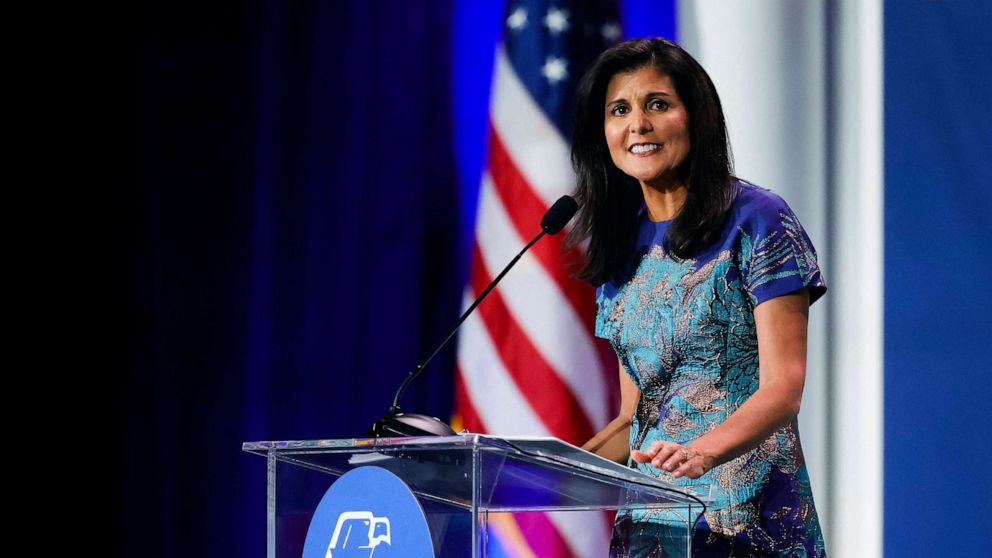
With her announcement this week that she is running for president, Nikki Haley has made a bit of history again — becoming the first prominent woman of color to seek the Republican nomination.
With Vice President Kamala Harris presumed to be President Joe Biden’s running mate if he announces a second run, as he has said he will, it’s possible that both major political parties in America could simultaneously have a woman on their ticket for the first time. And both would be South Asian, specifically of Indian descent — which observers called a massive feat considering the community makes up only about 1{515baef3fee8ea94d67a98a2b336e0215adf67d225b0e21a4f5c9b13e8fbd502} of the country’s population and produced two recent political stars.
“This is absolutely a moment,” Sara Sadhwani, an assistant professor of politics at Pomona College and co-author of the Indian American Election Survey, told ABC News. “We see South Asians who have largely been on the outskirts of American politics in many ways. This is a moment where we’re seeing South Asians step into the limelight.”
That representation began at the national level more than half a century ago, when Dalip Singh Saund led a push to change immigration laws so he and other Indians could become citizens. He then became the first Asian American, first South Asian and first Sikh in Congress, in 1956.
There are now five South Asians in Congress, often referred to as “the Samosa Caucus.”
“Since 2016, we’ve quintupled our representation in Congress and gone from 12 to 43 in state legislatures. Over that same period of time, our population has not multiplied the same way,” said Neil Makhija, the executive director of the Indian American Impact, an organization that helps South Asians run for elected office. “Once people start running, it shows that it’s possible.”
When it comes to world leaders, University of California, Riverside, public policy professor Karthick Ramakrishnan points to Rishi Sunak, whose parents are of Indian descent, as someone who represents how fast a community can advance — considering the British ruled India until 1947. “One generation,” Ramakrishnan said, “Someone who is the child of the empire is now the prime minister of Britain.”
Nearly one-fourth of the world’s population lives in South Asia and many of the countries within it — India, Pakistan, Bangladesh, Nepal and Sri Lanka — have all already had women prime ministers or presidents.
“[Women leading countries] is not something that’s necessarily out of the norm of the cultures from which a lot of these people are coming from,” said Maneesh Arora, an assistant professor of political science at Wellesley College.
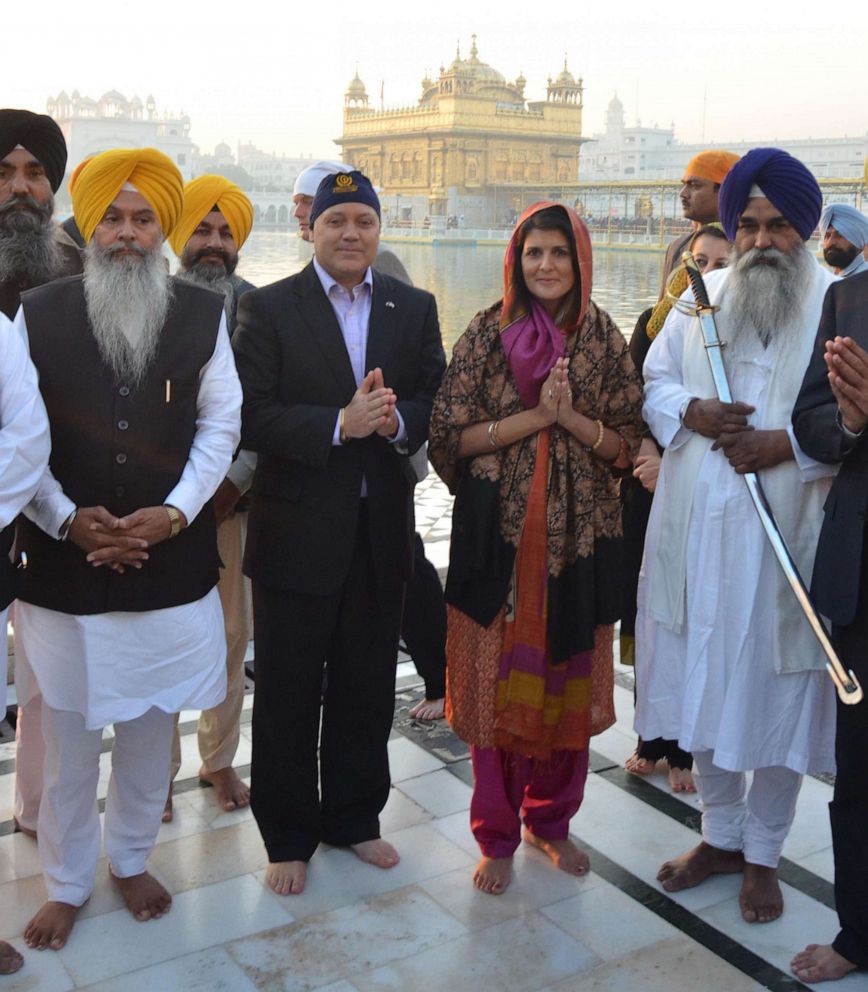
South Carolina Governor Nikki Haley along with her husband Michael Haley at the Golden Temple, Nov. 15, 2014, in Amritsar, India.
Hindustan Times via Getty Images
Harris’ maternal grandfather, P.V. Gopalan, worked to fight for the country’s independence from Britain and she’s spoken about her parents taking her in a stroller to political protests in the ’60s. Haley wrote in her autobiography that her mom, Raj Randhawa, studied law and was offered the first female judgeship in India, although Haley said her own family blocked it because she was a woman.
“They grew up in households where public service was not looked down upon. … Plenty of Indian Americans grew up in households where it was about becoming a doctor or engineer,” Ramakrishnan said.
Harris, who ran for president in 2020 before being selected as Biden’s vice president, and now Haley are testing what it means to pursue success at the highest levels of American politics.
Haley is not the first woman of color to seek the GOP nod: Angel Joy Chavis Rocker, a Black school counselor in Florida, ran in the 2000 campaign. But Haley is the most notable non-white conservative woman to ever enter the race.
Her campaign did not comment for this story.
What Haley has said about her heritage
Haley was born Nimrata Nikki Randhawa to Punjabi Sikh parents who emigrated from India in the 1960s. She has said that early on she adopted her middle name, which means “little one” in Punjabi, as her first name and later took on her husband’s last name as her own.
Haley was raised Sikh and has publicly talked about converting to Christianity, once saying the language barrier was what ultimately led to her decision to convert. “At some point, you have to understand the words …. Christianity spoke to me,” she previously said while adding, “It wasn’t political.” She explained to The New York Times in 2012: “We always said ‘no’ when my mom was trying to teach us Punjabi. Now I wish we had learned, but that is why I think I made the transition.”
She joined a Methodist church with her husband but has said she continues visiting the Sikh temple with family.
But for some South Asians, the conversation about Haley rarely gets past her name or religion.
“Her example would reflect the kind of assimilationism that most Indian Americans — most South Asians — actually don’t do. They don’t change their name and they don’t convert their religion,” Ramakrishnan said.
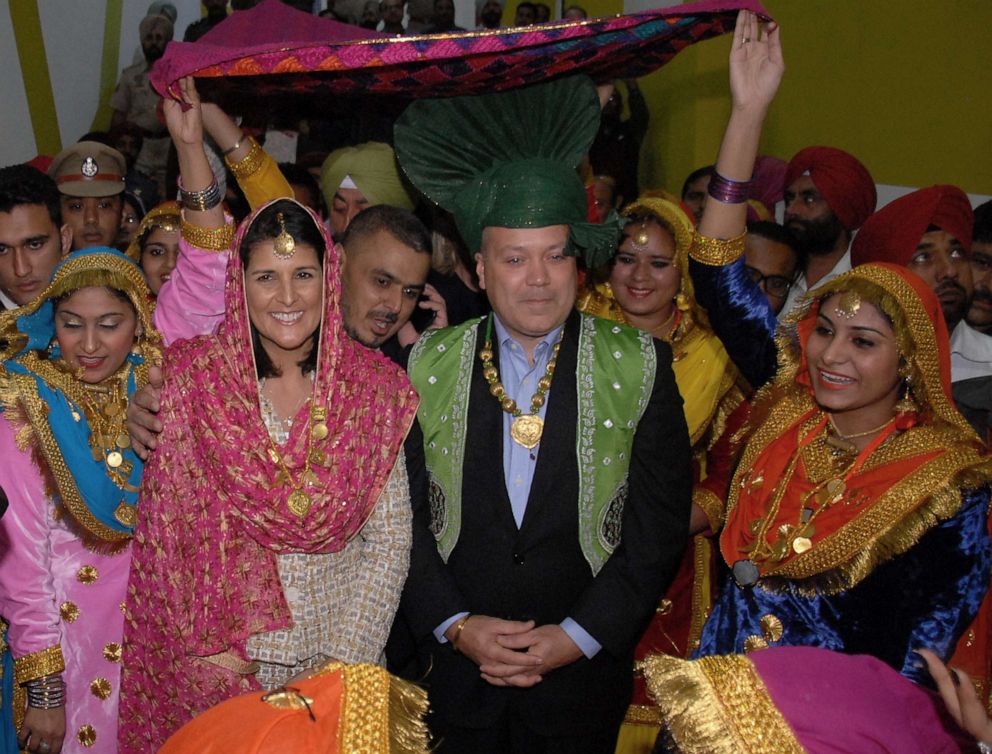
Governor of South Carolina Nikki Haley poses with her husband Michael Haley and traditional Punjabi dancers as she arrives to attend a function at Lovely Professional University LPU in Jalandhar, Nov. 14, 2014.
Shammi Mehra/AFP via Getty Images
In 2001, Haley also listed her race as “white” on her voter registration card, according to The Post and Courier. At the time, a spokesman for her declined to comment and state Republicans suggested the issue was a stunt because it had been uncovered by Democrats, who criticized her as disingenuous.
Dr. Hajar Yazhida, a University of Southern California assistant professor in sociology and faculty affiliate at their equity research institution, told ABC News that being able to have racial ambiguity has had a massive impact for both the vice president and Haley — especially on Haley’s journey. (Harris’ father is Black, from Jamaica; her mother was born in Chennai, India.)
“We might look at Kamala Harris on one side and Nikki Haley on the other and wonder how it is that two South Asian women ended up as political front-runners? But we have to remember that neither of the candidates are socially read as South Asian women,” Yazhida argued.
But Ramakrishnan said even being able to “claim” an identity is something unique to living in the United States — and something that most politicians do in some way: “We all have different aspects of our identity that we activate. … Given the context, people code-switch all the time.”
Haley has seen prejudice — even from fellow politicians.
During a runoff election for a state legislative seat in South Carolina, an opponent published ads referring to her as “Nimrata N. Randhawa” and sent out mailers with her standing with her dad in his turban.
When she was running for governor in 2010, a South Carolina state senator referred to her and then-President Barack Obama with a racial epithet.
Haley has touched on some of the struggles her family faced. “I am the proud daughter of Indian immigrants. They came to America and settled in a small southern town. My father wore a turban. My mother wore a sari. I was a brown girl in a black and white world,” she said at the 2020 Republican National Convention. “We faced discrimination and hardship, but my parents never gave into grievance and hate.”
The NAACP also pointed to then-Gov. Haley’s heritage in 2011 when criticizing South Carolina for flying the Confederate flag at the Statehouse for nearly half a century. In 2015, in the wake of the fatal shooting of nine Black people at Charleston’s Emanuel African Methodist Episcopal Church, Haley urged the flag to be removed and state Republicans quickly agreed.
Former South Carolina Republican Governor Nikki Haley speaks at the Republican Jewish Coalition Annual Leadership Meeting in Las Vegas, Nov. 19, 2022.
Wade Vandervort/AFP via Getty Images
Haley’s politics differ from most in the community
Pomona College professor Sadhwani said South Asians really want to support other South Asians, regardless of party. But the data she has collected on Haley appears to be an exception. “Haley’s unfavorable score is 55{515baef3fee8ea94d67a98a2b336e0215adf67d225b0e21a4f5c9b13e8fbd502} in our sample,” Sadhwani said. This could be in part because many South Asian people identify as Democrats, data shows
Former President Donald Trump wasn’t able to capture the South Asian vote either — but he tried. In 2019, he held a “Howdy Modi!” rally with Indian Prime Minister Narendra Modi that attracted thousands and filmed an ad where he attempted to speak in Hindi.
That got him ahead with the group — but not by enough. “Trump made inroads among Indian American voters between 2016 and 2020. He still lost the Indian American vote,” said professor Ramakrishnan.
Biden and Harris have focused on South Asians and the Indian community as well, with Biden releasing an agenda for the Indian American community prior to the 2020 election and both him and the vice president including cultural celebrations as part of administration events.
Numbers illustrate how Asian American voters, and Indian voters, can be influential. According to AAPI Data, an organization that publishes demographic data and research, in 2018 there were an estimated 161,000 eligible Indian voters in Texas, 87,000 in Florida, 61,000 in Pennsylvania, 57,000 in Georgia and 45,000 in Michigan.
Major contests in those states, including the 2020 and 2016 presidential elections, have all recently been decided by smaller margins.
And the community is fast growing. In the last two decades, for example, the Indian population in the U.S. has doubled to about 4.6 million in 2019, according to the Pew Research Center.
Roughly 70{515baef3fee8ea94d67a98a2b336e0215adf67d225b0e21a4f5c9b13e8fbd502} of Indian voters in America leaned Democratic as of 2022, according to AAPI Data. That’s more than Latinos but less than African Americans. Some of the reasons include religion, extensive training in science and living in a post-9/11 world.
In one of his most notable — and controversial — promises as a presidential candidate, Trump said he would block Muslims from entering the U.S. At the time, Haley appeared to distance herself from such a policy. Delivering the Republicans’ official 2016 State of the Union response, she said that America should resist following the “angriest voices” and welcome “properly vetted legal immigrants, regardless of their race or religion.”
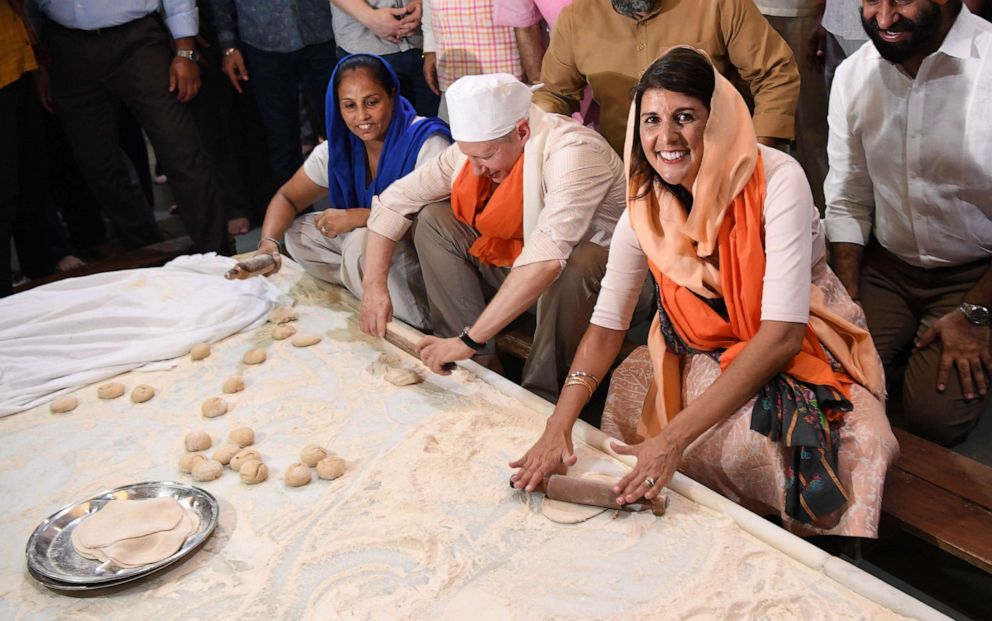
Ambassador to the United Nations Nikki Haley makes Indian bread in the kitchen of the Sis Ganj Gurudwara, a Sikh temple, in New Delhi, June 28, 2018.
Prakash Singh/AFP via Getty Images
According to AAPI Data, more than three-fourths of Indians and the majority of Asian voters overall voted for Democratic nominee Hillary Clinton over Trump in 2016, a finding that echoes other exit polling. Haley went on to join Trump’s administration, leaving some in her own community wondering how strongly she felt about what she had said just 12 months before.
Sangay Mishra, an associate professor of political science at Drew University and the author of “Desi’s Divided: The Political Lives of South Asian Americans,” said the vast majority of the South Asian community feels strongly about issues like abortion rights, restricting guns and critical race theory.
“In politics it’s hard to predict how the community will react. But it’s clear it doesn’t align with how she thinks,” Mishra said.
‘An opportunity for Haley’
But can Haley align South Asian donors?
Indian Americans have the highest levels of income in the country, according to the U.S. Bureau of Labor and Statistics, a feat that’s often connected to the 1960s when the U.S. specifically engineered a demographic of highly professional immigrants. (Harris and Haley have something else in common that researchers said is powerful — they are byproducts of this era, with both of their parents coming to America around this time.)
An analysis done by The Los Angeles Times a few months into the 2020 Democratic primary race found that despite Indian Americans being a small demographic, they had donated more than $3 million to presidential campaigns — more than people in Hollywood.
Mishra told ABC News he created a list of major bundlers during the Obama administration and the number of South Asian names was a fairly big list compared to the population. “They were overwhelmingly going for the Democratic Party,” he said.
“What has not been noticed is this growth of a segment of Indian Americans who are affluent, and that goes back to the character of the community,” Mishra said.
Data from FiveThirtyEight details just the donations that South Asians made to other South Asian candidates running for House or Senate seats from 2000-2020. The numbers, especially for Democratic candidates, have exploded.
Haley’s former spokesperson Rob Godfrey said he remembered her being embraced by such donors while running in South Carolina. “Members of the South Asian community, members of the Indian community, have always been traditionally Democratic,” he acknowledged. “But when Nikki ran for governor, there was no shortage of support for her from the South Asian and Indian communities because they had a lot of great pride in her candidacy … she very much enjoyed the support of them within the state and they were very generous contributors to her campaign, from New Jersey to Chicago to California to Texas.”
Sadwani said that when it comes to South Asians though, her research showed that the numbers won’t be enough to tip the scale.
Haley’s announcement video, on Tuesday, highlighted her heritage and her optimistic vision of a society unencumbered by racial division.
“I was the proud daughter of Indian immigrants,” Haley said in her video, adding: “My mom would always say, ‘Your job is not to focus on the differences but the similarities.'”
Sadwani said that message isn’t for the South Asian community — it’s for everyone else.
“We’re talking more conservative-leaning Latinos, other Asian Americans and even plenty of of non-immigrant voters who are completely opposed to the age old story of the United States being a place that welcomes immigrants and might be disenchanted by the overt racial commentary, the negative stereotypes of a Trump administration, even while supporting many of the Trump-based policies,” Sadwani said. “I think this becomes an opportunity for Haley.”