

CNN
—
Left vs. right. Woke vs. the unwoke. Red State Jesus vs. Blue State Jesus.
There are some leaders who see faith and politics strictly as an either/or competition: You win by turning out your side and crushing the opposition.
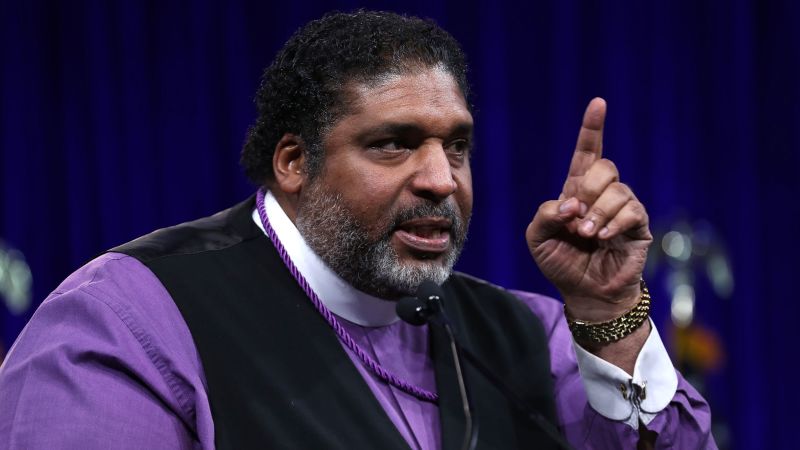
But the Rev. William J. Barber II, who has been called “the closest person we have to MLK” in contemporary America, has refined a third mode of activism called “fusion politics.” It creates political coalitions that often transcend the conservative vs. progressive binary.
Barber, a MacArthur “genius grant” recipient, says a coalition of the “rejected stones” of America—the poor, immigrants, working-class whites, religious minorities, people of color and members of the LGBTQ community can transform the country because they share a common enemy.
“The same forces demonizing immigrants are also attacking low-wage workers,” the North Carolina pastor said in an interview several years ago. “The same politicians denying living wages are also suppressing the vote; the same people who want less of us to vote are also denying the evidence of the climate crisis and refusing to act now; the same people who are willing to destroy the Earth are willing to deny tens of millions of Americans access to health care.”
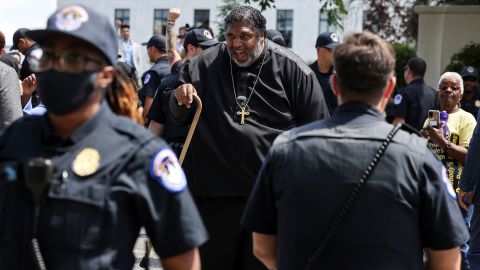
Barber’s fusion politics has helped transform the 59-year-old pastor into one of the country’s most prominent activist and speakers. As co-chair of the Poor People’s Campaign: A National Call for Moral Revival, he has helped lead one of the nation’s most sustained and visible anti-poverty efforts.
He electrified the crowd at the 2016 Democratic National Convention with a speech that one commentator called a “drop the mic” moment. And at a time when both political parties have been accused of ignoring the working class, Barber routinely organizes and marches with groups such as fast-food workers and union members.
“There is a sleeping giant in America,” Barber told CNN. “Poor and low-wealth folks now make up 30{515baef3fee8ea94d67a98a2b336e0215adf67d225b0e21a4f5c9b13e8fbd502} of the electorate in every state and over 40{515baef3fee8ea94d67a98a2b336e0215adf67d225b0e21a4f5c9b13e8fbd502} of the electorate in every state where the margin of victory for the presidency was less than 3{515baef3fee8ea94d67a98a2b336e0215adf67d225b0e21a4f5c9b13e8fbd502}. If you could just get that many poor and low-wealth people to vote, they could fundamentally shift every election in the country.”
Starting this month, Barber will take his fusion politics to the Ivy League. Yale Divinity School has announced he’ll be the founding director of its new Center for Public Theology and Public Policy. In that role, Barber says he hopes to train a new generation of leaders who will be comfortable “creating a just society both in the academy and in the streets.”

Though he’s stepping down as pastor of the North Carolina church where he has served for 30 years, Barber says he is not retiring from activism. He remains president of Repairers of the Breach, a nonprofit that promotes moral fusion politics.
Barber recently spoke to CNN about his faith and activism and why he opposes White Christian nationalism, a movement that insists the US was founded as a Christian nation and seeks to erase the separation of church and state.
Barber’s answers were edited for brevity and clarity.
You’ve talked about poverty as a moral issue and said the US cannot tolerate record levels of inequality. But some extreme levels of poverty have always existed in this country. Why is it so urgent to face those problems now, and why should someone who isn’t poor care?
Doctor King used to say America has a high blood pressure of creeds, but an anemia of deeds. In every generation we’ve had to have a moment to focus on the urgency of the right now. We will never be able to fix our democracy until we fully face these issues. We will constantly ebb and flow out of recessions because inequality hurts us all.
Joseph Stiglitz (the Nobel Prize-winning economist) talks about this in his book “The Price of Inequality,” and says that it costs us more as a nation for these inequalities to exist than it would for us to fix them.
Look at how much it costs us to not have a living (minimum) wage. There was a group of Nobel Peace Prize-winning economists two years ago that debunked the notion that paying people a living wage (the federal minimum wage in the US is $7.25 an hour) would hurt business. They said it’s not true.
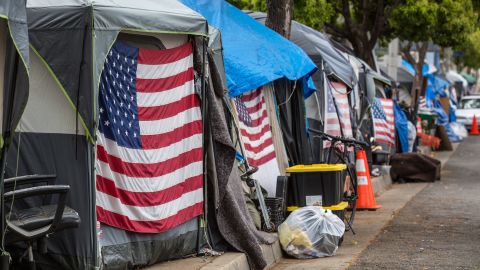
Well, President Roosevelt said that in the 1930s. He said that any corporation that didn’t pay people a living wage didn’t deserve to be an American corporation.
I don’t think that American society as a democracy can stand much more. We’re moving toward 50{515baef3fee8ea94d67a98a2b336e0215adf67d225b0e21a4f5c9b13e8fbd502} of all Americans being poor and low wealth. It’s unnecessary.
We say in our founding documents that every politician swears to promote the general welfare of all people. You’re not promoting the general welfare of all people when you can get elected and go to Congress and get free health care but then sit in Congress and block the people who elected you from having the same thing.
We say equal protection under the law is fundamental. Well, there’s nothing equal about corporations getting all kinds of tax breaks and all kinds of ways to make more and more money, while the average worker makes 300{515baef3fee8ea94d67a98a2b336e0215adf67d225b0e21a4f5c9b13e8fbd502} less than the CEOs.
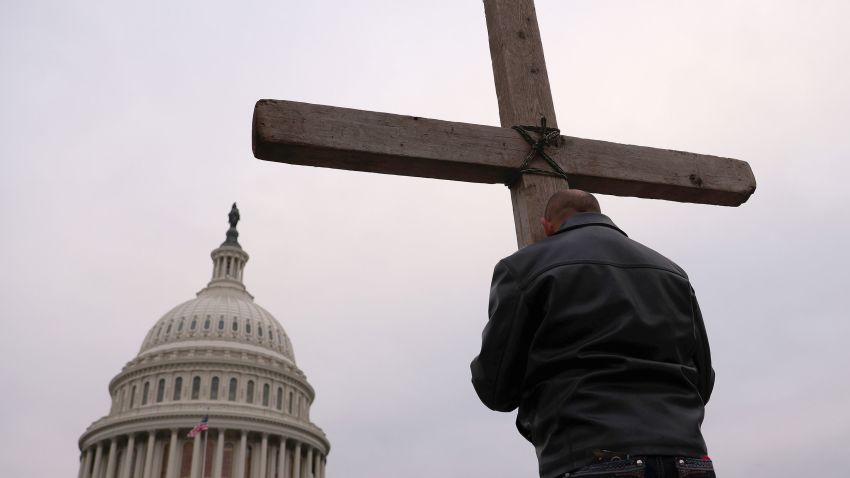
Marjorie Taylor Greene calls herself a ‘nationalist.’ This is what that means
Some people cite the scripture where Jesus says, “The poor you always have with you” to argue that poverty is inevitable, and that trying to end it is a hopeless cause.
Every time they say that, they are misquoting Jesus. Because that’s not what Jesus meant or said. He was saying, yeah, the poor are going to be with you always, because he was quoting from Deuteronomy [15:11]. The rest of that scripture says the poor will always be with you because of your greed — I’m paraphrasing it, but that’s the meaning of it. The poor will always be with you is a critique of our unwillingness to address poverty.
To have this level of inequality existing is a violation of our deepest moral, constitutional and religious values. It’s morally inconsistent, morally indefensible, and economically insane. Why would you not want to lift 55 to 60 million people out of poverty if you could by paying them a basic living wage? Why would you not want that amount of resources coming to people and then coming back into the economy?
I want to ask you about Christian nationalism. What’s wrong with saying God loves America and that the country should be built on Christian values?
God doesn’t say it. That’s what’s wrong with it. The scriptures says God loves all people and that if a nation is going to embrace Christian values, then we got to know what those values are. And those values certainly aren’t anti-gay, against people who may have had an abortion, pro-tax cut, pro one party and pro-gun. There’s nowhere in the scriptures where you see Jesus lifting that up.
Jesus said the Gospel is about good news to the poor, healing to the brokenhearted, welcoming all people, caring for the least of these: the immigrant, the hungry, the sick, the imprisoned. Christian nationalism attempts to sanctify oppression and not liberation. It attempts to sanctify lies and not truth. At best, it’s a form of theological malpractice. At worst, it’s a form of heresy.
When you have some people calling themselves Christian nationalists, you never hear them say, “Jesus said this.” They say, “I’m a Christian, and I say it.” But that’s not good enough. If it doesn’t line up with the founder, then it’s flawed.
Are you an evangelical?
I’m very much an evangelical. I tell folks that I’m a conservative, liberal, evangelical Christian. And what that means is I believe in Jesus, not to the exclusion of other faith traditions because my founder said that “I have others who are not of this fold.” I believe that love, truth, mercy, grace and justice are fundamental to a life of faith. And for me to be evangelical means to start where Jesus started.
The word “evangel” is good news. When Jesus used that phase it was in his first sermon, which was a public policy sermon. He said it in the face of Caesar, where Caesar had hurt and exploited the poor. He said it right in the ghetto of Nazareth, where people said, “nothing good could come out of Nazareth.” He said, “The Spirit of the Lord is upon me to preach good news” — evangel —”to the poor.” That’s what evangelicalism is to Jesus. That’s the kind of evangelicalism that I embrace.
You’ve had health challenges over the years. How do you keep going year after year and keep yourself from being burned out?
I read the Bible one time, specifically looking to see if I could find any person in scripture that God used in a major way that did not have some physical challenge. And I couldn’t find it. That helped me get over any pity party.
You know, Moses couldn’t talk. Ezekiel had strange post-traumatic syndrome types of emotional issues. Jeremiah was crying all the time from his struggles with depression. Paul had a physical thorn in the flesh. Jesus was acquainted with sorrow.
Then then I looked down through history, and I couldn’t find anybody. Harriet Tubman had epileptic-type fits. Martin Luther King was stabbed before he did the March on Washington and had a breathing disorder after that.
During covid, I thought deeply about death and mortality. I have some immune deficiencies and challenges. I’ve battled this ankylosing spondylitis for now 40-plus years. At any time, it could shut my body down.
During covid, as I kept meeting people, I sat down one day and I said, Lord, why am I still here? I’m not better than these people. I know I’ve been around covid. My doctor said to me if I caught covid I probably would not fare well.
As I was musing one day, it dawned on me. That’s the wrong question. The question is never, why are you still alive? Why are you still breathing? The question is what are you going to do with the breath you have?
Because at any given moment, the scripture says we’re a step from death. And so I’ve decided that whatever breath I have, it is too precious to waste on hate, on oppression and on being mean to people. It’s only to be used for the cause of justice.
John Blake is the author of “More Than I Imagined: What a Black Man Discovered About the White Mother He Never Knew.”


