In 2024, Republicans may complete a historic foreign policy reversal

In 2024, Republicans may complete a historic foreign policy reversal


CNN
 — 

The GOP in 2024 is moving toward a reprise of its most consequential foreign policy debate ever in a presidential primary. Only this time, the results may be reversed.

The 1952 GOP presidential nomination fight proved a turning point in the party’s history, when Dwight Eisenhower, a champion of internationalism and alliance with Europe to contain the Soviet Union, defeated Sen. Robert Taft, a skeptic of international alliances who wanted to shift America’s focus from defending Europe toward confronting communist China.

A similar divide is opening within the GOP now. In a distant echo of Taft, former President Donald Trump and Florida Gov. Ron DeSantis, the race’s two front-runners have both declared that defending Ukraine against Russia is not an American “vital interest” and “distracts” (as DeSantis put it) from the more important challenge of confronting China. Other likely 2024 candidates, such as former Vice President Mike Pence and former UN Ambassador Nikki Haley, come closer to upholding the Eisenhower position that the US must remain steadfast in protecting Europe against Russian aggression – and insisting that abandoning Ukraine would embolden China and other potential US adversaries.
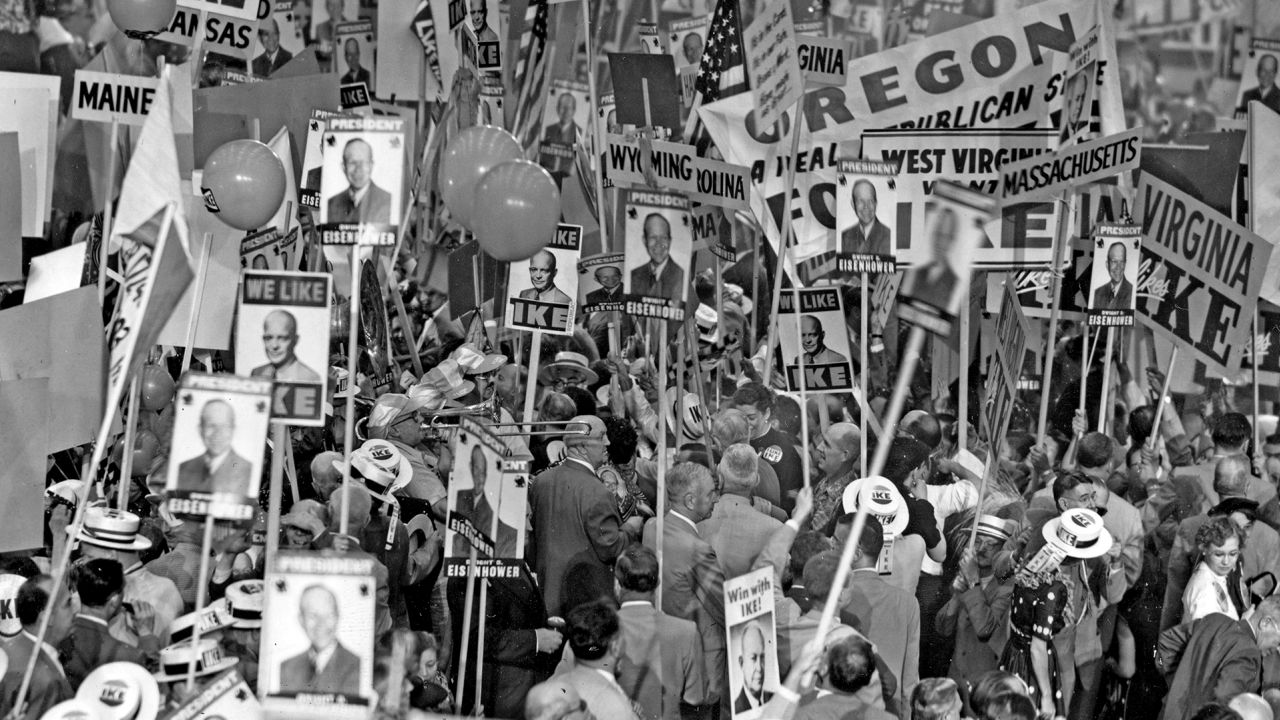
Delegates, many of whom support Dwight David Eisenhower as their candidate for President, gather at the Republican National Convention in Chicago in July 1952.

After Eisenhower’s landmark victory over Taft in 1952, every Republican presidential nominee over the next six decades – a list that extended from Richard Nixon through Ronald Reagan to George W. Bush, John McCain and Mitt Romney – identified more with the internationalist than isolationist wing of the party.

But Trump broke that streak when he won the nomination in 2016 behind a message of brusque economic nationalism and skepticism of international alliances. Now, the GOP appears on track for a 2024 nomination fight which may demonstrate that Trump’s rise has lastingly shifted the party’s balance of power on foreign policy – and ended the long era of GOP internationalism Eisenhower’s victory began.

The fact that DeSantis unveiled his views about Ukraine in a statement to Fox News host Tucker Carlson, a fierce opponent of American engagement with allies, underscored the governor’s determination to court Trump’s base with his provocative remarks. After several days of intense criticism from Republican internationalists, DeSantis retreated last week from his description of the war as a “territorial dispute” and called Russian President Vladimir Putin “a war criminal,” much harsher language than Trump has ever used. But DeSantis, in his interview with British journalist Piers Morgan for another Fox outlet, also reiterated his skepticism of open-ended US support for Ukraine. “I just don’t think that’s a sufficient interest for us to escalate more involvement,” the governor said.
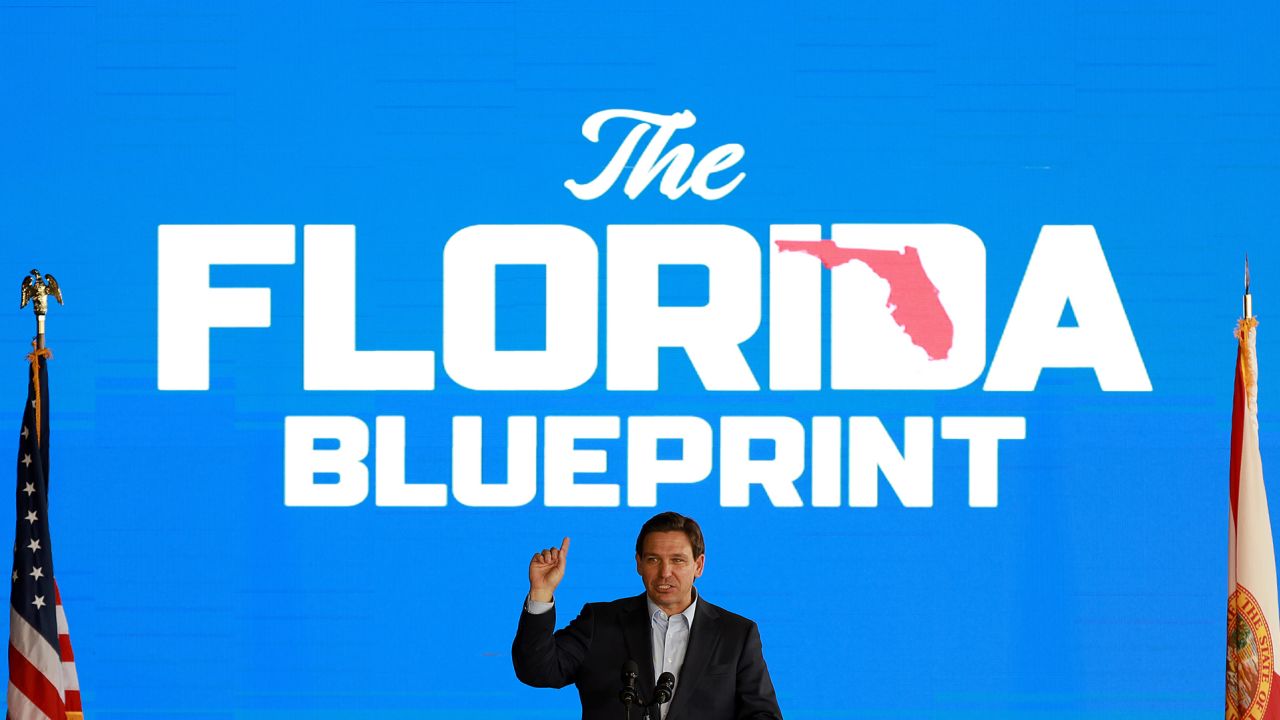
 Florida Gov. Ron DeSantis speaks during an event spotlighting his newly released book,

Even with his qualifying statements last week, DeSantis’ skeptical posture toward Ukraine shows the magnetic pull that Trump has exerted on his party, tugging it away from the Eisenhower tradition.

“Trump-ism is the dominant tendency in Republican foreign policy and it’s isolationist, its unilateralist, its amoral,” said Richard Haass, president of the Council on Foreign Relations and former director of policy planning at the State Department under George W. Bush. The “traditional institutional approach to the world [which was] … the dominant Republican approach since World War II … has clearly been eclipsed for now,” said Haass, who also held foreign policy positions in the Ronald Reagan and George H.W. Bush administrations.

Ivo Daalder, president of the Chicago Council on Global Affairs and former US permanent representative to NATO under Barack Obama, agrees. The fact that both 2024 GOP front-runners are expressing a broad skepticism about US engagement abroad, he said, raises the possibility that Republican “internationalists have not only lost in ’16 and ‘20” when Trump headed the GOP ticket, “but have lost the party forever.”

The 1952 presidential election, by contrast, was the moment when GOP internationalists seemed to win the party forever. Leading into World War II, the party had been closely split between an internationalist wing determined to counter Adolf Hitler and imperial Japan and an isolationist faction resistant to entanglement in the intensifying confrontation with fascism, especially in Europe. The divide was both ideological and geographic, pitting generally more moderate internationalist East Coast Republicans (many of them tied to Wall Street and international finance) against more conservative isolationist forces centered in the small towns and small businesses of the Midwest and the far West.

The Japanese surprise attack that triggered the US entry into World War II ended the political viability of a purely isolationist stance.

“After Pearl Harbor there was no way to be a strict isolationist and a national political [figure],” said Joyce Mao, an associate professor of history at Middlebury College and author of the book “Asia First,” which recounts the GOP foreign policy debates of that era.

After World War II, Republican internationalists joined with Democratic presidents Franklin Roosevelt and Harry Truman to build the international institutions meant to prevent another global war: the United Nations, the Marshall Plan to economically rebuild Europe and the North Atlantic Treaty Organization to militarily defend it from the Soviet Union. Eisenhower, who had organized the Allied invasion of Europe on D-Day in 1944, was firmly in that camp and, in fact, returned to Europe in January 1951 to serve as NATO’s first supreme commander.

But Robert Taft led a block of “old guard” congressional Republicans that remained much more skeptical of European commitments. Taft, a senator from Ohio and the son of former Republican president William Howard Taft, had generally opposed American aid to Europe before Pearl Harbor and even after the war he pushed to reduce the Marshall Plan and voted against the creation of NATO. Like many of the Republicans who initially resisted involvement in World War II, Mao noted, Robert Taft in the post-war period tried to separate himself both from that isolationist past and the contemporary priorities of GOP internationalists like Eisenhower by arguing for an “Asia First” foreign policy that would shift resources and emphasis from defending Europe to confronting the Communists who had seized control of China.

“Eisenhower was viewed by Taft and his colleagues as much too moderate,” Mao said. “His European focus was deemed by that conservative wing of the party as much too similar to the liberal Democrats. If this was going to be a moment for conservatism to reassert itself not only against liberalism but also against the moderates in the Republican Party, China provided an ideal plank” to do so.

All these strains culminated in the landmark battle for the 1952 GOP presidential nomination. Taft, the Republican Senate leader, was a passionate favorite of conservatives. Eisenhower, still in Europe as NATO supreme commander, was in many respects a reluctant candidate. But as Stephen Ambrose showed in his classic biography, Eisenhower felt compelled to run largely from fear that Taft would lead the US out of NATO, while simultaneously risking a catastrophic war in China. (Eisenhower was also deeply disenchanted with Truman’s leadership.) Eisenhower resigned his NATO position, returned to the US, mobilized enough support from the GOP’s internationalist wing to beat Taft at the 1952 Republican convention, and then decisively won the presidency that November. “Eisenhower became president precisely because he did not trust this version of isolationism in Taft,” said Peter Feaver, a Duke University political scientist who served as a senior adviser for strategic planning on the National Security Council under George W. Bush.

Both as a general election candidate and as president, Eisenhower tried to minimize his public conflicts with his party’s “old guard.” But he unmistakably steered the party (and the nation) toward acceptance of American global leadership within a robust international system of alliances. With only modest variation, that became the dominant foreign policy ideology of the GOP for the next 60 years under Presidents Richard Nixon, Gerald Ford, Ronald Reagan and George H.W. Bush. Late in that period, George W. Bush offered a different emphasis by stressing unilateral American action over coordination with allies, but even he emphasized the need for the US to remain engaged with the world. “It’s a pretty unbroken streak,” said Geoffrey Kabaservice, author of “Rule and Ruin,” a history of the struggles between GOP conservatives and moderates.

Taft-like isolationism, coupled with nativist opposition to immigration and protectionist opposition to free trade, first resurfaced as a major force in the GOP with the long-shot presidential campaigns of conservative commentator Patrick J. Buchanan in 1992 and 1996. Two decades later, Trump revived that same triumvirate of isolationism, protectionism and nativism – what scholars sometimes call “defensive nationalism” – in his winning drive for the 2016 GOP nomination.

Though some traditional GOP internationalists had hoped that Trump in office might moderate those impulses, as president he barreled down all those roads, repeatedly clashing with traditional allies. Now, DeSantis’ choice to echo Trump in devaluing Ukraine – following the calls from so many House conservatives to reduce the US commitment there – is deflating another hope of the GOP’s beleaguered internationalist wing: that Trump’s ascent represented a temporary detour and the party would snap back to its traditional support for international engagement once he left office.

“Trump-ism has to be taken seriously,” as a long-term force in GOP thinking about the world, Haass said. The foreign policy center of gravity in the Republican Party, he added, has moved toward “a much more pinched or minimal American relationship with the world, [with] not a lot of interest in contributing to global responses to challenges like climate change or pandemics.”

Even before DeSantis qualified his comments in the interview with Morgan, Feaver believed the Florida governor was trying to find a position on Ukraine somewhere between Trump’s undiluted skepticism and the unreserved support of Sens. Lindsey Graham of South Carolina and Mitch McConnell of Kentucky. But, Feaver said, by including such inflammatory language as “territorial dispute” in his initial comments, DeSantis demonstrated the risks of pursuing such a strategy of “triangulation.”

“Triangulation is a risky game because if you get the language off, you may commit yourself in a campaign to a line that makes no sense when you are governing,” Feaver said. “This is one of the hardest problems for newcomers and challengers when they are campaigning for president. By giving applause lines that work for the narrow segments of ideologically hardened factions that they are trying to win over for the primary, they can lock themselves into policy positions that are not sound when they actually win.”

As an example, Feaver said DeSantis’ insistence that the US should shift more attention from countering Russia to containing China – an argument he repeated with Morgan – was illogical because “abandoning Ukraine assists China’s most significant ally, Russia.” Haley made a similar case in her recent Wall Street Journal article criticizing DeSantis (though not by name) for his comments to Carlson. “It’s naive to think we can counter China by ignoring Russia,” Haley wrote.

Daalder points out another logical flaw in the updated “Asia First” arguments from DeSantis and Trump. “If the US were to abandon its allies in Europe … our allies in Asia are going to ask, ‘What’s to say they are not going to do the same with regards to China?’” Daalder said. “By demonstrating your willingness to stand up to Russia you are also strengthening the view that in Asia that when it comes to it that we will be there to help them.”

But polls leave no doubt that both prongs of the modern Robert Taft position – that the US should reduce its commitment to Europe-focused international alliances and harden its resistance to China – have a substantial base of support in the contemporary Republican coalition. In a Gallup poll released earlier this month, by a lopsided margin of 76{515baef3fee8ea94d67a98a2b336e0215adf67d225b0e21a4f5c9b13e8fbd502} to 12{515baef3fee8ea94d67a98a2b336e0215adf67d225b0e21a4f5c9b13e8fbd502}, Republican voters were more likely to identify China than Russia as the principal US adversary in the world. (More Democrats picked Russia than China.) Polls have also found a steady decline in Republican support for US aid to Ukraine: polls this year by both the Pew Research Center and Quinnipiac University found that the share of GOP voters who believe the US is doing too much now equals the combined percentage who think it is doing too little or the right amount. (Quinnipiac found big majorities of Democrats and independents still believe the US is doing the right amount or not enough.)

The latest Chicago Council on Global Affairs annual survey also tracks a broader retreat from the world among GOP voters. In that poll, conducted last November, the share of Republicans who said the US should take an active role in world affairs fell to 55{515baef3fee8ea94d67a98a2b336e0215adf67d225b0e21a4f5c9b13e8fbd502} – the lowest the survey has ever recorded. Underscoring that erosion, a slight majority of Republicans in the poll said the costs of an active US international role now exceed the benefits.

Opinions in the GOP about whether the US should do more or less in Ukraine don’t vary much along lines of education or age, the Pew poll found. But generally, these surveys show that the turn away from global leadership is most powerful among two distinct groups of Republicans: those who are younger, and those who lack college degrees. While a solid three-fifths of Republicans with a college degree in the Chicago Council poll said the benefits of US leadership exceed the costs, for instance, a majority of non-college Republicans disagreed. Younger Republicans were also much more likely than those over 60 to say the costs exceed the benefits.

It’s probably no coincidence that those two groups – Republicans without a college degree and those who are younger – have consistently registered as Trump’s strongest supporters in early polls about the 2024 race.

Former President Donald Trump arrives during a rally at the Waco Regional Airport on March 25 in Texas.

Trump is signaling that in a second term he will likely push even further in an isolationist and protectionist direction. John Bolton, Trump’s former national security adviser, has said he believed the former president came close to withdrawing the US from NATO and would likely do so if elected to a second term. Trump certainly hinted at that possibility in a recent campaign video in which he declared, “we have to finish the process we began under my administration of fundamentally reevaluating NATO’s purpose and NATO’s mission.” Trump has also said he would impose a four-year plan “to phase out all Chinese imports of essential goods, everything from electronics to steel to pharmaceuticals.” That would be a wrenching change in the global economy.

In all these ways, Trump is promising to fulfill Robert Taft’s vision from seven decades ago – and to erase Eisenhower’s lasting victory in setting the GOP’s direction. DeSantis does not appear to have decided to jump entirely on that Trump train – but neither is he lying down on the tracks to stop it. With these two men far ahead of any potential rival, it seems highly likely that the GOP in 2024 will continue to move away from Eisenhower-style international cooperation toward a volatile compound of isolationism and unilateralism. And that could generate enormous turbulence across the globe.

Trump’s first term, as Daalder noted, was a chaotic time for the international order and traditional US alliances. But “If an isolationist leader gets elected president in 2024,” Daalder added, “you haven’t seen nothing yet.”

Republicans: Trump shadow looms large over House GOP policy retreat

Republicans: Trump shadow looms large over House GOP policy retreat


Orlando, Florida
CNN
 — 

Property Republicans experienced hoped to use their yearly retreat to get on the same page about impending policy battles and devise a tactic to maintain their fragile the vast majority.

As a substitute, they discover themselves participating in protection for previous President Donald Trump.

Whilst most Republicans experienced hoped to steer distinct of any presidential politics – even with getting in Florida, house to two significant opportunity GOP rivals in 2024 – Trump’s announcement in excess of the weekend that he expects to be imminently arrested has set him back again in the center of the conversation and pressured Republicans to publicly rally to his facet. Even some GOP lawmakers who have known as for the party to move on from Trump have lined up to offer their complete-throated defense of the ex-president, attacking the Manhattan District Attorney’s place of work that is investigating Trump as a political witch hunt.

Speaker Kevin McCarthy, echoing phone calls from inside his conference, has instructed GOP-led committees to look into whether the Manhattan DA employed federal resources to probe a payment made by Trump’s then-personal lawyer Michael Cohen to grownup film star Stormy Daniels days just before the 2016 presidential election.

McCarthy said Sunday that he presently talked to Home Judiciary Committee Chairman Jim Jordan, a Republican from Ohio, about an investigation into the make a difference, and hinted that there could be extra developments on that front shortly.

“Remember, we also have a decide on committee on the weaponization of governing administration, this applies straight to that. I think you will see steps from them,” McCarthy instructed reporters at a news meeting kicking off their three-working day plan retreat.

But Republicans weren’t in entire lockstep with Trump. McCarthy cautiously broke with Trump’s calls to protest and “take our nation back” if he is arrested, which has sparked worries of political violence reminiscent of the January 6 attack on the Capitol.

“I don’t believe people need to protest this, no,” McCarthy claimed. But he added: “You could misinterpret when President Trump talks … he is not chatting in a damaging way, and nobody should really. Nobody must hurt a single one more … We want calmness.”

Firebrand Rep. Marjorie Taylor Greene of Georgia, having said that, provided a various just take.

“I do not believe there is just about anything improper with calling for protests,” she told reporters right after the information meeting on Sunday. “Americans have the appropriate to assemble and the correct to protest. And that is an critical constitutional ideal. And he does not have to say ‘peaceful’ for it to indicate peaceful. Of study course he indicates tranquil.”

The hottest Trump drama is as soon as again threatening to divide the GOP and overshadow their carefully-laid messaging designs – a common predicament for Republicans who served in Congress whilst Trump was in business and invested many years becoming compelled to respond to for his typical controversies. Republican leaders who experienced hoped to emphasis on their legislative agenda during the very first news conference of their coverage retreat as a substitute fielded many inquiries from reporters about Trump and the Manhattan DA’s investigation.

Questioned regardless of whether he thinks it would be proper for Trump to run for president if he is in the long run convicted, McCarthy explained: “He has a constitutional appropriate to run.”

Multiple Republican lawmakers – which include Home GOP Meeting Chair Elise Stefanik – have endorsed Trump, though at the very least two of his staunch supporters have thrown their weight behind other candidates in the race: South Carolina Rep. Ralph Norman is backing previous South Carolina Gov. Nikki Haley, and Rep. Chip Roy of Texas is supporting Florida Gov. Ron DeSantis.

Most GOP lawmakers, however, have been unwilling to decide sides just still, waiting around to see how the area develops. Even McCarthy, who credited his speakership to Trump, has still to make his preference known.

“I could endorse in the key, but I have not endorsed,” he explained to reporters on Friday. When pressed on if he will do so, he once more recurring: “I could endorse but I have not.”

Aside from a potentially bruising GOP primary contest, Household Republicans have other important inside battles on the horizon. They are about to dive into some of the most complicated and divisive policy fights of their razor-thin the vast majority, which includes lifting the nation’s borrowing restrict, funding the governing administration, reauthorizing federal foodstuff stamp systems and deciding irrespective of whether to continue on help for Ukraine.

Element of their objective in the course of their once-a-year retreat is to just get the conference in sync forward of these looming debates.

“The price of something like this is, can we keep the era of very good emotions likely in just the Republican meeting?” stated Rep. Dusty Johnson of South Dakota, who chairs the centrist-leaning Most important Road Caucus. “This is gonna be a great possibility for us to just get in the exact room, have a few hundred of us breathe the exact air, and remind ourselves that we have extra in typical than we have aside.”

While the GOP has notched a handful of victories due to the fact having in excess of the Household, such as a resolution to overturn a DC criminal offense invoice, most of their bills have been messaging endeavors thus considerably. And even actions that have been believed to be lower-hanging fruit, like a border protection program, have proved a lot more tough than predicted in their trim majority.

Property Republicans know their biggest troubles lie in advance.

“The question is really going to be as we get into period two,” GOP Rep. Brian Fitzpatrick of Pennsylvania, who co-sales opportunities a bipartisan caucus with Democrats, instructed CNN. “The actual examination is going to be the must-pass parts of laws.”

The GOP’s investigations on a broad array of subjects, such as Hunter Biden’s organization deals and the cure of January 6 defendants, have triggered some consternation between the party’s moderates. And some have been also skeptical about the want for a congressional reaction to a possible Trump indictment.

“I’m likely to wait around until I listen to far more specifics and browse the indictment itself,” Rep. Don Bacon, a Nebraska Republican who signifies a district President Joe Biden gained, advised CNN. “I have religion in our authorized system. If these expenses are political bogus things, and they may perhaps be, it will develop into crystal clear adequate shortly.”

GOP leaders are nevertheless expressing confidence in their potential to continue to be united.

“House Republicans are functioning as a team,” Household GOP Whip Tom Emmer of Minnesota said at the Orlando information conference. “Because which is what the American persons elected us to do.”

Bacon framed the stakes of the legislative fights with Biden and Senate The vast majority Chief Chuck Schumer to appear by saying, “We want to be the governing celebration that voters have confidence in. This will figure out 2024 results. This usually means we cannot cave to Biden’s and Schumer’s calls for, but we can not refuse to come across consensus and make agreements on ought to go laws.”

GOP Rep. Tim Burchett of Tennessee, who advised CNN he is eager to shut down the govt if conservatives do not get what they are calling for pertaining to the financial debt ceiling, reflected on how Property Republicans could study from their Democratic counterparts in presenting a unified entrance.

“They’re superior than us at the carrot and the stick. If they get in line, they get the carrot. If they really do not, they get the stick. They all tout the unity issue. Maybe which is a single of our weaknesses,” he instructed CNN.

The have to-pass items of laws expose not only the fault lines of a trim vast majority, but also underscore the hurdles House Republicans deal with in cementing their changeover from a nay-stating minority to a governing vast majority.

“Campaigning is for dividing. Governing is for uniting,” GOP Rep. Tony Gonzales of Texas advised CNN, introducing that sentiment have to lengthen outside of Residence Republicans to Biden and Senate Democrats.

“I’d say in typical, not everybody will come up listed here to be really serious legislators. A whole lot of folks come up in this article for fame and fortune. I expended 20 yrs in the military services. I’m centered on staying a critical legislator,” he added.

Fitzpatrick told CNN, “It’s unquestionably an adjustment,” when describing the House Republicans’ transition from minority to greater part, especially for individuals customers who have not served in the the vast majority in advance of. But Fitzpatrick pointed to the reality that the messaging expenses that Republicans have brought to the ground so significantly have handed just about unanimously.

Some of the House GOP’s greatest hurdles will occur in hoping to generate a spending budget blueprint, which they hope will kick off negotiations in excess of the elevating debt ceiling, wherever Republicans are demanding steep shelling out cuts.

More complicating the GOP’s objective to equilibrium the spending plan and claw back again federal paying, Republican leaders – egged on by Trump – have vowed not to touch Social Safety and Medicare.

Norman acknowledged how tough it is heading to be to coalesce about a framework that the complete convention can concur on. Before leaving Washington, the far-appropriate Residence Freedom Caucus laid out their own hardline paying out requires in the credit card debt ceiling battle.

“I really do not anticipate to get 218 on the first blush. What we existing, there’s gonna be some gnashing of teeth,” he told CNN. “Every dollar up below has an advocate.”

Burchett informed CNN he stands behind the proposals staying pushed by the Freedom Caucus.

“It seems like every single time the conservatives are the only ones that compromise. And we are just likely to have to say no compromise,” he informed CNN, including he is ready to shut down the govt on this problem. “I did it beneath Trump, and I’ll guaranteed as heck do it underneath Biden.”

McCarthy stated he assumed it was “productive” for his associates to define “ideas” for the finances, and dismissed the concept that any person was drawing pink lines.

Questioned about Biden’s insistence that Household Republicans display them their spending budget just before negotiations can continue on, McCarthy replied, “Why do we have to have a finances out to chat about the financial debt ceiling? We’re not passing the spending budget, we’re executing a debt ceiling.”

He added that he has instructed the president, “We’re not going to raise taxes, and we’re not heading to go a clean debt ceiling, but every thing else is up for negotiation.”

Attitudes begin to shift regarding monetary policy, economic growth, and stock prices

Attitudes begin to shift regarding monetary policy, economic growth, and stock prices

This post was originally published on TKer.co

Stocks declined, with the S&P 500 falling 1.1{515baef3fee8ea94d67a98a2b336e0215adf67d225b0e21a4f5c9b13e8fbd502} last week. The index is now up 6.5{515baef3fee8ea94d67a98a2b336e0215adf67d225b0e21a4f5c9b13e8fbd502} year to date, up 14.4{515baef3fee8ea94d67a98a2b336e0215adf67d225b0e21a4f5c9b13e8fbd502} from its October 12 closing low of 3,577.03, and down 14.7{515baef3fee8ea94d67a98a2b336e0215adf67d225b0e21a4f5c9b13e8fbd502} from its January 3, 2022 closing high of 4,796.56.

Over the past two weeks or so, it seems attitudes have begun to shift favorably regarding monetary policy, economic growth, and the trajectory of stock prices.

1. The Fed acknowledges inflation is coming down 🦅

In May of last year, Fed Chair Jerome Powell warned “there could be some pain involved in restoring price stability.” A month later, we learned inflation was unexpectedly heating up again. And then on June 15, the Fed announced an eye-popping 75-basis-point interest rate hike, the largest increase the central bank made in a single announcement since 1994.

Back then, I explained how these dynamics presented a conundrum for the stock market as market beatings would continue until inflation improved in the Fed’s eyes.

Fast forward to February 1, following several months of cooling inflation data, when Powell said at the conclusion of the Fed’s monetary policy meeting: “We can now say, I think, for the first time that the disinflationary process has started. We can see that.“ (Emphasis added.)

The consumer price index has cooled significantly, signaling disinflation. (Source: BLS via <a data-i13n="cpos:1;pos:1" href="https://fred.stlouisfed.org/series/PCEPILFE#0" rel="nofollow noopener" target="_blank" data-ylk="slk:FRED;cpos:1;pos:1" class="link ">FRED</a>)
The consumer price index has cooled significantly, signaling disinflation. (Source: BLS via FRED)

“Powell cited the word ‘disinflation’ 13 times in this press conference,” Tom Lee, head of research at Fundstrat Global Advisors, wrote that day in a note to clients. “This is a major change in language and tone and shows that the Fed is now officially recognizing the growing disinflation forces underway. In [the December press conference], ‘disinflation’ was used ZERO times by Powell.”

This is a pretty big deal for the stock market, as prices tend to bottom in the weeks and months before major bullish developments. If this less hawkish tone from the Fed holds, then it’s possible the October 12 low for the S&P 500 was the beginning of the next bull market.

1

“In our view, Chair Powell is placing more weight on an ‘immaculate disinflation’ scenario, where inflation pressures subside without some softening in labor market conditions, including higher unemployment,” Michael Gapen, U.S. economist at BofA, wrote on Tuesday. “This stands in contrast to the Powell from Jackson Hole, Wyoming, last August, who leaned strongly into doing whatever it takes to bring inflation down and emphasized that inflation was unlikely to subside without some ‘pain’ in labor markets.”

As long as the inflation numbers continue to trend on the cooler side, the Fed seems likely to keep its less hawkish tone.

For more, read: TKer’s 2022 word of the year: ‘Pain’ 🥊, When the Fed-sponsored market beatings will end 📈, and The market beatings will continue until inflation improves 🥊.

Upgrade to paid

2. The economy is less likely to go into recession 💪

I can’t pinpoint exactly when the consensus among economists was that the U.S. was due for a recession. The worries certainly intensified after we learned GDP growth was negative in Q1 of last year, and they got a whole lot worse when we learned growth was negative in Q2 as well.

For more on how recessions are and aren’t defined, read: You call this a recession? 🤨.

Over this period, I’ve been skeptical of the idea that the U.S. was destined for a downturn given the massive economic tailwinds I couldn’t stop thinking about and still can’t stop thinking about.

Coming into 2023, the baseline expectation for many Wall Street firms was that the U.S. would enter a recession at some point during the year.

But after the robust January jobs report and expansionary January ISM Services survey earlier this month, sentiment among economists has shifted a bit.

On Monday, Goldman Sachs economist Jan Hatzius published a note titled, “Receding Recession Risk,“ in which he lowered the odds of the U.S. entering a recession in the next 12 months to 25{515baef3fee8ea94d67a98a2b336e0215adf67d225b0e21a4f5c9b13e8fbd502} from 35{515baef3fee8ea94d67a98a2b336e0215adf67d225b0e21a4f5c9b13e8fbd502}.

“Continued strength in the labor market and early signs of improvement in the business surveys suggest that the risk of a near-term slump has diminished notably,“ Hatzius wrote.

On Wednesday, we learned the Atlanta Fed’s GDPNow model saw real GDP growth climbing at a 2.2{515baef3fee8ea94d67a98a2b336e0215adf67d225b0e21a4f5c9b13e8fbd502} rate in Q1. This metric is up considerably from its initial estimate of 0.7{515baef3fee8ea94d67a98a2b336e0215adf67d225b0e21a4f5c9b13e8fbd502} growth as of January 27.

Recent economic data suggests economic growth is much stronger than forecasters expect. (Source: <a data-i13n="cpos:1;pos:1" href="https://www.atlantafed.org/-/media/documents/cqer/researchcq/gdpnow/RealGDPTrackingSlides.pdf" rel="nofollow noopener" target="_blank" data-ylk="slk:Atlanta Fed;cpos:1;pos:1" class="link ">Atlanta Fed</a>)
Recent economic data suggests economic growth is much stronger than forecasters expect. (Source: Atlanta Fed)

On Thursday, The New York Times published an article from Jeanna Smialek titled: “What Recession? Some Economists See Chances of a Growth Rebound.“ The title speaks for itself.

On Sunday, The Wall Street Journal published an article from Nick Timiraos titled: “Hard or Soft Landing? Some Economists See Neither if Growth Accelerates.“ It addresses the same themes.

All that said, it could take a few more weeks of resilient economic data before more economists officially revise their forecasts to the upside.

For more, read: 9 reasons to be optimistic about the economy and markets 💪 and The bullish ‘goldilocks’ soft landing scenario that everyone wants 😀.

Share

3. The stock market might not crater in the first half 📉

Many prominent Wall Street strategists warned that the S&P 500 was likely to sell-off sharply during the early part of 2023 before recovering at least some of those losses later in the year. This was driven by the expectation that expectations for earnings would continue to get revised lower.

But there were at least three issues with all this: 1) stocks often rise in years when earnings fall, 2) stocks usually bottom before earnings bottom, and 3) when many people expect stocks to sell-off for the same reason, then that information is likely to be already priced into the market.

The S&P 500 is up 6.5{515baef3fee8ea94d67a98a2b336e0215adf67d225b0e21a4f5c9b13e8fbd502} in 2023 so far, and the index has spent much of this period higher than where it started the year.

At least one top strategist has abandoned his call for an early sell-off. Here’s Goldman Sachs’ David Kostin in a Feb. 3 note to clients (emphasis added):

Recent macro developments have strengthened our economists’ confidence in a soft landing and reduced equity downside risk in the near term. Outside the US, the growth picture in China has brightened following an earlier-than-expected reopening and Europe is now on track to avoid a recession following a warmer-than-expected winter. In addition, Fed Chair Powell this week did little to push back on the easing of financial conditions. Our rates strategists’ expected path of Treasuries suggest little near-term upside to yields. We therefore believe the risk of a substantial drawdown in the near term has diminished, barring unforeseen data surprises. We raise our 3-month S&P 500 price target to 4,000 (-3{515baef3fee8ea94d67a98a2b336e0215adf67d225b0e21a4f5c9b13e8fbd502} from today) from 3,600. As shown this week, still-light institutional investor positioning points to the risk of a chase that would see the market temporarily overshoot our S&P 500 target of 4,000.

Most of the S&P 500 have announced quarterly financial results in recent weeks, and based on what they’ve revealed, it looks like the outlook for earnings may not be as grim as previously anticipated.

“[W]e see no recession ahead in the broad economy — or in earnings — but a soft landing,” Ed Yardeni, president of Yardeni Research, said on Tuesday (h/t Carl Quintanilla). “We are currently estimating that S&P 500 operating earnings will be up 4.7{515baef3fee8ea94d67a98a2b336e0215adf67d225b0e21a4f5c9b13e8fbd502} this year to $225 per share and 11.1{515baef3fee8ea94d67a98a2b336e0215adf67d225b0e21a4f5c9b13e8fbd502} next year to $250.”

S&P 500 earnings are expected to grow in 2023 and 2024. (Source: Yardeni Research via <a data-i13n="cpos:1;pos:1" href="https://twitter.com/carlquintanilla/status/1622909989697339398/photo/1" rel="nofollow noopener" target="_blank" data-ylk="slk:@CarlQuintanilla;cpos:1;pos:1" class="link ">@CarlQuintanilla</a>)
S&P 500 earnings are expected to grow in 2023 and 2024. (Source: Yardeni Research via @CarlQuintanilla)

The S&P 500 is currently trading above most strategists’ year-end target for the index. Should these gains hold and perhaps improve, we could soon see some strategists revise up their targets.

For more, read: Wall Street’s 2023 outlook for stocks 🔭, Stocks often rise in years when earnings fall 🤯, One of the most frequently cited risks to stocks in 2023 is ‘overstated’ 😑, and Everyone’s talking about a near-term sell-off. A contrarian signal?

What to make of all this

Not everyone thinks resilient economic growth is unambiguously good news.

“With very strong job growth, a higher labor force participation rate, and a decline in the unemployment rate to the lowest level since 1969, it is beginning to look more like a ‘no landing’ scenario,” Apollo’s Torsten Slok wrote in a February 4 note. “Under the no landing scenario the economy does not slow down, and upside risks to inflation are coming back after the initial decline in inflation driven by supply chain improvements.”

Renewed concerns about inflation could force the Fed to get more hawkish, which puts economic growth and rising stock prices at risk. In other words, good news could become bad news once again. For more on this dynamic, read: Your guide to ‘good news is bad news’ and ‘bad news is good news’ 🙃.

But if there’s one thing we’ve learned in recent months, it’s that we can simultaneously have consecutive months of healthy job growth and inflation readings that come in cool. For more on this dynamic, read: The bullish ‘goldilocks’ soft landing scenario that everyone wants 😀.

As always, time will tell what actually happens. But for the time being, the optimists appear to be triumphing over the pessimists as inflation, economic growth, and stock prices have been trending favorably in recent months.

–

More from TKer:

Share

That’s interesting! 💡

Did you know cricket is the second most watched sport in the world? And it’s emerging in the U.S. in a big way. From JohnWallStreet:

…American Cricket Enterprises (ACE), the entity operating Major League Cricket (MLC), has raised more than $100 million. ACE founders Sameer Mehta, Vijay Srinivasan, Satyan Gajwani and Vineet Jain — and the balance of company investors — are betting the league will be able to draw the sport’s top players and attract interest from fans around the globe, becoming a staple of the cricket calendar in the process. If it can, club valuations will “grow like a hockey stick,” Sanjay Govil (chairman, Infinite Computer Solutions and CEO, Zyter Inc.) said. Govil owns the team in Washington D.C. Dallas, San Francisco, Los Angeles, New York City and Seattle will also have clubs playing in the inaugural ’23 season, which is slated to take place from June 13-30.

Reviewing the macro crosscurrents 🔀

There were a few notable data points from last week to consider:

⛓️ Supply chains continue to improve. The New York Fed’s Global Supply Chain Pressure Index

2

— a composite of various supply chain indicators — fell in January and is hovering at levels seen in late 2020. It’s way down from its December 2021 supply chain crisis high.

(Source: <a data-i13n="cpos:1;pos:1" href="https://www.newyorkfed.org/research/policy/gscpi#/interactive" rel="nofollow noopener" target="_blank" data-ylk="slk:NY Fed;cpos:1;pos:1" class="link ">NY Fed</a>)

📈 Inventory levels are up. According to Census Bureau data released Tuesday, wholesale inventories climbed 0.1{515baef3fee8ea94d67a98a2b336e0215adf67d225b0e21a4f5c9b13e8fbd502} to $932.9 billion in December. The inventories/sales ratio was 1.36, up significantly from 1.24 the previous year.

For more on supply chains and inventory levels, read: “We can stop calling it a supply chain crisis ⛓,“ “9 reasons to be optimistic about the economy and markets 💪, “and “The bullish ‘goldilocks’ soft landing scenario that everyone wants 😀.“

👍 Consumer sentiment is improving. From the University of Michigan February Survey of Consumers: “After three consecutive months of increases, sentiment is now 6{515baef3fee8ea94d67a98a2b336e0215adf67d225b0e21a4f5c9b13e8fbd502} above a year ago but still 14{515baef3fee8ea94d67a98a2b336e0215adf67d225b0e21a4f5c9b13e8fbd502} below two years ago, prior to the current inflationary episode. Overall, high prices continue to weigh on consumers despite the recent moderation in inflation, and sentiment remains more than 22{515baef3fee8ea94d67a98a2b336e0215adf67d225b0e21a4f5c9b13e8fbd502} below its historical average since 1978.“

(Source: University of Michigan via <a data-i13n="cpos:1;pos:1" href="https://twitter.com/M_McDonough/status/1624062147427794944/" rel="nofollow noopener" target="_blank" data-ylk="slk:@M_McDonough;cpos:1;pos:1" class="link ">@M_McDonough</a>)

🛍️ Consumers are spending. From BofA: “We saw signs of strengthening in consumer spending in both retail and services in January, accelerating from December. Total Bank of America credit and debit card spending per household was up 5.1{515baef3fee8ea94d67a98a2b336e0215adf67d225b0e21a4f5c9b13e8fbd502} YoY in January, vs. 2.2{515baef3fee8ea94d67a98a2b336e0215adf67d225b0e21a4f5c9b13e8fbd502} YoY in December. On a month-over-month (MoM) seasonally adjusted (SA) basis, total card spending per household was up 1.7{515baef3fee8ea94d67a98a2b336e0215adf67d225b0e21a4f5c9b13e8fbd502}, more than reversing the 1.4{515baef3fee8ea94d67a98a2b336e0215adf67d225b0e21a4f5c9b13e8fbd502} MoM decline in December.“

(Source: <a data-i13n="cpos:1;pos:1" href="https://business.bofa.com/content/dam/flagship/bank-of-america-institute/economic-insights/consumer-checkpoint-february-2023.pdf" rel="nofollow noopener" target="_blank" data-ylk="slk:BofA;cpos:1;pos:1" class="link ">BofA</a>)

🍻 They’re buying cheap beer. From FreightWaves’ Rachel Premack: “…Beer became suddenly pricey at the end of last year. Beer prices at retail, which doesn’t include bars or restaurants, popped 7{515baef3fee8ea94d67a98a2b336e0215adf67d225b0e21a4f5c9b13e8fbd502} during the last 13 weeks of 2022… That price increase is showing up in how people are buying brews, said Dave Williams, vice president of Bump Williams Consulting. People are increasingly buying, say, 12-packs over 30-packs or even single servings of beer. They’re trading down too — snagging the more economic Keystone over comparatively pricey Coors. That explains why the “below premium” segment was the only one to see an increase in demand in January compared to January 2022, according to the National Beer Wholesalers Association’s Beer Purchasers’ Index…”

(Source: <a data-i13n="cpos:1;pos:1" href="https://www.freightwaves.com/news/what-crappy-beer-demand-tells-us-about-the-economy" rel="nofollow noopener" target="_blank" data-ylk="slk:FreightWaves;cpos:1;pos:1" class="link ">FreightWaves</a>)

💳 Consumers are taking on more debt, but levels are manageable. According to Federal Reserve data, total revolving consumer credit outstanding increased to $1.196 trillion in December. Revolving credit consists mostly of credit card loans.

(Source: Federal Reserve via <a data-i13n="cpos:1;pos:1" href="https://fred.stlouisfed.org/series/REVOLSL#" rel="nofollow noopener" target="_blank" data-ylk="slk:FRED;cpos:1;pos:1" class="link ">FRED</a>)
(Source: Federal Reserve via FRED)

While the aggregate borrowing seems high, they’re much more reasonable when you look at consumer finances more holistically. From BofA: “On the savings side, Bank of America internal data suggests median household savings and checking balances across income groups have been trending down since April 2022, with the lowest income group (<$50k) seeing the steepest drawdown. But deposits remain above 2019 levels (Exhibit 6) for all income cohorts.“

(Source: <a data-i13n="cpos:1;pos:1" href="https://business.bofa.com/content/dam/flagship/bank-of-america-institute/economic-insights/consumer-checkpoint-february-2023.pdf" rel="nofollow noopener" target="_blank" data-ylk="slk:BofA;cpos:1;pos:1" class="link ">BofA</a>)

💳 No, they are not maxing out their credit cards. From BofA: “Lower income consumers appear to still have some level of comfort in terms of their financial constraints. On the one hand, the ratio of median household card spending to median deposit balances (spending-to-savings ratio) remained lower than in 2019 for households with an annual income of less than <$150k (Exhibit 7). This suggests this cohort’s spending would not need to be reduced too much for the spending-to-savings ratio to return to 2019 levels. On the other hand, the Bank of America credit card utilization rate also remained lower than in 2019 across income groups (Exhibit 8).“

(Source: <a data-i13n="cpos:1;pos:1" href="https://business.bofa.com/content/dam/flagship/bank-of-america-institute/economic-insights/consumer-checkpoint-february-2023.pdf" rel="nofollow noopener" target="_blank" data-ylk="slk:BofA;cpos:1;pos:1" class="link ">BofA</a>)

For more on this, read: Consumer finances are in remarkably good shape 💰

💵 Consumers are getting more on their savings accounts. From Semafor’s Liz Hoffman: “The average savings account rate has quintupled since last January to 0.33{515baef3fee8ea94d67a98a2b336e0215adf67d225b0e21a4f5c9b13e8fbd502}, according to data from the U.S. Federal Deposit Insurance Corporation…“

(Source: <a data-i13n="cpos:1;pos:1" href="https://www.semafor.com/newsletter/02/09/2023/national-security-worries-force-forbes-to-look-for-a-us-investor" rel="nofollow noopener" target="_blank" data-ylk="slk:Semafor;cpos:1;pos:1" class="link ">Semafor</a>)

🤔 Low union participation helps explain low wage growth. From UBS: ““Wage growth is slowing noticeably along multiple measures even with a decades low unemployment rate. Why? … One reason could be low bargaining power for workers… The share of unionized workers among private employees fell to 6{515baef3fee8ea94d67a98a2b336e0215adf67d225b0e21a4f5c9b13e8fbd502} in 2022, according to the BLS.”

💰 Wall Street is busy. From Bloomberg on Tuesday: “About seven IPOs are expected to raise a combined $900 million and begin trading by Friday [Feb. 10], making for the busiest week since October’s $990 million listing by Intel Corp.’s self-driving technology unit Mobileye Global Inc., according to data compiled by Bloomberg. [Last] week’s debuts include solar power equipment maker Nextracker Inc., which plans to raise as much as $535 million in what would be the year’s biggest deal yet. Enlight Renewable Energy Ltd., which is already public in Israel, plans to add a listing on the Nasdaq.“

(Source: <a data-i13n="cpos:1;pos:1" href="https://www.bloomberg.com/news/articles/2023-02-07/ipo-market-warms-up-with-busiest-us-trading-week-since-october" rel="nofollow noopener" target="_blank" data-ylk="slk:Bloomberg;cpos:1;pos:1" class="link ">Bloomberg</a>)

And it’s not just IPOs. There were numerous reports of dealmaking activity last week involving some big names (link).

(via <a data-i13n="cpos:1;pos:1" href="https://twitter.com/SamRo/status/1622907207896469505" rel="nofollow noopener" target="_blank" data-ylk="slk:@SamRo;cpos:1;pos:1" class="link ">@SamRo</a>)

📉 👎 Big companies announce layoffs. On Monday, Bloomberg reported that Dell Technologies would be “eliminating about 6,650.“ On Tuesday, Zoom announced it would “say goodbye to around 1,300 hardworking, talented colleagues.“ On Wednesday, Disney announced it would be “reducing our workforce by approximately 7,000 jobs.“ On Thursday, News Corp announced “an expected 5{515baef3fee8ea94d67a98a2b336e0215adf67d225b0e21a4f5c9b13e8fbd502} headcount reduction, or around 1,250 positions,” and Axios reported that Yahoo would lay off “more than 1,600 people.”

Here’s UBS economist Paul Donovan offering some perspective: “Another company—Disney this time — has announced headcount reductions. We get US initial jobless claims data [Thursday], and the macroeconomic data does not match the high profile press releases of job losses. A major reason is that large companies are not that important economically — smaller businesses matter most to labor markets. Smaller businesses tend to have underemployment rather than unemployment. It is quite hard to fire 10{515baef3fee8ea94d67a98a2b336e0215adf67d225b0e21a4f5c9b13e8fbd502} of a three-person company.“

For more on this, read: Making sense of conflicting news on the labor market 🤔.

⚠️ More big layoff announcements to come? Goldman Sachs economists think it’s possible. From a research note published Monday: “…on the negative side, there could be additional layoff announcements yet to come from other large companies, as roughly 15{515baef3fee8ea94d67a98a2b336e0215adf67d225b0e21a4f5c9b13e8fbd502} of companies in the S&P 500 have seen headcount increases of 40{515baef3fee8ea94d67a98a2b336e0215adf67d225b0e21a4f5c9b13e8fbd502} or more since the start of the pandemic (Exhibit 4), and only one-fifth of them have announced layoffs so far.“

(Source: Goldman Sachs)

(Source: Goldman Sachs)

But: “…on the positive side, similar to the rebalancing seen so far in the broader labor market, even these companies that have announced layoffs have reduced their total demand for workers overwhelmingly by reducing job openings rather than by conducting layoffs.“ For more on job openings, read: How job openings explain everything in the economy and the markets right now 📋.

Also: “…Exhibit 7 shows that most industries (8 out of 11) have reemployment rates above pre-pandemic levels, including the information sector (the sector of most major tech companies), and that all of them have reemployment rates that are above the recent expansion average.”

(Source: Goldman Sachs)

(Source: Goldman Sachs)

I’ve started an informal thread on Twitter tracking anecdotes of companies hiring (Link).

For more on hiring, read: That’s a lot of hiring 🍾 and You should not be surprised by the strength of the labor market 💪.

💼 Unemployment claims remain low. Initial claims for unemployment benefits climbed to 196,000 during the week ending Feb. 4, up from 183,000 the week prior. While the number is up from its six-decade low of 166,000 in March, it remains near levels seen during periods of economic expansion.

(Source: DOL via <a data-i13n="cpos:1;pos:1" href="https://fred.stlouisfed.org/series/ICSA#" rel="nofollow noopener" target="_blank" data-ylk="slk:FRED;cpos:1;pos:1" class="link ">FRED</a>)

For more on low unemployment, read: 9 reasons to be optimistic about the economy and markets 💪.

🏠 On work from home #WFH. From Stanford professor Nick Bloom: “Data on 4,000 U.S. firms #WFH policies: 1) 50{515baef3fee8ea94d67a98a2b336e0215adf67d225b0e21a4f5c9b13e8fbd502} of firms are fully on-site, like food-service, accommodation and retail, 2) 40{515baef3fee8ea94d67a98a2b336e0215adf67d225b0e21a4f5c9b13e8fbd502} combine #WFH and in person days in various ways: min-days, anchor days, employee choice etc, 3) 8{515baef3fee8ea94d67a98a2b336e0215adf67d225b0e21a4f5c9b13e8fbd502} are fully remote“

(Source: <a data-i13n="cpos:1;pos:1" href="https://twitter.com/I_Am_NickBloom/status/1622910542485549057/" rel="nofollow noopener" target="_blank" data-ylk="slk:@I_Am_NickBloom;cpos:1;pos:1" class="link ">@I_Am_NickBloom</a>)

Putting it all together 🤔

We’re getting a lot of evidence that we may get the bullish “Goldilocks” soft landing scenario where inflation cools to manageable levels without the economy having to sink into recession.

And the Federal Reserve has recently adopted a less hawkish tone, acknowledging on February 1 that “for the first time that the disinflationary process has started.“

Nevertheless, inflation still has to come down more before the Fed is comfortable with price levels. So we should expect the central bank to continue to tighten monetary policy, which means we should be prepared for tighter financial conditions (e.g. higher interest rates, tighter lending standards, and lower stock valuations). All of this means the market beatings may continue and the risk the economy sinks into a recession will be elevated.

It’s important to remember that while recession risks are elevated, consumers are coming from a very strong financial position. Unemployed people are getting jobs. Those with jobs are getting raises. And many still have excess savings to tap into. Indeed, strong spending data confirms this financial resilience. So it’s too early to sound the alarm from a consumption perspective.

At this point, any downturn is unlikely to turn into economic calamity given that the financial health of consumers and businesses remains very strong.

As always, long-term investors should remember that recessions and bear markets are just part of the deal when you enter the stock market with the aim of generating long-term returns. While markets have had a terrible year, the long-run outlook for stocks remains positive.

For more on how the macro story is evolving, check out the previous TKer macro crosscurrents »

For more on why this is an unusually unfavorable environment for the stock market, read: The market beatings will continue until inflation improves 🥊 »

For a closer look at where we are and how we got here, read: The complicated mess of the markets and economy, explained 🧩 »

This post was originally published on TKer.co

Sam Ro is the founder of TKer.co. Follow him on Twitter at @SamRo

Click here for the latest stock market news and in-depth analysis, including events that move stocks

Read the latest financial and business news from Yahoo Finance

Download the Yahoo Finance app for Apple or Android

Follow Yahoo Finance on Twitter, Facebook, Instagram, Flipboard, LinkedIn, and YouTube

Trump unveils new education policy loaded with culture war proposals

Trump unveils new education policy loaded with culture war proposals

“As the expressing goes, personnel is plan and at the conclusion of the day if we have pink-haired communists teaching our youngsters we have a main problem,” Trump reported. “We’re at the end of the record on schooling and but we spend the most, but we’re going to be tops in education and learning no subject where you go everywhere in the planet.”

While significant swaths of schooling policy are dictated by point out and neighborhood governments, Trump’s proposals still symbolize a radical departure from prolonged-standing approaches. Taken in whole, they characterize an try by the previous president to set his have imprint on debates close to the nation’s faculty techniques that have popped up throughout condition capitals.

Conservatives, for illustration, have pushed for restrictions on transgender athletes, even though transgender females have been allowed to contend in women’s classes in the Olympics due to the fact 2003 and the NCAA considering the fact that 2010.

Just times in the past, meanwhile, Gov. Ron DeSantis (R-Fla.) — a likely 2024 competitor — blocked large faculties in his point out from teaching an Superior Placement African American research curriculum above what he explained as the inclusion of subjects like “queer theory” and movements that termed for “abolishing prisons.”

The White Property and education and learning groups, which include the Higher education Board, have pushed again aggressively on DeSantis, arguing that he has no basis or trustworthiness to make this sort of determinations. Far more broadly, school administrators and progressive activists have pointed out that most general public college officers throughout the nation do not train critical race concept, even in districts wherever lawmakers are in search of to ban it.

But Trump’s plan proposal underscores how primed Republicans are for these styles of fights. All through his time in office, the most important thrust of Trump’s education platform was not so a lot on cultural factors as on a need to extend school preference, which include a federal tax credit rating to assistance parents spend for personal university tuition.

Now jogging for workplace once more, Trump is contacting for a certification software for academics who “embrace patriotic values” and “funding tastes and favorable treatment” for states and college districts that stick to his phone calls for abolishing instructor tenure. He also calls for slicing administrative roles, and adopting a “parental bill of legal rights.” Trump reported he would also take out “the radical zealots and Marxists” he statements have “infiltrated” the Section of Education.

A historic show of Black political unity is light on policy

A historic show of Black political unity is light on policy

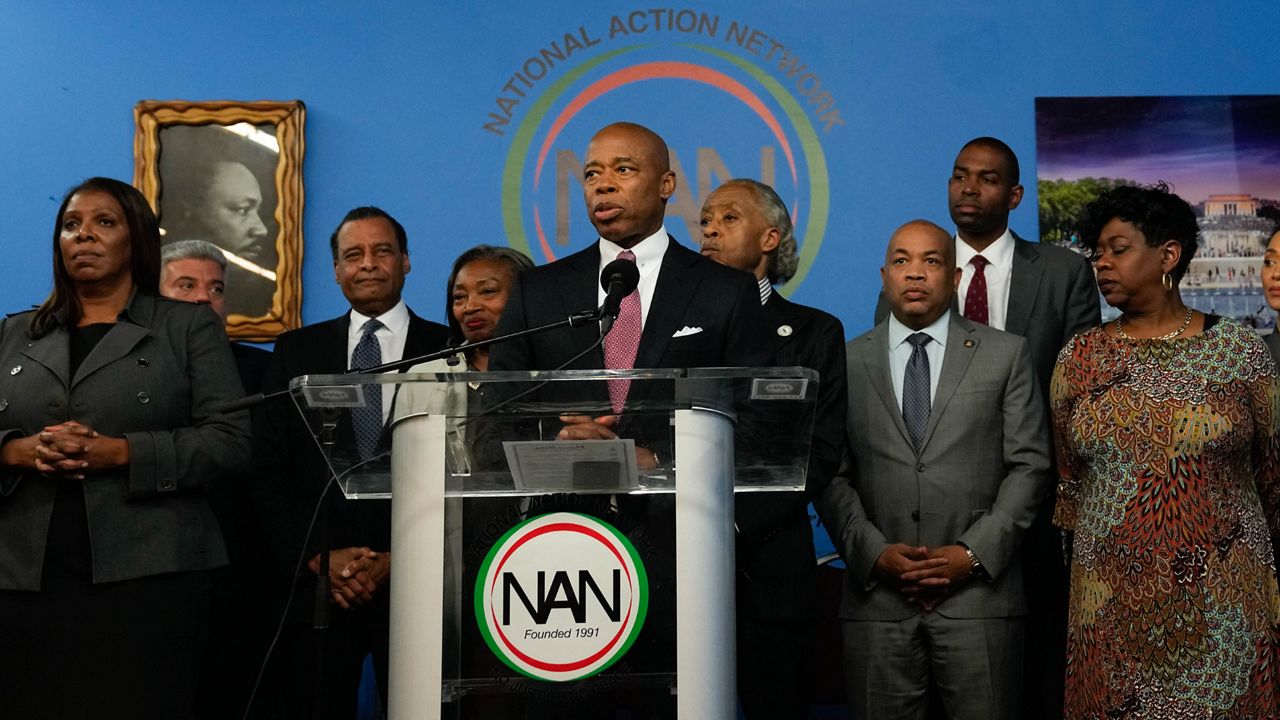
On Thursday, the Rev. Al Sharpton convened what he billed as a historic assembly of New York’s prime Black elected officials — which is also to say a conference of New York’s major elected officials.

Blacks occupy just about every situation of main political affect in New York, from mayor to condition attorney general to the state’s two legislative leaders. And on Thursday they sought to get on the identical web page concerning the concern of community protection.

“Never in advance of in the historical past of this point out have we noticed so several of our major officials come from the Black local community. And it was our concept that we would have these officials sit and focus on community protection,” Sharpton told the media immediately after the private 90 minute meeting.


What You Want To Know

  • New York’s prime Black elected officers collected Thursday evening for a summit on public security
  • The personal assembly was convened by Rev. Al Sharpton at his Nationwide Motion Network headquarters in Harlem
  • Addressing the media later on, participants emphasised the will need to current far more unified messaging but did not discuss coverage
  • “This is what our ancestors prayed for, is standing on this phase correct now,” reported Mayor Eric Adams

This 12 months “will be the 12 months we present this country how to govern,” he said. “And how to govern by men and women that have been still left out of the governing for quite a few yrs, and are now in key positions. We could be on distinctive hymns, but we’re in the exact hymn book. And we’re heading to sing with each other this yr.”

General public security was a divisive difficulty throughout previous year’s midterm elections, one that Republicans utilised to their advantage but also one that made rifts among Democrats. Mayor Eric Adams’ tricky-on-criminal offense strategy and his drive to roll back the state’s bail reform regulations set him at odds with state leaders like Assembly Speaker Carl Heastie, of the Bronx.

But although individuals spoke broadly about the want to realize both of those criminal justice reforms and community security, they made available no details on coverage, instead emphasizing the need to current a unified concept.

Specifics were being mentioned, claimed Legal professional Typical Letitia James, but “none of these concerns will be talked over in this article prior to the media. We will talk about them in non-public, we will arrive forth with a system, we will map out where the issues are, and we will join collectively as a person.”

“We really like the press,” claimed condition Senate The vast majority Chief Andrea Stewart-Cousins, “but you don’t require to talk with each individual other via the push.”

Mayor Adams mentioned legislative successes on the two the city and state ranges had been obscured all through his 1st yr in business, and that the group was united in its endeavours to combat institutional racism.

“This is what our ancestors prayed for, is standing on this stage proper now,” the Mayor stated. “And we’re likely to stay up to individuals prayers, all those sacrifices, all the things they went as a result of.”

Why Japan’s shock policy shift didn’t ‘freak out’ US markets: Morning Brief

Why Japan’s shock policy shift didn’t ‘freak out’ US markets: Morning Brief

This short article to start with appeared in the Early morning Transient. Get the Morning Short sent directly to your inbox each Monday to Friday by 6:30 a.m. ET. Subscribe

Wednesday, December 21, 2022

Modern newsletter is by Julie Hyman, anchor and correspondent at Yahoo Finance. Stick to Julie on Twitter @juleshyman. Examine this and more current market news on the go with Yahoo Finance Application.

Traders confronted a person extra shock late Monday to cap off a unstable year: a surprise adjust in monetary plan from the Bank of Japan.

The BoJ announced a tweak to its generate curve command policy, indicating it will now allow the yield on 10-calendar year govt bonds to increase to about .5{515baef3fee8ea94d67a98a2b336e0215adf67d225b0e21a4f5c9b13e8fbd502}, up from a preceding cap of .25{515baef3fee8ea94d67a98a2b336e0215adf67d225b0e21a4f5c9b13e8fbd502}. The central financial institution is nonetheless targeting a {515baef3fee8ea94d67a98a2b336e0215adf67d225b0e21a4f5c9b13e8fbd502} amount on its 10-year bond and taken care of a -.1{515baef3fee8ea94d67a98a2b336e0215adf67d225b0e21a4f5c9b13e8fbd502} benchmark desire charge.

A “nasty early Christmas shock,” the Wall Street Journal dubbed it. “Bank of Japan stuns markets,” the Financial Occasions blared. Bloomberg Information referred to as it a “shocker.”

Without a doubt, forex and costs markets reacted accordingly, with the Japanese yen (JPY=X) surging 4{515baef3fee8ea94d67a98a2b336e0215adf67d225b0e21a4f5c9b13e8fbd502} versus the U.S. greenback, and the U.S. 10-calendar year Treasury produce leaping by more than 10 basis points.

For markets, the big offer is the Financial institution of Japan hadn’t joined the global central lender tightening party until eventually now, and its venture of keeping low-and-steady monetary coverage has been a single of the longest-standing in the planet.

BoJ Governor Haruhiko Kuroda claimed in a push conference next the final decision that this shift even now doesn’t sign tightening, but somewhat a continuation of the bank’s generate curve command policy. Kuroda is thanks to action down from his submit in April.

Bank of Japan Governor Haruhiko Kuroda attends a news conference in Tokyo, Japan in this photo provided by Kyodo on December 20, 2022. Mandatory credit Kyodo/via REUTERS ATTENTION EDITORS - THIS IMAGE WAS PROVIDED BY A THIRD PARTY. MANDATORY CREDIT. JAPAN OUT. NO COMMERCIAL OR EDITORIAL SALES IN JAPAN

Bank of Japan Governor Haruhiko Kuroda attends a information convention in Tokyo, Japan in this picture delivered by Kyodo on December 20, 2022. Through Reuters

Amidst all the pleasure, U.S. stocks mostly shrugged.

“The modest go better in Japanese costs is crucial for Fx markets, but it will not have any influence on the condition of the U.S. economic outlook,” wrote Torsten Slok, chief economist at Apollo Global Management, in a observe to investors.

One particular of the issues with a probable increase in rates in Japan is that Japanese buyers would pull revenue from foreign assets amid the prospect for improved returns at household.

Slok indicates the impact would be negligible, however, with Japanese holdings of U.S. long-expression Treasury bonds accounting for just 5{515baef3fee8ea94d67a98a2b336e0215adf67d225b0e21a4f5c9b13e8fbd502} of the whole. For U.S. corporate bonds and U.S. equities, Japanese holdings comprise just 2{515baef3fee8ea94d67a98a2b336e0215adf67d225b0e21a4f5c9b13e8fbd502} and 1{515baef3fee8ea94d67a98a2b336e0215adf67d225b0e21a4f5c9b13e8fbd502} of the overall, respectively.

Yet another chance when there’s a sector shock is that it could cause some form of “blowup,” stated Steve Sosnick, chief strategist at Interactive Brokers.

In certain, these utilizing a “carry trade” could have been susceptible subsequent the Bank of Japan’s announcement. As Sosnick discussed in a website write-up, “The trade involves borrowing a lower yielding currency — usually the yen — and working with the proceeds to acquire bigger yielding mounted profits property or to finance speculation in equities and other possibility belongings. In concept, those who had the have trade on must be finding clobbered with the yen growing dramatically.”

But there was no evidence of that clobbering in the marketplace, he mentioned, probably mainly because the yen had already been moving larger, or possibly for the reason that hedge money have been repositioning into the close of the calendar year.

Without a doubt, the rise in the yen could basically finish up currently being fantastic news for U.S. shares, creating this “terrible early Xmas surprise” a person to the upside.

Considering that it achieved its higher as opposed to the yen on Oct 20 of this yr, the greenback has fallen by about 12{515baef3fee8ea94d67a98a2b336e0215adf67d225b0e21a4f5c9b13e8fbd502}. That type of transfer tends to presage a inventory rally, analysts at Bespoke Financial commitment Team wrote in a notice on Tuesday.

Seeking at other occasions when the yen rallied by at least 10{515baef3fee8ea94d67a98a2b336e0215adf67d225b0e21a4f5c9b13e8fbd502} compared to the greenback over a two-month time period, Bespoke observed stocks were increased a 12 months later on in each individual occasion because 1978, and experienced only risen by fewer than double-digits twice.

“One thirty day period later, the S&P 500 was only better 62{515baef3fee8ea94d67a98a2b336e0215adf67d225b0e21a4f5c9b13e8fbd502} of the time, but a few, six, and twelve months afterwards, U.S. shares rallied 85{515baef3fee8ea94d67a98a2b336e0215adf67d225b0e21a4f5c9b13e8fbd502} of the time,” they reported.

“When the headline strike, my response was possibly like a great deal of other people’s reaction, which was – whoa!” Sosnick stated. “It was surprising, but finally not a reason to freak out.”

What to Enjoy Currently

Financial system

  • 7:00 a.m. ET: MBA Home loan Programs, 7 days finished Dec. 16 (3.2{515baef3fee8ea94d67a98a2b336e0215adf67d225b0e21a4f5c9b13e8fbd502} during prior 7 days)

  • 8:30 a.m. ET: Current Account Equilibrium, Q3 (-$222. billion expected, -$251.1 billion through prior thirty day period)

  • 10:00 a.m. ET: Present Residence Revenue, November (4.20 million envisioned, 4.43 million for the duration of prior month)

  • 10:00 a.m. ET: Present House Profits, thirty day period-above-month, November (-5.2{515baef3fee8ea94d67a98a2b336e0215adf67d225b0e21a4f5c9b13e8fbd502} envisioned, -5.9{515baef3fee8ea94d67a98a2b336e0215adf67d225b0e21a4f5c9b13e8fbd502} in the course of prior thirty day period)

  • 10:00 a.m. ET: Meeting Board Customer Self esteem, December (101. predicted, 100.2 through prior thirty day period)

  • 10:00 a.m. ET: Conference Board Present Situation, November (137.4 during prior thirty day period)

  • 10:00 a.m. ET: Meeting Board Anticipations, November (75.4 throughout prior thirty day period)

Earnings

  • Micron Engineering (MU), Cintas (CTAS), MillerKnoll (MLKN), Rite Assist (RAD), Toro (TTC), Carnival Cruises (CCL)

—

Simply click in this article for the hottest stock market news and in-depth assessment, which includes activities that move stocks

Read the most recent economic and organization information from Yahoo Finance

Obtain the Yahoo Finance application for Apple or Android

Adhere to Yahoo Finance on Twitter, Facebook, Instagram, Flipboard, LinkedIn, and YouTube