

Why Silicon Valley Bank’s crisis is rattling America’s biggest banks

Why Silicon Valley Bank’s crisis is rattling America’s biggest banks

The issues of two tiny financial institutions on the West Coast are rippling across marketplaces and producing new investor issues about some of the country’s largest fiscal establishments.

Why? A few words and phrases: increasing desire fees.

The Federal Reserve’s intense campaign to bring down inflation served set the phase for major troubles at two California lending institutions — SVB Financial (SIVB) and Silvergate Capital (SI) — as an outflow of deposits pressured both to provide property at a decline. These belongings ended up bonds.

Banks are huge traders in belongings like Treasury payments simply because they have to have tons of secure areas to park their dollars. Lots of money establishments piled into these investments through a interval of historically-very low fascination rates that spanned the early yrs of the pandemic, as banking companies took in tons of new deposits and lending was considerably restrained.

But now the Fed is mountaineering fees at a immediate clip, with Fed Chair Jay Powell warning earlier this 7 days the central bank could have to velocity up the tempo of its price improves to cool the financial system further more. The challenge that makes for financial institutions is easy: increased costs decreased the benefit of their current bonds.

The withdrawals at SVB’s Silicon Valley Financial institution have arrive from startups and technologies companies, several of which also ran into new issues at the time the Fed commenced boosting fees.

The deposit outflow compelled SVB to provide belongings and take a $1.8 billion decline, a go the bank produced “because we anticipate continued larger curiosity fees, pressured general public and personal marketplaces, and elevated hard cash-burn up degrees from our clientele as they make investments in their companies.” Its shares fell extra than 60{515baef3fee8ea94d67a98a2b336e0215adf67d225b0e21a4f5c9b13e8fbd502} Thursday.

In pre-market place trading on Friday, SVB shares had been down a different 60{515baef3fee8ea94d67a98a2b336e0215adf67d225b0e21a4f5c9b13e8fbd502} after overnight reporting from Bloomberg reported VC companies ranging from Peter Thiel’s Founders Fund to Union Sq. Ventures experienced informed portfolio corporations to pull their funds from Silicon Valley Lender.

Silicon Valley Bank headquarters and branch in Santa Clara on Aug 7, 2019.

Silicon Valley Bank headquarters and branch in Santa Clara on Aug 7, 2019.

Forced sales, forced losses

Banks never have to comprehend losses on bonds that may have gone down in price amid growing charges if they are not pushed to offer these property. But Silvergate Money and SVB Fiscal did not have that alternative. Buyer withdrawals at Silvergate Financial institution and SVB’s Silicon Valley Financial institution forced their hand.

At Silvergate, which caters to cryptocurrency shoppers, clients yanked their income in the worry that adopted the 2022 collapse of cryptocurrency exchange FTX. Silvergate stated in January that it had recognized losses of $886 million from providing securities as deposits fell. That weakened the bank substantially. On Wednesday it reported it would wind down its lender, and its shares plunged Thursday.

Soon after disclosing the $1.8 billion decline and new funds elevate, Silicon Valley’s CEO Greg Becker urged relaxed in a get in touch with with enterprise capitalists Thursday, in accordance to The Information, inquiring these traders not to withdraw cash. It now is in search of to increase $2.25 billion of new funds to address the new losses.

Greg Becker, President and CEO at SVB speaks  at the 2022 Milken Institute Global Conference in Beverly Hills, California, U.S., May 3, 2022.  REUTERS/Mike Blake

Greg Becker, President and CEO at SVB speaks at the 2022 Milken Institute Worldwide Meeting in Beverly Hills, California, U.S., Could 3, 2022. REUTERS/Mike Blake

The problem now among the buyers is that considerably even bigger banking institutions could be forced to do the exact same. That despatched the stocks of big economical establishments tumbling Thursday, like the biggest of the major: JPMorgan Chase (JPM) and Lender of The united states (BAC). A major financial institution index fell by the most Thursday in virtually three several years.

The most significant U.S. banking institutions are considerably stronger than they were being in the direct up to the final big banking crisis, in 2008, in component for the reason that regulators forced them to hold much more money and endure numerous stress examination eventualities above the very last ten years and a fifty percent. And the giants have far more numerous funding and buyer bases than financial institutions these kinds of as Silicon Valley or Silvergate, which provides them many more possibilities during tough times.

Longtime banking analyst Mike Mayo claimed Thursday all through an visual appeal on CNBC the most significant financial institutions are “a pillar of power and balance” and considerably a lot more resilient than they were prior to the 2008 disaster. “The most important threats are outside the house the major banking companies,” he mentioned, and still all banking institutions are “obtaining painted with the similar brush.”

Financial institution shares, he said, “have gotten Powelled,” referring to the Fed chair.

“Likely from zero to 5{515baef3fee8ea94d67a98a2b336e0215adf67d225b0e21a4f5c9b13e8fbd502} curiosity premiums in a period that is more quickly than any time in 4 a long time, you are heading to have casualties.”

WASHINGTON, DC - SEPTEMBER 09:  Federal Deposit Insurance Corporation Chairman Martin Gruenberg testifies during a hearing before Senate Banking, Housing and Urban Affairs Committee September 9, 2014 on Capitol Hill in Washington, DC. The committee held a hearing on

Federal Deposit Insurance plan Corporation Chairman Martin Gruenberg recently highlighted the risks that rising curiosity charges pose to banks. (Picture by Alex Wong/Getty Images)

Federal Deposit Insurance plan Corporation Chair Martin Gruenberg highlighted the new interest charge risks struggling with the sector all through a speech on March 6, noting that unrealized losses on readily available-for-sale and held-to-maturity securities totaled $620 billion at the stop of 2022 across all U.S. financial institutions.

“The present curiosity level surroundings has experienced extraordinary effects on the profitability and risk profile of banks’ funding and financial commitment methods,” he reported. “Initial, as a final result of the larger fascination fees, for a longer period phrase maturity assets obtained by banks when desire rates were being lessen are now really worth a lot less than their face values. The consequence is that most banks have some sum of unrealized losses on securities.”

These unrealized losses, he included, “weaken a bank’s foreseeable future skill to meet surprising liquidity requirements.”

The fantastic news, in accordance to Gruenberg, is that “banking institutions are typically in a potent fiscal problem, and have not been pressured to know losses by advertising depreciated securities.”

Click below for the most up-to-date inventory marketplace news and in-depth evaluation, which include gatherings that transfer shares

Read through the most recent economic and enterprise news from Yahoo Finance
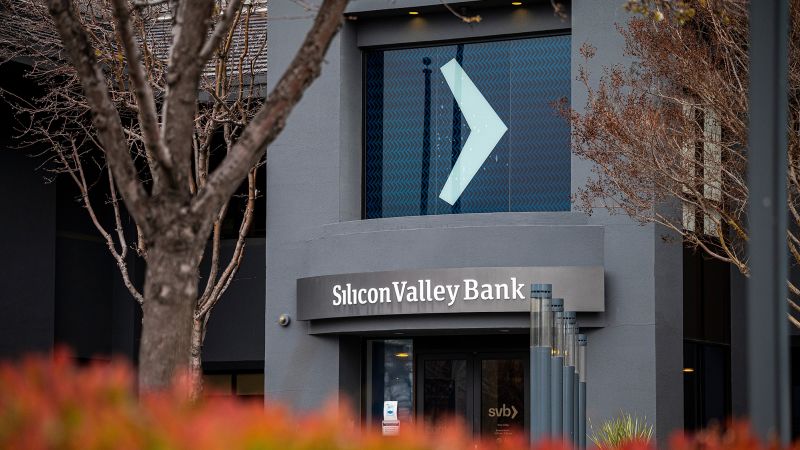
Silicon Valley Bank collapses after failing to raise capital

Silicon Valley Bank collapses after failing to raise capital


New York
CNN
 — 

Silicon Valley Bank collapsed Friday early morning immediately after a stunning 48 hours in which a financial institution operate and a capital disaster led to the next-premier failure of a money establishment in US background.

California regulators closed down the tech financial institution and put it below the regulate of the US Federal Deposit Insurance coverage Company. The FDIC is acting as a receiver, which usually implies it will liquidate the bank’s property to pay back back again its customers, including depositors and collectors.

The FDIC, an unbiased federal government agency that insures financial institution deposits and oversees economic institutions, said all insured depositors will have complete accessibility to their insured deposits by no later than Monday early morning. It mentioned it would pay out uninsured depositors an “advance dividend inside the following 7 days.”

The bank, earlier owned by SVB Financial Team, did not reply to CNN’s request for comment.

The wheels began to appear off on Wednesday, when SVB introduced it had marketed a bunch of securities at a reduction and that it would provide $2.25 billion in new shares to shore up its balance sheet. That brought on a panic among the essential venture capital companies, who reportedly recommended corporations to withdraw their money from the lender.

The company’s stock cratered on Thursday, dragging other banks down with it. By Friday early morning, SVB’s shares ended up halted and it experienced abandoned efforts to quickly elevate funds or come across a buyer. Numerous other financial institution shares ended up temporarily halted Friday, which includes Very first Republic, PacWest Bancorp, and Signature Lender.

The mid-morning timing of the FDIC’s takeover was noteworthy, as the agency commonly waits till the market place has closed to intervene.

“SVB’s situation deteriorated so quickly that it could not very last just five a lot more several hours,” wrote Much better Marketplaces CEO Dennis M. Kelleher. “That’s due to the fact its depositors had been withdrawing their income so quickly that the financial institution was bancrupt, and an intraday closure was unavoidable due to a common bank run.”

Silicon Valley Bank’s drop stems partly from the Federal Reserve’s intense desire amount hikes around the past year.

When curiosity premiums were being close to zero, banking companies loaded up on lengthy-dated, seemingly low-hazard Treasuries. But as the Fed raises desire prices to fight inflation, the price of all those belongings has fallen, leaving financial institutions sitting down on unrealized losses.

Higher prices strike tech primarily really hard, undercutting the value of tech stocks and earning it rough to raise cash, Moody’s chief economist Mark Zandi said. That prompted many tech firms to attract down the deposits they held at SVB to fund their operations.

“Higher rates have also lowered the value of their treasury and other securities which SVB desired to fork out depositors,” Zandi stated. ” All of this set off the run on their deposits that pressured the FDIC to takeover SVB.”

Deputy Treasury Secretary Wally Adeyemo on Friday sought to reassure the public about the wellness of the banking method soon after the unexpected collapse of SVB.

“Federal regulators are spending focus to this certain fiscal institution and when we believe about the broader money system, we’re quite self-assured in the skill and the resilience of the process,” Adeyemo explained to CNN in an exclusive interview.

The opinions arrive following Treasury Secretary Janet Yellen convened an unscheduled assembly of money regulators to go over the implosion of Silicon Valley Lender, a main loan company to the hurting tech sector.

“We have the applications that are necessary to [deal with] incidents like what is transpired to Silicon Valley Bank,” Adeyemo explained.

Adeyemo explained US officers are “learning extra information” about the collapse of Silicon Valley Financial institution. He argued the Dodd-Frank monetary reform overhaul, signed into legislation in 2010, has given regulators the equipment they have to have to deal with this and improved the capitalization of financial institutions.

Adeyemo declined to predict what, if any, influence there will be to the broader overall economy or the tech marketplace.

Despite preliminary stress on Wall Avenue over the operate on SVB, which brought about its shares to crater, analysts stated the bank’s collapse is not likely to set off the type of domino outcome that gripped the banking business during the money crisis.

“The program is as properly-capitalized and liquid as it has ever been,” Zandi stated. “The banks that are now in trouble are significantly too modest to be a significant risk to the broader system.”

But scaled-down financial institutions that are disproportionately tied to cash-strapped industries like tech and crypto may be in for a tough journey, according to Ed Moya, senior industry analyst at Oanda.

“Everyone on Wall Avenue realized that the Fed’s fee-hiking campaign would finally break anything, and ideal now that is having down tiny banking companies,” Moya said.

Although somewhat mysterious exterior of Silicon Valley, SVB was amid the best 20 American business banks, with $209 billion in full assets at the finish of final year, in accordance to the FDIC.

It is the most significant loan company to fall short considering the fact that Washington Mutual collapsed in 2008.

The bank partnered with virtually 50 percent of all enterprise-backed tech and wellness treatment providers in the United States, several of which pulled deposits out of the lender.

Mike Mayo, Wells Fargo senior lender analyst, said the disaster at SVB may perhaps be “an idiosyncratic problem.”

“This is evening and working day compared to the worldwide economic disaster from 15 decades ago,” he informed CNN’s Julia Chatterly on Friday. Back then, he stated, “banks had been getting extreme threats, and people today imagined anything was wonderful. Now everyone’s worried, but beneath the area the financial institutions are a lot more resilient than they’ve been in a generation.”

SVB’s unexpected fall mirrored other dangerous bets that have been exposed in the past year’s sector turmoil.

Crypto-centered financial institution Silvergate said Wednesday it is winding down functions and will liquidate the financial institution following remaining fiscally pummeled by turmoil in digital belongings. Signature Lender, another financial institution, was strike tough by the lender selloff, with shares sinking 30{515baef3fee8ea94d67a98a2b336e0215adf67d225b0e21a4f5c9b13e8fbd502} ahead of remaining halted for volatility Friday.

“SVB’s institutional problems replicate a more substantial and additional popular systemic issue: The banking market is sitting on a ton of reduced-yielding assets that, many thanks to the past 12 months of price raises, are now far underwater — and sinking,” wrote Konrad Alt, co-founder of Klaros Team.

Alt believed that price will increase have “effectively wiped out close to 28{515baef3fee8ea94d67a98a2b336e0215adf67d225b0e21a4f5c9b13e8fbd502} of all the capital in the banking business as of the finish of 2022.”