Is the global economy deglobalizing? And if so, why? And what is next?

Is the global economy deglobalizing? And if so, why? And what is next?

The globalization of the world financial system continued even as a result of the COVID pandemic, but current variations in federal government coverage and community sentiment could herald a new period of deglobalization, implies a paper to be mentioned at the Brookings Papers on Economic Exercise (BPEA) conference on March 31.

The authors—Pinelopi K. Goldberg of Yale University and Tristan Reed of the Environment Bank—use knowledge on trade, capital flows, and immigration to present that, after advancing promptly for two a long time, globalization slowed, but continued, right after the 2008-2009 money crisis.

Authorities coverage and public sentiment began to change toward deglobalization all over 2015 with rising issue about the labor marketplace effect of U.S. imports from lower-wage nations fueling a trade war concerning the United States and China. But the financial consequences, although significant, had been not adequate to reverse decades-aged globalization trends, in accordance to the paper, Is the World-wide Overall economy Deglobalizing?

The pandemic lifted inquiries about the fragility of international offer chains and generated requires for “reshoring” generation domestically. But, just after a short-term drop in 2020, trade improved sharply. U.S. companies, for the most element, held on to their relationships with foreign suppliers and even pursued new kinds.

Goldberg and Reed Figure 1, BPEA Spring 2023

“If nearly anything, trade increased economies’ resilience in the course of the COVID pandemic,” the authors write. For case in point, imports of deal with masks from China and Korea achieved desire that could not be matched by U.S. suppliers.

Even so, Russia’s invasion of Ukraine in February 2022, by exposing Europe’s dependence on Russia for strength, established new demands for reshoring and “friendshoring” (trading only with welcoming international locations). For occasion, the United States in Oct 2022 imposed sweeping limits on semiconductor exports aimed at protecting against China from advancing technologically.

“We are in a shifting landscape.”

“These developments can plausibly be thought of the markers of a new period,” the authors create. They conclude their paper with “highly speculative” feelings about the very long-run probable consequences if deglobalization has, in simple fact, begun. Amid them:

  • Improved friendshoring could enhance countries’ resilience to geopolitical shocks, these types of as war, but reduce resilience to other shocks, this kind of as pandemics.
  • Expansion and innovation could gradual in a deglobalizing world overall economy, with a decoupling between the United States and China posing a specific risk.
  • Reduced foreign level of competition in the type of trade and immigration could add to bigger selling prices and wages in the United States.
  • As state-of-the-art economies transform inward, poverty reduction and enhancement could slow in little, low-earnings countries that have relied on exports.

“We are in a shifting landscape,” Goldberg explained in an job interview with The Brookings Establishment. “We evidently see a reversal in plan. We really do not see the outcomes in knowledge but, but given the reversal in plan, you would count on big consequences down the street.”


Citation

Goldberg, Pinelopi K. and Tristan Reed. 2023. “Is the Global Economic climate Deglobalizing? And if so, why? And what is future?” BPEA Convention Draft, Spring.

DISCLOSURE

The authors did not get economic assist from any company or man or woman for this short article or from any agency or particular person with a money or political desire in this short article. The authors are not at the moment an officer, director, or board member of any corporation with a monetary or political curiosity in this article.

Consumers Express a Little More Optimism About the Economy | Economy

Consumers Express a Little More Optimism About the Economy | Economy

Customer self-assurance shockingly rose in March as people turned more optimistic about the long run even though remaining worried about the existing state of the financial system, the Convention Board noted on Tuesday.

The current predicament index, measuring consumers’ assessment of present financial disorders, fell to 151.1 from 153. in February. The expectations Index, measuring the short-phrase outlook for the financial state edged up to 73 from 70.4 in February.

That even now leaves the anticipations index down below the stage of 80, typically a sign that a recession is probable inside the next 12 months. The study was completed about 10 times right after the failure of Silicon Valley Bank rattled markets.

“Driven by an uptick in expectations, shopper self esteem enhanced to some degree in March, but stays down below the ordinary level noticed in 2022 (104.5). The gain reflects an improved outlook for people beneath 55 yrs of age and for homes earning $50,000 and around,” claimed Ataman Ozyildirim, senior director, economics at the organization firm.

“While buyers really feel a bit more self-confident about what’s in advance, they are slightly a lot less optimistic about the existing landscape,” he included. “The share of people stating work are ‘plentiful’ fell, although the share of those stating work opportunities are ‘not so plentiful’ rose.”

“The most up-to-date success also expose that their expectations of inflation in excess of the next 12 months stays elevated – at 6.3 per cent,” Ozyildrim mentioned. “Overall obtaining strategies for appliances continued to soften whilst auto purchases noticed a slight boost.”

Political Cartoons on the Financial system

Even though people normally categorical doubts about the overall economy, they have continued to shell out. Nonetheless, there are signals that the economic climate and the labor industry, a resource of resilience all over the coronavirus pandemic, have both of those softened of late. Home price ranges fell a little in January but continue being 3.8{515baef3fee8ea94d67a98a2b336e0215adf67d225b0e21a4f5c9b13e8fbd502} earlier mentioned the stage of a 12 months in the past.

The path for the financial state stays uncertain, offered the current crisis in the banking business. Federal Reserve Chairman Jerome Powell warned previous 7 days that a credit crunch could be the result of banking institutions pulling in their horns in response to the strains they are going through.

The Fed continues to be dedicated to raising interest fees despite obtaining elevated them additional than fourfold in the final yr. But marketplaces are really pricing in fee cuts by the central financial institution this yr, despite the fact that that is not what Fed officials are forecasting.

“A recession in the 2nd 50 percent of 2023 continues to be our base case, but the odds of a later downturn have risen,” Vanguard Main World-wide Economist Joe Davis explained on Tuesday. “Core aspects of the economic system, this sort of as use and the labor market, proceed to show higher than-development activity.”

China’s New Premier Courts Foreign CEOs With Vow to Open Economy

China’s New Premier Courts Foreign CEOs With Vow to Open Economy

(Bloomberg) — Premier Li Qiang vowed that China will open up broader to the outside environment and set up a “broad space” for foreign providers to create in the Asian country.

Most Go through from Bloomberg

“China’s economic climate has deeply built-in into the world wide program,” Li informed foreign attendees of the China Enhancement Forum on Monday, according to condition broadcaster China Central Tv. “China will unswervingly stick to opening up, no matter of variations to the worldwide surroundings.”

The country’s expansion will present new momentum for the world economic climate, he included.

The reviews underscore Beijing’s force to assure buyers of its financial restoration and commitment to worldwide organizations at the 3-day forum. Overseas executives manufactured their 1st excursion to the world’s No. 2 economic climate because it reopened its borders right after three decades of stringent pandemic limits.

Li thanked the international associates in the viewers for the support they’d supplied more than the years and urged them to “take a extensive-time period view” amid economic issues.

“It is like urgent on the journey for the duration of a rainy day,” Li reported. “If 1 keeps their head down, they’d only see a muddy street. But if one particular appears in advance, they’d see the rainbow right after the rain.”

Examine: Jack Ma’s Retreat Undercuts China Pitch to Non-public Enterprise

About 70 overseas executives — like Apple Inc.’s Tim Cook dinner, Bridgewater Associates’ Ray Dalio and Deloitte’s Sharon Thorne — ended up shown on CCTV attending the forum. The celebration was Li’s 1st with foreign companies given that becoming China’s No. 2 formal before this thirty day period.

Li struck an enthusiastic, upbeat tone about China’s contribution to world progress and its capability to triumph over long run challenges, Andrew Forrest, founder and chairman of Fortescue Metals Group Ltd., told Bloomberg in an interview adhering to the meeting with the premier.

A key message from the China Enhancement Forum this year is that “China is open up for enterprise again” mentioned Scott Kennedy, a China expert at the Center for Strategic & International Scientific studies who attended the celebration.

At the exact same time, China is searching for to turn out to be additional self-reliant in important technologies amid US attempts to suppress its advancements in chip technologies, and organizations continue on to complain that current market entry is still restricted.

Additional: Jack Ma’s Retreat Undercuts China Pitch to Personal Small business

The financial restoration also stays uncertain. Income at industrial firms in China plunged in the initial two months, unemployment has amplified and the housing market is even now weak. The international overall economy is also weakening, curbing demand for Chinese exports.

Beijing is counting on a rebound in domestic investment and client demand from customers to fulfill its financial advancement concentrate on of about 5{515baef3fee8ea94d67a98a2b336e0215adf67d225b0e21a4f5c9b13e8fbd502} this year. Economists surveyed by Bloomberg hope the economic system to develop 5.3{515baef3fee8ea94d67a98a2b336e0215adf67d225b0e21a4f5c9b13e8fbd502} this calendar year.

–With aid from Philip Glamann.

(Updates with feedback from Scott Kennedy.)

Most Go through from Bloomberg Businessweek

©2023 Bloomberg L.P.

US ups interest rates, UBS buys Credit Suisse – this week’s economy news

US ups interest rates, UBS buys Credit Suisse – this week’s economy news
  • This weekly round-up brings you the latest stories from the world of economics and finance.
  • Top economy stories: US raises interest rates by 0.25 percentage points; UBS takes over Credit Suisse; IMF board approves Sri Lanka bailout.

1. US raises interest rates again as it weighs up banking crisis

The US Federal Reserve has raised interest rates by a quarter of a percentage point but indicated it is on the verge of pausing further increases. This is to help balance out inflation risks given the threat of banking-system instability and a potential credit crunch that could lead to a sharp economic slowdown.

The rate hike is the US central bank’s ninth in a row and lifts its key interest rate to 4.75-5.00{515baef3fee8ea94d67a98a2b336e0215adf67d225b0e21a4f5c9b13e8fbd502} – its highest level since 2007 and up from practically zero a year ago. But in a key shift driven by the sudden failures of Silicon Valley Bank (SVB) and Signature Bank this month, the Fed’s latest policy statement no longer says that “ongoing increases” in rates will likely be appropriate.

Fed Chair Jerome Powell sought to reassure investors about the soundness of the banking system, saying that the management of SVB “failed badly” but that the bank’s collapse this month does not indicate wider weaknesses in the banking system.

US ups interest rates, UBS buys Credit Suisse – this week’s economy news

Ongoing inflation has led to nine consecutive rises in US interest rates.

Image: US Bureau of Labor Statistics

However, Powell admitted that Fed officials still need to see how banks might change their lending behaviour in response to the SVB and Signature collapses. “It’s really … a question of not knowing at this point,” he said. “How significant will this credit tightening be, and how sustainable?”

Reuters says that the Fed’s relentless rate hikes to try and rein-in inflation are among the factors being blamed for the biggest banking sector meltdown since the 2008 financial crisis. In February, US regulators said the country’s banks had unrealized losses of more than $620 billion on securities, underscoring the hit from rising interest rates.

JPMorgan says the banking crisis and rising interest rates mean the US appears to be heading for a recession. “A soft landing now looks unlikely, with the airplane in a tailspin (lack of market confidence) and engines about to turn off (bank lending),” its strategists said in a note to clients. “Even if central bankers successfully contain the contagion, credit conditions look set to tighten more rapidly because of pressure from both markets and regulators.”

2. UBS takes over Credit Suisse as banks seek to stem crisis fears

Some of the world’s largest central banks came together last weekend to stop a potential banking crisis from spreading, as Swiss authorities persuaded UBS to buy rival bank Credit Suisse in an historic deal.

UBS will buy Credit Suisse for CHF3 billion ($3.23 billion) in stock and assume up to CHF5 billion ($5.4 billion) in losses. Credit Suisse’s share price slumped last week after its largest investor said it could not provide the bank with more money, prompting large falls in other banking stocks.

FTSE 100 performance

Stocks on the FTSE 100 have fallen because of the banking crisis.

Image: London Stock Exchange

The Swiss National Bank’s chairman says the UBS takeover prevented “extreme consequences for Switzerland but also the global economy”. The European Central Bank (ECB) described the rescue deal as “instrumental” for restoring calm, and vowed to support Eurozone banks with loans if needed.

Germany's DAX stock index

Germany’s DAX index of the 40 major German blue-chip companies has also wobbled.

Image: Borse Frankurt

In a global response not seen since the height of the pandemic, the ECB also joined forces with the US Federal Reserve and central banks in Canada, England, Japan and Switzerland to bolster the flow of cash around. The banks will offer daily currency swaps – an expansion from a previous weekly programme – in what is effectively a low-risk short-term loan offering to ensure the world’s major economies have adequate supply of US dollars to meet local demands.

However, the UBS takeover has not pleased distressed debt investors and corporate litigators in the US, who are preparing to fight the Swiss government over its move to write down $17bn of Credit Suisse bonds as part of the deal, The Financial Times reports.

3. News in brief: Stories on the economy from around the world

The International Monetary Fund (IMF) board has approved a nearly $3 billion bailout for Sri Lanka. The full programme will enable the country to access up to $7 billion in funding – but IMF Managing Director Kristalina Georgieva says Sri Lanka needs to undertake various reforms in return.

Japan’s core consumer inflation slowed in February, but an index stripping away energy costs hit a four-decade high, suggesting that cost-push pressures may persist longer than policy-makers thought. The core consumer price index rose by 3.1{515baef3fee8ea94d67a98a2b336e0215adf67d225b0e21a4f5c9b13e8fbd502} last month from a year earlier, down from a 41-year high of 4.2{515baef3fee8ea94d67a98a2b336e0215adf67d225b0e21a4f5c9b13e8fbd502} in January.

South Korea’s exports plummeted by 17.4{515baef3fee8ea94d67a98a2b336e0215adf67d225b0e21a4f5c9b13e8fbd502} in the first 20 days of March compared with a year earlier, with semiconductor shipments sliding by 44.7{515baef3fee8ea94d67a98a2b336e0215adf67d225b0e21a4f5c9b13e8fbd502}, Bloomberg reports. The country is one of the world’s biggest exporters, and its economic health is a key indicator of trends in the global economy.

Germany’s economy will shrink again in the first quarter and underlying inflation could prove to be stubborn, even if overall price growth is likely to slow sharply soon, the central bank says. This would put Europe’s biggest economy into recession, after it contracted by 0.4{515baef3fee8ea94d67a98a2b336e0215adf67d225b0e21a4f5c9b13e8fbd502} in the final quarter of 2022. Investor confidence in Germany has fallen for the first time in six months.

The World Economic Forum’s Centre for the Fourth Industrial Revolution Network has built a global community of central banks, international organizations and leading blockchain experts to identify and leverage innovations in distributed ledger technologies (DLT) that could help usher in a new age for the global banking system.

We are now helping central banks build, pilot and scale innovative policy frameworks for guiding the implementation of DLT, with a focus on central bank digital currencies (CBDCs). DLT has widespread implications for the financial and monetary systems of tomorrow, but decisions about its use require input from multiple sectors in order to realize the technology’s full potential.

“Over the next four years, we should expect to see many central banks decide whether they will use blockchain and distributed ledger technologies to improve their processes and economic welfare. Given the systemic importance of central bank processes, and the relative freshness of blockchain technology, banks must carefully consider all known and unknown risks to implementation.”

—Ashley Lannquist, Blockchain and Digital Assets Platform, World Economic Forum

Our Central Banks in the Age of Blockchain community is an initiative of the Platform for Shaping the Future of Technology Governance: Blockchain and Digital Assets.

Read more about our impact, and learn how you can join this first-of-its-kind initiative.

The Bank of England has raised interest rates by a further quarter of a percentage point following an unexpected rise in British inflation to 10.4{515baef3fee8ea94d67a98a2b336e0215adf67d225b0e21a4f5c9b13e8fbd502} in February. Rates now stand at 4.25{515baef3fee8ea94d67a98a2b336e0215adf67d225b0e21a4f5c9b13e8fbd502}, but the bank says its Monetary Policy Committee sees less urgency about maintaining its fast run of rate hikes, and that price growth is on course to fall sharply in April-June.

Nigeria’s central bank is likely to extend its sharp monetary tightening as it looks to contain rising inflation, according to a Bloomberg survey of economists. Annual inflation in Africa’s biggest economy rose to 21.91{515baef3fee8ea94d67a98a2b336e0215adf67d225b0e21a4f5c9b13e8fbd502} in February from 21.82{515baef3fee8ea94d67a98a2b336e0215adf67d225b0e21a4f5c9b13e8fbd502} in January. The bank hiked its key interest rate to 17.5{515baef3fee8ea94d67a98a2b336e0215adf67d225b0e21a4f5c9b13e8fbd502} in January, from 10.5{515baef3fee8ea94d67a98a2b336e0215adf67d225b0e21a4f5c9b13e8fbd502} last May.

Lebanon’s central bank will begin selling unlimited amounts of US dollars in a bid to halt the spiralling devaluation of the Lebanese pound. The currency has lost more than 98{515baef3fee8ea94d67a98a2b336e0215adf67d225b0e21a4f5c9b13e8fbd502} of its value since the economy began unravelling in 2019.

4. More on finance and the economy on Agenda

The failure of SVB has raised questions about financial safeguards. John Letzing, the World Economic Forum’s Digital Editor, Strategic Intelligence, explores why – and how – banks are regulated.

Why do bank runs happen? They are a result of a bank facing a loss of confidence, sparking customers to withdraw deposits, this blog says. It also explores how these fears and contagion can spread from one institution to another.

Financial regulation and supervision is in the spotlight as banking turmoil intensifies in the US and Europe. Could regulation technology – or “reg-tech” – help avert banking failures? World Economic Forum Lead Editor Gayle Markovitz explores.

Fed’s Powell says SVB collapse may slow the economy through tighter credit

Fed’s Powell says SVB collapse may slow the economy through tighter credit

Federal Reserve Board Chair Jerome Powell speaks through a news conference at the Federal Reserve in Washington, DC, on March 22, 2023.

Olivier Douliery | AFP | Getty Pictures

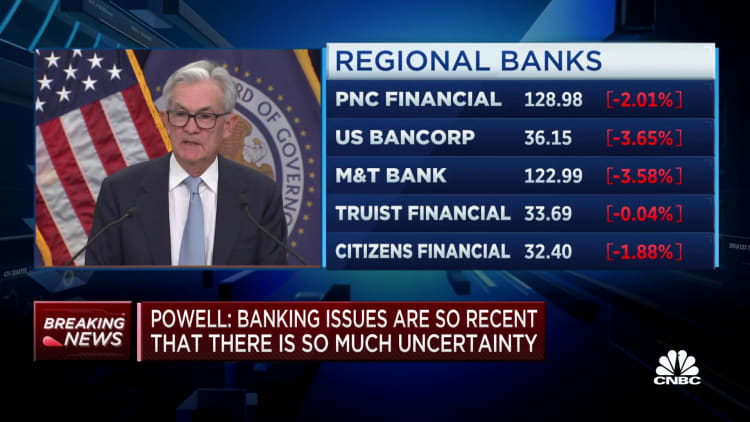
Federal Reserve Chair Jerome Powell reported Wednesday that the U.S. banking sector is powerful but that the current failure of some regional financial institutions could cause ripple effects that gradual down the financial state.

At a press meeting right after the most recent Federal Open Marketplaces Committee meeting, Powell described the banking technique as “audio and resilient” but said the central bank was monitoring a improve in the availability of credit score for customers and organizations.

“Monetary problems appear to have tightened, and possibly by a lot more than the regular indexes say. … The query for us although is how substantial will that be — what will be the extent of it, and what will be the period of it,” Powell explained.

“We are going to be looking to see how serious is this and does it glimpse like it is really likely to be sustained. And if it is, it could conveniently have a significant macroeconomic impact, and we would element that into our plan selections,” he extra.

Our response was how did this happen, says Fed Chair Powell of SVB failure

The Fed hiked its benchmark desire charge by a quarter of a percentage stage on Wednesday, but its projections referred to as for just just one extra hike above the relaxation of the 12 months. The central bank chief mentioned that tighter monetary conditions induced by more stringent lending choices from banking companies could have a very similar effects as further more hikes from the Fed.

Powell’s responses appear after regional financial institutions have appear less than significant tension this thirty day period. Silicon Valley Financial institution collapsed, making it the next premier failure in U.S. heritage, in part simply because the speedy increase in desire costs devalued its bond portfolio and designed significant paper losses for the financial institution.

SVB’s administration “unsuccessful poorly” in handling its desire amount dangers, even though other financial institutions have managed to deal with the hikes, Powell reported.

Other banking institutions like Very first Republic and PacWest have witnessed considerable outflows of deposits. The Fed set up a new Financial institution Phrase Funding Software to aid financial institutions entry funds, but the stocks for regional financial institutions have fallen in volatile buying and selling given that the facility was created on March 12.

Powell explained that deposit flows have stabilized more than the previous 7 days and that Americans really should sense confident that their money is harmless, however he stopped quick of explicitly stating that all deposits are now confirmed.

“What I am stating is you’ve got noticed that we have the applications to shield depositors when there is a risk of serious harm to the economy or to the financial technique, and we’re geared up to use individuals applications. I think depositors ought to assume that their deposits are risk-free,” he mentioned.

The collapse of Silicon Valley Financial institution has led to much more scrutiny on the Federal Reserve’s supervisory part in excess of banking companies, in particular from Sen. Elizabeth Warren (D-MA).

The Fed is conducting an internal critique of possible regulatory concerns all around SVB, led by Vice Chair for Supervision Michael Barr, and Powell mentioned he expects investigations from outdoors the central bank as effectively.

Safety of Global Financial System, Fed Meeting Weigh on Markets, Economy | Economy

Safety of Global Financial System, Fed Meeting Weigh on Markets, Economy | Economy

The specter of a worldwide financial crisis hangs in excess of the market and the financial system Monday adhering to the acquisition of embattled Swiss financial institution Credit score Suisse by rival UBS in a fireplace sale brokered by the Swiss government Sunday afternoon.

Credit Suisse, an international monetary big with a series of scandals and mishaps in new several years, saw the value of its inventory erode substantially late final 7 days as it warned of deposits leaving the financial institution and other money troubles. While not specifically relevant to the modern failures of Silicon Valley Financial institution and Signature Lender of New York, its hasty demise underscores the fragility of the worldwide money system and the erosion of self esteem amongst buyers, traders and banking regulators.

Those concerns grew Sunday as a coalition of regional banking institutions, struggling with withdrawals as their clients seek the security of larger sized financial institutions, known as on the U.S. Federal Deposit Insurance policies Corp. to make a assertion backing all deposits and not just those people of threatened banking companies. Past Sunday, the U.S. govt declared an extraordinary rescue system for the depositors at SVB and Signature, but it is unclear irrespective of whether that means a blanket vote of assistance for all financial institutions.

Monday brought blended news as the index monitoring regional lender stocks rose a little in premarket buying and selling, but shares of Very first Republic Financial institution – a San Francisco establishment that received a $30 billion lifeline on Thursday from a team of banking companies – fell adhering to a credit history downgrade from rating agency S&P.

The Dow Jones Industrial Common was about 200 factors higher shortly just after the open.

Just last 7 days alone, banks took advantage of $300 billion in help from the Federal Reserve, after the central bank designed financial loans and other economical aid readily available to banking institutions. And also Sunday, the Fed joined central financial institutions around the globe to make positive the international stream of bucks remains intact.

Political Cartoons on the Overall economy

Banks have discovered on their own holding very long-expression govt bonds as reserves and collateral for their obligations to depositors and mortgage consumers, at a time when those people securities have lost some of their sector price thanks to the Fed’s aggressive and speedy elevating of desire premiums. As very long as the banking companies keep the bonds to maturity, they are great. But some have been compelled to dollars them in early at a decline to meet heavier-than-expected withdrawals.

There were reviews, originating with Bloomberg Information, on Sunday that Biden administration officers were speaking with famed investor Warren Buffett about having some positions in regional banks as a way to provide more cash and the unmistakable vote of self-confidence that would supply. Buffett performed a similar role through the 2008 economical crisis, when he obtained $5 billion of Goldman Sachs shares. Buffett has turn out to be a person of the richest people in The us getting companies when they are out of favor and holding on to them for very long periods of time, reaping good benefits in the system. His stake in Goldman, sold in 2020, netted Buffett a $3 billion gain.

U.S. officials followed the developments in Switzerland carefully soon after it grew to become clear on Friday that a buyer would likely have to be observed for Credit rating Suisse. UBS reportedly made an preliminary provide of only $1 billion but was persuaded to up its provide by Swiss officers.

“This acquisition is attractive for UBS shareholders but, allow us be very clear, as much as Credit rating Suisse is concerned, this is an emergency rescue. We have structured a transaction which will protect the value still left in the organization even though limiting our downside exposure,” explained UBS Chairman Colm Kelleher in a assertion.

“We welcome the bulletins by the Swiss authorities right now to guidance economic balance. The funds and liquidity positions of the U.S. banking method are solid, and the U.S. economical process is resilient,” claimed a joint statement launched by Treasury Secretary Janet Yellen and Federal Reserve Board Chairman Jerome Powel. “We have been in close get in touch with with our intercontinental counterparts to assist their implementation.”

The ongoing crisis has thrown into doubt the Fed’s steps this 7 days when it fulfills to think about increasing desire premiums. The central lender was envisioned to rubber stamp an maximize of a 50 percent level, or 50 foundation factors, in its important lending level adhering to more powerful-than-predicted economic facts at the commence of the 12 months. Then, some more current data showed a moderation in the labor market place and a quicker slowdown in wholesale inflation, prompting the market place to selling price in a lessen hike of 25 basis points.

“The hastily brokered deal, developed to continuous worldwide marketplaces, has seemingly progressed with no shareholder settlement and this is heading to go away some of Credit history Suisse’s most significant investors nursing distressing losses,” reported Oliver Rust, head of solution at inflation facts aggregator Truflation. “Currently, European marketplaces seem to be somewhat unfazed, and US futures glimpse mostly good. Even so, but one more big banking collapse is going to preserve traders nervous, as is the future FOMC announcement on Wednesday.”

But with the Fed providing monetary guidance to the banking program and fears of tighter credit as financial institutions adjust to a new truth, Goldman Sachs and many others are expecting the Fed to consider a pause until finally it is clear the money program has weathered the storm.

“While policymakers have responded aggressively to shore up the financial procedure, markets look to be a lot less than absolutely confident that efforts to aid small and midsize banking institutions will confirm sufficient,” Goldman Sachs economist David Mericle mentioned Monday morning in a be aware to consumers.

The Fed is also facing political tension as it seems regulators could have known of some troubles at SVB and, in any case, are struggling with questions about how closely they have been scrutinizing the more compact financial institutions. The criticism is coming from the two ends of the political spectrum with some Republicans blaming SVB’s failure on “wokeism” stemming from the bank’s determination to range, equity and inclusion systems.

Democratic Sen Elizabeth Warren of Massachusetts, who often criticizes the Fed for getting additional attuned to the fears of Wall Avenue than each day employees, scolded Powell on Sunday.

“Look, my sights on Jay Powell are well-recognized at this issue. He has experienced two employment. Just one is to offer with monetary coverage. A single is to offer with regulation. He has unsuccessful at each,” she explained in the course of an appearance on NBC’s “Meet the Push.”

Though the banking crisis and actions of the Fed will overshadow all else this week, there are refreshing reports coming that should really solid new gentle on the wellness of the housing sector. Existing property gross sales for February are owing out Tuesday with anticipations for a slight improvement as house loan rates eased. Then on Thursday, new house sales are most likely to clearly show a drop from January.

Housing has been in particular afflicted by the Fed’s marketing campaign of combating inflation by boosting fascination prices. That has driven house loan costs to concentrations about double what they ended up a year in the past and set the brakes on the housing market.

There are fears now that an extended period of time of uncertainty in the banking sector could direct to fewer financial loans and tighter situations for credit history all over the overall economy. Banks are an vital source of purchaser financial loans, as well as main loan companies to the professional actual estate market.

“Based on FDIC info, US banking institutions with significantly less than $250 billion in assets account for about half of C&I (business and industrial) lending, and in excess of fifty percent of home loan and business authentic estate lending,” BCA Analysis famous on Monday morning. “As this kind of, the turmoil in the banking sector will inevitably weigh on financial activity. Additionally, bank lending standards – a reputable foremost indicator for credit score growth – were tightening even right before the SVB debacle. The functions more than the earlier weeks will only exacerbate this pattern.”

“Our Global Investment Approach service continues to imagine that the future world wide recession will start in 2024, which is later than most buyers hope,” BCA additional. “However, supplied the current strains in the banking program, the risk of an previously begin day has amplified.”