Russia-Ukraine war live: Putin visits occupied Kherson region; US journalist appears in Moscow court | Russia

Russia-Ukraine war live: Putin visits occupied Kherson region; US journalist appears in Moscow court | Russia

Putin attends military meeting in Kherson

Russian president Vladimir Putin has attended a military command meeting in Ukraine’s southern Kherson region which is partly held by Russia, the Kremlin has said.

Putin heard reports from commanders of the airborne forces and the “Dnieper” army group as well as other senior officers who briefed him on the situation in the Kherson and Zaporizhzhia regions, both of which Moscow has proclaimed part of Russia, Reuters reported.

Russian troops retreated from Kherson, the regional capital, last November, and have been reinforcing their positions on the opposite bank of the Dnipro river in anticipation of the Ukrainian counteroffensive.

The Kremlin did not say when Putin attended the military command meeting.

Key events

Switzerland has condemned Russia’s war against Ukraine in the strongest terms, it is very much committed to humanitarian aid for Ukraine and is doing everything possible to seriously implement sanctions against Russia, its president has said today.

At a joint news conference with Olaf Scholz, the German Chancellor, Alain Berset said: “We adopted the (EU) sanctions and of course we take this completely seriously and we are simply doing everything that can be done in order to enforce them seriously”.

Romania’s ruling Social Democrat Party (PSD) has said that it will ask the coalition government to approve an emergency decree enforcing a temporary ban on Ukrainian grain imports, mirroring similar moves by countries in central and eastern Europe.

Reuters reports:

On Monday, Slovakia joined Poland and Hungary in banning grain imports from Ukraine as even Kyiv’s staunchest allies come under domestic pressure to shield their agriculture markets.

“PSD will ask the governing coalition to make a political decision to enable … the government to issue the decree,” the party, to which the agriculture minister belongs, said in a statement.

“At the same time, Romania must continue to support Ukraine by facilitating the transit of farm products to other European Union states or to Black Sea commercial routes.”

Summary of the day so far …

  • Vladimir Putin has visited military headquarters in Russian-occupied areas Ukraine, the Kremlin has said. Putin was shown on Russian state television disembarking a military helicopter in Russian-held Ukraine and greeting senior military commanders. It was not stated when the visit took place.

  • The Kremlin said Putin attended a military command meeting in the Kherson region. He heard reports from commanders of the airborne forces and the “Dnieper” army group and other senior officers on the situation in Kherson and Zaporizhzhia regions, both of which Moscow has proclaimed part of Russia. The Russian president also visited national guard headquarters in Ukraine’s Luhansk region in the eastern Donbas, which Moscow also claims to have annexed along with adjacent Donetsk region.

Putin visits Russian troops in Ukraine’s occupied Kherson and Luhansk regions – video

  • Wall Street Journal reporter Evan Gershkovich has appeared in court to appeal on Tuesday against his detention in Moscow on charges of espionage. The court will hear a complaint filed by Gershkovich against the decision to keep him in custody in Lefortovo prison while the case is being investigated. The hearing is essentially procedural covering how Gershkovich should be detained as he awaits trial, not about the substance of the charges.

US journalist Evan Gershkovich, arrested on espionage charges, stands inside a defendants' cage before a hearing to consider an appeal on his arrest at the Moscow City Court.
US journalist Evan Gershkovich, arrested on espionage charges, stands inside a defendants’ cage before a hearing to consider an appeal on his arrest at the Moscow City Court. Photograph: Natalia Kolesnikova/AFP/Getty Images
  • Poland and Ukraine will resume negotiations early on Tuesday to try to reopen the transit of food and grains, the Polish agriculture minister told public radio station PR1. The two countries held talks on Monday over bans by central eastern European countries seeking to shelter their farmers from the impact of an influx of cheaper Ukrainian grain.

  • Russian forces are stepping up their use of heavy artillery and air strikes in the devastated eastern Ukrainian city of Bakhmut, the commander of Ukraine’s ground forces said on Tuesday.

  • Russia’s defence minister, Sergei Shoigu, told his Chinese counterpart on Tuesday that their countries’ military cooperation was a “stabilising” force in the world and helped to reduce the chances of conflict.

  • The Belarusian leader, Alexander Lukashenko, held a meeting with the Russian-installed head of Ukraine’s occupied Donetsk region, Denis Pushilin, on Tuesday.

The FT’s Max Seddon has published some video from inside the court, noting that “media are allowed to take photos and videos of Evan [Gershkovich] in the cage, but not speak to him. He can’t say anything back either.”

Media are allowed to take photos and videos of Evan in the cage, but not speak to him. He can’t say anything back either.

At right, @usembru ambassador to Moscow Lynne Tracey, in the blue jacket. She visited Evan in prison yesterday. pic.twitter.com/Gn9jlwubb0

— max seddon (@maxseddon) April 18, 2023

Here is the first picture that has come through of Wall Street Journal reporter Evan Gershkovich in court in Moscow.

Wall Street Journal reporter Evan Gershkovich, who was detained in March while on a reporting trip stands behind a glass wall of an enclosure for defendants before a court hearing to consider an appeal against his detention, in Moscow.
Wall Street Journal reporter Evan Gershkovich, who was detained in March while on a reporting trip stands behind a glass wall of an enclosure for defendants before a court hearing to consider an appeal against his detention, in Moscow. Photograph: Evgenia Novozhenina/Reuters

US Ambassador to Russia Lynne Tracy is also present.

US Ambassador to Russia Lynne Tracy waits in a hall of the Moscow City Court.
US Ambassador to Russia Lynne Tracy waits in a hall of the Moscow City Court. Photograph: Natalia Kolesnikova/AFP/Getty Images

Max Seddon, the FT’s Moscow bureau chief, has tweeted:

The first proper picture of Evan Gershkovich, the WSJ reporter arrested in Russia on absurd charges, in court ahead of his appeal against his jailing today. So surreal to see Evan, who’s covered so many Kafkaesque hearings as a reporter, in the cage

Reuters has just snapped that Wall Street Journal reporter Evan Gershkovich has appeared in person in a Moscow court, where he is appealing against being detained while awaiting trial.

More details soon …

Russia’s defence minister, Sergei Shoigu, told his Chinese counterpart on Tuesday that their countries’ military cooperation was a “stabilising” force in the world and helped to reduce the chances of conflict. The Chinese defence minister, Li Shangfu, is in Moscow as the countries look to deepen their military cooperation.

Reuters cites Interfax quoting Shoigu saying: “The coordination of our efforts in the international arena has a stabilising effect on the global situation and helps to reduce the potential for conflict.”

Russia’s state-owned news agency Tass is carrying further details of the meeting between the Belarusian leader Alexander, Lukashenko, and the Russian-imposed leader of the occupied Donetsk People’s Republic, Denis Pushilin, in Minsk.

Tass quotes Lukashenko saying:

I would like, as they say, first-hand, to hear the situation in the Donetsk People’s Republic, if possible. How are we doing there at the front? There are very intense battles going on. Both to the north and to the south. Yes, and in the direction of Donetsk. Shelling, it’s hard for people. And in this situation, what can Belarus do for Donetsk, how can we help? There is a lot of work ahead. We need to recover, we need to revive industrial enterprises, agriculture. In the end, people will live there. This is 100{515baef3fee8ea94d67a98a2b336e0215adf67d225b0e21a4f5c9b13e8fbd502}. And people need to be fed.

Ukraine says Russian claim Black Sea grain shipments have resumed is untrue
Luke Harding

Luke Harding

Luke Harding reports for the Guardian from Ukraine:

Ukraine says Russia’s claim that grain shipments in the Black Sea had resumed was “a lie” and said Moscow was continuing to block inspections.

Officials said a statement by Russia’s RIA news agency that the UN-brokered initiative was working were categorically untrue.

They said Russia, for the second time, stopped inspections yesterday of Ukrainian ships waiting to return to port. Inspections had not yet resumed today.

Under the deal signed by Ukraine, Russia and Turkey, Ukraine submits names of bulk carriers each day to be inspected. Last week, and again on Monday, Russia scrubbed up the names, meaning no inspections were carried out and the grain corridor didn’t function.

“It’s unacceptable,” one official told the Guardian on Tuesday

Here is some of the video released by the Kremlin of Vladimir Putin’s visit to occupied Ukraine.

Putin visits Russian troops in Ukraine’s occupied Kherson and Luhansk regions – video

A quick snap from Reuters, citing the state-run Belta news agency, reports that the Belarusian leader, Alexander Lukashenko, held a meeting with the Russian-installed head of Ukraine’s occupied Donetsk region, Denis Pushilin, on Tuesday.

Russia’s ministry of defence has posted to its official Telegram about Vladimir Putin’s visit to occupied Ukraine. It said:

The situation in the Kherson and Zaporizhzhia directions was discussed during a meeting at the Dniepr group of forces headquarters. The president received reports from Col Gen Mikhail Teplinsky, the commander of the airborne troops, Col Gen Oleg Makarevich, the commander of the Dniepr group of forces, and other military commanders.

At the Vostok National Guard headquarters in Luhansk People’s Republic, Putin received reports from Col Gen Aleksandr Lapin and other high-ranking officers on the situation there.

Evan Gershkovich will appeal against arrest in Russian court today

Wall Street Journal reporter Evan Gershkovich will appeal on Tuesday against his arrest and detention in Moscow on charges of espionage, according to court documents, Reuters reports.

According to a public Russian judicial document, a Russian court will hear on Tuesday a complaint filed by Gershkovich against the decision to keep him in custody in Lefortovo prison while the case is being investigated.

The court documents gave nothing more than basic details about the case. The court said it was forbidden to publish some documents. A Russian lawyer for Gershkovich did not respond to a request for comment from Reuters.

The hearing is essentially procedural covering how Gershkovich should be detained as he awaits trial, not about the substance of the charges as investigators are still working on the details of the case.

Russia increases shelling, air strikes in Bakhmut – Ukrainian general

Russian forces are stepping up their use of heavy artillery and air strikes in the devastated eastern Ukrainian city of Bakhmut, the commander of Ukraine’s ground forces said on Tuesday.

Fighting in and around Bakhmut has for months been the focus of the war in Ukraine.

“Currently, the enemy is increasing the activity of heavy artillery and the number of airstrikes, turning the city into ruins,” Gen Oleksandr Syrskyi said in a statement, Reuters reports.

He said Russia remained committed to taking Bakhmut “at any cost” but was suffering significant losses in the battle for the city.

It has been difficult to independently verify the battlefield situation on the ground. The head of the Wagner mercenary group, which has spearheaded Russia’s attempt to take Bakhmut, said this month that its fighters controlled more than 80{515baef3fee8ea94d67a98a2b336e0215adf67d225b0e21a4f5c9b13e8fbd502} of the city. Ukraine denied this, saying it still controlled considerably more than 20{515baef3fee8ea94d67a98a2b336e0215adf67d225b0e21a4f5c9b13e8fbd502} of the city.

Here are some of the images of Vladimir Putin visiting occupied Ukraine, which have come from a video released by the Kremlin this morning. They appear to show the Russian president in occupied Kherson and occupied Luhansk, two of the regions of Ukraine which the Russian Federation claims to have annexed.

In this still image taken from a handout video from the Kremlin Russian President Vladimir Putin disembarks a helicopter as he visits the headquarters of the “Dnieper” army group in the occupied Kherson Region.
In this still image taken from a handout video from the Kremlin Russian President Vladimir Putin disembarks a helicopter as he visits the headquarters of the ‘Dnieper’ army group in the occupied Kherson Region.
Photograph: Kremlin/Reuters
This screen grab taken from Kremlin footage shows Putin attending a meeting in the occupied Kherson region of Ukraine.
This screen grab taken from Kremlin footage shows Putin attending a meeting in the occupied Kherson region of Ukraine. Photograph: Russian presidential press office/AFP/Getty Images
Putin presents an Orthodox icon to military commanders in occupied Kherson.
Putin presents an Orthodox icon to military commanders in occupied Kherson. Photograph: Kremlin/Reuters
In this picture, Putin visits the national guard headquarters in the occupied Luhansk region.
In this picture, Putin visits the national guard headquarters in the occupied Luhansk region. Photograph: Kremlin/Reuters

Volodymyr Zelenskiy has posted on his official Telegram channel to state that since Russia’s full-scale invasion of Ukraine began in February 2022, over 2,000 Ukrainian service personnel have been returned from captivity. Ukraine’s president posted:

Since 24 February, Ukraine has returned 2,235 Ukrainian men and women from Russian captivity. We remember everyone. We will bring back each and every one.

Here is a little more on what appears to have been a visit to occupied areas of Ukraine by Russian President Vladimir Putin, his second in two months.

Associated Press reports that the Kremlin video, broadcast by Russian state television showed Putin visiting the command post for Russian forces in the occupied southern Kherson region. It showed Putin arriving by helicopter to receive reports from the top military brass about the combat situation.

The Russian leader then moved by helicopter to the headquarters of the Russian National Guard of the occupied eastern Luhansk region to hear report from commanders.

In both locations, Putin congratulated the military on the Orthodox Easter that was celebrated Sunday, and presented them with icons.

The exact location and time the released footage of Putin in Ukraine was taken has not been independently verified.

Last month, Putin visited the Russian-held Sea of Azov port city of Mariupol, which was captured by Russian troops in May after two months of fierce fighting. It was interpreted as a show of defiance, coming days after the international criminal court issued an arrest warrant for him on war crimes charges.
Patrick Wintour

Patrick Wintour

Patrick Wintour, the Guardian diplomatic editor, reports on the thorny issue of corruption in Ukraine:

A fierce debate has broken out in Ukraine over allegations that a clampdown on corruption is being used to frame high profile business advocates of state reform, raising wider doubts about Ukraine’s internal political trajectory – and its ability to absorb billions in European reconstruction funds once the war ends.

The concerns have been expressed to the US Department of State and UK Foreign Office, and are shared in part by Ukrainian anti-corruption campaigners.

The issue is diplomatically sensitive since critics are wary of playing into a Russian narrative that Ukraine is endemically corrupt, or suggesting that anti-corruption institutions, which western allies and Ukrainian civil society played a large part in establishing, have gone off the rails.

Katya Ryzhenko, from Transparency International Ukraine, called for a review of the anti-corruption authority of Ukraine (known by its Ukrainian acronym Nabu).

“It is a good sign that despite being in the middle of a war, Ukraine’s anti-corruption ecosystem is not afraid to go after the big names and to have these cases transparently adjudicated by independent judges.” But, she added “the cases have highlighted serious problems in how Ukraine’s anti-corruption bodies operate”.

A former Ukrainian official who was instrumental in campaigning for the establishment of Ukraine’s anti-corruption bodies said that officials appeared to be targeting people for corporate governance breaches, rather than overt corruption . “This is a tragedy in which there will be no winners,” the former official said.

Read more of Patrick Wintour’s report here: High stakes for Ukraine as clampdown on corruption comes under scrutiny
Finland joins NATO, doubling alliance’s border with Russia in blow to Putin

Finland joins NATO, doubling alliance’s border with Russia in blow to Putin


CNN
 — 

Finland officially became the 31st member of the North Atlantic Treaty Organization (NATO) on Tuesday, marking a major shift in the security landscape in northeastern Europe that adds some 1,300 kilometers (830 miles) to the alliance’s frontier with Russia.

The Nordic nation’s accession was sealed during a formal ceremony at the NATO headquarters in Brussels on Tuesday.

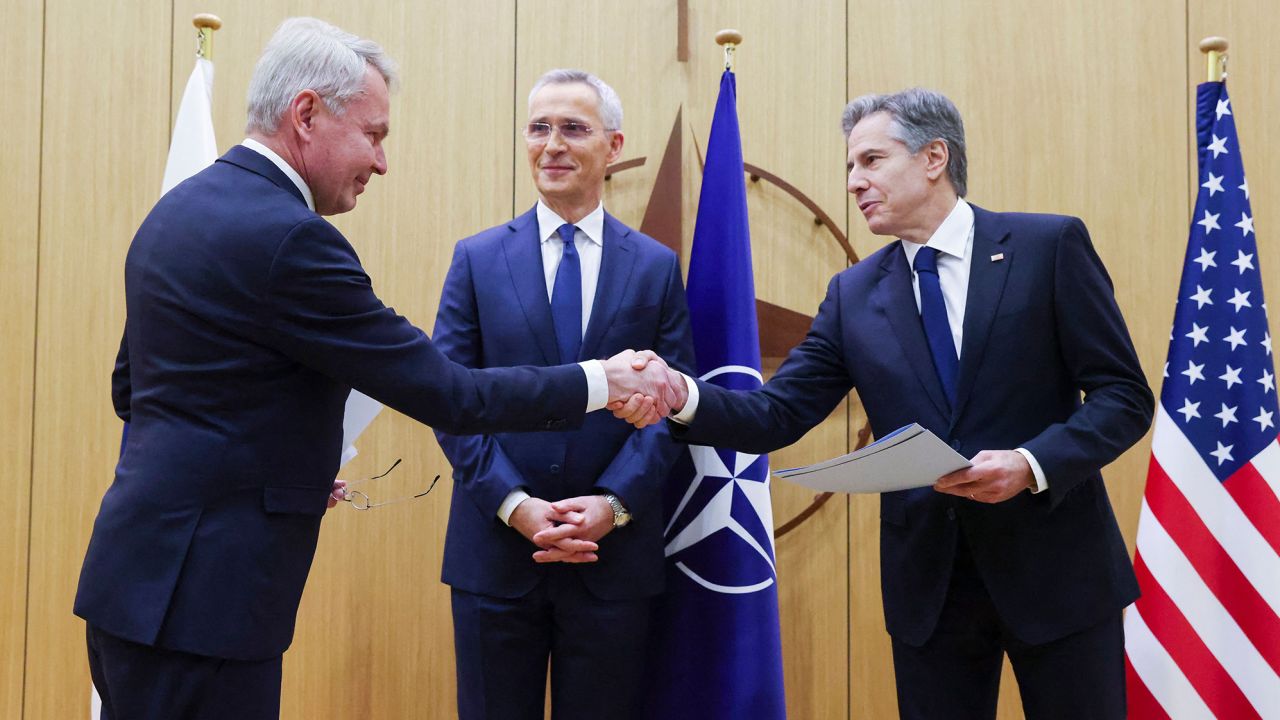
US Secretary of State Antony Blinken and NATO Secretary General Jens Stoltenberg were on hand as the Minister for Foreign Affairs, Pekka Haavisto, established Finland’s accession.

“Finland has today become a member of the defense alliance NATO. The era of military non-alignment in our history has come to an end. A new era begins,” the Finnish presidency said in a statement.

“Each country maximizes its own security. So does Finland. At the same time, NATO membership strengthens our international position and room for maneuver. As a partner, we have long actively participated in NATO activities. In the future, Finland will make a contribution to NATO’s collective deterrence and defense,” it added.

Finnish Foreign Affairs Minister Pekka Haavisto (left) shakes hands with US Secretary of State Antony Blinken (right), flanked by NATO Secretary General Jens Stoltenberg (center), in Brussels, on Tuesday.

Finland’s acceptance into the US-led security alliance presents a blow to Russian President Vladimir Putin, who has long sought to undermine NATO, and before invading Ukraine, demanded the bloc refrain from further expansion.

The invasion instead drove non-aligned Finland and Sweden to abandon their neutrality and seek protection within NATO, though Sweden’s attempt to join the bloc has been stalled by alliance members Turkey and Hungary.

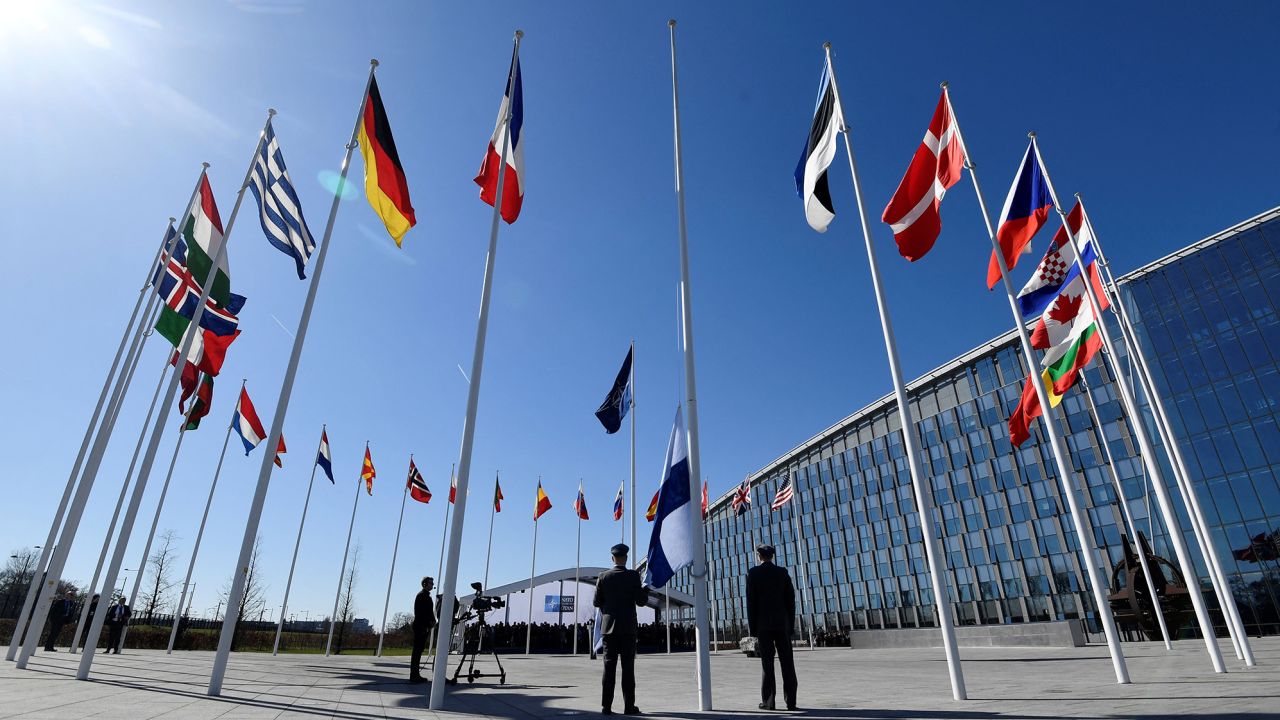
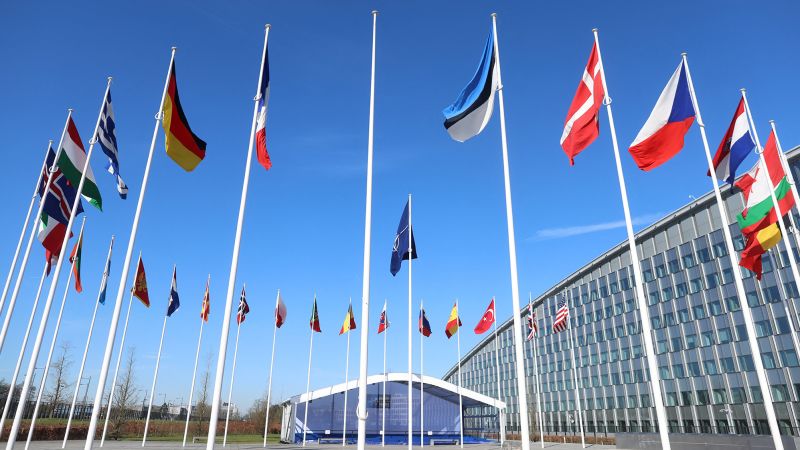
On the eve of Tuesday’s ceremony, NATO Secretary General Jens Stoltenberg heralded the raising of the Finnish flag for the first time at the alliance’s headquarters in Belgium, saying “it will be a good day for Finland’s security, for Nordic security, and for NATO as a whole.”

But Russia has warned that further NATO expansion will not bring more stability to Europe, and on Monday said it would scale up forces near Finland if the alliance sent any troops or equipment to the new member country.

“We will strengthen our military capabilities in the west and northwest if NATO members deploy forces and equipment on Finnish territory,” Russia’s Deputy Foreign Minister Alexander Grushko told Russian state news agency RIA Novosti.

Kremlin spokesperson Dmitry Peskov reiterated that Finland’s accession will force Moscow to “take counter-measures to ensure our own security, both tactically and strategically.”

Prior to Tuesday, Russia shared about 1,215 kilometers (755 miles) of land border with five NATO members. Finland’s accession more than doubles NATO’s land border with Russia.

Stoltenberg said Putin had “failed” in his attempt to “slam NATO’s door shut.”

“Today, we show the world that he failed, that aggression and intimidation do not work. Instead of less NATO, he has achieved the opposite – more NATO – and our door remains firmly open,” he added.

“Joining NATO is good for Finland. It is good for Nordic security and it’s good for NATO as a whole. Finland brings substantial and highly capable forces expertise on national resilience and years of experience working side by side with NATO allies.”

Finland’s NATO membership guarantees the northern European nation access to the resources of the entire alliance in the event of attack.

It includes the protection offered by NATO’s Article 5 principle, which states that an attack on one member of NATO is an attack on all members. It’s been a cornerstone of the 30-member alliance since it was founded in 1949 as a counterweight to the Soviet Union.

NATO membership also better integrates Finnish forces in training and planning with NATO allies.

The country is no stranger to working with NATO, with its troops regularly participating in NATO exercises under a partner status.

The Finnish Defense Force also operate some of the same weapons systems as other NATO members, including US-made F/A-18 fighters, German-designed Leopard main battle tanks and K9 Howitzers used by Norway and Estonia among others.

Helsinki has also signed on the F-35 stealth fighter program, which will allow its air force to work smoothly with NATO members including the US, UK, Norway, Italy, Canada, Poland, Denmark and the Netherlands.

A November report from the Washington-based Wilson Center lists three key areas where Finland benefits NATO: reserve forces, technology access and artillery forces.

“Finland’s artillery forces are the largest and best-equipped in western Europe,” the report said.

“With some 1,500 artillery weapons, including 700 Howitzer guns, 700 heavy mortar, and 100 rocket launcher systems, the Finnish artillery has more artillery firepower than the combined militaries of Poland, Germany, Norway, and Sweden can currently muster,” it said.

The Wilson Center report also noted Finland’s strong cyber security record, pointing out the country is home to Nokia, “a major provider of 5G infrastructure,” and one of three major providers of 5G infrastructure in the world, along with Sweden’s Ericsson and China’s Huawei.

And it said Finland can muster 900,000 reserves who have been trained as conscripts in its armed forces. The wartime strength of Finnish forces is 280,000 troops, it says.

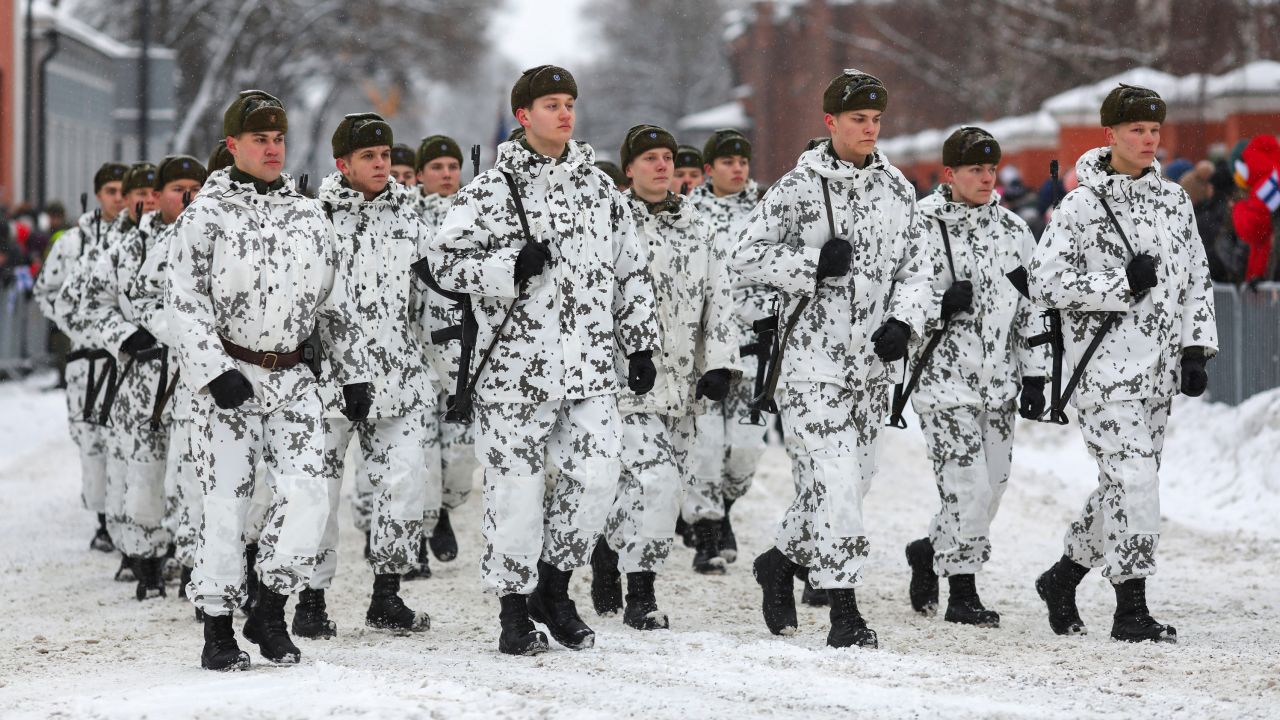
Soliders from the Finnish Armed Forces march during the Independence Day parade in Hamina city in December 2022.

Finland’s accession comes days after Turkey’s parliament voted to ratify the country’s membership, clearing the final hurdle for the country to join NATO and putting an end to months of delays.

Finnish and Swedish public support for joining NATO surged following the invasion of Ukraine. “Everything changed when Russia invaded Ukraine,” outgoing Finnish Prime Minister Sanna Marin said last April. “People’s mindset in Finland, also in Sweden, changed and shifted very dramatically.”

NATO has an open-door policy, meaning that any country can be invited to join if it expresses an interest, as long as it is able and willing to uphold the principles of the alliance’s founding treaty.

However, under the accession rules, any member state can veto a new country from joining.

An overwhelming majority of NATO members welcomed Finland and Sweden’s applications, but two countries – Turkey and Hungary – began to stall the process.

Turkey and Hungary later softened their stance on Finland’s accession, opening the door to its membership in March, while continuing to block Sweden’s membership application.

There is hope for Sweden’s bid, however. On Monday, Stoltenberg said Finland’s accession is “in itself something we should celebrate” but that it was also good for Sweden.

“It makes Sweden more integrated into NATO and makes Sweden even more safer,” Stoltenberg said. “At the same time we celebrate and enjoy that Finland is now a full-fledged member, we should continue work to finalize the Swedish accession process.”

Finnish military personnel raise the Finnish national flag in Brussels after the country formally joined NATO on Tuesday.

Finland’s fold into the alliance also reignited calls from Ukraine to join.

“Finland’s accession is a clear message that the time to revise old strategies and old perceptions has come and there is no better solution to ensuring Euro-Atlantic security as a whole than eventual membership of Ukraine in NATO,” Ukrainian Foreign Minister Dmytro Kuleba said as he was welcomed to the NATO headquarters by Stoltenberg on Tuesday.

A chorus of NATO members congratulated Finland as it joined the alliance on Tuesday.

“Finland, welcome to NATO,” Britain’s Prime Minister Rishi Sunak tweeted. “This is a historic day for you and for our alliance. It’s a step that makes every one of us safer. All NATO members now need to take the necessary steps to admit Sweden, so we stand together as one to defend freedom in Europe and across the world.”

He also called on Turkey and Hungary to ratify Sweden’s bid for NATO membership.

German Chancellor Olaf Scholz also hailed Finland’s accession to NATO.

“Finland is now a member of #NATO – this is good news and a victory for transatlantic security. With #Finland, our defense alliance has gained a strong friend,” he tweeted.

Scholz also gave his backing to Sweden’s bid to join the military alliance.

Josep Borrell, the European Union’s foreign policy chief, tweeted: “I warmly welcome the accession of #Finland to @NATO. This historic step will strengthen the Alliance, reinforce European & Transatlantic security and contribute to further fostering our #EU-NATO strategic partnership.”

Russia arrests Wall Street Journal reporter Evan Gershkovich on espionage charges

Russia arrests Wall Street Journal reporter Evan Gershkovich on espionage charges

Russian authorities on Thursday arrested an American journalist for The Wall Street Journal on spying rates. 

Evan Gershkovich was detained in the Ural Mountains city of Yekaterinburg on suspicion of “espionage in the interests of the American authorities,” the Federal Safety Company (FSB) explained in a assertion, which was noted by state media.

The FSB accused Gershkovich of accumulating “information constituting a state mystery about the pursuits of a single of the enterprises of the Russian armed forces-industrial complicated.”

The Journal denied the fees.

The FSB supplied no evidence or further more facts on when Gershkovich was detained. He was later on taken to the Lefortovo court in Moscow and formally arrested. The court swiftly requested Gershkovich’s original detention right until Could 29, in accordance to the formal Telegram channel of the capital’s courts.

Russia's top security agency says an American reporter for the Wall Street Journal has been arrested on espionage charges. The Federal Security Service said Thursday that Evan Gershkovich was detained in the Ural Mountains city of Yekaterinburg while allegedly trying to obtain classified information.
Officers escort Evan Gershkovich from the Moscow court docket to an awaiting auto. Alexander Zemlianichenko / AP

He denied his guilt, according to the TASS point out news agency. If convicted, he could face up to 20 decades in jail.

Gershkovich is the first journalist from an American outlet to be arrested on espionage charges in Russia since the Cold War. The costs appear at a time of bitter tensions involving Washington and Moscow more than the war in Ukraine, and as the Kremlin cracks down on free speech at home.

“We are not speaking about suspicions, but about the fact that he was detained pink-handed,” Kremlin spokesman Dimtry Peskov said at a news briefing, including that the arrest was up to the FSB.

The Journal stated in a statement that it “vehemently denies the allegations from the FSB and seeks the immediate release of our trusted and devoted reporter.” It included: “We stand in solidarity with Evan and his loved ones.”

U.S. officials have been in touch with the Journal, a senior Biden administration official explained.

Secretary of Condition Antony Blinken said in a statement that he was “deeply anxious more than Russia’s broadly-reported detention of a U.S. citizen journalist.”

“In the strongest achievable terms, we condemn the Kremlin’s ongoing tries to intimidate, repress, and punish journalists and civil society voices,” he mentioned. 

Gershkovich covers Russia, Ukraine and the previous Soviet Union for the Journal.

He was earlier a reporter for Agence France-Presse and the Moscow Occasions and a news assistant at The New York Instances, in accordance to his creator page on the Journal’s site.

Gershkovich, 31, speaks Russian. His mothers and fathers live in the United States and are originally from the previous Soviet Union.

His most new short article was published Tuesday and co-bylined, with the headline: “Russia’s Economic system Is Starting to Arrive Undone.”

The FSB pointed out that he had accreditation from the Russian Foreign Ministry to perform as a journalist, but ministry spokeswoman Maria Zakharova stated Gershkovich was utilizing his journalistic credentials as a cover for “activities that have nothing at all to do with journalism.”

His arrest will come amid superior tensions among Moscow and Washington over Russia’s invasion of Ukraine.

It also will come next the high-profile prisoner swap involving WNBA star Brittney Griner.

Griner was introduced from a Russian penal colony in December in exchange for arms supplier Viktor Bout after she pleaded responsible to getting vape canisters with cannabis oil in her baggage, but explained she experienced no prison intent.

There had been hopes that Paul Whelan — a U.S. corporate safety govt jailed in Russia on espionage expenses — may well be included in the exchange, but he continues to be imprisoned.

Russian Deputy Foreign Minister Sergei Ryabkov ruled out any speedy swap involving Gershkovich.

“I wouldn’t even take into consideration this concern now because people who had been previously swapped experienced currently served their sentences,” Ryabkov claimed, in accordance to Russian news businesses.

In latest yrs, Russian President Vladimir Putin has overseen the greatest crackdown on the absolutely free press and political dissent given that the Soviet period.

That intensified right after his complete-scale invasion of Ukraine, with Russia adopting rigorous rules that prohibit criticism of the military services, major a lot of journalists to flee the region.

“Let’s hold out to see what the FSB exclusively presents, but it seems that they have taken a hostage,” mentioned Tatiana Stanovaya, a nonresident scholar at the Carnegie Endowment for Intercontinental Peace and the founder and head of the political evaluation agency R.Politik.

“This undoubtedly provides Russia and the United States’ partnership to a new amount of confrontation,” she included.

Kristen Welker, Henry Austin and Involved Push contributed.

Russia-Ukraine war live: war crimes dominate agenda at UN in Geneva; US warns China against arming Russia | Ukraine

Russia-Ukraine war live: war crimes dominate agenda at UN in Geneva; US warns China against arming Russia | Ukraine

Key events

Summary of the day so far …

  • Air raid alerts sounded across Ukraine’s Kyiv region late on Sunday night as Kyiv’s regional military administration confirmed the country’s air defences were at work. The nearby northern city of Chernihiv also reported shooting down Iranian-made Shahed drones, according to its regional governor, Vyacheslav Chaus.

  • Ukraine’s ministry of defence claimed in total to have shot down 11 of 14 drones deployed, including nine over Kyiv. Two emergency service workers were killed and three other people injured during a drone attack on Khmelnytskyi, according to city’s mayor.

  • Belarus’s exiled opposition has claimed partisans destroyed a Russian plane at an airstrip near the capital Minsk on Sunday. “Partisans … confirmed a successful special operation to blow up a rare Russian plane at the airfield in Machulishchy near Minsk,” tweeted Franak Viacorka, a close adviser of opposition figurehead Sviatlana Tsikhanouskaya. “This is the most successful diversion since the beginning of 2022.” The two Belarusians who carried out the operation had used drones, he said, adding that they had already left the country and were safe.

  • Turkey’s foreign minister Mevlüt Çavuşoğlu said on Monday that talks with Sweden and Finland regarding their Nato membership bids would resume on 9 March, after a delay in January in the wake of a Qur’an-burning protest. The meeting will take place in Brussels and will include discussion on the implementation of the memorandum signed between the countries. It later emerged that the Qur’an-burning incident in Stockholm was funded by a far-right journalist with links to Kremlin-backed media.

  • Respect for human rights has gone into reverse, the United Nations chief warned Monday, calling for a renewal of the Universal Declaration of Human Rights, 75 years after its signing. Pointing to the war raging in Ukraine, and threats to rights from soaring poverty, hunger and climate disasters, António Guterres said the declaration was “under assault from all sides”. He said the “Russian invasion of Ukraine has triggered the most massive violations of human rights” being witnessed in the world today. “It has unleashed widespread death, destruction and displacement,” he said.

  • The UK’s ministry of defence has claimed that “Russia will likely be concerned that unexplained explosions are occurring” in and around Mariupol, a location “at least 80km away from the frontline … [which] it had probably previously assessed as beyond the range of routine Ukrainian strike capabilities.”

  • The US is “confident” that China is considering providing lethal equipment to support Russia in Ukraine, according to the CIA director, William Burns. In an interview with CBS’s Face the Nation on Sunday, Burns said he was “confident that the Chinese leadership is considering the provision of lethal equipment” but noted “we also don’t see that a final decision has been made yet, and we don’t see evidence of actual shipments of lethal equipment”.

  • China has always maintained communication with all sides in the Russia-Ukraine conflict, including Kyiv, a foreign ministry spokesperson told a regular news briefing on Monday.

  • Russia’s former president said in remarks published on Monday that the continued arms supply to Kyiv risks a global nuclear catastrophe, reiterating his threat of nuclear war over Ukraine. Dmitry Medvedev’s apocalyptic rhetoric has been seen as an attempt to deter the US-led Nato military alliance and Kyiv’s western allies from getting even more involved in the war.

That is it from me, Martin Belam, for now. I will be back later. Léonie Chao-Fong will be with you for the next few hours.

Jennifer Rankin

Jennifer Rankin

A Ukrainian Nobel peace laureate has called for the swift creation of a special tribunal to try Vladimir Putin and his associates for the crime of aggression, arguing that it could have “a cooling effect” on atrocities committed by the Kremlin’s invading forces.

Oleksandra Matviichuk, the head of the Centre for Civil Liberties, also said a speedy start to war crimes trials against the Russian president and soldiers could save people’s lives by deterring Russian forces from committing further crimes.

Starting legal proceedings could have “a cooling effect” on the brutality of human rights violations that Russian troops were committing daily in Ukraine, she told the Guardian in an interview.

Oleksandra Matviichuk at the Council of Europe in January.
Oleksandra Matviichuk at the Council of Europe in January. Photograph: Anadolu Agency/Getty Images

Some troops, perhaps not all, would realise that Putin’s authoritarian regime had an end date, Matviichuk said, if they knew they would be held to account. The possibility of justice would help them realise “I will not be able to hide under abstract Putin and maybe I will have to be responsible for every thing which I commit by my own hands,” she said.

Read more of Jennifer Rankin’s interview and report here: Ukrainian Nobel peace laureate calls for special tribunal to try Putin

Here is a recent view of the military cemetery in Dnipro that has just been sent to us over the news wires.

A view of a military cemetery amid the Russia-Ukraine war in Dnipro.
A view of a military cemetery amid the Russia-Ukraine war in Dnipro. Photograph: Anadolu Agency/Getty Images

The Kremlin said on Monday it was worried about the state of affairs in Moldova’s breakaway Transnistria region, where it said Ukraine and other European countries were stirring up the situation.

Moscow last week told the west that it would view any actions that threatened Russian peacekeepers in Transnistria as an attack on Russia itself, a warning that came amid increased concerns in Moldova, a small ex-Soviet republic located between Romania and Ukraine, of a possible Russian threat.

Moldova’s pro-European president, Maia Sandu, this month accused Moscow of plotting a coup, something Russia denied.

“Naturally, the situation in Transnistria is the subject of our closest attention and a reason for our concern,” Reuters reports Kremlin spokesperson Dmitry Peskov told the media. “The situation is unsettled, it is being provoked, provoked from outside.

“But we know that our opponents in the Ukrainian regime, the Kyiv regime, as well as those in European countries, are capable of various types of provocation.”

Ukrainian President Volodymyr Zelenskiy has dismissed Moscow’s assertion that Ukraine wants to take over the region, while Moldova said there was no truth to the allegations.

Vadim Krasnoselsky, the self-styled president of Transnistria, had earlier described the situation in the region as tense, but urged people to remain calm and said that citizens would be informed immediately should any threat of danger arise.

Respect for human rights has gone into reverse, the United Nations chief warned on Monday, calling for a renewal of the Universal Declaration of Human Rights, 75 years after its signing.

Pointing to the war raging in Ukraine, and threats to rights from soaring poverty, hunger and climate disasters, AFP reports António Guterres as saying the declaration was “under assault from all sides.”

“Some governments chip away at it. Others use a wrecking ball,” he told the opening of the UN Human Rights Council’s main annual session, describing the disregard and disdain seen for human rights around the world as “a wake-up call”.

He said the “Russian invasion of Ukraine has triggered the most massive violations of human rights” being witnessed in the world today.

“It has unleashed widespread death, destruction and displacement,” he said.

AFP reports that a second person has died as a result of Russian drone attacks overnight.

It quotes Oleksandr Symchyshyn, mayor of Khmelnytskyi, saying “Unfortunately, we have another hospital death. Doctors failed to save the life of another hero, a rescuer”. Earlier, the mayor and Ukraine’s ministry of defence reported that someone from the emergency services had been killed. Ukraine claims to have shot down 11 of 14 drones deployed by Russian forces.

Nine were downed over the capital, Kyiv, the head of the city’s military administration said, and there were no reported casualties or damage to infrastructure.

The official, Sergiy Popko, said Russian forces were trying “to exhaust our air defences”, and said the attack had come in two separate waves.

Here are some of the latest images sent to us over the news wires from Ukraine.

A Russian military helicopter flies near a church in occupied Donetsk.
A Russian military helicopter flies near a church in occupied Donetsk. Photograph: Alexander Ermochenko/Reuters
A Ukrainian serviceman rests in the frontline city of Bakhmut.
A Ukrainian serviceman rests in the frontline city of Bakhmut. Photograph: RFE/RL/SERHII NUZHNENKO/Reuters
A general view shows the frontline city of Bakhmut.
A general view shows the frontline city of Bakhmut. Photograph: RFE/RL/SERHII NUZHNENKO/Reuters
57-year-old Tatyana sits in her home as she describes her injuries following her dog stepping on a butterfly landmine which sent shrapnel into her own leg and killed the dog in Izyum, Ukraine.
57-year-old Tatyana sits in her home as she describes her injuries following her dog stepping on a butterfly landmine which sent shrapnel into her own leg and killed the dog in Izyum, Ukraine. Photograph: Anadolu Agency/Getty Images

Ramon Antonio Vargas has spoken to Randi Thompson, president of Los Angeles-based nonprofit Kidsave, who is calling on Americans to aid efforts to place Ukrainian children orphaned by the Russian invasion in new families within their country.

Read more here: Ukrainian children orphaned by war ‘need a tremendous amount of help’

Just to add to that report from the Ukraine ministry of defence that an emergency service worker was killed in Khmelnytskyi overnight, AFP is reporting that the mayor of Khmelnytskyi, Oleksandr Symchyshyn, has said: “For now, we know of one dead and four injured” after the drone attack on the city.

Ukraine’s ministry of defence has claimed that overnight its forces shot down 11 Iranian-made Shahed drones. It also confirmed that an officer of Ukraine’s emergency services was killed in Khmelnytskyi.

Last night, enemy attacked Ukraine with Iran-made Shahed drones.
11 of them were shot down.
A @SESU_UA officer was killed in Khmelnytskyi; he was on duty at that time.

— Defense of Ukraine (@DefenceU) February 27, 2023

The claims have not been independently verified.

China has always maintained communication with all sides in the Russia-Ukraine conflict, including Kyiv, a foreign ministry spokesperson told a regular news briefing on Monday.

Reuters reports Mao Ning was answering a question on Ukraine’s Volodymyr Zelenskiy saying he would welcome talks with China.

In another question on Zelenskiy saying that he planned to speak to the Chinese president, Xi Jinping, Mao said: “China’s position on the Ukraine crisis is consistent and very clear.”

“The core is to call for peace and promote dialogue and promote a political solution to the crisis. We have always maintained communication with the sides involved including Ukraine,” Mao said.

Turkey’s talks with Sweden and Finland over Nato bid to resume 9 March

Turkish foreign minister Mevlüt Çavuşoğlu said on Monday that talks with Sweden and Finland regarding their Nato membership bids would resume on 9 March, after a delay in January in the wake of a Qur’an-burning protest.

Reuters reports that speaking in Ankara, Çavuşoğlu said the meeting would take place in Brussels and would include discussion on the implementation of the memorandum signed between the countries.

It later emerged that the Qur’an-burning incident in Stockholm was funded by a far-right journalist with links to Kremlin-backed media.

In its latest daily intelligence briefing on the war, the UK’s Ministry of Defence has raised the issue of explosions in occupied Mariupol. It writes:

Since 21 February 2023, pro-Russian officials have reported at least 14 explosions around the Russian-occupied city of Mariupol. Sites of the incidents have included an ammo cache at the airport, two fuel depots, and a steel works that Russia uses as a military base. Mariupol lies at least 80km away from the frontline.

Russia will likely be concerned that unexplained explosions are occurring in a zone it had probably previously assessed as beyond the range of routine Ukrainian strike capabilities. Although widely devasted earlier in the war, Mariupol is important to Russia because it is the largest city Russia captured in 2022 that it still controls, and sits on a key logistics route.

The claims have not been independently verified.

Suspilne, Ukraine’s state broadcaster, has reported on the Telegram app that trams and trolleybuses in the port city of Odesa have stopped this morning because of a shortage of electricity.

Russia’s former president said in remarks published on Monday that the continued arms supply to Kyiv risks a global nuclear catastrophe, reiterating his threat of nuclear war over Ukraine.

Dmitry Medvedev’s apocalyptic rhetoric has been seen as an attempt to deter the US-led Nato military alliance and Kyiv’s western allies from getting even more involved in the war.

The latest comments by Medvedev, an ally of President Vladimir Putin who serves as deputy chairman of Putin’s security council, follow Putin’s nuclear warning last week and his Sunday remarks casting Moscow’s confrontation with the west as an existential battle for the survival of Russia and the Russian people.

Of course, the pumping in of weapons can continue …. and prevent any possibility of reviving negotiations,” Medvedev said in remarks published in the daily Izvestia.

Our enemies are doing just that, not wanting to understand that their goals will certainly lead to a total fiasco. Loss for everyone. A collapse. Apocalypse. Where you forget for centuries about your former life, until the rubble ceases to emit radiation.”

Partisans destroy Russian plane in Belarus, officials claim

Belarus’s exiled opposition has claimed partisans destroyed a Russian A-50 surveillance military aircraft in a drone attack at an airstrip near the capital Minsk on Sunday.

Franak Viacorka, a close adviser of opposition figurehead Sviatlana Tsikhanouskaya, tweeted:

Partisans … confirmed a successful special operation to blow up a rare Russian plane at the airfield in Machulishchy near Minsk.

This is the most successful diversion since the beginning of 2022.”

The two Belarusians who carried out the operation had used drones, he said, adding that they had already left the country and were safe.

Reuters reported Aliaksandr Azarov, leader of Belarusian anti-government organisation BYPOL, as saying on the organisation’s Telegram messaging app and on the Poland-based Belsat news channel:

Those were drones. The participants of the operation are Belarusian … They are now safe, outside the country.”

The Guardian has not been able to independently verify the reports.

Front and central parts of the aircraft as well as the radar antenna were damaged as a result of two explosions in the attack at the Machulishchy air base near Minsk, BYPOL reported.

The Beriev A-50 aircraft, which has the Nato reporting name of Mainstay, is a Russian airborne early warning aircraft, with airborne command and control capabilities, and the ability to track up to 60 targets at a time, according to Reuters.

As battles continue to rage across Ukraine’s eastern front here are some of the latest images to come through our newswires.

Ukrainian servicemen fire a howitzer towards Russian positions in the Donetsk region, eastern Ukraine, 26 February 2023
Ukrainian servicemen fire a howitzer towards Russian positions in the Donetsk region, eastern Ukraine, on Sunday. Photograph: Oleg Petrasyuk/EPA
Ukrainian servicemen fire an SPG anti-tank rocket launcher in the Donetsk region
Ukrainian servicemen fire an SPG anti-tank rocket launcher in the Donetsk region. Photograph: Oleg Petrasyuk/EPA
A SPG anti-tank rocket launcher being prepared in the Donetsk region
A SPG anti-tank rocket launcher being prepared in the Donetsk region. Photograph: Oleg Petrasyuk/EPA
A Ukrainian serviceman walks in a trench on a frontline position at an undisclosed location in eastern Ukraine
A Ukrainian serviceman walks in a trench on a frontline position at an undisclosed location in eastern Ukraine. Photograph: Oleg Petrasyuk/EPA
A Ukrainian serviceman sits in the trench on the frontline position in Donetsk
A Ukrainian serviceman sits in the trench on the frontline position in Donetsk. Photograph: Oleg Petrasyuk/EPA
Destroyed buildings and a car as a result of shelling in the village of Kamenka, Kharkiv region
Destroyed buildings and a car as a result of shelling in the village of Kamenka, Kharkiv region. Photograph: Anatolii Stepanov/AFP/Getty Images

UN human rights council to meet, will extend war crimes investigation

The UN human rights council is set to meet today in a united call to condemn Russia’s invasion of Ukraine and extend its investigation into war crimes in the conflict.

Days after the United Nations general assembly in New York voted overwhelmingly to demand Russia immediately withdraw from Ukraine, the war is expected to dominate the opening of the top UN rights body’s main annual session in Geneva.

We’re looking for this session to show, as the UN general assembly showed … that the world stands side-by-side with Ukraine,” British ambassador Simon Manley said at an event Friday marking the one-year anniversary of Russia’s full-scale invasion.

The meeting, which is due to last a record six weeks, will be the first presided over by new UN rights chief Volker Turk, who kicks the session off early Monday.

The UN secretary general, António Guterres, will also address the council on the first day, while nearly 150 ministers and heads of state and government will speak, virtually or in person, during the four-day high-level segment.

Among them will be the top diplomats of the US, China, Ukraine and Iran.

Moscow will send deputy foreign minister Sergey Ryabkov to address the council in person on Thursday.

One key resolution will be on extending a high-level investigation into crimes committed in Ukraine since Russia’s full-scale invasion.

The so-called Commission of Inquiry, which has already determined that Russia is committing war crimes on a “massive scale” in Ukraine, is due to present a comprehensive report to the council in late March.

The commission must “continue its important work, which is of paramount importance for the principles of accountability and justice”, Yevheniia Filipenko, permanent representative of Ukraine to the United Nations office in Geneva, told reporters on Friday.

Summary and welcome

Hello and welcome back to the Guardian’s live coverage of the war in Ukraine. I’m Samantha Lock and I’ll be bringing you all the latest developments as they unfold.

The UN human rights council is set to meet today in Geneva in a united call to condemn Russia’s invasion of Ukraine and extend a probe into war crimes in the conflict.

Days after the United Nations general assembly in New York voted overwhelmingly to demand Russia immediately withdraw from Ukraine, the war is expected to dominate the opening of the top UN rights body’s main annual session.

US officials have also warned China against providing lethal aid to support Russia’s war on Ukraine. CIA director William Burns said he is “confident” that Beijing is considering providing the equipment to Moscow’s forces but a final decision has not been made yet and there has been no evidence of actual shipments of lethal equipment.

It’s 7.30am in Kyiv. Here’s where we stand:

  • The US is “confident” that China is considering providing lethal equipment to support Russia in Ukraine, according to the CIA director, William Burns. In an interview with CBS’s Face the Nation on Sunday, Burns said he was “confident that the Chinese leadership is considering the provision of lethal equipment” but noted “we also don’t see that a final decision has been made yet, and we don’t see evidence of actual shipments of lethal equipment”. The US has made clear behind closed doors that such a move would have serious consequences. The White House national security adviser, Jake Sullivan, said in an interview with CNN’s State of the Union programme: “Beijing will have to make its own decisions about how it proceeds, whether it provides military assistance, but if it goes down that road, it will come at real costs to China.”

  • Vladimir Putin has accused the west of seeking to “dismember” Russia and to turn the vast country into a series of weak mini-states. In an interview with the state TV channel Rossiya on Sunday, the Russian president claimed the US and its Nato allies wanted to “inflict a strategic defeat on us”. The aim, he said, was to “make our people suffer”.

  • Putin has claimed Russia had no choice but to take into account the nuclear capabilities of Nato as the US-led military alliance was seeking the defeat of Russia. “In today’s conditions, when all the leading Nato countries have declared their main goal as inflicting a strategic defeat on us, so that our people suffer as they say, how can we ignore their nuclear capabilities in these conditions?” Putin told Rossiya 1 state television, according to Tass. “They tried to reshape the world exclusively on their terms. We had no choice but to react,” he said, adding that the west was complicit in Ukraine’s “crimes”.

  • Ukraine’s military has dismissed claims by Russia’s Wagner mercenary group that it had captured Yahidne, a village on Bakhmut’s northern outskirts. It said intense fighting was going on across the whole frontline. On Saturday the founder of the Wagner group, Yevgeny Prigozhin, said his forces had taken Yahidne and the nearby village of Berkhivka. The latest Ukrainian update cited “unsuccessful” Russian offensives in the two settlements and four others. All were subject to heavy shelling, it said.

  • Volodymyr Zelenskiy fired a senior military commander in charge of fighting Russian troops in Ukraine’s east. The Ukrainian president dismissed Eduard Moskalyov as commander of the joint forces of Ukraine, which are engaged in battles in the Donbas region, but gave no reason for the move on Sunday.

  • Belarus’s exiled opposition has claimed partisans destroyed a Russian plane at an airstrip near the capital Minsk on Sunday. “Partisans … confirmed a successful special operation to blow up a rare Russian plane at the airfield in Machulishchy near Minsk,” tweeted Franak Viacorka, a close adviser of opposition figurehead Sviatlana Tsikhanouskaya. “This is the most successful diversion since the beginning of 2022.” The two Belarusians who carried out the operation had used drones, he said, adding that they had already left the country and were safe. The Guardian has not been able to independently verify the reports.

  • Joe Biden has said the prospect of China negotiating peace between Ukraine and Russia is “just not rational”. Speaking on ABC News about China’s peace plan, the US president said: “I’ve seen nothing [that] would indicate there’s something that would be beneficial to anyone other than Russia. The idea that China is gonna be negotiating the outcome of a war that’s a totally unjust war for Ukraine is just not rational.”

  • The German defence minister, Boris Pistorius, said he expected the contracts for the backfilling of howitzers that Berlin rushed to Ukraine last year to be signed by the end of March – months earlier than originally planned – “if everything works out”. Talking to German public broadcaster ARD on Sunday, he did not specify the number of weapons to be reordered. Pistorius also said it was up to Kyiv to decide when, and under what conditions, to enter talks with Moscow. He suggested the same was true for any decision on recapturing the Crimean peninsula, which Russia annexed from Ukraine in 2014.

  • Washington is reportedly in talks with Berlin and Warsaw to hold joint military manoeuvres in Poland in response to Russia’s threat to the eastern border of the Nato alliance. Exercises were being “considered”, Pistorius told Germany’s ARD, without confirming or adding any details “for now”. He said military manoeuvres in a country bordering Ukraine – invaded one year ago by Russia – would send a “very clear” signal to Nato allies “but also to Putin”.

Ukrainian servicemen seen on Ukraine’s eastern front.
Ukrainian servicemen seen on Ukraine’s eastern front. Photograph: pr

Russia-Ukraine war live: UK warns conflict could last another year; Russian general ‘under intense pressure in Donetsk’ | Russia

Russia-Ukraine war live: UK warns conflict could last another year; Russian general ‘under intense pressure in Donetsk’ | Russia

Russian general probably under intense pressure to take Vuhledar, says UK

The town of Vuhledar, in southern Donetsk oblast, has experienced heavy shelling again, according to the MoD’s latest defence intelligence update.

“There is a realistic possibility that Russia is preparing for another offensive effort in this area despite costly failed attacks in early February and late 2022,” the update on Thursday morning said.

Colonel General Rustam Muradov, commander of Russia’s Eastern Group of forces, is likely to be under intense pressure to improve results in Vuhledar after harsh criticism from the Russian nationalist community, according to the MoD.

“However, it is unlikely that Muradov has a striking force capable of achieving a breakthrough,” it said.

Key events

Summary

Hello and welcome to those now following today’s live coverage on the war in Ukraine. It’s 1pm in Kyiv.

On the eve of the anniversary of the start of the war, Vladimir Putin has threatened to strengthen Russia’s nuclear forces. His comments were released before an address to mark Thursday’s Defender of the Fatherland public holiday.

And Nato’s chief, Jens Stoltenberg, says the military alliance has seen “some signs” that China may be planning to support Russia in its war in Ukraine, and strongly urged Beijing to desist from what would be a violation of international law.

The UN general assembly is expected to endorse a broad resolution demanding Russia unconditionally and immediately withdraw from Ukraine’s territory by a massive majority. But China, South Africa, India and many countries in the global south are likely to continue to abstain, underlining their alienation from what they regarded as the west’s war.

We’ll have more on these stories shortly. In the meantime, here are the key recent developments:

  • Russia is intensifying hostilities in Ukraine a year after its invasion in a deliberate attempt to deplete Ukrainian forces, the Ukrainian military said on Thursday.The fiercest fighting remained around the eastern city of Bakhmut, Brigadier general Oleksiy Gromov said, according to Reuters.

  • Finland will send three Leopard 2 battle tanks to Ukraine, the country’s defence ministry said according to Reuters. The announcement comes after Sweden’s defence minister said it was open to sending some of its Leopard battle tanks, and the Czech government announced a further military aid shipment to Ukraine.

  • The founder of Russia’s Wagner mercenary force has said much-needed ammunition for his troops has been dispatched, after a public row in which he accused the military leadership of treason. In an audio clip on Thursday, Prigozhin said he felt the pressure he and others had put on the ministry had paid off, and he had been told that ammunition was now on its way.

  • A Russian fighter plane crashed on Thursday and the pilot was killed in Russia’s Belgorod region, near the border with Ukraine. The cause of the incident is not yet known, the Russian defence ministry said. The cause of the crash was a “technical malfunction”, according to preliminary information and crashed in an uninhabited area and there were no reports of other damage.

  • Sweden is open to sending some of its Leopard battle tanks to Ukraine as it prepares to present another package of aid to help Kyiv fight off the Russian invasion, the Nordic country’s defence minister said.

  • Moldova dismissed an accusation by Russia’s defence ministry on Thursday that Ukraine planned to invade the breakaway Moldovan region of Transdniestria after staging a false-flag operation, and called for calm.

  • The US Treasury secretary stepped up calls for increased financing support to Ukraine, as the US readies an additional $10bn in economic assistance in the coming weeks. Janet Yellen said it was critical for the International Monetary Fund (IMF) to “move swiftly” towards a fully financed loan programme for Ukraine.

  • ‘I think he is not going to stop’: UK defence secretary on Putin’s war. Ben Wallace has said the conflict in Ukraine could last another year. PA news also reported that Wallace stressed that the war was “not a Nato conflict”.

  • Spain’s prime minister, Pedro Sánchez, has arrived in Kyiv to meet Volodymyr Zelenskiy as the first anniversary of the Russian invasion approaches. Arriving in the Ukrainian capital, Sánchez said: “I’m back in Ukraine a year after the start of the war. We will stay by Ukraine’s side until peace returns to Europe.”

  • The town of Vuhledar, in southern Donetsk oblast, has experienced heavy shelling again, according to the UK MoD’s latest defence intelligence update. “There is a realistic possibility that Russia is preparing for another offensive effort in this area despite costly failed attacks in early February and late 2022,” the update on Thursday morning said.

  • The Chinese government did not consult with Kyiv when preparing its peace plan to end Russia’s war in Ukraine, a senior Ukrainian official said on condition of anonymity. “China did not consult with us,” the official told reporters.

  • Vladimir Putin will use an address to mark Thursday’s Defender of the Fatherland public holiday to threaten to strengthen the country’s nuclear forces. Putin said that for the first time, Sarmat intercontinental ballistic missiles – a weapon able to carry multiple nuclear warheads – would be deployed this year.

  • Joe Biden has said Putin made a “big mistake” by suspending the last remaining nuclear arms treaty with the US. The Russian deputy foreign minister, Sergei Ryabkov, has said Russia’s decision to suspend its participation in the New Start nuclear arms reduction treaty with the US will not increase the risk of a nuclear war. Russia’s parliament on Wednesday approved Putin’s move to suspend the treaty.

  • The Biden administration is considering releasing intelligence it believes shows that China is weighing whether to supply weapons to support Russia’s war in Ukraine, the Wall Street Journal reported on Wednesday.

  • The UN secretary general, António Guterres, condemned Russia’s invasion of Ukraine as “an affront to our collective conscience”, at a two-day meeting of the general assembly. Friday’s anniversary is “a grim milestone for the people of Ukraine and for the international community”, he said in New York.

  • Two civilians were killed in Russian shelling of the Kherson region in southern Ukraine on Wednesday, according to regional officials. Oleksandr Prokudin, the head of the regional military administration, said an 81-year-old woman and a 68-year-old man were killed during shelling of the village of Novotyahinka, about 40km (25 miles) from Kherson city. A Russian missile strike on the north-eastern city of Kharkiv on Wednesday morning left two civilians wounded, Oleh Synyehubov, the governor of Kharkiv region, has said.

  • Biden vowed that the US would defend “literally every inch of Nato” territory, ahead of talks with Nato’s secretary general, Jens Stoltenberg, and leaders of the Bucharest Nine (B9), a collection of nations on the most eastern parts of the Nato alliance and closest to Russia.

  • All members of the B9 have jointly condemned Russia’s war in Ukraine, a Polish presidential adviser said. Biden and the B9 leaders “reaffirmed their unwavering support for Ukraine and underscored their shared commitment to stand with the Ukrainian people for as long as it takes” according to a White House account of Wednesday afternoon’s meeting in Warsaw.

  • China’s top diplomat, Wang Yi, has met Vladimir Putin in Moscow, as China and Russia reaffirm their close bilateral relationship. Wang told Putin that Beijing would play a “constructive” role in reaching a political settlement of the crisis in Ukraine, the Russian state-owned Tass news agency reported.

  • Earlier on Wednesday, Wang met Sergei Lavrov, Russia’s foreign minister, where he said he expected to reach a “new consensus” on advancing the relationship between the two allies. Xi Jinping, China’s president, is expected to visit Putin in Russia in the coming months.

  • Vladimir Putin has praised soldiers who are “fighting heroically, courageously, bravely” to “defend the fatherland”, in a speech at a rally in Moscow to mark a year of war in Ukraine. Thousands gathered at Luzhniki stadium in Moscow for a concert marking Defenders of the Fatherland Day.

  • EU countries have failed to agree on a new set of sanctions against Russia meant to be in place for the one-year anniversary of Moscow’s invasion of Ukraine on Friday, four diplomatic sources in Brussels have told Reuters. More talks among Brussels representatives of EU member countries were due on Thursday afternoon, said the sources.

Russia is intensifying hostilities in Ukraine a year after its invasion in a deliberate attempt to deplete Ukrainian forces, the Ukrainian military said on Thursday.

Brigadier general Oleksiy Gromov said Russia had set the goal of capturing all the territory it does not control in the two regions that make up the industrial Donbas area of eastern Ukraine by summer, Reuters reports.

The fiercest fighting remained around the eastern city of Bakhmut, he told a military briefing on the eve of Friday’s anniversary of the invasion on Feb. 24 last year.

Gromov said:

The enemy, having an advantage in the resource of human mobilisation, is deliberately intensifying hostilities in an effort to deplete the units of the armed forces of Ukraine…In the short term, it is important for the Kremlin to capture the key settlements in the Donetsk region, and in the future to capture (all of) the Donetsk and Luhansk regions before the summer.

Finland will send three Leopard 2 battle tanks to Ukraine, Reuters cites the country’s defence ministry as saying on Thursday.

The announcement comes after Sweden’s defence minister said it was open to sending some of its Leopard battle tanks.

As reported earlier, the Czech government has announced a further military aid shipment to Ukraine.

Here are some of the latest images from Ukraine:

A city worker cleans along the Wall of Remembrance of the Fallen for Ukraine near Mykhailivska Square, Kyiv
A city worker cleans along the Wall of Remembrance of the Fallen for Ukraine near Mykhailivska Square, Kyiv. Photograph: Aaron Chown/PA
A damaged business tower in Kyiv
A damaged business tower in Kyiv. Photograph: Aaron Chown/PA
Bags containing aid including food and hygiene products at a day centre in Kyiv
Bags containing aid including food and hygiene products at a day centre in Kyiv. Photograph: Aaron Chown/PA

The Czech government has approved a further military aid shipment to Ukraine and will continue to send equipment from stocks, the defence minister, Jana Černochová, said on Thursday.

Černochová did not disclose details of specific equipment being shipped, reports Reuters, but said the country had so far sent 38 tanks, 55 armoured vehicles, four aircraft and 13 self-propelled howitzers from its military reserves, alongside larger shipments from the private sector.

The founder of Russia’s Wagner mercenary force has said much-needed ammunition for his troops has been dispatched, after a public row in which he accused the military leadership of treason.

On Wednesday, Yevgeny Prigozhin published a grisly image of dozens of men who he said had been killed because commanders including the defence minister, Sergei Shoigu, and the chief of the general staff, Valery Gerasimov, had withheld ammunition to spite him, Reuters reports. Neither man commented but the defence ministry rejected the charge.

In an audio clip on Thursday, Prigozhin said he felt the pressure he and others had put on the ministry had paid off, and he had been told that ammunition was now on its way.

“So far it’s all on paper but, so we have been told, the principal documents have already been signed,” Prigozhin said.

A Russian fighter plane crashed on Thursday and the pilot was killed in Russia’s Belgorod region, near the border with Ukraine.

The cause of the crash was a “technical malfunction”, according to preliminary information, the TASS news agency cited the ministry as saying. The plane crashed in an uninhabited area and there were no reports of other damage, it said.

In a post on the Telegram messenger app, Belgorod’s governor, Vyacheslav Gladkov, said the emergency services and investigators were on the scene near the town of Valyuki, and the reason for the crash was being established.

Mikhail Afanasyev wants your letters, write Andrew Roth and Pjotr Sauer. The Russian journalist from Abakan in Siberia was jailed last year for writing about a small group of national guardsmen who had refused to fight in Ukraine. But Afanasyev remains defiant, while local supporters crowdfund thousands of dollars to pay off his legal fines.

“It is the duty of every person to expand the horizon of freedom by his actions, so that light pours in and overcomes the darkness,” Afanasyev wrote from pre-trial detention in a letter to his supporters this month.

“I really ask you to write to me, very much! It helps me a lot … I just want to be a journalist, faithful to my profession to the end and defend its values.”

Read more of the story here:

Sweden is open to sending some of its Leopard battle tanks to Ukraine as it prepares to present another package of aid to help Kyiv fight off the Russian invasion, its defence minister told the local news agency TT.

The latest instalment Sweden has delivered to Ukraine since the invasion includes armoured infantry fighting vehicles, which the defence minister, Pal Jonson, told Reuters would be the country’s main contribution to Ukraine in terms of equipment for ground warfare.

Sweden is also preparing to send Ukraine the advanced Archer artillery system to Ukraine, and support has been growing in the Swedish parliament for additionally contributing some of the country’s around 120 Leopard tanks.

“We are open to that and we are in close dialogue with above all Germany about it,” Jonson was quoted by TT as saying.

Moldova dismisses Russia accusation of Ukraine planning to invade Transnistria

Moldova has dismissed an accusation by Russia’s defence ministry on Thursday that Ukraine planned to invade the breakaway Moldovan region of Transdniestria after staging a false-flag operation, and called for calm, Reuters reports.

Earlier we reported on Russia’s defence ministry accusing Ukraine of planning to invade Moldova’s breakaway Transnistria region after a false-flag operation, citing reports from the RIA news agency.

The ministry said Ukraine planned to stage an attack purportedly by Russian forces from Transnistria as a pretext for the invasion, according to RIA.

Separately, the Tass news agency quoted the Russian deputy foreign minister Mikhail Galuzin as saying the west had instructed the Chisinau government to stop all interaction with the Moscow-backed Transnistrian administration.

Moldova’s president, Maia Sandu, accused Moscow earlier this month of planning a coup to overthrow the government and drag Transnistria into its war.

The mainly Russian-speaking region broke away from the then Soviet Moldova in 1990. After the breakup of the Soviet Union in 1991, pro-Russia separatists fought a bloody war with the Moldovan government forces.

The US Treasury secretary has stepped up calls for increased financing support to Ukraine, as the US readies an additional $10bn in economic assistance in the coming weeks.

In remarks prepared for delivery to a news conference as G20 finance leaders gathered on the outskirts of the Indian technology hub of Bengaluru, Janet Yellen said it was critical for the International Monetary Fund (IMF) to “move swiftly” towards a fully financed loan programme for Ukraine, Reuters reports.

As President Biden has said, we will stand with Ukraine in its fight – for as long as it takes. Continued, robust support for Ukraine will be a major topic of discussion during my time here in India.

Yellen added:

Our economic assistance is making Ukraine’s resistance possible by supporting the home front: funding critical public services and helping keep the government running. In the coming months, we expect to provide around $10bn in additional economic support for Ukraine.

Yevgeny Prigozhin, the Russian founder of the Wagner mercenary group, was able to pass UK anti-money laundering checks by submitting a utility bill in the name of his elderly mother, the FT reports.

Leaked emails seen by the Financial Times show that the law firm Discreet Law in 2021 requested identification documents from Prigozhin, who has been placed under sanctions and accused of human rights abuses around the world, before taking him on as a client.

As part of anti-laundering checks, Prigozhin’s Russian lawyers forwarded the London-based law firm a copy of his passport and a gas bill in the name of his then 81-year-old mother, Violetta, for an address in St Petersburg, the FT reports.

Discreet Law’s founder, Roger Gherson, said the firm “cannot comment on confidential communications with [its] former clients”.

Here are some of the latest images from Ukraine:

Destroyed Russian military equipment is displayed in Kyiv’s Mykhailivska Square
Destroyed Russian military equipment is displayed in Kyiv’s Mykhailivska Square. Photograph: Aaron Chown/PA
The Wall of Remembrance of the Fallen for Ukraine near Mykhailivska Square, Kyiv.
The Wall of Remembrance of the Fallen for Ukraine near Mykhailivska Square, Kyiv. Photograph: Aaron Chown/PA
A damaged residential building in the town of Lyman, Donetsk region
A damaged residential building in the town of Lyman, Donetsk region. Photograph: Ihor Tkachov/AFP/Getty Images

Summary

Hello and welcome to those now following today’s live coverage on the war in Ukraine. It’s 10am in Kyiv.

On the eve of the anniversary of the start of the war, Vladimir Putin has threatened to strengthen Russia’s nuclear forces. His comments were released before an address to mark Thursday’s Defender of the Fatherland public holiday.

And Nato’s chief, Jens Stoltenberg, says the military alliance has seen “some signs” that China may be planning to support Russia in its war in Ukraine, and strongly urged Beijing to desist from what would be a violation of international law.

The UN general assembly is expected to endorse a broad resolution demanding Russia unconditionally and immediately withdraw from Ukraine’s territory by a massive majority. But China, South Africa, India and many countries in the global south are likely to continue to abstain, underlining their alienation from what they regarded as the west’s war.

We’ll have more on these stories shortly. In the meantime, here are the key recent developments:

  • ‘I think he is not going to stop’: UK defence secretary on Putin’s war. Ben Wallace has said the conflict in Ukraine could last another year. PA news also reported that Wallace stressed that the war was “not a Nato conflict”.

  • Spain’s prime minister, Pedro Sánchez, has arrived in Kyiv to meet Volodymyr Zelenskiy as the first anniversary of the Russian invasion approaches. Arriving in the Ukrainian capital, Sánchez said: “I’m back in Ukraine a year after the start of the war. We will stay by Ukraine’s side until peace returns to Europe.”

  • The town of Vuhledar, in southern Donetsk oblast, has experienced heavy shelling again, according to the UK MoD’s latest defence intelligence update. “There is a realistic possibility that Russia is preparing for another offensive effort in this area despite costly failed attacks in early February and late 2022,” the update on Thursday morning said.

  • The Chinese government did not consult with Kyiv when preparing its peace plan to end Russia’s war in Ukraine, a senior Ukrainian official said on condition of anonymity. “China did not consult with us,” the official told reporters.

  • Vladimir Putin will use an address to mark Thursday’s Defender of the Fatherland public holiday to threaten to strengthen the country’s nuclear forces. Putin said that for the first time, Sarmat intercontinental ballistic missiles – a weapon able to carry multiple nuclear warheads – would be deployed this year.

  • Joe Biden has said Putin made a “big mistake” by suspending the last remaining nuclear arms treaty with the US. The Russian deputy foreign minister, Sergei Ryabkov, has said Russia’s decision to suspend its participation in the New Start nuclear arms reduction treaty with the US will not increase the risk of a nuclear war. Russia’s parliament on Wednesday approved Putin’s move to suspend the treaty.

  • The Biden administration is considering releasing intelligence it believes shows that China is weighing whether to supply weapons to support Russia’s war in Ukraine, the Wall Street Journal reported on Wednesday.

  • The UN secretary general, António Guterres, condemned Russia’s invasion of Ukraine as “an affront to our collective conscience”, at a two-day meeting of the general assembly. Friday’s anniversary is “a grim milestone for the people of Ukraine and for the international community”, he said in New York.

  • Two civilians were killed in Russian shelling of the Kherson region in southern Ukraine on Wednesday, according to regional officials. Oleksandr Prokudin, the head of the regional military administration, said an 81-year-old woman and a 68-year-old man were killed during shelling of the village of Novotyahinka, about 40km (25 miles) from Kherson city. A Russian missile strike on the north-eastern city of Kharkiv on Wednesday morning left two civilians wounded, Oleh Synyehubov, the governor of Kharkiv region, has said.

  • Biden vowed that the US would defend “literally every inch of Nato” territory, ahead of talks with Nato’s secretary general, Jens Stoltenberg, and leaders of the Bucharest Nine (B9), a collection of nations on the most eastern parts of the Nato alliance and closest to Russia.

  • All members of the B9 have jointly condemned Russia’s war in Ukraine, a Polish presidential adviser said. Biden and the B9 leaders “reaffirmed their unwavering support for Ukraine and underscored their shared commitment to stand with the Ukrainian people for as long as it takes” according to a White House account of Wednesday afternoon’s meeting in Warsaw.

  • China’s top diplomat, Wang Yi, has met Vladimir Putin in Moscow, as China and Russia reaffirm their close bilateral relationship. Wang told Putin that Beijing would play a “constructive” role in reaching a political settlement of the crisis in Ukraine, the Russian state-owned Tass news agency reported.

  • Earlier on Wednesday, Wang met Sergei Lavrov, Russia’s foreign minister, where he said he expected to reach a “new consensus” on advancing the relationship between the two allies. Xi Jinping, China’s president, is expected to visit Putin in Russia in the coming months.

  • Vladimir Putin has praised soldiers who are “fighting heroically, courageously, bravely” to “defend the fatherland”, in a speech at a rally in Moscow to mark a year of war in Ukraine. Thousands gathered at Luzhniki stadium in Moscow for a concert marking Defenders of the Fatherland Day.

  • EU countries have failed to agree on a new set of sanctions against Russia meant to be in place for the one-year anniversary of Moscow’s invasion of Ukraine on Friday, four diplomatic sources in Brussels have told Reuters. More talks among Brussels representatives of EU member countries were due on Thursday afternoon, said the sources.

On Thursday 2 February, my friend Pete Reed died as he tried to evacuate civilians in the Ukrainian city of Bakhmut, writes Cengiz Yar.

Based on footage we now have of the incident, his vehicle was hit by a Russian anti-tank missile. He was killed in the blast, and others in his team were severely injured. Reports suggest it was likely a double-tap strike, a technique used frequently by Russia in Syria, where an attack is made to draw in additional support and recovery operations before a second attack is made.

Pete was one of the most selfless people I’ve ever met. You should know a bit about the good he did in this world.

I met him in the spring of 2016 over some drinks in Iraq, where I worked as a photographer. He was loud, a bit goofy, and trying to do some good. What good? He hadn’t quite figured that out yet.

Read more by Cengiz Yar here:

Sam Jones

Spain’s prime minister, Pedro Sánchez, has arrived in Kyiv to meet Volodymyr Zelenskiy as the first anniversary of the Russian invasion approaches.

Arriving in the Ukrainian capital, Sánchez said:

I’m back in Ukraine a year after the start of the war. We will stay by Ukraine’s side until peace returns to Europe.

Sánchez, who last visited Ukraine in April, is understood to have travelled to Ukraine at Zelenskiy’s invitation.

Pedro Sánchez arriving in Kyiv
Pedro Sánchez arriving in Kyiv this morning, where he was met by the deputy foreign minister, Yevhen Perebyinis. Photograph: Spanish government handout

Vuelvo a Kyiv un año después del inicio de la guerra.

Estaremos al lado de Ucrania y de su gente hasta que la paz regrese a Europa.

Сьогодні повертаюся до Києва.

Ми будемо з Україною та її народом, поки до Європи не повернеться мир. pic.twitter.com/9ekUL9Lmfl

— Pedro Sánchez (@sanchezcastejon) February 23, 2023

Nations: No clarity on neutrality, no Olympics for Russia

Nations: No clarity on neutrality, no Olympics for Russia

The governments of 34 nations launched a assertion Monday calling on the IOC to explain the definition of “neutrality” as it seeks a way to permit Russian and Belarusian athletes again into intercontinental sporting activities and, in the long run, following year’s Paris Olympics.

“As long as these basic challenges and the substantial absence of clarity and concrete depth on a workable ‘neutrality’ design are not resolved, we do not concur that Russian and Belarusian athletes really should be authorized back into competitors,” read through the assertion.

Amongst these signing the assertion were being officials from the United States, Britain, France, Canada and Germany. Those 5 countries brought virtually a person-fifth of all athletes to the Tokyo Online games in 2021. Other international locations that experienced recommended an Olympic boycott was achievable if the war continues — these types of as Poland, Latvia, Lithuania and Denmark — also signed onto the statement, which did not go so far as to point out a boycott.

The assertion was the item of a Feb. 10 summit in London concerning governing administration leaders, who listened to from Ukrainian President Volodymyr Zelenskyy. Zelenskyy claimed Russia athletes experienced no place at the Paris Game titles as prolonged as the country’s invasion of Ukraine carries on.

The International Olympic Committee is trying to obtain a way to allow for Russians into the Olympics, citing the feeling of United Nations human rights authorities who believe Russians and Belarusians should not facial area discrimination just for the passports they maintain. The IOC needs opponents from those international locations who have not supported the war to be capable to compete as neutral athletes, with no symbols of their nations authorized.

An IOC spokesman claimed the committee has now started a process to define the conditions underneath which Russians could contend in global opposition if, in simple fact, it decides to continue on down the current path.

It’s a final decision that desires clarity lengthy prior to next summer’s Olympics mainly because 2023 marks the start off of the Olympic qualifying period of time. Russia and Belarus, traditionally viewed as part of Europe in the intercontinental sports activities program, have as a substitute been invited to compete in some Asian qualifiers later this calendar year. The future IOC executive board conference is established for March 28-30.

Assistant Secretary of Condition Lee Satterfield signed the assertion on behalf of the United States. In a separate statement, she emphasized the will need for the IOC to provide clarity on the definition of neutrality.

“The United States will proceed to be part of a wide group of nations to maintain Russia and Belarus — and the lousy actors who dictate their steps — accountable for this brutal war,” Satterfield stated. “Russia has proven, time and yet again, it has no regard for and is incapable of adhering to the guidelines — in international sport and in worldwide legislation.”

Though acknowledging there was an argument for them to contend as neutral athletes, the governing administration officials pointed out in the joint assertion how intently sports activities and politics are intertwined in Russia and Belarus. Russia invaded Ukraine a calendar year back Friday and Belarus has been Russia’s closest ally.

“We have strong considerations on how possible it is for Russian and Belarusian Olympic athletes to contend as ‘neutrals’ — underneath the IOC’s disorders of no identification with their state — when they are straight funded and supported by their states (unlike, for example, specialist tennis players),” the statement reported. “The powerful one-way links and affiliations amongst Russian athletes and the Russian navy are also of distinct concern. Our collective solution throughout has for that reason under no circumstances been one of discrimination only on the basis of nationality, but these sturdy problems need to have to be dealt with by the IOC.”

When the war begun, the IOC recommended sporting activities businesses bar Russians from competitions, labeling it as a evaluate for these athletes’ safety. That stance improved at the start off of this yr. Final 7 days, IOC president Thomas Bach explained the IOC stood in solidarity with Ukraine’s athletes, but also that sporting activities has to regard the human rights of all athletes.

“History will exhibit who is carrying out additional for peace. The kinds who test to hold traces open up, to talk, or the ones who want to isolate or divide,” Bach mentioned.

Also past week, European Union lawmakers condemned the IOC’s endeavours to reintegrate Russia into earth sporting activities. The EU parliament asked the 27 member states to tension the IOC to reverse its conclusion and stated the Olympic body’s tactic was “an humiliation to the intercontinental earth of sport.”

Monday’s statement, although contacting for clarity from the IOC, stated the fastest way for Russia to get back into the worldwide sports scene would be “by ending the war they started off.”

___

Far more AP Olympics: https://apnews.com/hub/2024-paris-olympic-online games and https://twitter.com/AP_Sporting activities