Russia-Ukraine war live: Putin visits occupied Kherson region; US journalist appears in Moscow court | Russia

Russia-Ukraine war live: Putin visits occupied Kherson region; US journalist appears in Moscow court | Russia

Putin attends military meeting in Kherson

Russian president Vladimir Putin has attended a military command meeting in Ukraine’s southern Kherson region which is partly held by Russia, the Kremlin has said.

Putin heard reports from commanders of the airborne forces and the “Dnieper” army group as well as other senior officers who briefed him on the situation in the Kherson and Zaporizhzhia regions, both of which Moscow has proclaimed part of Russia, Reuters reported.

Russian troops retreated from Kherson, the regional capital, last November, and have been reinforcing their positions on the opposite bank of the Dnipro river in anticipation of the Ukrainian counteroffensive.

The Kremlin did not say when Putin attended the military command meeting.

Key events

Switzerland has condemned Russia’s war against Ukraine in the strongest terms, it is very much committed to humanitarian aid for Ukraine and is doing everything possible to seriously implement sanctions against Russia, its president has said today.

At a joint news conference with Olaf Scholz, the German Chancellor, Alain Berset said: “We adopted the (EU) sanctions and of course we take this completely seriously and we are simply doing everything that can be done in order to enforce them seriously”.

Romania’s ruling Social Democrat Party (PSD) has said that it will ask the coalition government to approve an emergency decree enforcing a temporary ban on Ukrainian grain imports, mirroring similar moves by countries in central and eastern Europe.

Reuters reports:

On Monday, Slovakia joined Poland and Hungary in banning grain imports from Ukraine as even Kyiv’s staunchest allies come under domestic pressure to shield their agriculture markets.

“PSD will ask the governing coalition to make a political decision to enable … the government to issue the decree,” the party, to which the agriculture minister belongs, said in a statement.

“At the same time, Romania must continue to support Ukraine by facilitating the transit of farm products to other European Union states or to Black Sea commercial routes.”

Summary of the day so far …

  • Vladimir Putin has visited military headquarters in Russian-occupied areas Ukraine, the Kremlin has said. Putin was shown on Russian state television disembarking a military helicopter in Russian-held Ukraine and greeting senior military commanders. It was not stated when the visit took place.

  • The Kremlin said Putin attended a military command meeting in the Kherson region. He heard reports from commanders of the airborne forces and the “Dnieper” army group and other senior officers on the situation in Kherson and Zaporizhzhia regions, both of which Moscow has proclaimed part of Russia. The Russian president also visited national guard headquarters in Ukraine’s Luhansk region in the eastern Donbas, which Moscow also claims to have annexed along with adjacent Donetsk region.

Putin visits Russian troops in Ukraine’s occupied Kherson and Luhansk regions – video

  • Wall Street Journal reporter Evan Gershkovich has appeared in court to appeal on Tuesday against his detention in Moscow on charges of espionage. The court will hear a complaint filed by Gershkovich against the decision to keep him in custody in Lefortovo prison while the case is being investigated. The hearing is essentially procedural covering how Gershkovich should be detained as he awaits trial, not about the substance of the charges.

US journalist Evan Gershkovich, arrested on espionage charges, stands inside a defendants' cage before a hearing to consider an appeal on his arrest at the Moscow City Court.
US journalist Evan Gershkovich, arrested on espionage charges, stands inside a defendants’ cage before a hearing to consider an appeal on his arrest at the Moscow City Court. Photograph: Natalia Kolesnikova/AFP/Getty Images
  • Poland and Ukraine will resume negotiations early on Tuesday to try to reopen the transit of food and grains, the Polish agriculture minister told public radio station PR1. The two countries held talks on Monday over bans by central eastern European countries seeking to shelter their farmers from the impact of an influx of cheaper Ukrainian grain.

  • Russian forces are stepping up their use of heavy artillery and air strikes in the devastated eastern Ukrainian city of Bakhmut, the commander of Ukraine’s ground forces said on Tuesday.

  • Russia’s defence minister, Sergei Shoigu, told his Chinese counterpart on Tuesday that their countries’ military cooperation was a “stabilising” force in the world and helped to reduce the chances of conflict.

  • The Belarusian leader, Alexander Lukashenko, held a meeting with the Russian-installed head of Ukraine’s occupied Donetsk region, Denis Pushilin, on Tuesday.

The FT’s Max Seddon has published some video from inside the court, noting that “media are allowed to take photos and videos of Evan [Gershkovich] in the cage, but not speak to him. He can’t say anything back either.”

Media are allowed to take photos and videos of Evan in the cage, but not speak to him. He can’t say anything back either.

At right, @usembru ambassador to Moscow Lynne Tracey, in the blue jacket. She visited Evan in prison yesterday. pic.twitter.com/Gn9jlwubb0

— max seddon (@maxseddon) April 18, 2023

Here is the first picture that has come through of Wall Street Journal reporter Evan Gershkovich in court in Moscow.

Wall Street Journal reporter Evan Gershkovich, who was detained in March while on a reporting trip stands behind a glass wall of an enclosure for defendants before a court hearing to consider an appeal against his detention, in Moscow.
Wall Street Journal reporter Evan Gershkovich, who was detained in March while on a reporting trip stands behind a glass wall of an enclosure for defendants before a court hearing to consider an appeal against his detention, in Moscow. Photograph: Evgenia Novozhenina/Reuters

US Ambassador to Russia Lynne Tracy is also present.

US Ambassador to Russia Lynne Tracy waits in a hall of the Moscow City Court.
US Ambassador to Russia Lynne Tracy waits in a hall of the Moscow City Court. Photograph: Natalia Kolesnikova/AFP/Getty Images

Max Seddon, the FT’s Moscow bureau chief, has tweeted:

The first proper picture of Evan Gershkovich, the WSJ reporter arrested in Russia on absurd charges, in court ahead of his appeal against his jailing today. So surreal to see Evan, who’s covered so many Kafkaesque hearings as a reporter, in the cage

Reuters has just snapped that Wall Street Journal reporter Evan Gershkovich has appeared in person in a Moscow court, where he is appealing against being detained while awaiting trial.

More details soon …

Russia’s defence minister, Sergei Shoigu, told his Chinese counterpart on Tuesday that their countries’ military cooperation was a “stabilising” force in the world and helped to reduce the chances of conflict. The Chinese defence minister, Li Shangfu, is in Moscow as the countries look to deepen their military cooperation.

Reuters cites Interfax quoting Shoigu saying: “The coordination of our efforts in the international arena has a stabilising effect on the global situation and helps to reduce the potential for conflict.”

Russia’s state-owned news agency Tass is carrying further details of the meeting between the Belarusian leader Alexander, Lukashenko, and the Russian-imposed leader of the occupied Donetsk People’s Republic, Denis Pushilin, in Minsk.

Tass quotes Lukashenko saying:

I would like, as they say, first-hand, to hear the situation in the Donetsk People’s Republic, if possible. How are we doing there at the front? There are very intense battles going on. Both to the north and to the south. Yes, and in the direction of Donetsk. Shelling, it’s hard for people. And in this situation, what can Belarus do for Donetsk, how can we help? There is a lot of work ahead. We need to recover, we need to revive industrial enterprises, agriculture. In the end, people will live there. This is 100{515baef3fee8ea94d67a98a2b336e0215adf67d225b0e21a4f5c9b13e8fbd502}. And people need to be fed.

Ukraine says Russian claim Black Sea grain shipments have resumed is untrue

Luke Harding

Luke Harding

Luke Harding reports for the Guardian from Ukraine:

Ukraine says Russia’s claim that grain shipments in the Black Sea had resumed was “a lie” and said Moscow was continuing to block inspections.

Officials said a statement by Russia’s RIA news agency that the UN-brokered initiative was working were categorically untrue.

They said Russia, for the second time, stopped inspections yesterday of Ukrainian ships waiting to return to port. Inspections had not yet resumed today.

Under the deal signed by Ukraine, Russia and Turkey, Ukraine submits names of bulk carriers each day to be inspected. Last week, and again on Monday, Russia scrubbed up the names, meaning no inspections were carried out and the grain corridor didn’t function.

“It’s unacceptable,” one official told the Guardian on Tuesday

Here is some of the video released by the Kremlin of Vladimir Putin’s visit to occupied Ukraine.

Putin visits Russian troops in Ukraine’s occupied Kherson and Luhansk regions – video

A quick snap from Reuters, citing the state-run Belta news agency, reports that the Belarusian leader, Alexander Lukashenko, held a meeting with the Russian-installed head of Ukraine’s occupied Donetsk region, Denis Pushilin, on Tuesday.

Russia’s ministry of defence has posted to its official Telegram about Vladimir Putin’s visit to occupied Ukraine. It said:

The situation in the Kherson and Zaporizhzhia directions was discussed during a meeting at the Dniepr group of forces headquarters. The president received reports from Col Gen Mikhail Teplinsky, the commander of the airborne troops, Col Gen Oleg Makarevich, the commander of the Dniepr group of forces, and other military commanders.

At the Vostok National Guard headquarters in Luhansk People’s Republic, Putin received reports from Col Gen Aleksandr Lapin and other high-ranking officers on the situation there.

Evan Gershkovich will appeal against arrest in Russian court today

Wall Street Journal reporter Evan Gershkovich will appeal on Tuesday against his arrest and detention in Moscow on charges of espionage, according to court documents, Reuters reports.

According to a public Russian judicial document, a Russian court will hear on Tuesday a complaint filed by Gershkovich against the decision to keep him in custody in Lefortovo prison while the case is being investigated.

The court documents gave nothing more than basic details about the case. The court said it was forbidden to publish some documents. A Russian lawyer for Gershkovich did not respond to a request for comment from Reuters.

The hearing is essentially procedural covering how Gershkovich should be detained as he awaits trial, not about the substance of the charges as investigators are still working on the details of the case.

Russia increases shelling, air strikes in Bakhmut – Ukrainian general

Russian forces are stepping up their use of heavy artillery and air strikes in the devastated eastern Ukrainian city of Bakhmut, the commander of Ukraine’s ground forces said on Tuesday.

Fighting in and around Bakhmut has for months been the focus of the war in Ukraine.

“Currently, the enemy is increasing the activity of heavy artillery and the number of airstrikes, turning the city into ruins,” Gen Oleksandr Syrskyi said in a statement, Reuters reports.

He said Russia remained committed to taking Bakhmut “at any cost” but was suffering significant losses in the battle for the city.

It has been difficult to independently verify the battlefield situation on the ground. The head of the Wagner mercenary group, which has spearheaded Russia’s attempt to take Bakhmut, said this month that its fighters controlled more than 80{515baef3fee8ea94d67a98a2b336e0215adf67d225b0e21a4f5c9b13e8fbd502} of the city. Ukraine denied this, saying it still controlled considerably more than 20{515baef3fee8ea94d67a98a2b336e0215adf67d225b0e21a4f5c9b13e8fbd502} of the city.

Here are some of the images of Vladimir Putin visiting occupied Ukraine, which have come from a video released by the Kremlin this morning. They appear to show the Russian president in occupied Kherson and occupied Luhansk, two of the regions of Ukraine which the Russian Federation claims to have annexed.

In this still image taken from a handout video from the Kremlin Russian President Vladimir Putin disembarks a helicopter as he visits the headquarters of the “Dnieper” army group in the occupied Kherson Region.
In this still image taken from a handout video from the Kremlin Russian President Vladimir Putin disembarks a helicopter as he visits the headquarters of the ‘Dnieper’ army group in the occupied Kherson Region.
Photograph: Kremlin/Reuters
This screen grab taken from Kremlin footage shows Putin attending a meeting in the occupied Kherson region of Ukraine.
This screen grab taken from Kremlin footage shows Putin attending a meeting in the occupied Kherson region of Ukraine. Photograph: Russian presidential press office/AFP/Getty Images
Putin presents an Orthodox icon to military commanders in occupied Kherson.
Putin presents an Orthodox icon to military commanders in occupied Kherson. Photograph: Kremlin/Reuters
In this picture, Putin visits the national guard headquarters in the occupied Luhansk region.
In this picture, Putin visits the national guard headquarters in the occupied Luhansk region. Photograph: Kremlin/Reuters

Volodymyr Zelenskiy has posted on his official Telegram channel to state that since Russia’s full-scale invasion of Ukraine began in February 2022, over 2,000 Ukrainian service personnel have been returned from captivity. Ukraine’s president posted:

Since 24 February, Ukraine has returned 2,235 Ukrainian men and women from Russian captivity. We remember everyone. We will bring back each and every one.

Here is a little more on what appears to have been a visit to occupied areas of Ukraine by Russian President Vladimir Putin, his second in two months.

Associated Press reports that the Kremlin video, broadcast by Russian state television showed Putin visiting the command post for Russian forces in the occupied southern Kherson region. It showed Putin arriving by helicopter to receive reports from the top military brass about the combat situation.

The Russian leader then moved by helicopter to the headquarters of the Russian National Guard of the occupied eastern Luhansk region to hear report from commanders.

In both locations, Putin congratulated the military on the Orthodox Easter that was celebrated Sunday, and presented them with icons.

The exact location and time the released footage of Putin in Ukraine was taken has not been independently verified.

Last month, Putin visited the Russian-held Sea of Azov port city of Mariupol, which was captured by Russian troops in May after two months of fierce fighting. It was interpreted as a show of defiance, coming days after the international criminal court issued an arrest warrant for him on war crimes charges.

Patrick Wintour

Patrick Wintour

Patrick Wintour, the Guardian diplomatic editor, reports on the thorny issue of corruption in Ukraine:

A fierce debate has broken out in Ukraine over allegations that a clampdown on corruption is being used to frame high profile business advocates of state reform, raising wider doubts about Ukraine’s internal political trajectory – and its ability to absorb billions in European reconstruction funds once the war ends.

The concerns have been expressed to the US Department of State and UK Foreign Office, and are shared in part by Ukrainian anti-corruption campaigners.

The issue is diplomatically sensitive since critics are wary of playing into a Russian narrative that Ukraine is endemically corrupt, or suggesting that anti-corruption institutions, which western allies and Ukrainian civil society played a large part in establishing, have gone off the rails.

Katya Ryzhenko, from Transparency International Ukraine, called for a review of the anti-corruption authority of Ukraine (known by its Ukrainian acronym Nabu).

“It is a good sign that despite being in the middle of a war, Ukraine’s anti-corruption ecosystem is not afraid to go after the big names and to have these cases transparently adjudicated by independent judges.” But, she added “the cases have highlighted serious problems in how Ukraine’s anti-corruption bodies operate”.

A former Ukrainian official who was instrumental in campaigning for the establishment of Ukraine’s anti-corruption bodies said that officials appeared to be targeting people for corporate governance breaches, rather than overt corruption . “This is a tragedy in which there will be no winners,” the former official said.

Read more of Patrick Wintour’s report here: High stakes for Ukraine as clampdown on corruption comes under scrutiny

International travel tips from a reporter covering the war in Ukraine | World News

International travel tips from a reporter covering the war in Ukraine | World News

At Bloomberg Pursuits, we appreciate to journey. And we usually want to make confident we’re undertaking it right. So we’re speaking to globe-trotters in all of our luxury fields — food items, wine, sporting activities, vehicles, genuine estate — to study about their significant-finish hacks, tips, and off-the-wall encounters. These are the Distinguished Journey Hackers.

Trey Yingst, 29, joined Fox Information as a Jerusalem-centered international correspondent five a long time in the past, and since then he’s attained accolades for reporting almost everywhere from the Hamas-managed Gaza Strip to the front traces of Kyiv. He was a precocious talent even in college or university, when he established News2Share, an on the internet media outlet, prior to landing his task at Fox.

He logged a lot more than 70,000 miles on the highway past 12 months, traveling by plane, educate and vehicle. “This past calendar year, I’ve logged a good deal extra miles on the ground, simply because I’ve been in Ukraine for half the calendar year,” he says. “It’s a huge place, and most of the time we fly to Warsaw, then cross the border into Ukraine for the seven-hour generate to Kyiv.” The eastern front is a additional 7 to 12 hours. When he flies, Yingst depends on United, since it products and services many important US hubs from Tel Aviv, where he now life.

These are his vacation strategies.

Why you must use for a next passport.

I have two U.S. passports. I need to have them due to the fact I am primarily based in Tel Aviv. In get to function in Israel, I have to have a perform visa. But I normally journey to sites like Lebanon, Afghanistan or Iraq, nations that do not have friendly relations with Israel or think about it an enemy state. So I use what’s referred to as a clean passport. It is what my second a single serves as. To get 1, you have to fill out a special application, the DS-82.

A second also makes it possible for you to use a person passport to procedure paperwork, like finding a visa for a nation though you’re traveling on the other a single. It also presents you overall flexibility. I had to ship my passport right away to our bureau in London the moment, due to the fact I required an Afghanistan visa though Kabul was slipping. There is no embassy there. When I notify people I have two passports, in many cases they say, “Wow, I wish I could get a next a single.” I generally explain to them, “You can. You just have to implement.” It’s not a mystery.

I grew up traveling really a bit, and I went to some intriguing places as a boy or girl. My grandmother went to Easter Island. My relatives assumed the best way to teach us was to journey. I have a twin sister, and as children we would do these workbooks that ended up sent in the mail about different nations around the world: Highlights Leading Magic formula Adventures. They would have coloring, details, trivia. I usually cherished the Egypt a person, so when I turned 16, we went there. It’s my favorite region now, because I like the pyramids, and in large section because of people journey publications.

Make an advertisement hoc alarm in any lodge place with quickly obtainable goods.

If I’m keeping somewhere and I’m concerned about the floor security, I spot a drinking water bottle from the place following to the doorway and balance a small merchandise on it—a digital camera battery, for instance, or a Tv set remote. That way, if a person opens the doorway even though I’m sleeping, I’ll listen to the battery acquiring knocked off the bottle.

I started accomplishing that when I was in Gaza. I was involved that another person would appear into my area even if I had locked the door. It’s not just relevant in war zones, possibly. Anyone touring any where in the entire world is aware of that inns can be notoriously unsafe. Even if you have a “Do Not Disturb” indication on the door, it doesn’t cease a employees member from moving into. This is a makeshift alarm that enables me to sleep greater.

Packing this tiny product is like obtaining a second pair of hands.

I applied to do rock climbing very a little bit in faculty. When I first bought into journalism, I set off all over the world on my own, to find out about the craft. I took a carabiner with me, which my dad suggested. And I’ve usually taken one at any time due to the fact: Clip it to your belt buckle, your backpack, and it’s definitely like an more established of hands.

In May well 2021, there ended up protests in Jerusalem in between Israeli protection forces and Palestinians. Israel and Gaza went to war for about 11 times. We rushed to the scene when there was breaking news, and I was making an attempt to grab my camera, but I also experienced my gasoline mask, so I clipped it to my carabiner. Throughout the clashes, the protection forces fired tear gas and I necessary the mask. It’s also a way of attaching your backpack to your rolling baggage.

Technological innovation is fantastic, but normally hold an analog backup, way too.

Compose your vital quantities down. Don’t just maintain them in your mobile phone. Place them on a slip of paper, and put that in your passport, so that if you eliminate your cellphone, you have the crisis amount to get in touch with: a U.S. Embassy, for case in point.

Select the correct resort and you could possibly get into a time equipment.

My most loved resort is the Sheraton Grand Doha. It has an early 1980s search — I like to be in areas that transportation you back in time. If you go to the Willard Intercontinental in Washington, it has a related come to feel when you wander into the foyer. It will take you to a unique period. To me, that’s a great addition to a journey.

Keep in mind that there is far more to history than just reveals in museums.

I wished to be just like Indiana Jones, so I would dig holes in my backyard. When you go somewhere like Egypt, remember that so a lot of it is nevertheless to be uncovered — they obtain new items all the time. So if you’re fascinated in heritage, go see lively archaeological digs. I imagine which is truly interesting. You can inquire at your lodge or the area museum about digs that are underway.

Why even nonsmokers may possibly want to pack some cigarettes.

I’ve identified that when I’m traveling, cigarettes are something that can bridge gaps in conversation. People really like American cigarettes, especially Marlboro Reds. A carton or a number of packs of cigarettes in your bag can serve as an icebreaker, whether you are at a checkpoint or whether you are just traveling in a region and you never know any one, and you want to strike up a conversation and you see another person using tobacco. It is primarily accurate in the Middle East, in which much more men and women even now smoke, and in Ukraine, for case in point — men and women particularly were being inquiring soldiers about American cigarettes.

And each time I occur throughout a spot that sells American flag patches or pins, I obtain them. If I’m in a location where by persons are not hostile with People, I’ll give someone one of them. If you can carry one thing small from your lifestyle, it’s an icebreaker.

U.S.-China Trade War Over Technology Heats Up; What It Means For Apple, Micron, Tesla

U.S.-China Trade War Over Technology Heats Up; What It Means For Apple, Micron, Tesla

The U.S.-China trade war being fought over technology has been surprisingly one-sided. But that’s changing.


X


For nearly four years, Beijing held back — even after the U.S. went for the jugular last fall with broad-based bans on sales of design software, semiconductor manufacturing equipment and advanced chips from companies like Nvidia (NVDA) and Advanced Micro Devices (AMD) to Chinese firms.

Those measures amounted to a “policy of actively strangling large segments of the Chinese technology industry — strangling with an intent to kill,” wrote Center for Strategic and International Studies senior fellow Gregory Allen.

China Appeared Penned In

Yet Beijing appeared to be in no position to retaliate. It was penned in by its harsh Covid lockdowns and a more unified front among the U.S. and allies amid China’s implicit support of Russia’s Ukraine invasion.

China finally returned fire March 31, announcing a security review of U.S. memory-chip giant Micron Technology (MU).

Less than a week later came news that China may restrict exports of rare earth metals. It’s the world’s main source of the metals, which are crucial to semiconductor manufacturing, EV motors, missile systems and much more.

China’s return fire puts American multinationals at higher risk. Beijing is driving home the message that nations lining up behind the U.S. trade war will pay a steep price. The U.S. also faces the threat of wider economic disruption if China battles back against decoupling by closing off exports of indispensable technologies and materials that it dominates.

U.S.-China Trade War Over Tech

The heating up of the U.S.-China trade war for technological supremacy comes as Congress and the White House move closer to banning TikTok or forcing China’s ByteDance to sell it.

Yet Congress has proceeded with little concern about retaliation.

“Chinese leaders are worried about skilled high-tech manufacturers relocating production to India and Vietnam and will not want to accelerate these trends,” wrote Adam Segal, who chairs the Council on Foreign Relations program on national security and emerging technology.

If that’s right, Beijing may see little upside in going after Apple (AAPL) or Tesla (TSLA), which both manufacture products in China for export as well as domestic sales.

Beijing Fires Back After China Semiconductor Bans

China tradeBut Beijing appears to have settled on ways to retaliate against U.S.-led chip restrictions without facing such blowback. A ban on exports of rare earth metals might give tech manufacturers more reason to stay in China. China processes 90{515baef3fee8ea94d67a98a2b336e0215adf67d225b0e21a4f5c9b13e8fbd502} of rare earths.

Targeting Micron offers Beijing a way to punish the U.S. while strengthening Chinese chip firms. China also delivered an implicit threat to South Korea, whose memory giants Samsung and Hynix have major operations there.

In fiscal 2022, companies based in China and Hong Kong accounted for nearly $5 billion, or 16{515baef3fee8ea94d67a98a2b336e0215adf67d225b0e21a4f5c9b13e8fbd502}, of Micron Technology’s revenue. Those sales could be in jeopardy if Beijing restricts Micron. An outright ban, even on sales to foreign firms whose products are made in China, could be a much-bigger blow.

Micron Technology supplies memory chips for the Apple iPhone. Despite recent Apple efforts to ramp up production in India, most iPhones are still made in China. Since one memory chip can be subbed for another, blacklisting Micron wouldn’t cause major disruption for its customers. So China wouldn’t risk an exodus of high-tech manufacturers.

U.S.-China Trade War Background

As recently as September, Apple planned to use cheaper chips from China’s Yangtze Memory Technology for iPhones sold locally. But Apple had to quickly reverse course after the U.S. unloaded its ultimate weapon against China’s technology ambitions.

Until then, the U.S. had moved to block access to key technologies for hundreds of entities on a case-by-case basis. Export bans targeted firms or research centers linked to China’s military. Also those engaged in surveillance of the Muslim Uyghur population or charged with violating export rules or intellectual property theft.

Yet those restrictions were too porous to seriously blunt China’s technological progress. That may explain why Beijing resisted the urge to retaliate.

“Technological innovation has become the main battleground of the global playing field, and competition for tech dominance will grow unprecedentedly fierce,” President Xi Jinping said in a May 2021 address.


Join IBD experts as they analyze actionable stocks in the stock market rally on IBD Live


‘Strategic’ Turn For U.S.-China Relations

China looked likely to prevail, according to a December 2021 review from Harvard’s Belfer Center for Science and International Affairs. In key 21st century technologies, such as AI, semiconductors, quantum computing and green energy, the authors concluded that China “had already become No. 1” in some areas. And it was on a path to overtake the U.S. within a decade in others — unless something major changed. And something major did change starting last September.

In a Sept. 16 speech, National Security Advisor Jake Sullivan said U.S. export controls previously aimed to maintain technology leadership — staying “only a couple of generations ahead” of geopolitical rivals — but didn’t strive for dominance.

“That is not the strategic environment we are in today,” Sullivan said. Instead, he said, the U.S. faces a competitor willing to devote nearly limitless resources to achieving leadership in technologies that can act as “force multipliers.”

The new goal must be to “maintain as large of a lead as possible.”

Biden China Semiconductor Restrictions

The Biden administration in September blocked sales of high-end AI chips from Nvidia and AMD to Chinese companies. Then on Oct. 7, the U.S. announced sweeping export rules aimed at blocking China’s chip progress at every chokepoint.

The rules don’t just establish a presumption of denial for Chinese purchases of the most advanced AI chips. They also deny China the software to design those chips and the equipment to produce them. They also cut off the key components that go into high-level chip equipment and access to the world’s most advanced chip fabrication facilities. Lastly, the rules aim to deprive the Chinese chip industry of brain power. They require a license for any U.S. citizen, resident or firm to contribute to advanced semiconductor production in China.

The export rules set the floor for chip equipment exports above the 14-nanometer production achieved by China’s largest chipmaker, SMIC, as early as 2019. As the industry strives to make ever-smaller circuits, which translate to faster and more power-efficient semiconductors, the U.S. aims to degrade China’s semiconductor capability. When the U.S. first restricted exports to the state-owned SMIC in 2020, it allowed equipment sales above 10 nanometers.

Taiwan Semiconductor (TSM) recently celebrated the start of mass production using its 3-nanometer technology. TSMC is building a 3nm fab in Arizona as part of a $40 billion investment.


Catch The Next Big Winning Stock With MarketSmith


Allies Join U.S.-China Trade War Over Tech

Success of the U.S. export controls depends on the cooperation of key allies. News on that front has been largely positive. Taiwan, Japan and Netherlands are largely acceding to U.S. wishes. Netherlands is home to ASML (ASML), the only supplier of extreme ultraviolet lithography equipment needed for the most-advanced chips. In fact, ASML has agreed to go further. It’s also restricting exports of deep ultraviolet lithography equipment. That gear reportedly let SMIC achieve 7-nanometer production.

South Korea, though seeking assurances about its chipmakers’ ongoing investments in China, also appears to be on board.

In a March speech to Chinese businesses, Xi blasted the U.S. policy of “all-round containment, containment and suppression on our country, bringing unprecedented severe challenges to our development.”

France Grumbles

French President Emmanuel Macron, fresh from a China trip with a delegation including CEOs from Airbus (EADSY) and Alstom, voiced his own frustration with U.S. strategy and the presumption that Europe will fall in line.

“Is it in our interest to accelerate (a crisis) on Taiwan? No,” Macron was quoted as saying.

Carnegie Endowment for International Peace fellow Matt Sheehan had cautioned that America’s “strongly zero sum approach” to confront China on technology might not be popular.

That approach “isn’t equally compelling to countries that don’t see themselves as locked in a battle to be the one dominant global superpower.”

Yet Macron’s criticisms have been an outlier in the escalating U.S.-China trade war. In a March 30 speech, European Commission President Ursula von der Leyen painted a picture of “a China that is becoming more repressive at home and more assertive abroad.”

Xi has maintained his “no limits” friendship with Russian President Vladimir Putin, imposed control over Hong Kong and signaled that Taiwan’s turn may come sooner than later. All that has built support for America’s escalation of the technological cold war with China.


Five Best Chinese Stocks To Watch Now


China-Taiwan Flashpoint

Some analysts believe Biden is taking a calculated gamble. The bet is that slowing China’s technology progress in the intermediate term is worth the risk that China’s semiconductor sector will emerge stronger and self-sufficient in the long run.

Yet near-term concerns are preeminent. Taiwan boasts 90{515baef3fee8ea94d67a98a2b336e0215adf67d225b0e21a4f5c9b13e8fbd502} of the manufacturing capacity for the world’s most advanced chips, a 2021 Boston Consulting Group study estimated. The U.S. has embarked on a major expansion of semiconductor production to de-risk its supply chain. That includes $52 billion in subsidies from the 2022 Chips Act. Europe and South Korea are making similar efforts.

That may not be Biden’s only gamble. As the U.S. essentially weaponizes Taiwan’s advanced chipmaking, might Beijing try to assert its will over Taiwan by force?

That’s an almost unimaginable scenario, one that seems certain to plunge the global economy into chaos.

Yet China is “seriously” considering an economic blockade of Taiwan, with the idea of “winning the war without an actual fight,” deputy foreign minister Roy Chun Lee told Bloomberg this week. However, a blockade could easily escalate into military confrontation, he said.

Early this year, a scenario only moderately less explosive briefly seemed like a real risk. The U.S. aired intelligence suggesting China might begin arming Russia to try and help Putin finish off Ukraine.

Both U.S. and European officials warned Beijing that crossing that “red line” would bring serious reprisals.

China Flexes Its Economic Power

Yet, for now, Xi is showing no inclination to cross red lines as he prioritizes China’s economic strength, undercutting America where he can.

China scored a PR coup of sorts in March, seemingly filling the vacuum left by U.S.-Saudi frictions, when it brought together Iran and Saudi Arabia as they restored diplomatic relations. Then, claiming neutrality in the Russia-Ukraine conflict, Xi paid a visit to Putin to discuss China’s peace plan.

Although Kyiv sees the plan as a nonstarter, Macron, on his Beijing visit, credited Xi for a serious peace effort. And that wasn’t Macron’s only gift. Airbus announced plans for a second assembly line near Beijing as the European aerospace giant supplants Boeing (BA) amid heightened U.S.-China trade and geopolitical tensions.

Beijing is seizing every opportunity to use its economic might to drive a wedge between the U.S. and its allies.

U.S.-China Trade War Complicates Battery Charge

A few days after the Airbus news, Tesla (TSLA) CEO Elon Musk tweeted that the company will break ground this year on a new Shanghai factory that will produce 10,000 Megapack battery units to meet growing energy storage demand.

Meanwhile, Ford (F) has reached a deal with China-owned Contemporary Amperex Technology, also known as CATL, to produce lithium ferrous phosphate EV batteries at a new factory in Michigan. Tesla reportedly has had similar discussions with CATL. Yet the Ford-CATL partnership has drawn fire from U.S. lawmakers angry that a Chinese firm might benefit, if only indirectly, from Inflation Reduction Act subsidies. Beijing, for its part, reportedly plans to scrutinize the deal out of concern Ford will gain access to sensitive technologies.

The Ford-CATL partnership is “a symbol of how difficult it is for the United States to balance the interests of private industry with the desire to reduce dependence on Chinese technologies,” wrote Council on Foreign Relations researcher Seaton Huang.

China Considering Restricting Exports

China world tradeAs the federal government puts up hundreds of billions of dollars in subsidies to accelerate the build-out of a U.S.-centric supply chain, Beijing may be mulling ways to disrupt things.

China is considering restricting exports of technology and equipment for making photovoltaic cells for large solar panels.

Micron, which is building a $20 billion chip factory in New York, recently warned about the impact of a ban on Chinese exports of rare earths.

The U.S. is working to diversify its rare earth supply. MP Materials (MP), a major rare earths miner via its Mountain Pass, Calif., complex, has long shipped its unseparated bulk concentrate to China for processing. But it’s beginning to separate the rare earths it mines. The next step is completing a Texas manufacturing facility that will produce enough magnets to power 500,000 EVs per year. General Motors (GM) is a strategic partner.

U.S.-China Relations Tense, Economies Intertwined

In rare earths and solar, the U.S. has the capacity to diversify away from China, analysts say. But the process may be a multiyear one with high costs.

Five years after former President Donald Trump launched his China trade war, the world’s two biggest economies are still very much intertwined. Two-way U.S.-China trade, including Hong Kong, hit a record $725 billion in 2022, up 2.5{515baef3fee8ea94d67a98a2b336e0215adf67d225b0e21a4f5c9b13e8fbd502} from 2018.

That’s not to say there’s no decoupling. Trade in semiconductors and Boeing jets has tumbled. Agricultural exports to China have surged, but that’s thanks to food inflation.

Over the same period, U.S.-Vietnam trade exploded by $80 billion to $139 billion. China’s exports to Vietnam, however, more than doubled over the past five years, note Carnegie Endowment fellows Yukon Huang and Genevieve Slosberg. Much of the growth in exports to Vietnam came in areas like computer accessories and telecom equipment, where Chinese exports to the U.S. fell.

The implication: “China may be exporting less to the United States directly, but it is now indirectly exporting more.”

YOU MAY ALSO LIKE:

Why This IBD Tool Simplifies The Search For Top Stocks

Best Growth Stocks To Buy And Watch

IBD Digital: Unlock IBD’s Premium Stock Lists, Tools And Analysis Today

Time The Market With IBD’s ETF Market Strategy

How To Handle This Volatile Market; Five Key Earnings Ahead

Russia’s war economy isn’t as resilient as reports would have you believe

Russia’s war economy isn’t as resilient as reports would have you believe

Happy Friday, team. I’m Phil Rosen. This 7 days we’ve observed a storm of economic data in the US.

The alphabet soup of readings — CPI, PPI, and jobless statements — all place to cooling inflation and a softening labor current market.

In theory, that’s excellent news for the Fed, mainly because it suggests its coverage is doing work.

Must the central lender decide to make one last amount hike in Might, it could be like a greenlight for bulls.

The S&P 500 surged 35{515baef3fee8ea94d67a98a2b336e0215adf67d225b0e21a4f5c9b13e8fbd502} immediately after the final rate hike in 1995, and 28{515baef3fee8ea94d67a98a2b336e0215adf67d225b0e21a4f5c9b13e8fbd502} in the yr soon after the 2018 cycle’s previous go.

But don’t just take those figures in a vacuum — shares were damaging in the 1960s the yr immediately after the Fed’s remaining policy adjustment in that cycle. Other several years, like 1981 and 2000, observed downturns too.

Possibly way, it is really almost certainly finest to keep nimble, considering that any one can slice up facts to tell a story.

That provides us to today’s primary tale — economists say the formal data coming out of Russia is just not painting an correct photo of Putin’s wartime economy.

If this was forwarded to you, indicator up here. Obtain Insider’s app here.

Putin

Putin

Mark Kolbe/Getty Photographs

1. Russia’s economy is worse than Moscow claims, and significantly of that stems from juiced-up army investing covering up just how considerably the private sector is shrinking.

The Kremlin’s official GDP figures don’t particularly tell the entire tale, and there is explanation to be careful of believing the quantities, according to a report published for the Heart for Economic Plan Study.

The two authors set up a handful of choice indicators that increase substantially wanted context to the govt knowledge.

“This is visible in our alternate tracker of domestic financial activity: retail gross sales have been down, a plunge in domestic flight buys, and stagnation of the housing marketplace,” coverage economist Hanna Sakhno, a person of the co-authors, explained to me yesterday.

“These are the items that enterprises provide and shoppers invest in in an financial system, and they have been absorbing the impression. Our tracker reveals a contraction of the Russian economic climate in advance of the official figures launch specifically mainly because we use substantial-frequency indicators from the personal financial system.”

Motor vehicle profits, imports, credit progress, house costs, and other measures all point to a a lot fewer strong regime due to the fact Vladimir Putin’s war on Ukraine started.

Moscow in excess of current months has published secure or even enhanced figures, but the CEPR report indicates declines across the board.

Remember, because February 2022 when Putin launched his “particular military operation” in Ukraine, Western nations have sanctioned the Russian economical program, stifled electrical power flows, and boycotted trade.

Right before then, Russia was the world’s 11th premier financial state — now its oil supremacy is waning and all indicators point to a deterioration in its purpose as a environment electricity.

These 4 charts explain to the story of how war has reshaped Russia around the previous yr.

What do you consider of these indicators of Russia’s economic system? What is your outlook for the war in Ukraine? Tweet me (@philrosenn) or e mail me (prosen@insider.com) to let me know.

In other news:

commercial real estate

business true estate

Photo by Kena Betancur/VIEWpress)

2. US inventory futures drop early Friday, as buyers hold out for significant financial institutions to kick off earnings time and drop some mild on the economic outlook. Here are the most up-to-date market moves.

3. Significant bank earnings: Citigroup, JPMorgan, Wells Fargo, and BlackRock, all reporting.

4. Inflation slowed drastically in March, but Evercore analysts usually are not certain it truly is an all-very clear for stocks. Top rated stock-picker Julian Emanuel explained his desired names in the existing landscape — and how investors can situation for upside though reducing threat.

5. Brazil would like to conclusion the dominance of the US dollar. In Thursday reviews, President Lula identified as for BRICS nations to use their individual forex: “Who was it that determined the greenback was the forex following the disappearance of the gold conventional?” 

6. Financial institution of The usa reported traders must brace for significant cuts to corporate earnings. Firms are modifying to a tougher credit history environment, and that’s going to affect buybacks. The business sees S&P 500 earnings coming in a lot decrease than most consensus estimates.

7. These are the 10 shares most primed for a probable quick squeeze. A short squeeze sends a stock value soaring as shorter sellers — people who wager on a inventory falling — near out shedding positions and buy back shares. See the listing.

8. Real-estate investor Anne Curry manages a 311-device portfolio of attributes. She broke down how she scaled up utilizing the no-funds-down strategy and worked her way up to multifamily specials: “The moment you have the deal, the dollars is tremendous effortless.”

9. Satisfy a 37-yr-aged immigrant who started out with ‘zero credit’ in advance of developing a portfolio of serious estate. Trader Atif Afzal claimed when he very first moved to New York he could not even safe a property finance loan. He shared how he’s given that been able to obtain money independence.

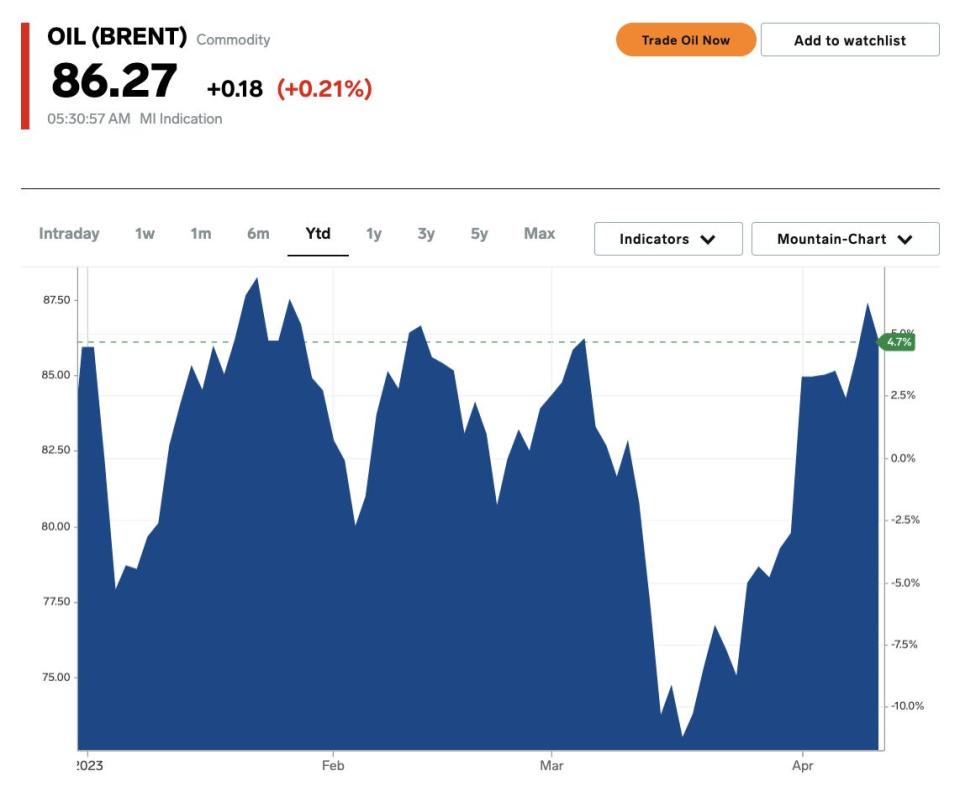
Brent crude price on April 14, 2023

Brent crude value on April 14, 2023

Markets Insider

10. Oil markets could see a provide shock of two million barrels a day this 12 months. With OPEC and Russia slashing creation, the global source of crude could confront a steep deficit just before the 12 months ends. At the very same time, oil demand is predicted to hit a history large in 2023.

Curated by Phil Rosen in New York. Suggestions or tips? Tweet @philrosenn or e-mail prosen@insider.com.

Edited by Max Adams (@maxradams) in New York and Hallam Bullock (@hallam_bullock) in London.

Read through the original posting on Organization Insider

Live updates: Russia’s war in Ukraine

Live updates: Russia’s war in Ukraine
Smoke billows during shelling on the outskirts of Chasiv Yar on April 7.
Smoke billows during shelling on the outskirts of Chasiv Yar on April 7. (Oleksandr Klymenko/Reuters)

The blasts in the japanese Ukrainian city of Chasiv Yar echo concerning properties each and every minute or two, a CNN crew reports.

Artillery, grad rockets and mortar fire were being all audible in the town at distinctive details Saturday — most of it considered to be outgoing from Ukrainian positions, but also some incoming from Russian forces.

The CNN crew, which very last visited Chasiv Yar eight days ago, mentioned the amount of indirect fire appeared to have greater from the former go to. It would seem to point out Ukrainian forces are doing the job challenging to retain open their essential offer route into close by Bakhmut, irrespective of mounting Russian strain.

Russian forces keep on “to conduct offensive actions (in their endeavor) to take whole control of the metropolis of Bakhmut,” the Common Personnel of the Ukrainian Armed Forces claimed in its most recent condition update Saturday.

Unofficial reviews suggest Russia’s troops have maintained their gradual advance via the centre of the extensive-embattled town, found just east of Chasiv Yar. The lengthy battle for Bakhmut has observed Moscow’s fighters start off to enter western parts of the town, according to the studies, with the railway station as a feasible subsequent important focus on.

Daily life beneath constant fire: Again in Chasiv Yar, Ivan, a university university student majoring in psychology, appeared unfazed by the frequent seem of fireplace.

The incoming?” he shrugged. “So what. I’m alive. I have meals. At times we have operating h2o.”

Ivan and his mother Ira are among the the handful of civilians still left in the town. 

“As extended as I can, I will keep below,” he claimed, right before going back again to sawing the trunk of a little tree. The logs will make a fireplace exactly where his mother can cook dinner.

Ira, a lady in her fifties with shorter hair and a gold pendant of the Virgin Mary all over her neck, concentrated on the day’s chores — not the risk.

“We wake up every single early morning, light a hearth and start out making ready foodstuff,” she told CNN. “Every day Ivan fetches h2o and collects firewood.”

She’s previously arranging ahead for Orthodox Easter, subsequent weekend. No church companies have been performed in a whilst, but she and Ivan will notice Easter with the handful of persons left in their getting old apartment intricate.

Irrespective of every thing, we will bake some pies, we will color eggs. We will have a holiday break,” Ira explained. “We are optimists.”

When most people have remaining, the city is significantly from empty, teeming with troopers, tanks, armored personnel carriers and army vehicles, which have left a thick layer of drying mud on the town’s streets.

Russia-Ukraine war live: Bakhmut counteroffensive starts soon, says Ukrainian ground forces commander | Ukraine

Russia-Ukraine war live: Bakhmut counteroffensive starts soon, says Ukrainian ground forces commander | Ukraine

Counteroffensive starts soon, says Ukrainian ground forces commander

Ukraine’s top ground forces commander, Col Gen Oleksandr Syrskyi, said his forces would soon begin a counter offensive after withstanding Russia’s brutal winter campaign.

He said Russia’s Wagner mercenaries, who have been at the frontline of Moscow’s assault on eastern and southern Ukraine, “are losing considerable strength and are running out of steam”.

“Very soon, we will take advantage of this opportunity, as we did in the past near Kyiv, Kharkiv, Balakliia and Kupiansk,” he said, listing Ukrainian counteroffensives last year that recaptured swathes of land.

Oleksandr Syrskyi, Ukraine’s top ground forces commander.
Oleksandr Syrskyi, Ukraine’s top ground forces commander. Photograph: Donetsk Regional Military-Civil Administration/Reuters

Key events

Summary of the day so far …

  • Ukraine’s top ground forces commander, Gen Oleksandr Syrskyi, said his forces would soon begin a counter offensive after withstanding Russia’s brutal winter campaign.

  • The overnight death toll in Kostyantynivka has risen to five. Three women and two men were killed in an attack which hit one of Ukraine’s “invicibility points”, humanitarian support centres where resident can charge their phones on generators and access other services.

  • Emergency services reported that rubble is being dismantled after a night shelling on Bilopillya in the Sumy region, during which it is claimed Russian planes dropped several aerial bombs on the city. One of them hit the police building, and a local school was also damaged. A policeman and a school guard were killed, nine more people were injured.

  • In Kryvyi Rih, Dnipropetrovsk oblast, it is reported that overnight there were five hits by “Shahed” drones, and that air defence forces managed to shoot down one.

  • Russia’s defence ministry said on Friday that the use of depleted uranium shells in Ukraine would harm Ukrainian troops, the wider population and negatively affect the country’s agriculture sector.

  • A Russian security officer who fled the country and entered Kazakhstan because he objected to the invasion of Ukraine has been sentenced to six-and-a-half years in high-security prison.

  • Estonia’s foreign ministry said on Friday it had decided to expel one Russian diplomat working at Moscow’s embassy in Tallinn.

That is it from me, Martin Belam, for now. I will be back later. Léonie Chao-Fong will be here shortly to take you through the next few hours of our live coverage.

Russia’s defence ministry said on Friday that the use of depleted uranium shells in Ukraine would harm Ukrainian troops, the wider population and negatively affect the country’s agriculture sector, Reuters reports, citing the Interfax news agency.

Andriy Yermak, head of the office of the Ukrainian presidency, has shared on Twitter a video which shows the aftermath of the attack in Bilopillya.

Білопілля. Сумщина. Після нічного обстрілу російськими авіабомбами триває розбір завалів. pic.twitter.com/muBPOkOFa3

— Andriy Yermak (@AndriyYermak) March 24, 2023

More details are being reported of the overnight attack on Bilopillya, with Suspilne posting a video and writing:

Rubble is being dismantled after a night [of] shelling, during which Russian planes dropped several aerial bombs on the city. One of them hit the police building, and a local school was also damaged. A policeman and a school guard were killed, nine more people were injured.

Suspilne, Ukraine’s state broadcaster, reports that according to emergency services in Kherson, “pyrotechnicians neutralised 31 explosive objects in the de-occupied settlements of Kherson region”.

Reuters has a quick snap saying that Estonia’s foreign ministry said on Friday it had decided to expel one Russian diplomat working at Moscow’s embassy in Tallinn.

Death toll in Kostyantynivka rises to five

Agence France-Presse reports, citing local emergency services, that the overnight death toll in Kostyantynivka had risen to five.

In addition to the three women known to have died earlier, AFP states that two additional men were killed in a strike that hit what it described as a “humanitarian support centre”.

Suspilne, Ukraine’s state broadcaster, earlier said an “invincibility point” had been struck. Many such points have been set up around Ukraine which provide generators for charging mobile phones and other services.

A Russian security officer who fled the country because he objected to the invasion of Ukraine has been sentenced to six-and-a-half years in high-security prison, Reuters reports, citing Tayga Info, a news website based in Novosibirsk.

Federal protective service Maj Mikhail Zhilin, 36, fled to Kazakhstan last year when Russia announced a conscription campaign, illegally crossing the border through woods while his wife and children drove through a checkpoint.

Zhilin sought refugee status in the former Soviet republic but his request was denied and authorities stopped him from leaving for Armenia.

Kazakhstan handed him over to Russia late last year, leading to the rare conviction of an officer for desertion.

Suspilne, Ukraine’s state broadcaster, offers this news summary of overnight developments to subscribers of its official Telegram channel:

At night, Russian troops shelled a “point of invincibility” in Kostyantynivka, Donetsk region. Three resettled women from other settlements of the region died under the rubble, and two more people were injured.

Sumy district came under massive fire at night: the Russian Federation used about 10 fighter jets, artillery and “Shahed” drones. Two people were killed in the city of Bilopillya, nine others were injured.

In Kryvyi Rih, Dnipropetrovsk oblast, there were five hits by “Shahed” drones. Air defence forces managed to shoot down one.

The claims have not been independently verified.

The UK Ministry of Defence has issued its daily intelligence briefing on Ukraine, in which it suggests Russia has been training troops in Belarus for both practical and political reasons. It writes:

As of mid-March 2023, Russia had likely redeployed at least 1,000 troops who had been training at the Obuz-Lesnovsky training ground in south-western Belarus.

Although no new rotation of troops has been noted, Russia has highly likely left the tented camp in place, suggesting it is considering continuing the training programme.

The fact that Russia has resorted to training its personnel under the much less experienced Belarusian army highlights how Russia’s “special military operation” has severely dislocated the Russian military’s training system – instructors have largely been deployed in Ukraine.

Russia likely also views Belarus’s continued indirect support to the operation as important political messaging.

Suspilne, Ukraine’s state broadcaster, reports that about 300 households were left without electricity overnight in Velyka Pysarivka in the Sumy region after Russian shelling damaged power lines. Citing the regional energy company, it reports that “emergency crews are working to restore electricity supply, and some consumers have already been reconnected”.

This morning we have a piece telling the story of Olha, who fled Kherson a year ago this week and has faced many challenges in relocating to the UK, including enrolling her children in school:

Last February, I was preparing to shoot a short film about Kherson’s streets. A rehearsal was scheduled – but it never took place.

That was the day they bombed airports simultaneously across the country. Public transport stopped running from our city. The frontline ran straight to our city and a week later we found ourselves under occupation. One morning changed our lives, and that of every Ukrainian family, for ever.

We are refugees now, even our cat, Venera. When we arrived in Britain, we never expected such kind support. When people find out we are from Ukraine, they often say: “I’m sorry,” or “Ukraine will win.” Some of them tell how they felt when Russia first invaded and how they bought humanitarian aid, such as food and diapers.

I have found a safe space in London, at a project for women and refugees. There we reveal our experience, do drama exercises and put on shows. For me it’s a kind of healing and I am happy to be a part of that community.

My children have had to abruptly switch to learning in a foreign language. For the first six months at school, my daughter did not understand anything at all. Struck by the difference in the curriculum, the gap only increased.

Read more here: ‘We are refugees now, even our cat’: a Kherson mother’s UK diary

Former Russian president Dmitry Medvedev has posted to Telegram video clips of himself being interviewed by journalists and social media users. Yesterday he threatened to attack any state that allowed the current president, Vladimir Putin, to be arrested. Today, Tass is carrying quotes from him about the stability of the Russian economy despite western sanctions. It quotes him saying:

If something similar [to the current anti-Russian sanctions of the west] happened in the Soviet period, it would be very difficult for us, it would not be clear at all how it would cope.

But now we have created our own modern, competitive agricultural sector. I am very proud of it. Therefore, we can feed ourselves. We are now feeding others. Now we are not turning to anyone, they are turning to us.

And civil industry lives. Some things are faster, some things are slower, but on the whole everything is going on quite normally.

Medvedev made the point that the official inflation figure in Russia is lower than in some European countries, saying: “Feel the difference. They ignited this campaign, they began to fight us, and now inflation is 15-20{515baef3fee8ea94d67a98a2b336e0215adf67d225b0e21a4f5c9b13e8fbd502} in some countries. Well, that’s what they need.”

Credit Suisse AG and UBS group AG are under scrutiny in a US Department of Justice probe into whether financial professionals helped Russian oligarchs evade sanctions, Bloomberg News reported on Thursday.

The DOJ also sent subpoenas to employees of some major US banks, the Bloomberg report said, adding that the Swiss banks were included in a wave of subpoenas sent before Credit Suisse’s takeover by UBS.

The DOJ inquiries are to identify which bank employees dealt with sanctioned clients and how those clients were vetted over past years, Bloomberg reported.

The bankers may then be further investigated to determine if they broke any laws, the report added.

Here is some analysis of what is happening in Bakhmut, via Reuters:

A slowdown by Russia in Bakhmut could mean it is diverting its troops and resources to other areas. Britain said on Thursday that Russian troops had made gains farther north this month, partially regaining control over the approaches to the town of Kreminna. Intense battles were also under way farther south.

The Ukrainian military analyst Oleh Zhdanov agreed with that assessment. He said on YouTube that Russia’s attacks on Bakhmut were decreasing, and it was shifting its efforts south to the town of Avdiivka.

Russia’s forces have become more active in areas to the north in the Kharkiv and Luhansk regions as well as central Zaporizhzhia and southern Kherson regions, he said.

Any shift in momentum in Bakhmut, if confirmed, would be remarkable given the city’s symbolic importance as the focus of Russia’s offensive, and the scale of the losses on both sides there in Europe’s bloodiest infantry battle since the second world war.

On the ground in Ukraine, frontlines have largely been frozen since November. Ukraine had looked likely to pull out of Bakhmut weeks ago but decided to fight on.

Russian forces may have to advance as far as Kyiv or Lviv in Ukraine, Russia’s former president Dmitry Medvedev said in an interview to Russian news agencies.

“Nothing can be ruled out here. If you need to get to Kyiv, then you need to go to Kyiv, if to Lviv, then you need to go to Lviv in order to destroy this infection,” RIA Novosti quoted Medvedev as saying on Friday.

There was no immediate response from Moscow to suggestions its forces in Bakhmut were losing momentum, but Wagner boss Yevgeny Prigozhin issued statements in recent days, warning of a Ukrainian counterassault.

On Monday, Prigozhin published a letter to the Russian defence minister, Sergei Shoigu, saying Ukraine aimed to cut off Wagner’s forces from Russia’s regular troops.

Reuters journalists near the frontline north of Bakhmut saw signs consistent with the suggestion that the Russian offensive in the area could be waning. At a Ukrainian-held village west of Soledar, on Bakhmut’s northern outskirts, the intensity of the Russian bombardment noticeably lessened from two days earlier.

“It was really hot here a week ago, but in the last three days it has been more quiet,” said a Ukrainian soldier who used the call sign Kamin (Stone).

“We can see this in the enemy’s airstrikes. If before there were five-six air raids in a day, today we had only one helicopter attack,” said the soldier.

Counteroffensive starts soon, says Ukrainian ground forces commander

Ukraine’s top ground forces commander, Col Gen Oleksandr Syrskyi, said his forces would soon begin a counter offensive after withstanding Russia’s brutal winter campaign.

He said Russia’s Wagner mercenaries, who have been at the frontline of Moscow’s assault on eastern and southern Ukraine, “are losing considerable strength and are running out of steam”.

“Very soon, we will take advantage of this opportunity, as we did in the past near Kyiv, Kharkiv, Balakliia and Kupiansk,” he said, listing Ukrainian counteroffensives last year that recaptured swathes of land.

Oleksandr Syrskyi, Ukraine’s top ground forces commander.
Oleksandr Syrskyi, Ukraine’s top ground forces commander. Photograph: Donetsk Regional Military-Civil Administration/Reuters

Opening summary

Welcome to the Guardian’s live coverage of the war in Ukraine with me, Helen Sullivan.

Our top story this morning: Ukrainian troops, on the defensive for four months, will soon launch a counterassault, Ukraine’s top ground forces commander has said, as Russia’s winter offensive weakens without capturing the eastern city of Bakhmut.

We’ll have more on this shortly. In the meantime here are the key recent developments:

  • Volodymyr Zelenskiy has renewed his call for more long-range weapons from western allies on Thursday. Speaking to an EU summit via video link, the Ukrainian president recounted the “devastating” scenes he had witnessed close to the frontlines, where fighting has been fiercest. The EU leaders endorsed a plan – agreed by foreign ministers on Monday – to send a million artillery shells to Ukraine over the next year.

  • Zelenskiy visited the southern region of Kherson, where he toured infrastructure and promised to rebuild following Russia’s invasion. Ukraine’s military said Russian forces had left the Kherson town of Nova Kakhovka but a Russian-installed official there denied it.

  • The EU leaders held talks on Thursday with the UN secretary general, António Guterres, focused on global food security and sanctions imposed on Russia. Guterres’ participation came after the renewal of a deal brokered by the UN and Turkey on the safe export of Ukrainian grain via the Black Sea – seen as crucial to overcoming a global food crisis.

  • The EU Commission president, Ursula von der Leyen, said the EU would work to find 16,200 Ukrainian children deported to Russia. Calling it a reminder of “the darkest times in our history”, she said only 300 had been returned so far.

  • Dmitry Medvedev, the deputy secretary of Russia’s security council, said Moscow’s relations with the west had hit an all-time low. Asked whether the threat of a nuclear conflict had eased, he said: “No, it hasn’t decreased, it has grown. Every day when they provide Ukraine with foreign weapons brings the nuclear apocalypse closer.” Medvedev said any attempt to arrest Vladimir Putin a would amount to a declaration of war against Russia.

  • Hungary would not arrest Putin if he entered the country, said prime minister Viktor Orbán’s chief of staff said.

  • Finland’s president, Sauli Niinistö, signed legislation to make his country part of the Nato. Last year, Finland applied to join in response to Russia’s war in Ukraine. Legislation incorporating Nato’s founding treaties was passed in parliament in Helsinki on 1 March.

  • The UN nuclear agency’s chief has said the situation at Ukraine’s Zaporizhzhia power plant “remains perilous” after a Russian missile strike disconnected it from the grid. Europe’s largest nuclear power plant needs a reliable electricity supply to operate pumps that circulate water to cool reactors and pools holding nuclear fuel.

  • Ukraine’s state emergency service said on Thursday that it had ended rescue attempts in Rzhyshchiv, Kyiv region, where nine people died in a Russian drone attack in the early hours of Wednesday morning.

  • Suspilne, Ukraine’s state broadcaster, reported that on Wednesday shelling in the Donetsk region killed two people and injured four others, while one person was killed and two were wounded in Kherson.

  • British military intelligence said Russia had partially regained control over the approaches to the eastern Ukrainian town of Kreminna after its troops were pushed back earlier this year.

  • Spain’s prime minister, Pedro Sánchez, has said he will discuss a peace plan for Ukraine with the Chinese president, Xi Jinping, during an official visit to China next week.

  • The governor of Florida, Ron DeSantis, has reversed his position on Ukraine after facing widespread criticism for calling the Russian invasion a “territorial dispute”. The likely contender for the Republican presidential nomination said his remark had been “mischaracterised”.