With her next runway display at Paris Style 7 days driving her, Victoria Beckham appears to be ushering in an remarkable new period for her eponymous label, almost 15 decades since it released.
“I’ve been doing vogue for a longer time than I did music,” Beckham explained, introspectively, above a cell phone phone from London just times just after her Drop-Winter 2023 display in the French capital.
Nonetheless known by quite a few further than the trend globe as “Posh Spice,” her nickname as a single-fifth of the Spice Ladies, she is a movie star gossip web-site mainstay, with a well-known partner, David Beckham, and increasingly nicely-acknowledged youngsters: Brooklyn, who married actor Nicola Peltz in a large-profile wedding day last yr, Romeo, Cruz and Harper.
Yet, Beckham’s brand name, introduced in 2008, has been warmly supported by the higher echelons of the manner industry (Anna Wintour is a normal visitor at her reveals).
Getting shown consistently for the duration of New York and London trend months right before creating her Paris Vogue 7 days debut very last September, she is surely no trend newbie and her label has very long been synonymous with a alluring and streamlined aesthetic — not a significantly cry from the sharp minis and modern silhouettes that were being so integral to Posh Spice’s search, despite the fact that now rendered in an certainly far more grown-up, glamorous way.
The actuality that her fashion line has existed for so very long is noteworthy. Although Beckham has received crucial praise in her tenure, it is really scarce for celebs without having formal layout training to locate success. Even Rihanna’s completely ready-to-wear line, Fenty, backed by the luxury conglomerate Louis Vuitton-Moët Hennessy, was shuttered immediately after two many years (while, it really should be noted, Rihanna’s attractiveness manufacturer of the similar name is flourishing).
Eva Longoria, Nicola Peltz Beckham, Brooklyn Beckham, Cruz Beckham, Edward Enninful, Harper Beckham, David Beckham and Anna Wintour attend the Victoria Beckham FW23 demonstrate throughout Paris Trend Week. Credit rating: Darren Gerrish/WireImage for Victoria Beckham
Even with her longevity, the industrial viability of Beckham’s operation has often been questioned — although it seems enterprise may well lastly be on the up. According to Women’s Put on Each day, Victoria Beckham Holdings Constrained, which is the centralized entity amongst Beckham’s manner and attractiveness ventures, noted profitability for the first time for the 2022 fiscal calendar year. In January, the brand’s CEO Marie LeBlanc also informed the Small business of Trend that profits have grown by double digits more than the very last 4 seasons.
“I imagine that now I can genuinely, truly commence building,” claimed Beckham even though reflecting on these milestones.
Beckham’s firm lately underwent a total restructuring on equally the small business and resourceful sides — from improved IT and electronic arranging methods together the again conclude to the reducing of selling prices (somewhat) to a “new layout crew, new atelier and new customers across each and every department, if you like,” she claimed.
A look from Victoria Beckham FW23. Credit score: Giovanni Giannoni/WWD/Getty Photos
Although she’s manufactured several improvements, Beckham’s dedication to top quality command has prolonged been unwavering: “I in no way want to hurry something. I believe, finally, it really is got to be proper. I hardly ever want to compromise,” she spelled out.
Her oeuvre isn’t going to appear to court docket trends, and she doesn’t operate with flash nor ephemerality (most likely belying expectations established by her Spice Girls persona). Her apparel combine fantasy with a distinct subject-of-factness: a Fall-Winter 2023 glimpse, for instance, showcased a layered chiffon and feather-accented costume styled with a sensible khaki trench. And, significantly, there isn’t really truly a Victoria Beckham logo or mark, preserve for her typeface.
This isn’t to say her brand is with out signature items. Beckham’s “watch chain” extras, which attribute a bold, reflective accent reminiscent of a timepiece’s wristband, are proving preferred. “It was motivated by a strap element on a view that my husband purchased me,” reported Beckham. “A vintage Patek Philippe.”
The metalwork is observed, entrance-and-center, on nano to jumbo sized purses, alongside with choose sneakers and jewellery. The carriers have caught on. From the newest collection, the additional large measurements have presently offered out in pre-orders. And Beckham appears to be to have uncovered a supporter from, most likely, an unanticipated market place indicator: her son, Cruz, who wore a chain-accented crossbody “Eva” bag and custom made Victoria Beckham monogrammed denim to his mother’s presentation.
“It’s funny due to the fact Cruz called me on the way to the clearly show and he was like, ‘Mom, can I borrow your eyeglasses?’ And I was like, ‘yeah, of course you can borrow my glasses.’ And then he explained, ‘Yeah, and I’ve just identified this bag in your wardrobe,'” Beckham stated, laughing. “It was intriguing that an 18-yr-previous boy would be captivated to that and say, ‘I want to use it.'”
May this necessarily mean menswear is on the horizon? “That would be a desire. Not fairly yet. But I’m normally impressed by menswear — you see that in the tailoring,” Beckham reported.
Models get their closing walk at the Victoria Beckham FW23. Credit: Motion Push/Shutterstock
While menswear may not be coming quickly, she did introduce a dedicated makeup and skincare manufacturer, Victoria Beckham Beauty, in 2019. And a lot more not too long ago, she launched VB Body, a “permanent capsule selection” of knitted shapewear-influenced separates, skirts and variety-slimming dresses. These parts are part of the total Victoria Beckham line, but are offered at a decrease price tag place.
“VB Physique was an thought that I had when I was truly expending a ton of time in Miami,” said Beckham. She and her partner retain a property in the Florida town David is a husband or wife in Inter Miami, the American soccer club. “I obtain the way that women gown there quite liberating in how they like to display off their bodies and rejoice who they are. I believe there’s a real self esteem in that.”
Given that relocating her runway show to Paris last yr, Beckham has seen an uptick in editorial and pink carpet notice. For Drop-Winter season 2023, she recruited Drew Barrymore for social media teasers all over the assortment as a nod to the lore of the documentary and movie “Grey Gardens” (Barrymore starred in the latter). “The tale won’t inspire me in a literal feeling, automatically,” states Beckham. “It can be much more so in the feeling of how we can have enjoyable with garments.”
Victoria Beckham backstage at her FW23 present. Credit rating: Motion Push/Shutterstock
That variety of electrical power feels contemporary. You will find a newfound wind in Beckham’s sails. She herself appears to be extra optimistic and this is remaining reflected in her individual styling. “I usually employed to wear black,” she mentioned. “And then, I do not know precisely what adjusted or what happened, but I hardly ever wear black today. I enjoy wearing coloration and I adore putting on unexpected hues jointly.” (Special color use and pairings are yet another aspect in Beckham’s brand name codes.)
What tenets, exterior of the Victoria Beckham aesthetic, have helped her keep the system? “Several years and many years ago,” Beckham shares, “(trend designer) Roland Mouret, who was a mentor to me in the beginning, reported ‘no subject what anyone suggests or what any person tells you is the correct detail to do, in the long run, you have got to go with what you believe is proper.’
“I have been wondering about that a great deal recently.” And, with that, she provides: “There is so substantially that I want to do with my manufacturer, across fashion and elegance. And, like I stated, now, I genuinely imagine that I can begin making. It was about acquiring the business back on track, which we have performed. And we have a wonderful layout group. We have rather a nicely-oiled machine.”
“All the things I do is rooted in actuality,” she concluded. “But, it hasn’t been at the compromise of the dream.”
Delighted Friday! Recovered artifacts from the Titanic shipwreck will be made into NFTs, a new electronic curatorial department at Cooper Hewitt, here’s the tech news you require to know prior to the weekend:
Is a weeding AI robotic the future of sustainable farming?
Researchers at a Massachusetts Institute of Technologies (MIT) startup have found a chopping-edge option to the bane of farmers’ existence: weeds. The FarmWise crew produced a weeding robot that uses synthetic intelligence (AI) to determine and snip weeds without disturbing crops.
“We have [a] growing population, and we can not extend the land or drinking water we have, so we need to dramatically boost the effectiveness of the farming sector,” FarmWise cofounder Sebastien Boyer reported in a press launch. “I think AI and details are heading to be major gamers in that journey.”
Its very first robotic, the Titan, makes use of device vision to differentiate among weeds and vegetables like cauliflower, tomatoes, artichokes, and leafy greens. Proper now, 15 Titans are roving by way of 30 big farms in California and Arizona, their movements managed by iPad-wielding operators who wander alongside the device.
Final thirty day period FarmWise unveiled a new robot, the Vulcan, that is lighter and pulled as a result of the fields by a tractor. The Vulcan is operated from the touchscreen-equipped tractor taxi that Boyer likens to those identified in a Tesla. In both equally styles, an AI positions hundreds of tiny blades in and about crops to snip off the weeds.
A person may well surprise why farmers may need a fancy machine to complete a undertaking that has been performed by hand for millennia or far more not long ago with herbicides. There is an agriculture labor scarcity in several parts throughout the world, and herbicide-resistant weeds are a developing (pun supposed) trouble. Moreover, herbicides can be poisonous to each human beings and ecosystems.
The equipment have permitted FarmWise prospects to ditch herbicides and farm natural, with the AI weeders complementing the do the job of fieldhands. Thanks to machine discovering, FarmWise is growing its database to empower its devices to weed for six to 12 new crops every single yr.
“It’s all about precision,” Boyer reported. “We’re going to better recognize what the plant wants and make smarter conclusions for each individual a single. That will deliver us to a level wherever we can use the similar sum of land, much less drinking water, practically no chemical compounds, substantially a lot less fertilizer, and still develop extra foodstuff than we’re producing right now.”
A substance lifecycle CAD plugin is now readily available for free
Squander is a large concern in the building sector, and squander reduction is critical to a sustainable foreseeable future. That’s why Felix Heisel, an assistant professor at Cornell University’s College of Architecture, Art, and Arranging, labored with Cornell’s Circular Design Lab to develop RhinoCircular, a CAD plugin that enables architects to assess the reuse prospective of development resources early in the design course of action.
The method went dwell final calendar year, but previous month, the group released a free of charge variation of RhinoCircular for Rhino3D and Grasshopper. It is available for download listed here.
“Embedded into [Rhino3D] application, the instrument is composed of quite a few factors that can be mixed or connected to match the unique desires of a proposed task in any layout period or on any stage of depth,” a quick from the Circular Building Lab defined. “The circularity indicator by itself is a range amongst and 1 calculated from parameters such as lifespan, efficiency of recycling, and portion of feedstock taken from renewable, recycled or reused resources. Values of desire, computed parameters or a mix of each can be provided by the consumer, further more organized by construction, use, or finish-of-use phases. Results are shown directly in the modeling environment.”
Cooper Hewitt establishes a digital curatorial section
This week Cooper Hewitt, Smithsonian Layout Museum introduced it has proven a Digital curatorial division that will gather and care for perform that originated and exists digitally. Notably, the Electronic division is the institutions’s first new collecting department in about 125 a long time.
Andrea Lipps, affiliate curator of present-day layout at Cooper Hewitt, will head the new department.
“Digital do the job problems us to rethink museum tactics about gathering, stewardship, and exhibit,” Lipps mentioned in a press launch. “We are developing new and enjoyable methods of preservation and presentation though envisioning approaches to supply higher general public obtain to this assortment. I’m thrilled the museum has formalized the Digital section, positioning us to proficiently and responsibly collect born-digital do the job, and I’m honored to direct these attempts.”
Right now, the museum has all-around 70 file- and code-dependent digital functions. These include electronic typefaces, web-based mostly operates, info visualizations, and emojis.
The Titanic is now an NFT
To start with, it sank. Eighty-five yrs later, it was immortalized in a 195-moment romance and disaster movie. N0w, the RMS Titanic is an NFT.
In February, Artifact Labs, a Internet3 business that preserves historical past on the blockchain, partnered with digital asset supervisor Undertaking Clever Financial Holdings and RMS Titanic, Inc. (RMST) to “bring the RMS Titanic and its actual physical artifacts into Internet3 and completely unlock the intrinsic worth of the linked mental property by tokenizing the property.”
RMST has the rights to recuperate artifacts from the wreck internet site, even though Undertaking Clever Economic Holdings will orchestrate the conversion of the intellectual house related with the artifacts into nonfungible tokens (NFTs). The NFTs will be supplied to traders as a way to fund investigation, preservation, and education and learning for RMST’s assets.
“We stay dedicated to sharing the legacy of the Titanic, her passengers, and crew, with persons around the environment,” RMS Titanic President Jessica Sanders explained in a push release. “As the salvor-in-possession of the Titanic wreck web-site, we are decided to be certain that the Ship’s artifacts are preserved in perpetuity and accessible to long term generations. We believe that that moving into the digital place enables us to get to a broader viewers with high-quality programming that educates and conjures up. We are fired up to have located the abilities and companions to enable us attain people plans.”
There are few issues besides keeping a clean alley that most Chicagoans agree on. Yet, last week, a majority of the city’s voters ousted the incumbent mayor, Lori Lightfoot, in the city’s mayoral primary.
With just under 17{515baef3fee8ea94d67a98a2b336e0215adf67d225b0e21a4f5c9b13e8fbd502} of the vote, Lightfoot became the first mayor to fail to advance to the runoff election since Jane Byrne lost the 1983 primary. But the recent election was not a stunning rebuke of Lightfoot, who commanded third place with a loyal base of mostly Black voters on the city’s South and West Sides, but a demand for a radically different approach toward combating crime amid pandemic recovery, with one candidate focused on law and order and the other hoping to boost the social safety net.
In one month, the general election could serve as a bellwether for how Democratic voters across the nation think about crime – a topic that became deeply politicized during an uptick in violence after the onset of Covid-19 and the widespread call for police reform after George Floyd’s murder. Chicago is the third largest city in the US, and its nearly 3 million residents are deeply segregated and break down into almost equal thirds white, Black and Hispanic. What may appear on the surface to be a reliable Democratic stronghold actually encompasses a wide spectrum of moderate liberals, progressives and even some Trump supporters, the latter concentrated among cops, firefighters and other public workers living on the far Northwest Side.
At a time when places like New York City and Washington DC are reassessing their approach to public safety issues and rebuilding their communities, Chicago’s election in April could inform how some of the biggest cities move forward.
When Lightfoot ascended to power in 2019, the political outsider made history as the first Black, openly gay mayor of Chicago and dominated all 50 of the city’s wards with the optimistic message that she would “bring in the light”.
But Lightfoot’s campaign promises of transparency foundered once she took office, particularly when it came to public safety. After Chicago police wrongfully raided the home of a Black woman, Anjanette Young, in 2019 and forced her to stand naked until a female officer arrived, Lightfoot claimed she knew nothing about the incident until local news broke the story. Her own lawyers tried to prevent the local TV station from airing the video of the botched raid and Lightfoot herself later admitted that she was aware of the raid before the news broke. When five alderwomen introduced an ordinance in 2021 banning no-knock raids – building on the momentum of the Breonna Taylor case – Lightfoot opposed the bill and argued it could hamper the police’s ability to respond quickly.
At the same time, Lightfoot engaged in a legal battle with the city’s cop union, the Fraternal Order of Police, over a vaccine mandate for public workers. Police expressed their frustration over burnout and multiple canceled days off by literally turning their backs on Lightfoot in 2021.
In February’s primary, Lightfoot attempted to thread the needle by marketing herself as a moderate candidate. But many voters bolted in one of two other directions: to the most progressive and conservative options. Paul Vallas and Brandon Johnson, the Cook county commissioner, going head-to-head on 4 April represent dueling philosophies of criminal justice.
Vallas, the former CEO of Chicago public schools who came in ninth place in his last run for mayor in 2019, ripped a page from the Republican playbook with a law-and-order message. On election night, he placed crime at the forefront of his campaign, declaring public safety a “civil right”. He also received an endorsement from the Fraternal Order of Police, along with its Trump-supporting president, John Catanzara, and has pledged to fill Chicago’s 1,700 police vacancies.
Paul Vallas has been endorsed by the Fraternal Order of Police. Photograph: Kamil Krzaczyński/Getty Images
Johnson’s résumé as a former teacher and Chicago Teachers Union deputy political director puts him at immediate odds with Vallas, whom critics say set the stage for the closure of 50 Chicago public schools predominantly in Black and Brown neighborhoods under former mayor Rahm Emanuel. Johnson’s progressive approach toward criminal justice would include a mental health hotline and eliminating no-knock warrants. He also committed to ending the city’s contract with ShotSpotter, which the city’s own inspector general found “rarely leads to evidence of a gun-related crime”. In a televised debate, both Lightfoot and Vallas supported keeping the acoustic gunshot detection tool used by police.
Johnson and Vallas agree on some policy issues including changing the Chicago police department’s patrol plan to allocate more police officers during high crime hours. Both have vouched for boosting the number of detectives so that CPD can solve more murders, though Johnson has dodged the question of whether he would reduce CPD’s nearly $2bn budget. But on most issues they represent very different directions for the city.
“What we have in this runoff is the tale of two cities in Chicago,” said Constance Mixon, a political science professor and director of the urban studies program at Elmhurst University. “It is a tale of progressives and Brandon Johnson, but it’s also a tale of more conservative voters, particularly in white ethnic neighborhoods on the far north-west and south-west sides of the city … Paul Vallas’s message of crime resonated with them.”
Like other cities across the US, violent crime escalated during the pandemic in Chicago. While homicides had been on a steady decline since 2016, they shot up from 500 in 2019 to 776 in 2020. Homicides dropped in 2022, but still rival the rate Chicago saw in the 1990s.
“Things like theft and burglary have been trending down for the last two or three decades and the last couple of years is no different. Even overall violence hasn’t increased that much,” said David Olson, a criminal justice professor and co-director of Loyola University’s Center for Criminal Justice Research. “The challenge politically are the crimes that have increased are the ones that are the most serious and the most visible in terms of coverage by the media and attention by people. And rightfully so, given the fact that homicide is the most serious offense.”
For years, crime had disproportionately affected Black and Brown communities on the South and West Sides of the city. But since the pandemic started it has increased in those areas, as well as predominantly white and wealthy neighborhoods – spurring fresh outrage and new attention to the issue. Carjackings in Lincoln Square, robberies on the Gold Coast, and kidnappings in Wrigleyville have rattled residents and dominated local headlines.
“Wealthier, whiter parts of the city have been safer for many, many years and the violence has persisted on the South and West sides in plain sight without the kind of attention and response that the issue is getting now,” said Roseanna Ander, founding executive director of the University of Chicago Crime Lab and the University of Chicago Education Lab. Leaders should recognize that public safety strategies should look at persistent problems throughout the entire city, rather than making one part of Chicago safer at the expense of other parts of the city, Ander added.
While the post-pandemic rise in crime has frustrated white Chicagoans, Black Chicagoans who have long dealt with the city’s crime problems have left in droves over the past decade. Recent census data showed Chicago’s Black population has dropped by nearly 10{515baef3fee8ea94d67a98a2b336e0215adf67d225b0e21a4f5c9b13e8fbd502} since 2010. Political strategist Delmarie Cobb attributes that exodus to two factors: crime and schools.
“Those two issues are front and center for Black people, whereas white people may just be experiencing crime for the first time, but they’re OK with the schools,” Cobb said. “With the tough-on-crime candidates, they’re often who get all the attention and support because those people who are experiencing crime for the first time at this level, they want somebody who can do it quickly.”
How the two mayoral candidates communicate their message on crime to Black voters will prove crucial. In the primary, Johnson garnered support from white progressives on the North Side but in order to beat Vallas, he’ll have to court Hispanics on the West Side who voted for his progressive rival, Congressman Jesús G “Chuy” García, and Black voters who backed Lightfoot on the South Side. Vallas is already trying to shore up support from Black politicians, racking up key endorsements from the former Illinois secretary of state Jesse White and Lightfoot’s ally Alderman Walter Burnett. Toni Preckwinkle, Lightfoot’s rival in the 2019 election, and US congressman Danny Davis, who represents much of the South and West Sides, endorsed Johnson.
Paul Johnson’s progressive approach toward criminal justice would include a mental health hotline and eliminating no-knock warrants. Photograph: Anadolu Agency/Getty Images
Johnson may have trouble taking the middle road in the general election. Though his policies on criminal justice reform fired up a progressive base in the primary, Johnson has tried to distance himself from past comments on defunding the police. When it comes to filling police vacancies, Johnson told Block Club Chicago that hiring more officers wouldn’t solve the city’s crime problem, instead saying that funding could be reallocated by shifting officers’ roles and hiring additional emergency service responders.
During one primary debate, Lightfoot questioned how Johnson would boost the number of detectives without increasing the police budget.
“He says he wants to promote detectives,” Lightfoot said. “When you promote detectives then you’ve got to backfill the patrol officers and if he’s not willing to commit to not defunding the police, he’s gonna have less officers on the street and our communities are gonna be less safe.”
It is possible that Johnson could reallocate funding rather than increasing CPD’s budget, counters Craig Futterman, a clinical professor of law at the University of Chicago Law School and director of the school’s Civil Rights and Police Accountability Project.
“Within a fixed budget, you can put less of your officers in the kind of stop-and-frisk mode, street policing mode and more in investigating mode,” he said. “That’s not necessarily going to cost you more money.”
For Vallas, the endorsement from the Fraternal Order of Police will either become his winning advantage or his achilles heel. The group welcomed Florida’s conservative governor Ron DeSantis for a speech in February while its president, Catanzara, has landed in the news for defending January 6 rioters and comparing Lightfoot’s vaccine mandate to the Nazi Germany.
More than the endorsements, however, voters may choose based on their visceral feelings about what’s needed to reduce crime, Olson said.
“For a lot of people, their gut feeling is, well, if we just had more police, that would address the problem, and it’s more complicated than that,” he said.
“So if one candidate presents this blunt: ‘We just need more police’, that may swing some folks. If another approaches with: ‘We’ve got to address the root causes, this is a long-term problem that needs a long-term solution’, that might resonate because they see that as perhaps being a more realistic understanding.”
Many organization leaders throughout the state have been hoping for a dismal jobs report from the Bureau of Labor Statistics.
Lousy work numbers would necessarily mean that the economic system is weakening, and that the Federal Reserve wouldn’t have to preserve increasing desire prices to get a manage on inflation. If fascination charge improves prevent, businesses will be able to borrow funds much more inexpensively.
But the work report was not dismal. The U.S. economy attained 311,000 jobs in February, the Bureau of Labor Statistics (BLS) stated on March 10, about a third far more than the 225,000 work predicted by economists polled by the Wall Street Journal. That follows a January acquire of 50 {515baef3fee8ea94d67a98a2b336e0215adf67d225b0e21a4f5c9b13e8fbd502} a million jobs. The latest positions report arrives immediately after a handful of more places of potent data—U.S. client paying out rose by the most in virtually two a long time in January, and there are nonetheless almost two positions for each and every unemployed worker, in accordance to a BLS knowledge launch on March 8.
The jobs report does counsel that the economy’s breakneck pace of development is slowing.
For case in point, the U.S. economic climate experienced included, on regular, 343,000 careers on average for the past six months, so February did symbolize a slight slowdown. Some industries continued to shed work, including details, which consists of big tech businesses, and transportation and warehousing, which contains the individuals who function in e-commerce. Wage advancement appears to be slowing, and the unemployment level ticked up somewhat, to 3.6{515baef3fee8ea94d67a98a2b336e0215adf67d225b0e21a4f5c9b13e8fbd502}.
But there have been also some significant work gains in industries like leisure and hospitality, retail, and even construction, regardless of concerns that the housing current market is softening.
A lot more than just about anything, the work report presents far more puzzling details to economists in an era the place no one particular appears to seriously recognize irrespective of whether or not the U.S. financial state is headed south—though lots of persons seem to be to be salivating for negative economic facts. Economists didn’t know what to make of it. “If you squint at the quantities, you may possibly be in a position to see signals of a slowing labor industry,” Lisa Sturtevant, main economist of Bright MLS, a serious estate listing service, wrote in commentary. “February’s occupation gains beat anticipations yet again in an additional display screen of resiliency for this labor industry,” one more analyst, Cody Harker, head of info and insights from Bayard Advertising and marketing, commented.
The ordinary American can consider comfort and ease in figuring out that irrespective of some gloomy financial predictions, the job marketplace is nevertheless sturdy. Unemployed workers should have no trouble discovering a new career.
But this jobs report also signifies that the Federal Reserve will probable continue to quickly raise fascination costs, which is not joyful news for any customer who is making an attempt to borrow cash shortly. The Fed’s Open up Market Committee will launch its subsequent choice on fascination fees on March 22. Testifying before Congress on March 7, Fed chair Jerome Powell claimed that the strength of new economic data “suggests that the supreme level of curiosity fees is likely to be bigger than formerly predicted.”
What that implies for the up coming couple weeks is extra business enterprise leaders and economists seeking to read the tea leaves for any indicators of a economic downturn, and arguing the scenario that the economic climate is slowing down. Economists maintain considering up explanations why this strong info is a fluke—unseasonably warm temperature led to abnormal client paying in January, all these position gains are just replenishing industries that experienced large cuts all through the pandemic, CEOs are pessimistic so hiring simply cannot continue.
“People want some reassurance that inflation will occur down—and some people, primarily those people who have been around for a when, believe that a economic downturn is the only way to completely lower those people inflation expectations,” claims Daniel Altman, chief economist for Instawork, a adaptable staffing enterprise.
By now, forecasting teams like the Conference Board, which tracks economic indicators, forecast that high inflation and slowing customer spending will “idea the financial system into recession in 2023.” The knowledge don’t clearly show any indication of that nonetheless. But an economic forecaster can go on to hope.
Shares received crushed on Thursday as anxieties rippled as a result of the banking sector and traders remained on edge in advance of a essential February careers report slated for Friday morning.
At the closing bell, the S&P 500 (^GSPC) was down 1.8{515baef3fee8ea94d67a98a2b336e0215adf67d225b0e21a4f5c9b13e8fbd502}, the Dow Jones Industrial Ordinary (^DJI) was off by 1.6{515baef3fee8ea94d67a98a2b336e0215adf67d225b0e21a4f5c9b13e8fbd502}, or 542 points, and the Nasdaq Composite (^IXIC) was down by 2{515baef3fee8ea94d67a98a2b336e0215adf67d225b0e21a4f5c9b13e8fbd502}.
Via Thursday’s shut the market was on rate for its worst 7 days of the 12 months, Bloomberg knowledge showed.
The marketing on Thursday accelerated all over the investing session as a collapse in shares of SVB Financial (SIVB) pressured lender shares and elevated worries in excess of formerly unexpected knock-on results from the Federal Reserve’s charge hiking marketing campaign on the monetary method.
On Wednesday, SVB announced a $2.25 billion cash raise and the sale of just about all of its securities portfolio for a decline of $1.8 billion. The firm’s Silicon Valley Bank subsidiary is the lender for lots of startups and other players in the undertaking environment.
In a letter to investors on Wednesday, the corporation mentioned: “We are using these actions for the reason that we expect ongoing larger interest prices, pressured community and personal marketplaces, and elevated funds burn concentrations from our customers as they spend in their organizations.”
The Facts reported Thursday afternoon Greg Becker, CEO of Silicon Valley Lender, mentioned on a simply call with traders, “I would request everyone to remain serene and to aid us just like we supported you for the duration of the hard periods.”
Becker also reportedly advised buyers the financial institution has “sufficient liquidity,” but stated that “if every person is telling each other SVB is in problems, that would be a challenge.”
SVB shares fell 60{515baef3fee8ea94d67a98a2b336e0215adf67d225b0e21a4f5c9b13e8fbd502} on Thursday.
This decrease also weighed on regional banks, with the SPDR Regional Banking ETF (KRE) falling 8{515baef3fee8ea94d67a98a2b336e0215adf67d225b0e21a4f5c9b13e8fbd502} when the SPDR Economic Sector ETF (XLF) fell some 4{515baef3fee8ea94d67a98a2b336e0215adf67d225b0e21a4f5c9b13e8fbd502}.
Among major U.S. revenue-middle banks, shares of JPMorgan (JPM), Financial institution of The united states (BAC), and Wells Fargo (WFC) were being all down much more than 5{515baef3fee8ea94d67a98a2b336e0215adf67d225b0e21a4f5c9b13e8fbd502} on Thursday.
1st Republic Lender (FRC), which maintains a huge large net-value clients company, observed shares drop 16{515baef3fee8ea94d67a98a2b336e0215adf67d225b0e21a4f5c9b13e8fbd502} through Thursday’s trading session.
As Bloomberg’s Jonathan Ferro tweeted, Thursday looks to have marked the instant in the rate-mountaineering cycle that increased charges are good for banks right until they are no lengthier superior.
Earlier Thursday, labor market place details had been the main catalyst for the sector as buyers await a critical work report set for release Friday early morning.
The weekly report on initial filings for unemployment insurance policies Thursday morning confirmed 211,000 promises were being submitted very last week, an increase of 21,000 from the prior weak and what economists at Oxford Economics named the “initially hint of weak point” in this information.
“The leap in jobless claims to 211k past week from 190k is the very first indication of weakness in the claims information this year but is nevertheless very well small of the 300k+ amount that would be reliable with a economic downturn,” Michael Pearce, direct U.S. economist at Oxford Economics, wrote in a note to consumers. “As the Fed presses in advance with additional level hikes, we expect layoffs to eventually rise considerably.”
The preliminary pop from stocks subsequent this data came just after two days of testimony from Federal Reserve Chair Jerome Powell manufactured crystal clear curiosity rates are most likely to go better than anticipated amid strong labor industry and inflation info.
Federal Reserve Chair Jerome H. Powell testifies right before a Residence Fiscal Solutions listening to on “The Federal Reserve’s Semi-Yearly Financial Coverage Report” on Capitol Hill in Washington, U.S., March 8, 2023. REUTERS/Kevin Lamarque
Shares concluded Wednesday’s trading session mixed right after a provide-off Tuesday that was activated by feedback from Powell suggesting the Fed will want to increase costs greater than beforehand forecasted amid stubborn inflation.
“I was surprised by Powell’s willingness to accelerate the coverage tightening rate, but I am not shocked by the admission that terminal costs will will need to rise further more,” mentioned Neil Dutta, head of economics at Renaissance Macro.
“At existing, the futures industry is priced for a [50 basis point] go in March. There is no issue cracking open a doorway if you don’t intend to wander by way of.” Knowledge from the CME Group shows marketplaces inserting an 80{515baef3fee8ea94d67a98a2b336e0215adf67d225b0e21a4f5c9b13e8fbd502} on the Fed increasing costs by .50{515baef3fee8ea94d67a98a2b336e0215adf67d225b0e21a4f5c9b13e8fbd502} afterwards this month.
Somewhere else in markets, WTI crude oil fell about 1.5{515baef3fee8ea94d67a98a2b336e0215adf67d225b0e21a4f5c9b13e8fbd502} to trade around $75.50 a barrel, a retreat from the $80 a barrel oil was investing close to earlier this 7 days.
Investors ended up also preserving a close eye on the Treasury industry with the 10-calendar year generate firmer by about 5 foundation factors, trading at 3.92{515baef3fee8ea94d67a98a2b336e0215adf67d225b0e21a4f5c9b13e8fbd502} following a move higher in yields previously this week led to a deepening inversion of the produce curve.
In solitary-inventory news, shares of Silvergate (SI) ended up in emphasis on Thursday soon after the financial institution explained late Wednesday it would liquidate and wind down its functions right after struggling large losses amid huge deposit outflows from its electronic asset consumer base. Shares of Silvergate, which have shed a lot more than 95{515baef3fee8ea94d67a98a2b336e0215adf67d225b0e21a4f5c9b13e8fbd502} around the past year, fell 41{515baef3fee8ea94d67a98a2b336e0215adf67d225b0e21a4f5c9b13e8fbd502} on Thursday.
Other stocks on the move on Thursday integrated MongoDB (MDB), which fell 8.3{515baef3fee8ea94d67a98a2b336e0215adf67d225b0e21a4f5c9b13e8fbd502} subsequent a disappointing quarterly report. On the flip side, shares of Asana (ASAN) acquired 19{515baef3fee8ea94d67a98a2b336e0215adf67d225b0e21a4f5c9b13e8fbd502} Thursday after a amazingly powerful quarter.
Click on listed here for the most recent inventory marketplace information and in-depth investigation, like functions that shift shares
Go through the hottest financial and business information from Yahoo Finance
The sales year started off with a whimper. First, the covid stimulus package for the auto industry – a cut from June 1-Dec 31 of the car sales tax from 10{515baef3fee8ea94d67a98a2b336e0215adf67d225b0e21a4f5c9b13e8fbd502} to 5{515baef3fee8ea94d67a98a2b336e0215adf67d225b0e21a4f5c9b13e8fbd502} – expired. Those planning to buy cars in early 2023 instead made their purchases last year. In addition, the Chinese central government has been winding down its incentives for New Energy Vehicles (NEVs) for several years. They, too, expired at the end of 2022. That pulled planned NEV sales from 2023 into 2022, over and above the impact of the covid tax cut. In other words, electric vehicle (“EV”) sales in late 2022 were artificially high. This year will be grim across the board for the China automotive sector.
Local government incentives aren’t picking up the slack. Beijing has capped its 2023 NEV license plate incentives at the 2022 level of 70K units, while for 2023 Shanghai eliminated free license plates for PHEVs (and refuses to license urban commuter EVs such as the GM Wuling Hongguang Mini). Now Hunan has begun a 元5000 cash-for-clunkers subsidy, and the central government is urging local governments to upgrade their fleets from ICEs to EVs. However, more prosperous localities such as Shenzhen have already completed the switchover to EV taxis and buses. Most regional and lower-tier cities face a budget crunch, so the process will be slow and will focus on low-priced vehicles. That’s bad news for the many NEV startups, and for Tesla, Inc. (NASDAQ:TSLA) which sit in the premium segment.
Analysis is complicated by the Chinese [lunar] New Year holiday in late January. China is now an urban society, but its cities are populated by workers who migrated from rural areas. This year, around 250 million people traveled back to their hometowns. Car dealerships were closed, and those that reopened early remained empty. Of course, the government offices that issue license plates were closed, too.
To reiterate, it’s payback time. January sales fell 35{515baef3fee8ea94d67a98a2b336e0215adf67d225b0e21a4f5c9b13e8fbd502} overall, and 28{515baef3fee8ea94d67a98a2b336e0215adf67d225b0e21a4f5c9b13e8fbd502} for battery EVs (“BEVs”). However, as I outline below, February sales looked good only in comparison to January. That is bad news for Tesla, which will face lower margins and higher costs, due to lower capacity utilization and the delayed feed-through of higher commodity prices. It is worse news for the many startups, which will see poor sales from now until the normal cyclical increase that starts in September. NEVs are also facing pricing pressures, due to the multitude of players and spearheaded by Tesla’s price cuts.
Additional months of negative cash flow are very bad news. Already, Weltmeister (not traded) has effectively gone out of business, selling no cars this year and closing most of its remaining facilities last week. In their latest financial statements, available on Seeking Alpha, operating income remained negative for Li Auto, Inc. (LI) [Dec 2022], XPeng Inc. (XPEV) [Sep 2022], and NIO Inc. (NIO) [Dec 2022]. Sales of other entrants – Neta, Zeekr and others (not traded) – remain at very low levels. Again, BYD is an exception, as is GAC with its Aion brand. Both are profitable (or are part of larger, profitable enterprises), and so face no immediate pressures. They (alongside Tesla) also happen to be the two largest and best-performing NEV players.
Below I look at overall passenger vehicle sales, and then turn to NEVs. Going into 2023 Chinese analysts were already looking at lower growth, of the order of 30{515baef3fee8ea94d67a98a2b336e0215adf67d225b0e21a4f5c9b13e8fbd502}. I believe that is optimistic in terms of unit sales, and will represent minimal growth in 2023 for revenue and a negative for cash flow. I don’t attempt projections, since there are many articles on Seeking Alpha to provide a baseline. My last section focuses on Tesla, reiterating my January 2022 SA article projecting that Model 3 sales would decline.
Note that my core datasets are for retail sales of light passenger vehicles, but do not include imports. They also do not cover light commercial vehicles or buses, and are not wholesale shipments so ignore exports.
Payback: Overall Vehicle Sales
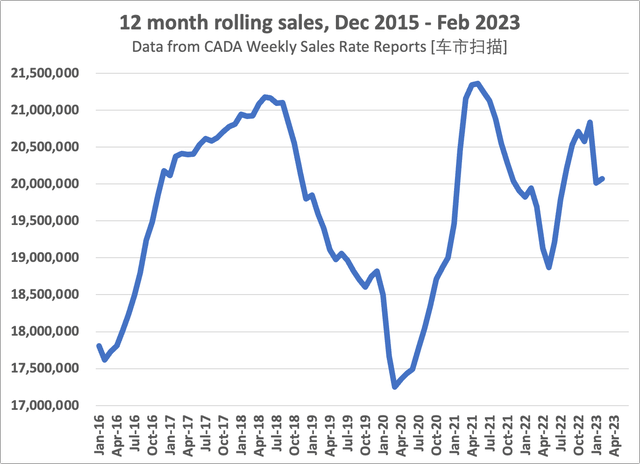
First, China remains the largest vehicle market, surpassing both Europe and North America. But it’s not growing. The migration for towns and farms to cities has ceased, consumers are under pressure as growth remains slow and real estate prices continue to fall, and the working-age population has been falling for a decade. Sales peaked in 2017, and will not expand going forward.
Author’s database, compiled from China Auto Dealers Assoc reports
What are the prospects for CY2023? The government is hoping for 5{515baef3fee8ea94d67a98a2b336e0215adf67d225b0e21a4f5c9b13e8fbd502} growth, but is looking to achieve that through pushing banks to lend for infrastructure and real estate investment. To use a monetary policy aphorism, that’s pushing on a wet string. Local governments saw their fiscal position deteriorate the past two years, and now have bills to pay for the covid testing mandated (but not paid for) by the central government under last year’s rolling lockdowns.
I spent most of my career as a specialist on Japan’s economy, and was in Tokyo in 1992 when their real estate bubble burst, and worked for a Japanese bank before graduate school. I’ve spent days in seminars looking at the evergreening of bad real estate loans, and how that undermined the effectiveness of macro policy. China is going down the same route, in part because that’s the only policy tool Beijing has, given the already complete buildout of regional airports, high speed rail and, lest we forget, a national expressway system that is more extensive than those of the U.S. or Europe – and doesn’t yet need maintenance.
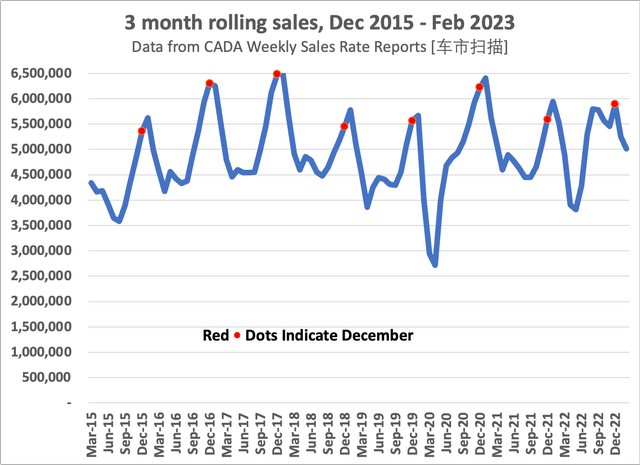
Let’s return to automotive, and look in more detail at passenger vehicle sales. The graph below provides sales using a 3-month moving average. To help with interpretation, December each year is marked with a red dot. First, sales show a distinct seasonal pattern, peaking at the end of winter, in January when the New Year falls later in February, and otherwise (as this winter) in December. Sales then fall through August, in some years with a June bump, before beginning their annual fall ascent.
However, 2022 was different from the previous 7 years, with the rolling average showing an early August peak. That difference represents roughly 700,000 extra sales, sales that will not be booked in the first half of 2023. Compared to recent years, that suggests that sales through July will be down 10{515baef3fee8ea94d67a98a2b336e0215adf67d225b0e21a4f5c9b13e8fbd502}, assuming that consumers will be spending as normal. The Chinese government doesn’t believe that will be the case, accepting lower growth and instead focusing on financial system stability. (See, amongst many possible examples, “Caixin Global, Mar 8, 2023: China’s Financial Shake-Up Shows Policymakers’ Growing Focus on Stability, Risk.”) For the sake of brevity, I won’t examine other indicators, such as commercial vehicle sales. All point in the same direction.
Authors database, compiled from monthly CADA reports
EV Sales
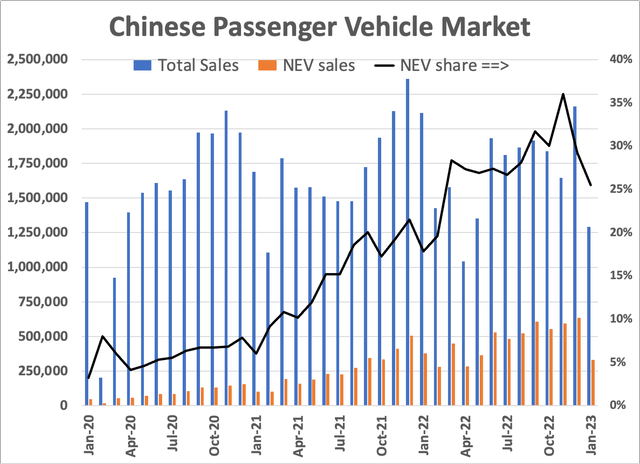
What though of NEV sales? While I otherwise ignore the differentiation, one segment was up in January, PHEV (plug-in hybrids), and by 48{515baef3fee8ea94d67a98a2b336e0215adf67d225b0e21a4f5c9b13e8fbd502}. After all, battery-only EVs don’t fit every use case, and news stories over the Chinese New Year holidays were replete with EV drivers waiting in line to plug into snow-covered chargers, as cold weather depleted their range. There weren’t many PHEV options in 2020, but then not that many EVs were sold, either. The data show the relative weight of PHEVs consistently rising, from about 1 in 8 NEVs sold in 2021Q1 to a bit over 1 in 5 in 2022Q4. That suggests an additional source of pressure on pure EV sales.
Second, the rate of diffusion of NEVs has slowed. Again, as the introduction noted, national incentives have expired and local/provincial ones haven’t increased. Historically, Shanghai has been the single biggest market; altogether, the top 10 cities account for over 1 in 3 NEVs sold (source: my compilation of monthly CPCA reports). Those markets are becoming saturated, with 40{515baef3fee8ea94d67a98a2b336e0215adf67d225b0e21a4f5c9b13e8fbd502} of sales now NEVs. They are also the wealthiest cities, and so are buying the higher-priced vehicles that NEV makers must sell to be profitable. Expanding sales requires moving into Tier 3-4 cities, but those have lower incomes, are losing populations, have governments that are in fiscal straits, and face the largest real estate losses. The latter are the dominant form of household savings, and in a down market are illiquid. (For more details on real estate, see Kenneth Rogoff and Yuanchen Yang, “A Tale of Tier 3 Cities.” IMF Working Paper 22/196, September 2022.)
Authors database, drawn from icauto.com.cn and other sources
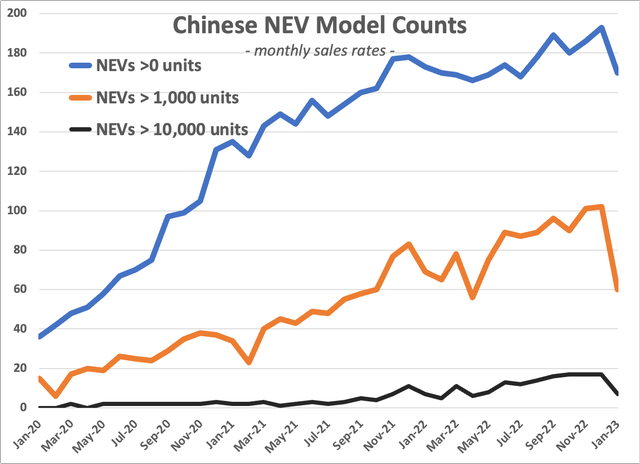
Third, there’s a price war going on. While that’s potentially good for sales volumes, it’s bad for everyone in the industry. Unfortunately for both firms and investors, competition is fierce. I track new model announcements. In 2022, my data include 232 new models and full model changes (and another 466 facelifts and minor changes). Of the new models, 70 were EVs and another 31 PHEVs. This year will see far more, with IHS anticipating 180 new EVs and PHEVs.
Authors database, drawn from icauto.com.cn and other sources
Over the course of 2023, the market will thus become more fragmented, even if some firms exit and some go out of production (as reflected in the blue line of counts of models in my database in the above graph). This should help offset the overall slowdown, as consumers will be more likely to find a model that hits their sweet spot, but it won’t help pricing. At the firm level, the net impact will depend on how many of these are new “top hats” to existing platforms that will come off an existing assembly line. For firms successfully employing a platform strategy, that will increase capacity utilization and economies of scale in component sourcing, even as it decreases sales for each individual model. Whether that will increase net profits (or slow losses) will depend on how much prices deteriorate. I don’t have access to such detailed data, nor do I have the full-time research assistant needed to pull it all together. The only analyst who seems to dive into that level of detail is Eunice Lee at Bernstein, but I have no funds invested with them so no access to those reports, which in any case I wouldn’t be able to cite.
Finally, to me the most sobering item is the 50{515baef3fee8ea94d67a98a2b336e0215adf67d225b0e21a4f5c9b13e8fbd502} fall of lithium carbonate prices since December 2022. It’s not because of a large new mine entering production, or new refining capacity. Carmakers overestimated the end-of-year sales surge of consumers rushing to buy before incentives rolled off (see here), and started paring production plans. They similar underestimated the payback of lower sales in January and particularly February. Why? – because the underlying demand for BEVs is proving below consensus.
CnEVPost
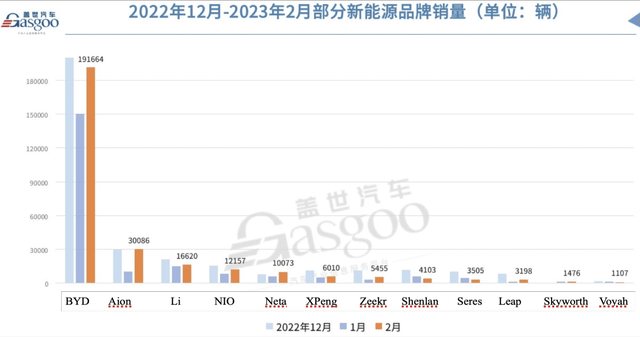
Let’s look at the performance in the major non-Tesla brands (Tesla couldn’t be included because they are slow to release domestic retail data). What the following graph illustrates is nothing short of disaster, because February sales failed in bounce back from the January holiday doldrums. The new entrants need growth to survive. Only 2 firms managed to beat December sales levels: the Guangzhou Automobile Group Co., Ltd. (GNZUF) (“GAC”) Aion brand, whose 4 models racked up sales of 270,000 units in 2022, and the small Neta (also called Hozon in some sources), with 3 models (one launched in November) and 2022 sales of 151,000. I am watching GAC, which is profitable, pays a dividend, and is trading at half of peak. Unfortunately there is no recent analysis on SA, and this article will not attempt to remedy that. Overall, though, I do not believe any of the new entrants in the graph provide “long” investment cases.
Gasgoo web site
Source: auto.gasgoo.com, to which the author appended English company names.
Tesla China
Will Tesla prove robust to these headwinds? How they fare in China in 2023 is central to their growth story and their profitability. The stock price depends on keeping both those narratives intact. Shanghai is Tesla’s largest production facility, so keeping capacity utilization high will be important to controlling costs and preserving margins. Ditto maintaining pricing.
Until we have data for 2023Q1, we will not know whether Tesla has at last dropped its pattern of end-of-quarter retail surges. Changing that habit would mean fewer exports early in a quarter and more later on, and so would leave Europe short of product, leading to a transitional quarter of poor sales. Likewise, in China operations would have to push for more sales early in the month. My own sense of organizational inertia is that such a shift could not be implemented in the space of a month or two, so again would lead to poor sales figures for the transitional quarter. I believe that Tesla management will weigh the gains in operational efficiency against the damage to the growth narrative, and choose the status quo.
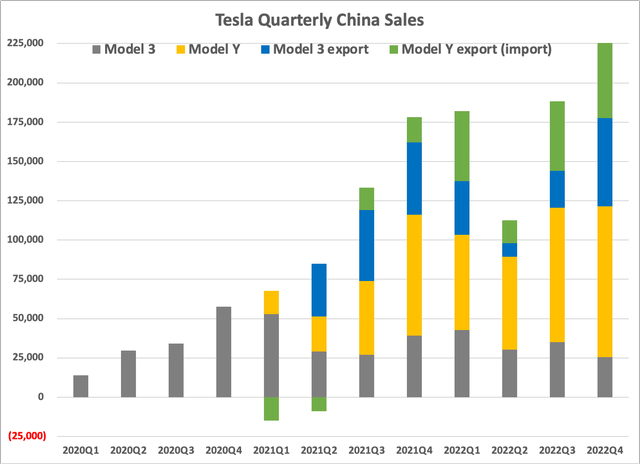
That proviso aside, the data show several things.
One is Tesla’s inability to grow domestic sales of the Model 3, which in fact peaked in 2020Q4. Absent a refreshed interior and new sheet metal to update styling, sales will continue to fall under the onslaught of new models in 2023.
The second is the success of the Model Y, which sells far better than the Model 3 ever has. With a higher selling price but non-battery production costs similar to the Model 3, it is central to Tesla’s profitability.
The third is the dependence of Shanghai on exports, which since 2021Q2 have accounted for over a third of output (2022Q2 was an exception). Without the ability to sell into the European market, Shanghai would operate at under 70{515baef3fee8ea94d67a98a2b336e0215adf67d225b0e21a4f5c9b13e8fbd502} of capacity. Lower labor costs and component costs imply that fixed costs are a higher share. Ironically, that raises Shanghai’s breakeven point. (Thanks to Glenn Mercer for this point.)
Authors database, compiled from multiple underlying sources
All of this raises a number of questions.
First, as Berlin ramps up, how will Shanghai keep utilization high? No other export markets (think Australia) are big enough to absorb the excess, but preliminary data for February show domestic sales below November and December 2022, while exports were over 50{515baef3fee8ea94d67a98a2b336e0215adf67d225b0e21a4f5c9b13e8fbd502} of wholesale shipments (source: CnEVPost: Tesla delivers 33,923 … exports 40,479). I follow China, not Europe, so will lean on comments in the discussion to flesh out scenarios.
Second, Reuters reported on March 1 that Tesla will start producing a refreshed Model 3 – some new sheet metal, a modified interior – in September. However, as I argued previously on SA, the Model 3 is not in a particularly attractive segment, though sedans continue to do better in China than in North America. This should certainly stop the slide in sales, but I do not believe it will offset the limitations of the segment. Furthermore, we have no confirmation from Tesla, and every reason to believe they will miss the target date. Additionally, what will Tesla do to maintain sales of the old version after the new one has its public reveal, while will be before it is actually available for sale? Model changeovers are generally accompanied by price reductions, which with September as the date would hit both the top and bottom line in 2023Q2. Given a long history of delays, however, it’s more likely that this is a story for 2024, not this year.
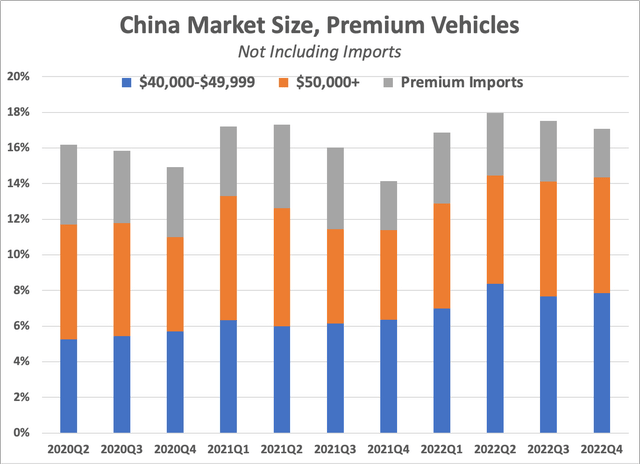
Third, will sales of the Model Y hold up? That single model is now the dominant product for Tesla in China, but it is also a stupendous cash cow, maintaining enviable volume even though it is entering its third year in the Chinese market. My sense is that there is no upside potential. Unlike the U.S., in China the share of the premium market is not expanding, and the dozen or so large, high-income cities that account for most Model Y sales are becoming saturated. Lower lithium prices will support discounting across the NEV spectrum, so will not necessarily help the Model Y. It will however allow premium EV makers with their larger batteries to lower prices more than carmakers operating in lower price brackets. With higher production volumes, and tooling costs now written off, Tesla has more room to discount than new entrants with lower volumes and brand new factories and tooling. So, I also see little downside in volume terms.
Authors database, compiled from various Chinese sources
Conclusions
There are many uncertainties going into 2023. I expect the first half of the year to see much slower growth for NEVs amidst an onslaught of new product. Sales will improve only in 2023Q4, with the normal seasonal upturn, resumed albeit slow economic growth, and lower NEV prices. New entrants in automotive face high hurdles, and I expect another one or two of the smaller NEV players to exit by year’s end, and stillbirths among those just launching their initial products. Watch for additional Chinese EV IPOs – and avoid!
Among the incumbents, GAC remains interesting, with its Aion NEV. Geely Automobile Holdings Limited (OTCPK:GELYF) has about 300,000 in NEV sales, but those are spread across multiple brands and models and corporate entities. That impedes achieving scale in production, and lowers the efficiency of its platform sharing. They nevertheless remain better than other incumbents such as Great Wall, SAIC, VW, GM, Toyota, Honda, Hyundai/Kia, FAW, Dongfeng, Changan, Chery – and on and on. China remains the world’s biggest automotive market, the biggest automotive producer, and is now a net exporter in volume terms. It is also a mature market, and that lowers its attractiveness for investors. Actions speak louder than words: I have yet to take the plunge.
Tesla remains highly profitable in its China operations, but 2023 will be challenging for the Chinese industry as a whole, and Tesla will not be exempt from those pressures. Tesla increasingly depends upon sales of a single product, the Model Y, as the Model 3 is past its prime. The Model Y continues to sell well, and is in a good segment, mid-sized SUVs. However, the premium segment is not expanding, and the steady stream of new NEV models will pressure margins for all producers. Factors such as falling lithium prices help everyone, and with competition, ultimately benefit no one (other, that is, than the final consumer).
In addition, the cash cow of Tesla Shanghai faces a major risk, its reliance on exports to Europe. No other new export markets are large enough to offset any decline there. If Tesla does launch a refreshed Model 3, it will be late in the year so the impact will be in 2024. Meanwhile, while the Cybertruck will launch in the U.S. in late 2023, it is a non-starter in China, where pickups remain utilitarian work trucks that sell in modest numbers in rural areas, and not in the major, high-income cities that comprise Tesla’s core market. Newer, less expensive models are years away and will carry smaller margins multiplied by lower prices.
In sum, Tesla has less downside than the many small players in the NEV market. In line with the NEV market as a whole, Tesla did well in 2022. It’s now payback time, and in line with the NEV market as a whole, Tesla also faces little upside in 2023. That is bad news for a growth stock.
Editor’s Note: This article discusses one or more securities that do not trade on a major U.S. exchange. Please be aware of the risks associated with these stocks.