This post initial appeared in the Early morning Quick. Get the Morning Transient despatched instantly to your inbox every single Monday to Friday by 6:30 a.m. ET. Subscribe
The Federal Reserve has elevated desire costs aggressively over the last calendar year in a bid to slow inflation and the labor current market.
Its attempts are even now not quite feeding by way of to the facts. Friday’s March careers report is the newest scenario in stage.
The U.S. financial system designed 236,000 employment in March and the unemployment charge fell back again to 3.5{515baef3fee8ea94d67a98a2b336e0215adf67d225b0e21a4f5c9b13e8fbd502}.
As RSM main economist Joe Brusuelas claimed in an e mail on Friday, the labor industry continues to be “stout.”
With Friday’s facts, the Fed is likely to raise premiums by a further .25{515baef3fee8ea94d67a98a2b336e0215adf67d225b0e21a4f5c9b13e8fbd502} next thirty day period. The Fed’s forecasts published in March recommend that would mark the conclusion of level hikes for the Fed.
Numerous economists, including Brusuelas, suspect this will certainly arrive to go for the central bank. Brusuelas wrote, “it is now suitable to commence considering a ‘one and done’ coverage path at the Federal Reserve.”
Nationwide main economist Kathy Bostjancic wrote Friday the March jobs report “is supportive of yet another charge hike in May — which we believe could be the last for the tightening cycle. Adopted by a lengthy pause.”
In excess of at Wells Fargo, economists Sarah Dwelling and Michael Pugliese wrote Friday, “On equilibrium, this is the style of work report we consider policymakers at the FOMC want to see: job growth slowing in an orderly vogue, labor provide increasing and wage expansion that is edging nearer to premiums that are constant with the central bank’s 2{515baef3fee8ea94d67a98a2b336e0215adf67d225b0e21a4f5c9b13e8fbd502} inflation concentrate on.”
The agency expects a charge hike in May perhaps, “but it could be the past amount hike of the cycle as policymakers retain rates on hold for an extended period of time and allow the medication take.”
Indicators like a increase in original jobless claims, a drop in open up position listings, and layoff raises captured by Challenger Gray’s month-to-month report all counsel a slowing in the labor current market — and the overall economy — that is constant with the Fed getting ready to back again off its amount hikes.
And still the idea that the economy is eventually matching the Fed’s objective is just one that has been simmering in markets for months.
Only to be swatted away by the information at each and every turn.
In late 2022, an financial slowdown seemed in the offing as month to month job gains fell underneath 300,000 from September through December. A shock work report in January set more aggressive level hikes back again on the table.
U.S. Federal Reserve Chair Jerome Powell attends a press meeting in Washington, D.C., the United States, on March 22, 2023. The Fed lifted curiosity charges by 25 foundation details at the summary of its two-working day meeting on Wednesday, lifting the concentrate on array of the federal resources amount to 4.75-5 {515baef3fee8ea94d67a98a2b336e0215adf67d225b0e21a4f5c9b13e8fbd502}. (Image by Liu Jie/Xinhua by way of Getty Illustrations or photos)
Just previous month, a lender crisis seemed probable to force the Fed not only to end boosting costs but likely roll again rate hikes. On March 22, the Fed elevated rates an additional .25{515baef3fee8ea94d67a98a2b336e0215adf67d225b0e21a4f5c9b13e8fbd502}.
Right after inflation details that, like labor market details, is cooling but continues to be elevated and Friday’s powerful careers report, the market is expecting another rate hike subsequent month.
And so even though economists are once more circling the notion that now, lastly, in this minute we are ready to see the Fed pause, small in excess of the last six months has prompt the U.S. economic climate is all set to put the Fed in posture to again off.
Some in markets will chide the Powell Fed for acquiring been continuously incorrect in their financial forecasts. A further bout of revisions to chase actuality in 2023 would not silence these critics.
But getting completely wrong about the outlook has not stopped Powell & co. from performing on new information. And the notion that this Fed’s response perform might modify now could see investors again fall into the exact trap all about yet again.
Click listed here for the newest inventory market information and in-depth evaluation, together with functions that shift stocks
Study the most up-to-date money and business enterprise information from Yahoo Finance
The March employment report showed employing slowed past month but probably not by ample to simplicity stress on the Federal Reserve to elevate curiosity costs in its initiatives to gradual inflation.
The U.S. economic climate additional 236,000 employment in March while the unemployment amount fell to 3.5{515baef3fee8ea94d67a98a2b336e0215adf67d225b0e21a4f5c9b13e8fbd502}, info from the Bureau of Labor Studies launched Friday confirmed.
Right here are the key figures from the report, in comparison to final month’s revised figures:
Nonfarm payrolls: +236,000 vs. +326,000
Unemployment charge: 3.5{515baef3fee8ea94d67a98a2b336e0215adf67d225b0e21a4f5c9b13e8fbd502} vs. 3.6{515baef3fee8ea94d67a98a2b336e0215adf67d225b0e21a4f5c9b13e8fbd502}
Regular hourly earnings, thirty day period-more than-month: +.3{515baef3fee8ea94d67a98a2b336e0215adf67d225b0e21a4f5c9b13e8fbd502} vs. +.2{515baef3fee8ea94d67a98a2b336e0215adf67d225b0e21a4f5c9b13e8fbd502}
Normal hourly earnings, calendar year-above-year: +4.2{515baef3fee8ea94d67a98a2b336e0215adf67d225b0e21a4f5c9b13e8fbd502} vs. +4.6{515baef3fee8ea94d67a98a2b336e0215adf67d225b0e21a4f5c9b13e8fbd502}
By business, leisure and hospitality was once again the largest contributor to previous month’s occupation gains with 72,000 new staff coming into the sector all through March. Non permanent assistance services was the 2nd-major contributor to task growth past month with 65,000 workers signing up for the sector.
The labor force participation price also ticked better in March, climbing to 62.6{515baef3fee8ea94d67a98a2b336e0215adf67d225b0e21a4f5c9b13e8fbd502} from 62.5{515baef3fee8ea94d67a98a2b336e0215adf67d225b0e21a4f5c9b13e8fbd502} in February. Ordinary weekly several hours worked fell a bit to 34.4 from 34.5.
In excess of the very last 6 months the U.S. financial system has additional an typical of 334,000 jobs each and every thirty day period.
Subsequent Friday’s release, marketplaces are now pricing in a 67{515baef3fee8ea94d67a98a2b336e0215adf67d225b0e21a4f5c9b13e8fbd502} prospect the Federal Reserve raises costs by a different .25{515baef3fee8ea94d67a98a2b336e0215adf67d225b0e21a4f5c9b13e8fbd502} in Might, up from 50/50 odds of a hike on Thursday forward of the quantities, according to info from the CME Group.
Forecasts from the central lender introduced final thirty day period prompt a single extra .25{515baef3fee8ea94d67a98a2b336e0215adf67d225b0e21a4f5c9b13e8fbd502} amount maximize was probably this year.
Still, economists see March’s positions data as commencing a interval of slower development for the U.S. labor market place that will ultimately consequence in a increase in the unemployment rate.
“The 236,000 gain in non-farm payrolls in March adds to the evidence that the economy’s strong start off to the 12 months was partly a weather-linked blip, with momentum now fading once more,” wrote Andrew Hunter, deputy chief U.S. economist at Capital Economics, in a be aware on Friday.
“With the sharp fall in occupation openings and upward pattern in jobless claims also pointing to a cooling in labour demand, and the drag from the new banking turmoil even now to feed by means of, we anticipate work development to gradual a lot more sharply quickly.”
The Fed expects unemployment to rise to 4.5{515baef3fee8ea94d67a98a2b336e0215adf67d225b0e21a4f5c9b13e8fbd502} by the conclude of this year.
U.S. Federal Reserve Chair Jerome Powell attends a push convention in Washington, D.C., the United States, on March 22, 2023. (Picture by Liu Jie/Xinhua through Getty Photos)
Earlier this 7 days, knowledge on first jobless claims out Thursday and non-public payroll data from ADP out Wednesday recommended the labor market place is cooling.
A slowdown in wage progress — from 4.6{515baef3fee8ea94d67a98a2b336e0215adf67d225b0e21a4f5c9b13e8fbd502} above the prior calendar year in February to 4.2{515baef3fee8ea94d67a98a2b336e0215adf67d225b0e21a4f5c9b13e8fbd502} in March — served as one more indicator in Friday’s report some labor industry pressures are easing.
First statements are seen as the most effective real-time indicator of pressure in the labor current market this evaluate has revealed some symptoms of rising in the previous couple months, with statements totaling 228,000 past 7 days. ADP’s report out Wednesday early morning confirmed there had been 145,000 careers extra to the personal sector previous month, below anticipations.
Additionally, task openings details for February showed open roles in the economic system continue to fall, a different opportunity sign the labor industry is slowing. February marked the first time due to the fact June 2021 there had been fewer than 10 million work opportunities open up as of the conclusion of the thirty day period.
“Irrespective of weakening in work readings in the run-up to the non-farm work report, employment expansion has not nevertheless collapsed even though there are obvious indications of continued moderation,” wrote Nationwide chief economist Kathy Bostjancic in a be aware on Friday.
“In all the Federal Reserve will be happy by the specifics of the work report, but nonetheless is supportive of one more amount hike in May well — which we consider could be the final for the tightening cycle. Followed by a prolonged pause.”
Click listed here for the latest stock market place news and in-depth analysis, together with situations that shift shares
Browse the most recent money and business information from Yahoo Finance
U.S. stocks marched upward Thursday, with tech stocks main the Nasdaq bigger than other indexes, after fresh new data pointed to a gradual softening of labor current market circumstances in advance of the hugely predicted Friday positions report.
The S&P 500 (^GSPC) included .4{515baef3fee8ea94d67a98a2b336e0215adf67d225b0e21a4f5c9b13e8fbd502}, although the Dow Jones Industrial Average (^DJI) hovered just previously mentioned the flatline. The engineering-large Nasdaq Composite (^IXIC) received .8{515baef3fee8ea94d67a98a2b336e0215adf67d225b0e21a4f5c9b13e8fbd502}.
The stock and bond markets will the two shut for Great Friday on April 7.
Government bonds yields were being higher. The produce on the 10-yr take note was up slightly, even though amount-sensitive two-yr take note yields climbed to 3.82{515baef3fee8ea94d67a98a2b336e0215adf67d225b0e21a4f5c9b13e8fbd502} Thursday.
On the commodities front, gold futures (GC=F) are shining proper now immediately after the steel managed to break the $2,000-for every-ounce barrier on the again of weak US economic data, as effectively as hopes that the Fed will elevate costs additional little by little.
Crude oil (CL=F) continues to hover all-around $80 a barrel, minor altered immediately after major gains to get started the 7 days. At the exact same time, fuel costs nationwide have notched up to a 5-thirty day period substantial, surpassing $3.50 for each gallon, in accordance to data from AAA. The soar arrives as the OPEC+ coalition, in a surprise selection last weekend, made a decision to lower oil output.
In the meantime, apps for US unemployment positive aspects rose by 228,000 for the week ended April 1, the Labor Division data noted, larger than consensus estimates of 200,000. The prior week was revised up to 246,000 provided the government’s up-to-date seasonal factors. Continuing statements ended up also revised up for the week ending March 18 from 1.689 million to 1.823 million.
This arrives right after a report Wednesday from the private payroll organization ADP showed that employers added 145,000 employment in March as the labor market confirmed signals of slowing from its sturdy pace so significantly this year.
That figure was effectively beneath the consensus estimates of 210,000 and reduce than the revised 261,000 employment attained in February. But marketplace strategists say it is really unclear if ADP’s benefits foreshadow a softer nonfarm payrolls report Friday, wherever Wall Street’s attention now turns.
Boston, MA – February 24: An staff will work in the kitchen at Democracy Brewing. Places to eat applying “kitchen expenses,” meant to slim the gap in between wages for tipped and un-tipped personnel. (Photo by David L. Ryan/The Boston World by using Getty Images)
Economists surveyed by Bloomberg expect Friday’s work report to display 240,000 positions designed final thirty day period. This would be drastically reduce than the average position gains of 343,000 over the previous six months.
In added employment facts earlier this week, the government’s Work Openings and Labor Turnover Study (JOLTS) located that openings receded a lot more than anticipated to 9.931 million, marking the very first time the number dropped beneath 10 million because Might 2021.
The gradual slowing in the labor sector may perhaps be encouraging for policymakers. Some investors are sustaining “a pretty dovish path” from the Fed around the coming months.
“For instance, at the future assembly in May perhaps, the chances of a fee hike in accordance to futures remained at 47{515baef3fee8ea94d67a98a2b336e0215adf67d225b0e21a4f5c9b13e8fbd502}, right after acquiring been as significant as 70{515baef3fee8ea94d67a98a2b336e0215adf67d225b0e21a4f5c9b13e8fbd502} before in the 7 days,” Jim Reid and colleagues at Deutsche Lender wrote in notice to purchasers.
Meanwhile, Cleveland Fed President Loretta Mester reported on Wednesday she predicts charges will have to have to move bigger.
“Specifically how a lot increased the federal cash level will have to have to go from in this article and for how prolonged coverage will have to have to keep on being restrictive will rely on how substantially inflation and inflation anticipations are moving down,” Mester explained in a speech at the Money Marketeers of New York College.
Markets on Thursday seemed to welcome the remarks from St. Louis Federal Reserve President James Bullard, who cooled fears that the the latest lender failures will ship the economic system into a economic downturn.
Separately, the Global Financial Fund Handling Director Kristalina Georgieva stated Thursday that the international financial system will grow fewer 3{515baef3fee8ea94d67a98a2b336e0215adf67d225b0e21a4f5c9b13e8fbd502} this 12 months, the cheapest medium-expression development forecast considering the fact that 1990.
In solitary-inventory moves:
Costco Wholesale Corporation (Expense) shares slid after the retailer reported softer-than-expected March income amid a slowdown in discretionary shelling out from people.
Shares of Palantir Systems Inc. (PLTR) moved upward right after the enterprise expanded its cloud computing partnership with Microsoft to govt agencies.
CrowdStrike Holdings, Inc. (CRWD) shares rose Thursday pursuing an investor day on Tuesday through which hinted at coming up brief on medium-phrase advancement and revenue outlook.
Shares of AMC Amusement Holdings, Inc. (AMC) surged just after Delaware’s Courtroom of Chancery dominated towards a share conversion settlement.
Constellation Brands (STZ) shares received after the firm described benefits that defeat analyst expectations and improved its quarterly dividend.
Shares of Levi’s (LEVI) plunged 16{515baef3fee8ea94d67a98a2b336e0215adf67d225b0e21a4f5c9b13e8fbd502} right after the retailer noted a drop in quarterly gain. The organization managed whole 12 months assistance.
Airbnb (ABNB) shares ended up on the downswing Thursday after a publication claimed that leading experienced hosts are making out their personal reserving platforms and giving special discounts to cut out Airbnb.
Shares of Alphabet Inc. (GOOG) and (GOOGL) rose as Alphabet CEO Sundar Pichai stays bullish that Google’s lookup motor can keep its ground from a ChatGPT-led AI onslaught. The organization giant options to incorporate chat performance to Google Search, in accordance to the Wall Street Journal.
Somewhere else on the earnings entrance, WD-40 (WDFC), Lamb Weston (LW), and RPM (RPM) are also established to report on Thursday.
—
Dani Romero is a reporter for Yahoo Finance. Comply with her on Twitter @daniromerotv
Click in this article for the newest inventory industry news and in-depth investigation, which include occasions that shift shares
Read the most recent economic and business enterprise information from Yahoo Finance
Download the Yahoo Finance app for Apple or Android
If you were going to predict which news company would be the first out with its own massive AI model, Bloomberg would’ve been a good bet. For all its success expanding into consumer-facing news over the past decade, Bloomberg is fundamentally a data company, driven by $30,000/year subscriptions to its terminals.
On Friday, the company announced it had built something called BloombergGPT. Think of it as a computer that aims to “know” everything the entire company “knows.”
Bloomberg today released a research paper detailing the development of BloombergGPT™, a new large-scale generative artificial intelligence (AI) model. This large language model (LLM) has been specifically trained on a wide range of financial data to support a diverse set of natural language processing (NLP) tasks within the financial industry.
Recent advances in Artificial Intelligence (AI) based on LLMs have already demonstrated exciting new applications for many domains. However, the complexity and unique terminology of the financial domain warrant a domain-specific model. BloombergGPT represents the first step in the development and application of this new technology for the financial industry. This model will assist Bloomberg in improving existing financial NLP tasks, such as sentiment analysis, named entity recognition, news classification, and question answering, among others. Furthermore, BloombergGPT will unlock new opportunities for marshalling the vast quantities of data available on the Bloomberg Terminal to better help the firm’s customers, while bringing the full potential of AI to the financial domain.
How big is BloombergGPT? Well, the company says it was trained on a corpus of more than 700 billion tokens (or word fragments). For context, GPT-3, released in 2020, was trained on about 500 billion. (OpenAI has declined to reveal any equivalent number for GPT-4, the successor released last month, citing “the competitive landscape.”)
What’s in all that training data? Of the 700 million-plus tokens, 363 billion are taken from Bloomberg’s own financial data, the sort of information that powers its terminals — “the largest domain-specific dataset yet” constructed, it says. Another 345 billion tokens come from “general purpose datasets” obtained from elsewhere.
Rather than building a general-purpose LLM, or a small LLM exclusively on domain-specific data, we take a mixed approach. General models cover many domains, are able to perform at a high level across a wide variety of tasks, and obviate the need for specialization during training time. However, results from existing domain-specific models show that general models cannot replace them. At Bloomberg, we support a very large and diverse set of tasks, well served by a general model, but the vast majority of our applications are within the financial domain, better served by a specific model. For that reason, we set out to build a model that achieves best-in-class results on financial benchmarks, while also maintaining competitive performance on general-purpose LLM benchmarks.
The new BloombergGPT AI may be harbinger of the next wave of corporate AI. Current AIs are trained on web data (though firms can add their own training)
BloombergGPT is 52{515baef3fee8ea94d67a98a2b336e0215adf67d225b0e21a4f5c9b13e8fbd502} either proprietary data or cleaned financial data. And it shows signs of being better at financial tasks. pic.twitter.com/VmDKjg6ztX
The company-specific data, named FinPile, consists of “a range of English financial documents including news, filings, press releases, web-scraped financial documents, and social media drawn from the Bloomberg archives.” So if you’ve read a Bloomberg Businessweek story in the past few years, it’s in there. So are SEC filings, Bloomberg TV transcripts, Fed data, and “other data relevant to the financial markets.” It’s also trained on non-Bloomberg news sources:
The News category includes all news sources excluding news articles written by Bloomberg journalists. Overall, there are hundreds of English news sources in FinPile…Generally, the content in this dataset comes from reputable sources of news that are relevant to the financial community so as to maintain factuality and reduce bias.
The non-finance-specific data includes a massive corpus poetically known as The Pile; it includes everything from YouTube captions to Project Gutenberg to, yes, the cache of Enron emails that are always popping up in AI training. (It also has a complete copy of Wikipedia as of last July.)
But enough about the training data. What can BloombergGPT do? Because it shares a training base with other LLMs, BloombergGPT can do the sorts of things that we’ve come to expect from ChatGPT and similar models. But it can also perform tasks more tightly connected to Bloomberg’s needs. It can translate natural language requests (“apple and ibm market cap and eps”) into the Bloomberg Query Language terminal users love/hate (get(cur_mkt_cap,is_eps) for([’AAPL US Equity’,’IBM US Equity’])). It can also suggest Bloomberg-style headlines for news stories (sorry, copy editors):
Input: The US housing market shrank in value by $2.3 trillion, or 4.9{515baef3fee8ea94d67a98a2b336e0215adf67d225b0e21a4f5c9b13e8fbd502}, in the second half of 2022, according to Redfin. That’s the largest drop in percentage terms since the 2008 housing crisis, when values slumped 5.8{515baef3fee8ea94d67a98a2b336e0215adf67d225b0e21a4f5c9b13e8fbd502} during the same period. Output: Home Prices See Biggest Drop in 15 Years
Input: The global economy is in a better place today than many predicted months ago, Janet Yellen said at the G20. At home, she pointed to a resilient US economy, where headline inflation has moderated and the labor market is strong. She also called for the IMF to move swiftly toward a fully-financed program for Ukraine. Output: Yellen Sees Global Economy More Resilient Than Expected
Input: Google was sued by the US and eight states seeking the breakup of its ad-tech business for allegedly monopolizing the digital advertising market. The lawsuit is the Biden administration’s first big challenge to a tech titan and one of the rare times since 1982 that the DOJ has sought to cleave up a major company. Output: Google Sued for Monopoly in Online Ad Market
It’s also better tuned, they say, to answer specific business-related questions, whether they be sentiment analysis, categorization, data extraction, or something else entirely. (“For example, it performs well at identifying the CEO of a company.”)
The most interesting AI news of the week for me is Bloomberg’s 50B parameter model trained on financial data. Points to a polyglot future where a number of players can win in AI, as opposed to just Big Tech and OpenAI.
The paper includes a series of performance comparisons with GPT-3 and other LLMs and finds that BloombergGPT holds its own on general tasks — at least when facing off against similarly sized models — and outperforms on many finance-specific ones. (The internal testing battery includes such carnival-game-ready terms as “Penguins in a Table,” “Snarks,” “Web of Lies,” and the dreaded “Hyperbaton.”)
Across dozens of tasks in many benchmarks a clear picture emerges. Among the models with tens of billions of parameters that we compare to, BloombergGPT performs the best. Furthermore, in some cases, it is competitive or exceeds the performance of much larger models (hundreds of billions of parameters). While our goal for BloombergGPT was to be a best-in-class model for financial tasks, and we included general-purpose training data to support domain-specific training, the model has still attained abilities on general-purpose data that exceed similarly sized models, and in some cases match or outperform much larger models.
BloombergGPT is going to replace the Analyst
Analysts are fundamentally chat-based interfaces that senior finance folks use to gather, organize, and output data
Penguins aside, it’s not hard to imagine more specific use cases that go beyond benchmarking, either for Bloomberg’s journalists or its terminal customers. (The company’s announcement didn’t specify what it planned to do with what it has built.) A corpus of ~all of the world’s premium English-language business reporting — plus the universe of financial data, structured and otherwise, that underpins it — is just the sort of rich vein of information a generative AI is designed to mine. It’s institutional memory in a box.
BloombergGPT’s abilities excite us about the future. We have many questions. We’re exploring how to evaluate, improve, and use it. We’re also excited to see how the community can learn from our experience to build the next great model or application. https://t.co/4Or9l61d1u
That said, all the usual caveats for LLMs apply. BloombergGPT can, I’m sure, hallucinate. All that training data comes with its own set of potential biases. (I’d wager BloombergGPT won’t call for the revolution of the proletariat anytime soon.)
As for how BloombergGPT might inspire other news organizations…well, Bloomberg’s in a pretty unique situation here, with the scale of data it’s assembled and the product it can be applied to. But I believe there will be, in the longer term, openings for smaller publishers here, especially those with large digitized archives. Imagine the Anytown Gazette training an AI on 100 years of its newspaper archives, plus a massive collection of city/county/state documents and whatever other sources of local data it can get its hands on. It’s a radically different scale than what Bloomberg can reach, of course, and it may be more useful as an internal tool than anything public-facing. But given the incredible pace of AI advances over the past year, it might be a worthy idea sooner than you think.
Image of Michael Bloomberg as a comic-book wizard generated by AI, of course.
Depositors drained a further $126 billion from U.S. banking institutions in the course of the week ending March 22, according to new Federal Reserve info. This time the outflow arrived from the nation’s biggest establishments.
The major 25 financial institutions shed $90 billion on a seasonally altered foundation, in accordance to the Fed. The lesser banking institutions, which endured substantial withdrawals the previous week as regulators seized regional lenders Silicon Valley Lender and Signature Bank, have been equipped to stabilize their outflows. They really obtained again $6 billion on a seasonally adjusted foundation.
Overall market deposits fell to $17.3 trillion, down 4.4{515baef3fee8ea94d67a98a2b336e0215adf67d225b0e21a4f5c9b13e8fbd502} from the same week a 12 months ago. That is the lowest degree given that July 2021.
The new figures fortify some developments that were presently in location. Deposits had been declining at all financial institutions ahead of the Silicon Valley failure, slipping just about every of the very first two months of the 12 months. Deposits for all banking companies ended up also down 5{515baef3fee8ea94d67a98a2b336e0215adf67d225b0e21a4f5c9b13e8fbd502} every year in the fourth quarter of 2022.
Several observers attribute this industrywide shift to stress remaining used by an aggressive Federal Reserve campaign to lessen inflation.
Through the early section of the pandemic, when interest rates ended up traditionally low, financial institutions were awash in deposits. When the Fed began transferring people charges bigger to great the economy, customers who experienced deposits began looking for out areas with larger yields. The very first yr-about-year deposit decline for all banking institutions came in the next quarter of 2022.
Some of this money is flowing to dollars market place cash. Due to the fact the beginning of January, investors have poured $508 billion into these cash, according to a research take note from Bank of The usa, the highest quarterly inflow given that a peak earlier in the pandemic. Another $60 billion was added to these assets in the earlier week.
Governing administration and field officers have been functioning to avert enormous deposit outflows in the aftermath of March’s financial institution failures. Regulators pledged to include all depositors at equally financial institutions they seized, hoping that would serene any stress, and also promised to enable other regional banks if required. Eleven huge banks also resolved to deliver just one troubled regional loan provider, Very first Republic, with $30 billion in uninsured deposits to stabilize its condition.
The challenge the deposit outflows produce for all banks is that if they elevate prices on their deposits to keep customers, that could make them fewer profitable. But if they get rid of way too lots of clients, as Silicon Valley Lender did, they give up crucial funding and may well have to market property at a loss to cover withdrawals.
Silicon Valley Lender shoppers withdrew $42 billion in one particular day, leaving the financial institution with a adverse cash equilibrium of $958 million. That forced regulators to seize the bank, which was the 16th most significant in the U.S.
Click right here for the newest inventory current market information and in-depth investigation, which includes events that move shares
Go through the most recent financial and organization news from Yahoo Finance
(Bloomberg) — Study this in Japanese: 3兆ドルの日銀黒田レガシーが逆回転の恐れ、世界の金融市場に衝撃も
Most Read from Bloomberg
Financial institution of Japan Governor Haruhiko Kuroda altered the program of world-wide markets when he unleashed a $3.4 trillion firehose of Japanese income on the expense earth. Now Kazuo Ueda is probable to dismantle his legacy, setting the stage for a move reversal that challenges sending shockwaves by the international overall economy.
Just more than a week just before a momentous management adjust at the BOJ, buyers are gearing up for the seemingly inevitable close to a decade of ultra-minimal curiosity rates that punished domestic savers and despatched a wall of funds overseas. The exodus accelerated immediately after Kuroda moved to suppress bond yields in 2016, culminating in a mountain of offshore investments truly worth more than two-thirds Japan’s financial system.
All this threats unraveling below the new governor Ueda, who may have minimal option but to conclude the world’s boldest straightforward-money experiment just as increasing curiosity prices elsewhere are previously jolting the worldwide banking sector and threatening economic security. The stakes are enormous: Japanese buyers are the largest foreign holders of US govt bonds and individual every thing from Brazilian financial debt to European electrical power stations to bundles of risky financial loans stateside.
An increase in Japan’s borrowing charges threatens to amplify the swings in global bond markets, which are getting rocked by the Federal Reserve’s 12 months-extensive marketing campaign to beat inflation and the new danger of a credit score crunch. Versus this backdrop, tighter financial coverage by the BOJ is likely to intensify scrutiny of its country’s lenders in the wake of latest bank turmoil in the US and Europe.
A adjust in policy in Japan is “an further power that is not being appreciated” and “all G-3 economies in just one way or the other will be minimizing their harmony sheets and tightening policy” when it occurs, said Jean Boivin, head of the BlackRock Expenditure Institute and former Deputy Governor of the Financial institution of Canada. “When you management a price and loosen the grip, it can be difficult and messy. We believe it’s a major offer what happens following.”
The move reversal is previously underway. Japanese investors sold a history sum of abroad financial debt past year as regional yields rose on speculation that the BOJ would normalize plan.
Kuroda additional gas to the fire final December when he calm the central bank’s grip on yields by a portion. In just several hours, Japanese government bonds plunged and the yen skyrocketed, jolting all the things from Treasuries to the Australian greenback.
“You’ve presently seen the get started of that cash currently being repatriated again to Japan,” claimed Jeffrey Atherton, portfolio manager at Person GLG, section of Gentleman Group, the world’s major publicly traded hedge fund. “It would be rational for them to bring the cash property and not to consider the international exchange possibility,” mentioned Atherton, who runs the Japan CoreAlpha Equity Fund that’s crushed about 94{515baef3fee8ea94d67a98a2b336e0215adf67d225b0e21a4f5c9b13e8fbd502} of its friends in the previous calendar year.
Coming Household
Bets for a shift in BOJ coverage have eased in latest times as the upheaval in the banking sector raises the prospect that plan makers could prioritize money stability. Investor scrutiny of Japanese lenders’ stability sheets has developed, on concern they could echo some of the stresses that have floored quite a few regional US banking companies.
But current market members anticipate chatter on BOJ tweaks to resume when tensions dissipate.
Why Japanese Banking companies Are Properly Placed to Stand up to Banking Crisis
Ueda, the first at any time educational to captain the BOJ, is largely envisioned to speed up the pace of policy tightening sometime later on this year. Section of that may well contain further more loosening the central bank’s regulate on yields and unwinding a titanic bond-acquiring application developed to suppress borrowing prices and enhance Japan’s moribund economic system.
The BOJ has purchased 465 trillion yen ($3.55 trillion) of Japanese governing administration bonds considering the fact that Kuroda implemented quantitative easing a ten years ago, according to central financial institution information, depressing yields and fueling unparalleled distortions in the sovereign financial debt industry. As a final result, community cash sold 206 trillion yen of the securities during the period to search for greater returns elsewhere.
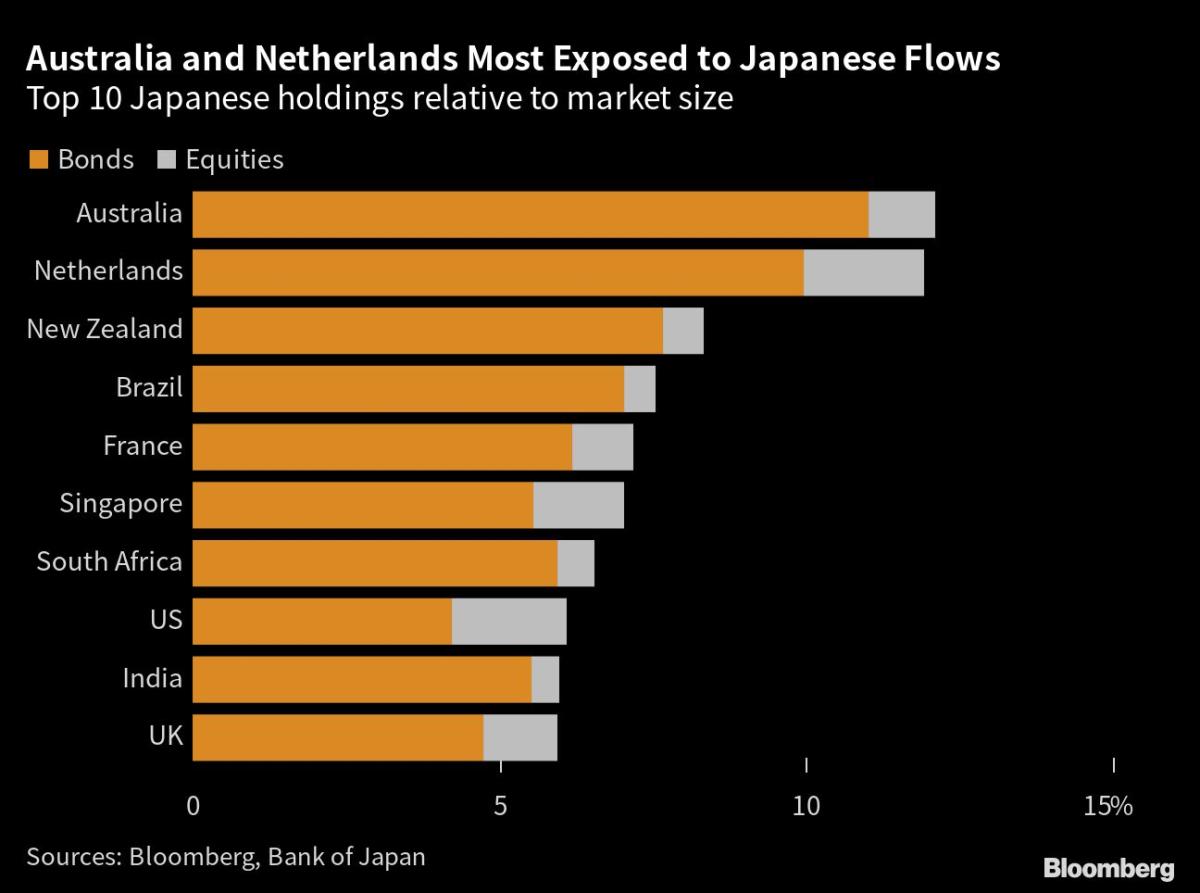
The shift was so seismic that Japanese investors turned the largest holders of Treasuries outside the house the US as effectively as house owners of about 10{515baef3fee8ea94d67a98a2b336e0215adf67d225b0e21a4f5c9b13e8fbd502} of Australian credit card debt and Dutch bonds. They also own 8{515baef3fee8ea94d67a98a2b336e0215adf67d225b0e21a4f5c9b13e8fbd502} of New Zealand’s securities and 7{515baef3fee8ea94d67a98a2b336e0215adf67d225b0e21a4f5c9b13e8fbd502} of Brazil’s debt, calculations by Bloomberg show.
The attain extends to stocks, with Japanese traders obtaining splashed out 54.1 trillion yen on global shares given that April 2013. Their holdings of equities are equal to between 1{515baef3fee8ea94d67a98a2b336e0215adf67d225b0e21a4f5c9b13e8fbd502} and 2{515baef3fee8ea94d67a98a2b336e0215adf67d225b0e21a4f5c9b13e8fbd502} of the stock markets in the US, Netherlands, Singapore and the Uk.
Japan’s extremely-lower charges have been a big cause the yen tumbled to a 32-year small past calendar year, and it has been a top possibility for profits-seeking carry traders to fund buys of currencies ranging from Brazil’s real to the Indonesian rupiah.
“Almost undoubtedly it contributed to a considerable decline of the yen, a enormous dysfunctioning of the Japanese bond current market,” previous United kingdom federal government minister and Goldman Sachs Team Inc. main economist Jim O’Neill stated of Kuroda’s policies. “Much of what occurred in Kuroda’s time will partially or completely reverse” ought to his successor pursue coverage normalization, although the banking disaster may well bring about authorities to proceed more cautiously, he extra.
The forex has pulled back from last year’s lows, assisted by a see that normalization is inevitable.
Incorporate to that equation last year’s historic world bond losses, and Japanese traders have even more cause to flock home, in accordance to Akira Takei, a 36-calendar year current market veteran and money supervisor at Asset Administration One Co.
“Japanese debt traders have had bad encounters outdoors the place in the past 12 months since a considerable leap in yields forced them to cut losses, so lots of of them even don’t want to see foreign bonds,” said Tokyo-centered Takei, whose agency oversees $460 billion. “They are now wondering that not all funds have to be invested abroad but can be invested domestically.”
The incoming president of Dai-ichi Lifetime Holdings Inc., a single of Japan’s largest institutional buyers, confirmed it was shifting a lot more income to domestic bonds from overseas securities, right after intense US level hikes created it highly-priced to hedge versus currency risks.
To be sure, several are geared up to go all out in betting Ueda will rock the boat at the time he will get into office.
A the latest Bloomberg survey confirmed 41{515baef3fee8ea94d67a98a2b336e0215adf67d225b0e21a4f5c9b13e8fbd502} of BOJ watchers see a tightening phase getting location in June, up from 26{515baef3fee8ea94d67a98a2b336e0215adf67d225b0e21a4f5c9b13e8fbd502} in February, when former Japan Vice Finance Minister Eisuke Sakakibara claimed the BOJ may well increase premiums by Oct.
A summary of views from the BOJ’s March 9-10 assembly confirmed the central lender stays cautious about executing a plan pivot before acquiring its inflation concentrate on. And that was even just after Japan’s inflation accelerated outside of 4{515baef3fee8ea94d67a98a2b336e0215adf67d225b0e21a4f5c9b13e8fbd502} to set a fresh new 4-decade high.
The next central bank conference, Ueda’s to start with, is scheduled to get place April 27-28.
Richard Clarida, who served as Vice Chairman at the Federal Reserve from 2018 to 2022, arguably has a lot more perception than most following getting recognised “straight shooter” Kuroda for several years and weighed Japan’s impression on US and worldwide monetary policy.
“Markets expect pretty early less than Ueda that yield-curve control is dismantled,” mentioned Clarida, who is now worldwide economic advisor at Pacific Financial commitment Administration Co. From in this article Ueda “may want to go in the course to shrink the harmony sheet or reinvest the redemptions, but that is not a person for day a single,” he said, including Japan’s tightening would be a “historic moment” for marketplaces nevertheless it could not be a “driver of world-wide bonds.”
Gradual Shift
Some other industry watchers have additional modest expectations of what will occur when the BOJ rolls again its stimulus application.
Ayako Sera, a market strategist at Sumitomo Mitsui Have faith in Financial institution Ltd., sees the US-Japan price hole persisting to a degree as the Fed is unlikely to supply substantial fee cuts if inflation remains higher and the BOJ isn’t anticipated to elevate fees considerably in the around time period.
“It’s vital to evaluate any tweaks and outlooks of the BOJ’s full monetary coverage package when wondering about their implication on the cross-border fund flows,” she reported.
Ryosuke Oshima, deputy common manager of product advertising team at Mitsubishi UFJ Kokusai Asset Administration Co. in Tokyo, is eyeing yield concentrations as a opportunity trigger for a change in flows.
“There may possibly be some urge for food for bond resources when the premiums transfer increased, like 1{515baef3fee8ea94d67a98a2b336e0215adf67d225b0e21a4f5c9b13e8fbd502} for the 10-year produce,” he reported. “But seeking at the knowledge, it is not likely they reverse all their investment decision back again household abruptly.”
For other people like 36-yr marketplaces veteran Rajeev De Mello, it is very likely only a issue of time prior to Ueda has to act and the consequences may perhaps have world repercussions.
“I thoroughly concur with the consensus that the BOJ will tighten — they’ll want to stop this policy as before long as possible,” explained De Mello, a money manager at GAMA Asset Management in Geneva. “It comes down to central bank trustworthiness, it will come down to inflation conditions being more and more fulfilled now — normalization will come to Japan.”
–With support from Winnie Hsu, Ayai Tomisawa, Hideyuki Sano, Yumi Teso, Emily Cadman and Jane Pong.