What if ChatGPT was trained on decades of financial news and data? BloombergGPT aims to be a domain-specific AI for business news

What if ChatGPT was trained on decades of financial news and data? BloombergGPT aims to be a domain-specific AI for business news

If you were going to predict which news company would be the first out with its own massive AI model, Bloomberg would’ve been a good bet. For all its success expanding into consumer-facing news over the past decade, Bloomberg is fundamentally a data company, driven by $30,000/year subscriptions to its terminals.

On Friday, the company announced it had built something called BloombergGPT. Think of it as a computer that aims to “know” everything the entire company “knows.”

Bloomberg today released a research paper detailing the development of BloombergGPT™, a new large-scale generative artificial intelligence (AI) model. This large language model (LLM) has been specifically trained on a wide range of financial data to support a diverse set of natural language processing (NLP) tasks within the financial industry.

Recent advances in Artificial Intelligence (AI) based on LLMs have already demonstrated exciting new applications for many domains. However, the complexity and unique terminology of the financial domain warrant a domain-specific model. BloombergGPT represents the first step in the development and application of this new technology for the financial industry. This model will assist Bloomberg in improving existing financial NLP tasks, such as sentiment analysis, named entity recognition, news classification, and question answering, among others. Furthermore, BloombergGPT will unlock new opportunities for marshalling the vast quantities of data available on the Bloomberg Terminal to better help the firm’s customers, while bringing the full potential of AI to the financial domain.

The technical details are, as promised, in this research paper. It’s by Bloomberg’s Shijie Wu, Ozan İrsoy, Steven Lu, Vadim Dabravolski, Mark Dredze, Sebastian Gehrmann, Prabhanjan Kambadur, David Rosenberg, and Gideon Mann.

How big is BloombergGPT? Well, the company says it was trained on a corpus of more than 700 billion tokens (or word fragments). For context, GPT-3, released in 2020, was trained on about 500 billion. (OpenAI has declined to reveal any equivalent number for GPT-4, the successor released last month, citing “the competitive landscape.”)

What’s in all that training data? Of the 700 million-plus tokens, 363 billion are taken from Bloomberg’s own financial data, the sort of information that powers its terminals — “the largest domain-specific dataset yet” constructed, it says. Another 345 billion tokens come from “general purpose datasets” obtained from elsewhere.

Rather than building a general-purpose LLM, or a small LLM exclusively on domain-specific data, we take a mixed approach. General models cover many domains, are able to perform at a high level across a wide variety of tasks, and obviate the need for specialization during training time. However, results from existing domain-specific models show that general models cannot replace them. At Bloomberg, we support a very large and diverse set of tasks, well served by a general model, but the vast majority of our applications are within the financial domain, better served by a specific model. For that reason, we set out to build a model that achieves best-in-class results on financial benchmarks, while also maintaining competitive performance on general-purpose LLM benchmarks.

The company-specific data, named FinPile, consists of “a range of English financial documents including news, filings, press releases, web-scraped financial documents, and social media drawn from the Bloomberg archives.” So if you’ve read a Bloomberg Businessweek story in the past few years, it’s in there. So are SEC filings, Bloomberg TV transcripts, Fed data, and “other data relevant to the financial markets.” It’s also trained on non-Bloomberg news sources:

The News category includes all news sources excluding news articles written by Bloomberg journalists. Overall, there are hundreds of English news sources in FinPile…Generally, the content in this dataset comes from reputable sources of news that are relevant to the financial community so as to maintain factuality and reduce bias.

The non-finance-specific data includes a massive corpus poetically known as The Pile; it includes everything from YouTube captions to Project Gutenberg to, yes, the cache of Enron emails that are always popping up in AI training. (It also has a complete copy of Wikipedia as of last July.)

But enough about the training data. What can BloombergGPT do? Because it shares a training base with other LLMs, BloombergGPT can do the sorts of things that we’ve come to expect from ChatGPT and similar models. But it can also perform tasks more tightly connected to Bloomberg’s needs. It can translate natural language requests (“apple and ibm market cap and eps”) into the Bloomberg Query Language terminal users love/hate (get(cur_mkt_cap,is_eps) for([’AAPL US Equity’,’IBM US Equity’])). It can also suggest Bloomberg-style headlines for news stories (sorry, copy editors):

Input: The US housing market shrank in value by $2.3 trillion, or 4.9{515baef3fee8ea94d67a98a2b336e0215adf67d225b0e21a4f5c9b13e8fbd502}, in the second half of 2022, according to Redfin. That’s the largest drop in percentage terms since the 2008 housing crisis, when values slumped 5.8{515baef3fee8ea94d67a98a2b336e0215adf67d225b0e21a4f5c9b13e8fbd502} during the same period.
Output: Home Prices See Biggest Drop in 15 Years

Input: The global economy is in a better place today than many predicted months ago, Janet Yellen said at the G20. At home, she pointed to a resilient US economy, where headline inflation has moderated and the labor market is strong. She also called for the IMF to move swiftly toward a fully-financed program for Ukraine.
Output: Yellen Sees Global Economy More Resilient Than Expected

Input: Google was sued by the US and eight states seeking the breakup of its ad-tech business for allegedly monopolizing the digital advertising market. The lawsuit is the Biden administration’s first big challenge to a tech titan and one of the rare times since 1982 that the DOJ has sought to cleave up a major company.
Output: Google Sued for Monopoly in Online Ad Market

It’s also better tuned, they say, to answer specific business-related questions, whether they be sentiment analysis, categorization, data extraction, or something else entirely. (“For example, it performs well at identifying the CEO of a company.”)

The paper includes a series of performance comparisons with GPT-3 and other LLMs and finds that BloombergGPT holds its own on general tasks — at least when facing off against similarly sized models — and outperforms on many finance-specific ones. (The internal testing battery includes such carnival-game-ready terms as “Penguins in a Table,” “Snarks,” “Web of Lies,” and the dreaded “Hyperbaton.”)

Across dozens of tasks in many benchmarks a clear picture emerges. Among the models with tens of billions of parameters that we compare to, BloombergGPT performs the best. Furthermore, in some cases, it is competitive or exceeds the performance of much larger models (hundreds of billions of parameters). While our goal for BloombergGPT was to be a best-in-class model for financial tasks, and we included general-purpose training data to support domain-specific training, the model has still attained abilities on general-purpose data that exceed similarly sized models, and in some cases match or outperform much larger models.

Penguins aside, it’s not hard to imagine more specific use cases that go beyond benchmarking, either for Bloomberg’s journalists or its terminal customers. (The company’s announcement didn’t specify what it planned to do with what it has built.) A corpus of ~all of the world’s premium English-language business reporting — plus the universe of financial data, structured and otherwise, that underpins it — is just the sort of rich vein of information a generative AI is designed to mine. It’s institutional memory in a box.

That said, all the usual caveats for LLMs apply. BloombergGPT can, I’m sure, hallucinate. All that training data comes with its own set of potential biases. (I’d wager BloombergGPT won’t call for the revolution of the proletariat anytime soon.)

As for how BloombergGPT might inspire other news organizations…well, Bloomberg’s in a pretty unique situation here, with the scale of data it’s assembled and the product it can be applied to. But I believe there will be, in the longer term, openings for smaller publishers here, especially those with large digitized archives. Imagine the Anytown Gazette training an AI on 100 years of its newspaper archives, plus a massive collection of city/county/state documents and whatever other sources of local data it can get its hands on. It’s a radically different scale than what Bloomberg can reach, of course, and it may be more useful as an internal tool than anything public-facing. But given the incredible pace of AI advances over the past year, it might be a worthy idea sooner than you think.

Image of Michael Bloomberg as a comic-book wizard generated by AI, of course.

GM aims to avoid pickup truck stockpile

GM aims to avoid pickup truck stockpile

“We are committed to actively controlling creation amounts to harmony supply with need,” Jacobson stated on the call.

“Inside of this portfolio focus on, trucks are anticipated to run at greater levels, reflecting bigger buyer-pushed variation needs, and sedans and SUVs are anticipated to operate at this assortment or lower,” Jacobson extra. “Throughout the yr, product sales seasonality, creation schedules and timing of fleet deliveries might get us out of this range from time to time, but that is the targeted array at which we will handle.”

Keith McCluskey, CEO of McCluskey Chevrolet in Cincinnati, explained Silverado materials have reached a well balanced stage, with his days’ supply operating at about 45 to 60 times, up from about 15 to 20 times at the height of the chip disaster. Idling the plant, he reported, is “the right thing to do to just, all over again, continue to keep a healthy balance on provide and need and inventory degrees.”

Cox Automotive approximated that the Sierra has extra than an 80-day provide, when inventory amounts top rated 100 times for the Silverado. GM explained these and other third-get together estimates are much too large, but the corporation would not disclose far more precise figures for aggressive motives.

“We have a quite manageable amount of inventory,” explained GM spokesperson Jim Cain. “We’re trying to maintain it at an optimum array to aid sturdy pricing.”

GM also builds large-duty Silverado and Sierra pickups in Flint, Mich. mild- and major-duty versions of the Silverado in Oshawa, Ont., in Canada and gentle-responsibility Chevy and GMC comprehensive-dimensions pickups at its Silao plant in Mexico. All four crops usually function on three shifts, Flores explained.

Analysts said demand has not softened however for big pickups, even though worries about the economic climate, larger interest fees and motor vehicle affordability could dent desire this yr.

Sales are inclined to be slower in the early months of the year, and pickup income also correlate to housing begins, which are down, claimed Michelle Krebs, an govt analyst with Cox Automotive.

GM’s shift indicators fascination in preserving the elevated ordinary transaction rates and revenue on its entire-sizing pickups that the industry has expert when materials have been very low in the latest a long time, Krebs stated.

The automaker has claimed its gasoline-run total-dimension pickups are assisting to fund its transition to electric powered automobiles.

GM has reported, “ ’We will not want to overproduce these motor vehicles and make it a circumstance in which we do have to heavily lower price them,’ ” mentioned Jessica Caldwell, govt director of insights for Edmunds. “At this issue, they are holding to what they mentioned, but time will tell if that will have on.”

With New College gambit, DeSantis aims to ‘recapture higher education’

With New College gambit, DeSantis aims to ‘recapture higher education’

Nestled between Sarasota Bay and the Tamiami Trail, the small campus once dubbed “Barefoot U” has been a progressive enclave in a conservative county for 60 years.

New College of Florida has clung to its identity since its founding at the peak of the counterculture movement.

Now, the 110-acre liberal arts school with fewer than 700 students finds itself in the national spotlight, thrust into the culture wars after Gov. Ron DeSantis announced the appointment of six noted conservatives to its board of trustees on Jan. 6.

The new members include Matthew Spalding, a former vice president of the Heritage Foundation, a conservative Washington, D.C., think tank; professors and right-leaning authors Charles Kesler and Mark Bauerlein; and Christopher Rufo, an activist who spurred a national backlash against critical race theory and LGBTQ issues.

Related: DeSantis installed 6 new trustees at Sarasota’s New College. Who are they?

Rufo, who appeared with DeSantis when the governor unveiled Florida’s “Stop Woke Act” in 2021, already has announced an ambitious plan to quickly revamp New College. In an interview with the New York Times, he said plans are afoot for a “top-down restructuring” and the design of “a new core curriculum from scratch.”

He predicted the school would look “very different in the next 120 days.”

Some Republicans say the appointments are an opportunity for Florida to emulate Hillsdale College, a small, private Christian university in Michigan that has helped DeSantis shape education policy since 2019. New College, they say, could be “a Hillsdale of the South.”

Related: Florida wants its own version of a small conservative college in Michigan

While a Hillsdale spokesperson called the comparison flattering, the label elicited polarized views and concern among some alumni, faculty, students and prospective students.

Both supporters and critics see the six appointments to the 13-member board as part of a larger, rapid push to alter Florida’s higher education system in much the same way DeSantis put his mark on K-12 schools in 2022.

Late last month, the governor’s budget office required all state universities and colleges to detail what they spend on diversity initiatives and critical race theory. And later this month, the state Board of Governors will consider a new policy that restricts faculty tenure and ties enforcement to the Stop WOKE Act.

DeSantis press secretary Bryan Griffin said New College is due for a change.

The new trustees will be “committed to refocusing the institution on academics and truth and ensuring that students are receiving a quality education,” he said. “The campus will become a place for learning and discourse, as it was designed to be.”

The newly reelected governor, supporters say, is out to “recapture higher education.”

‘Just the beginning’

When Bella Croteau first toured New College, the senior at Lakewood High in St. Petersburg immediately felt at home.

“My first thought was I don’t want to take a gap year anymore,” Croteau said. “I want to be here now. The demographic is exactly my type of people. There are so many LGBT students, there are a lot of Dungeons & Dragons players.”

Follow what’s happening in Tampa Bay schools

Follow what’s happening in Tampa Bay schools

Subscribe to our free Gradebook newsletter

We’ll break down the local and state education developments you need to know every Thursday.

You’re all signed up!

Want more of our free, weekly newsletters in your inbox? Let’s get started.

Explore all your options

Croteau gasped with delight during a visit when someone on campus said, “You look like you go here.”

“I was like, ‘That’s the best compliment ever,’” Croteau said.

Bella Croteau
Bella Croteau [ Courtesy of Bella Croteau ]

“It’s so important to feel like your existence can be acknowledged, especially in school, when you are always beneath someone, when you’re always the small fish,” they said. “Having an unconditional love for people, just humans, regardless of age or what major they’re in or what they identify as, having that there and saying we see you and we work with you — not around you — is what New College does and what makes it New College.”

The school, which has a ratio of six students for every faculty member and an average class size of 11, is known for its atypical approach. Students receive evaluations rather than grades and pursue independent research projects between traditional semesters.

Alaska Miller, a second-year student studying cognitive science and minoring in gender studies, described the campus as “quirky, queer and creative.” In trying to capture it, she mentioned she knew multiple people who read philosopher Michel Foucault for fun.

“Have you ever met that person who is a little quirky, but they’re like the smartest person you’ve ever met?” she said. “That’s like the kind of people who go to New College.”

Alaska Miller, a second-year cognitive science major, described the New College atmosphere as “quirky, queer and creative.”
Alaska Miller, a second-year cognitive science major, described the New College atmosphere as “quirky, queer and creative.” [ ANGELICA EDWARDS | Times ]

Miller said the school’s significant LGBTQ population is a hallmark of its culture. She heard about the six new trustees on the way to a dining hall.

“To see suddenly we’re in the middle of a culture war is completely insane,” Miller said. “I never in a million years thought they even knew we existed sometimes. But now they want to turn New College into this weird ‘Hillsdale of the South’? It’s very strange.”

To Miller, who considers herself a leftist, the portrayals of New College as a bastion of “woke ideology” don’t hold up. In a class on political theory, she read Karl Marx and Thomas Hobbs, Frantz Fanon and Niccolo Machiavelli, a group encompassing a wide range of thought.

Sam Sharf, a second-year student from Tampa studying international politics, agreed.

“We come here as a predominantly LGBT student body and have a progressive vision for society,” Sharf said. “It’s not like they’re teaching us to be like this. We would be like this regardless if we came here or not. This is just a place where freedom of thought is allowed to flourish. Not all teachers are sympathetic to our visions.”

Sam Sharf, a second-year international politics major, predicted the move to put a conservative stamp on New College could spread to other Florida schools.
Sam Sharf, a second-year international politics major, predicted the move to put a conservative stamp on New College could spread to other Florida schools. [ ANGELICA EDWARDS | Times ]

Sharf said she’s concerned about the attention the campus has drawn in recent days.

“Our small school is becoming a battleground in the conservative culture war, and with that it could bring violent actors to our campus,” she said.

She’s also concerned at the direction the new trustees may take.

“The alternative they’re positing is actually what they’re projecting us as being,” she said. “They want to create a conservative, dogmatized education where only that thought process is accepted … They don’t want people to learn things that are critical of the state or America, or just critical thinking in general. This is just the beginning. If they succeed, they’ll be emboldened to try this everywhere. They’ll try this at Florida State University or the University of Florida.”

A school ‘on the ropes’

Though U.S. News & World Report ranks New College No. 5 among public liberal arts colleges nationally, the school has faced troubles in recent years.

“They’ve kind of been on the ropes,” said Christian Ziegler, vice chairperson of the Florida GOP. After the new trustees were announced, he sent a message to supporters about DeSantis’ “aggressive and incredible actions,” asking them to “let the victory saturate — THIS IS WINNING!”

Christian Ziegler
Christian Ziegler [ Sarasota County Commission ]

The college’s most recent state accountability plan outlined two challenges to overcome. It said, “New College of Florida must become an inclusive community where all independent thinkers and innovators eager to learn in an engaging academic environment experience a strong sense of belonging.” Also, the college “must fully realize the transformative power of integrating career education with a challenging honors curriculum,” the plan said.

It laid out a goal that every student complete an internship or apprenticeship before graduating. It set a target to increase enrollment to 800 undergrads by 2026.

Since 2016, when New College welcomed a freshman class of 861, enrollment and revenue have declined. Patricia Okker became president in 2021 and was handed the task of building community partnerships, boosting the endowment and improving the school’s numbers. The most recent fall class saw a slight increase in enrollment and the largest group of transfer students in recent years.

Okker started a task force to improve retention rates and recently launched the New College Challenge, bringing students and scholars at top universities together to solve coastal resiliency issues.

For some, like faculty union chair Steve Shipman, the newest call for changes came as a surprise.

“It’s a little disheartening,” he said. “It felt like we were on an upswing.”

Griffin, the DeSantis press secretary, said the new trustees have a firsthand understanding of Florida’s education system after working with the state on other initiatives.

He pointed to the values section on New College’s mission page, which says the school is committed to creating a more “inclusive community” and “ensuring that historically marginalized and oppressed groups are not experiencing trauma and harm.”

Griffin said the passage illustrates the college has been “completely captured by a political ideology that puts trendy, truth-relative concepts above learning.”

“The public expects their tax dollars to go towards the statutorily stated mission of ‘provid[ing] a quality education,’” he said in an email, quoting state law. The school’s mission statement, Griffin argued, “quite literally admits the institution will adjust outcomes based on non-academic factors of their choosing.”

Ziegler, the GOP leader, said the change is beneficial for everyone involved.

“Their mission, vision and values have the same woke principles the governor and Legislature frankly are fighting against every day,” he said, adding that New College might fare better with state budget writers after undergoing “a reset.”

Ziegler said Hillsdale College has “carved out a reputation going back to the basics and really focusing on history as it really was, rather than going to college, getting brainwashed by liberals.”

He said that, as a father of three young daughters and a Sarasota County business owner, he’s excited by the prospect of broader higher education options for his family and the community.

“This is the first step,” Ziegler said. “And hopefully there are more steps when it comes to reforming higher education.”

What will happen?

On Monday, President Okker issued a statement giving a “warm welcome” to the new trustees, who are awaiting confirmation by the Republican-controlled state Senate. She said she was eager to hear their ideas for making New College “a national model for a top-tier liberal arts college.”

For the first time in years, Okker added, the school has a “tremendous opportunity” to be led by a full board.

Florida gives university boards of trustees broad powers — from hiring the president to planning and budgeting and deciding which academic programs stay or go. Each board has 13 members — six appointed by the governor, five by the state Board of Governors and one representative each for the students and faculty.

The Board of Governors, which is mostly appointed by the governor, soon will add a new trustee as well, likely giving the New College board a seven-member majority that could execute the governor’s vision for the school. State officials declined to answer questions about how the governor’s six vacancies came open at once and how the new trustees were vetted.

Others were more cautious than Okker but still optimistic about New College’s future.

Joey McMahon, a third-year transfer student, said he looks forward to talking with the new trustees, particularly Rufo, who compared his 120-day plan to Elon Musk’s takeover of Twitter.

Joey McMahon, a transfer from the University of South Florida, is studying psychology and philosophy at New College.
Joey McMahon, a transfer from the University of South Florida, is studying psychology and philosophy at New College. [ ANGELICA EDWARDS | Times ]

Shipman, the faculty union chair, said he was unsure how much could be achieved in that time frame, given academic hiring cycles. “We’re adopting a wait-and-see mentality,” he said.

Even Rufo’s fellow appointees expressed skepticism about his timeline.

Bauerlein, the Emory professor, said he felt the board would operate in a way that would be “a lot less political and a lot more managerial,” with a healthy mix of personalities.

“At this point, it’s good to have a guy like Christopher in the room,” he said, referring to Rufo. “We’re going to have a student representative on the board, who I’m betting will be very much on the opposite side of Christopher. There’ll be a faculty member who I imagine will not share Christopher’s outlook on things.”

Spalding, the Hillsdale professor, said in a statement that the “political controversy” surrounding the appointments was “overwrought.”

“I appreciate the complimentary nods to Hillsdale College,” he said, “but we are not going to serve New College’s mission by remaking it into a carbon copy of another institution.”

Croteau, the Lakewood High student, said they still plan to attend New College.

“It’s not like we’re going to disappear,” Croteau said. “Until something changes, it’s still the New College I toured and the one that I love. I’m just having high hopes now.”

Times Staff Writer Jeff Solochek contributed to this report. Divya Kumar and Ian Hodgson cover higher education for the Tampa Bay Times, in partnership with Open Campus.

• • •

Sign up for the Gradebook newsletter!

Every Thursday, get the latest updates on what’s happening in Tampa Bay area schools from Times education reporter Jeffrey S. Solochek. Click here to sign up.

Construction aims to smooth car, bike travel through Boundary Channel Drive maze

Construction aims to smooth car, bike travel through Boundary Channel Drive maze

If your travels have taken you near the Pentagon, you’ve got seen freeway signals for Boundary Channel Push — and on Wednesday, building begins to make the present maze of cloverleaf interchanges less difficult and safer to navigate for drivers, pedestrians and bicyclists.

If your travels have taken you in close proximity to the Pentagon in Virginia, you’ve seen freeway symptoms for Boundary Channel Generate — and on Wednesday, design commences to make the latest maze of cloverleaf interchanges simpler and safer to navigate for drivers, pedestrians and bicyclists.

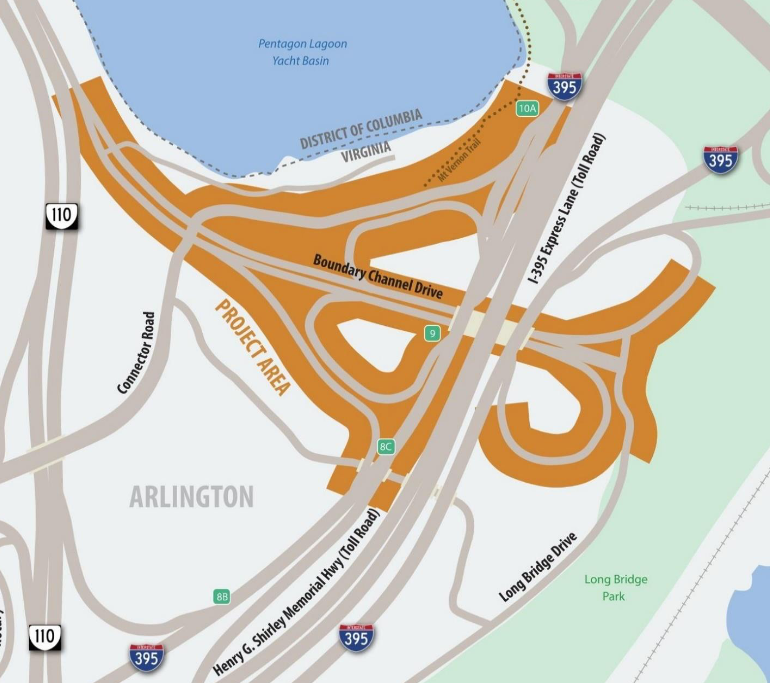
A morning groundbreaking of the Boundary Channel Drive at I-395 Interchange Improvement  challenge aims to lower vehicle congestion on ramps on and off the highway, and improve selections for non-auto travel in the spot that is within just walking length to the new Amazon HQ2 and Pentagon City.


The project’s place at Boundary Channel Travel and I-395, just east of the Pentagon. Click to enlarge. (Courtesy VDOT)

The current ramps that dump drivers on Boundary Channel Push will be replaced by roundabouts on both side of Interstate 395. The road by itself — Boundary Channel Drive — will be lowered from 4 lanes to two.

Sidewalks in the space will be improved, a shared-use path will be built together the westbound facet, and tie into the Mount Vernon Trail inside of Countrywide Park Company property.

West of I-395, Boundary Channel Travel passes the Pentagon Lagoon Yacht Basin and follows the Boundary Channel, and supplies obtain to the larger Washington Boulevard, also acknowledged as Va. Route 27, as effectively as Va. Route 110, also acknowledged as Richmond Highway.

The regional venture, coordinated by the Virginia Office of Transportation with Arlington County and the Northern Virginia Transportation Authority, is envisioned to be finished by late 2023.

NVTA, which focuses on regional commuter jobs, invested much more than $4.3 million to fund the challenge.

By the time it is accomplished, some of the existing on-and-off ramps with I-395 will be shut and eradicated.

The groundbreaking ceremony will be held at the Extensive Bridge Aquatics and Physical fitness Centre on Prolonged Bridge Push, located east of I-395. The eastern roundabout will connect Very long Bridge Travel to Boundary Channel Push.

Like WTOP on Fb and abide by WTOP on Twitter and Instagram to engage in discussion about this post and other folks.

Get breaking news and everyday headlines delivered to your electronic mail inbox by signing up below.

© 2022 WTOP. All Legal rights Reserved. This web-site is not intended for people situated inside the European Financial Region.