This article is an on-site version of our The Week Ahead newsletter. Sign up here to get the newsletter sent straight to your inbox every Sunday
Hello and welcome to the working week.
With the first quarter of 2023 out of the way, now for the data chronicling how the companies and countries have fared so far. On Tuesday the one to watch will be China’s first-quarter GDP report.
Beijing rounded off 2022 with a run of disappointing growth figures, ending the year with slightly more than 3 per cent annual growth. But now that China has lifted Covid-19 restrictions many are hoping the economy can make up lost ground and post some more impressive numbers.
In March President Xi Jinping set a target for annual growth of 5 per cent, a conservative estimate compared with the breakneck speed seen in previous years. This week’s GDP figures will be an early indication of whether the country’s economy can be expected to live up to that aim. A promising first glimpse was export figures, which expanded by nearly 15 per cent in March, hinting that a key part of the country’s economy is coming back to life.
Investors will also be keeping an eye on how trade tensions between Washington and Beijing have played in China’s economy. The US has been trying to strangle the flow of computer chips into the country to stop China from gaining more footholds in what it sees as a strategically important sector.
In Delaware, the Fox defamation trial is due to start on Monday. Voting machine maker Dominion claims that Fox News amplified false claims that the company’s machines were used to steal votes from former president Donald Trump during the last election. Dominion is seeking $1.6bn in damages.
On Dominion’s witness list are some of the network’s biggest names, including owner Rupert Murdoch, his son Lachlan, and presenters Tucker Carson and Sean Hannity.
Finally, Earth Day on Saturday aims to raise awareness of environmental issues. To mark the annual event, protest group Extinction Rebellion is hoping to flood London with 100,000 protesters over the weekend.
Jonathan is back next week, but I hope you have enjoyed my stint in preparing you for the upcoming week. Before I go, I would urge you to check out FT Edit, our new app for getting eight bits of the best journalism every week day. If you have any thoughts or feedback about the Week Ahead, please email me at david.hindley@ft.com or if you’re reading this as a newsletter, just hit reply.
Economic data
Chinese GDP data is likely to dominate this week, but there will also be plenty of insights into how the UK economy is faring, including PMI and unemployment figures for March, plus the outlook for inflation.
In the US the Federal Reserve is publishing its third Beige Book of the year, while at the end of the week the Bureau of Labor Statistics issues the state unemployment data for March.
Companies
Another batch of US banks report first-quarter results, including Bank of America, Goldman Sachs and Morgan Stanley. Last week ended with some of their rivals, such as JPMorgan, Citigroup and Wells Fargo, beating expectations, indicating that the turmoil in the US banking sector last month had little immediate effect on the profitability of the biggest lenders.
Also keep an eye on Tesla reporting its Q1 results on Wednesday. Elon Musk dropped the price of the company’s cars by as much as 9 per cent in March following an earlier cut to prices in January and investors will be keen to see if lower prices have translated into strong sales. The electric-car maker has already reported that it has shipped a record number of new vehicles in 2023.
Key economic and company reports
Here is a more complete list of what to expect in terms of company reports and economic data this week.
Monday
Deloitte publishes its annual survey of chief financial officers
UK, regional PMI data published by S&P Global
US, former Amazon executive David Risher is appointed the new boss of ride-hailing app Lyft, replacing the founders of the app Logan Green and John Zimmer. Risher takes over at a low point for the company as it loses market share to it main competitor Uber
Results: State Street Q1, PageGroup Q1 trading update
Tuesday
China, quarterly GDP data
UK, Monthly unemployment figures
Results: EasyJet trading update, Netflix Q1, Bank of America Q1, Goldman Sachs Q1, Lockheed Martin Q1, Silvergate Capital Q1, Johnson & Johnson Q1, Ericsson Q1
Wednesday
Eurozone, harmonised CPI data for March
US, Federal Reserve releases its Beige Book
UK Consumer Price Index (CPI) data for March
UK, house price index update for March
Results: Tesla Q1, IBM Q1, Morgan Stanley Q1, Equifax Q1, Heineken NV Q1, Just Eat Q1, Las Vegas Sands Corp Q1,L’Oréal Q1 sales, United Airlines Q1, Rio Tinto Q1 operations review just before midnight in London
Thursday
The CBI and PwC publish their quarterly survey of financial services. It tracks optimism, profits and employment for the first quarter of 2023 and looks ahead to the year’s halfway point
The European Central Bank publishes its monetary policy discussions about its outlook for the eurozone’s financial market
Results: WHSmith interim results, Snap Q1, Renault Q1 sales, AT&T Q1, B&MEuropean Value Retail Q4, American Express Q1, China Mobile Q1, Philip Morris International Q1, Ipsos Q1 sales
Friday
UK, the Office for National Statistics publishes monthly retail sales figures. Data from Barclays last week suggested consumers were spending more, but spending was still being outpaced by the rate of inflation
US, Bureau of Labor Statistics publishes jobs data for March
Results: China XD Electric Q1, ZTE Corp Q1, SAP SE Q1, BB Biotech Q1
World events
Finally, here is a rundown of other events and milestones this week.
Monday
Sweden, Spring mini budget, which will include a rise in defence spending as it prepares to join Nato
UK, House of Commons returns from its Easter break
US, Dominion against Fox News defamation trial begins in Delaware. A judge ruled that Rupert Murdoch and other executives could be called as witnesses
US, the Boston Marathon starts
Tuesday
Estonia, exercise Locked Shields, a cyber war game led by Nato, starts. More than 38 nations will take part in a host of cyber attacks to improve their response to assaults on critical infrastructure
India, Apple opens its first retail store in Mumbai
Israel, Holocaust remembrance day
Russia, Wall Street Journal reporter Evan Gershkovich is set to appeal against his detention in Russia on charges of espionage. The trial will be held away from the public
UK, Shortlist for the Booker Prize announced
Switzerland, Trinity, a 67mn-year-old skeleton of a Tyrannosaurus rex goes up for auction in Zurich. It is only the third full T-Rex skeleton to be sold and the first in Europe
Wednesday
For FT subscribers, the Inside Politics newsletter is holding an event charting the road to the UK’s expected 2024 general election and asks if a victory for the Labour party is no longer assured. Sign up here
UK, Chatham House exhibition “In conversation with the future” is aimed at fostering ideas for sustainability
US, 30th anniversary of the Waco siege, a stand-off between federal agents and members of the Branch Davidian cult that lasted for 51 days and ended with the deaths of four federal agents and 82 group members
Thursday
Solar eclipse in the southern hemisphere
Unicef publishes its yearly The State of the World’s Children report
Belgium, Nato secretary-general Jens Stoltenberg will meet Czech president Petr Pavel at the alliance’s headquarters in Brussels
Friday
The Muslim festival of Eid marks the end of Ramadan. Financial markets are closed in several countries in the Middle East including Saudi Arabia, Egypt and Jordan
UK, Extinction Rebellion along with several other climate groups plans to hold a rally that it hopes will bring 100,000 attendees to central London to push for action on climate change
Ukraine, fourth anniversary of Volodymyr Zelenskyy winning the country’s presidential election
Saturday
Events to make the 53rd Earth Day are held around the world. This year’s theme is “invest in our planet” and is geared towards pushing governments and businesses to take action on climate change
UK, 30th anniversary of the murder of 18-year-old Stephen Lawrence in a racially motivated attack. The Metropolitan Police’s handling of the case led to accusations of racism in the force
Sunday
UK, the London Marathon. About 40,000 people are set to line up
UK, all UK phones are scheduled to receive a test emergency alert. The system is planned to be used to issue warnings about life-threatening event such as floods and wildfires
Recommended newsletters for you
One Must-Read — The one piece of journalism you should read today. Sign up here
Working It — Discover the big ideas shaping today’s workplaces with a weekly newsletter from work & careers editor Isabel Berwick. Sign up here
(Bloomberg) — Premier Li Qiang vowed that China will open up broader to the outside environment and set up a “broad space” for foreign providers to create in the Asian country.
Most Go through from Bloomberg
“China’s economic climate has deeply built-in into the world wide program,” Li informed foreign attendees of the China Enhancement Forum on Monday, according to condition broadcaster China Central Tv. “China will unswervingly stick to opening up, no matter of variations to the worldwide surroundings.”
The country’s expansion will present new momentum for the world economic climate, he included.
The reviews underscore Beijing’s force to assure buyers of its financial restoration and commitment to worldwide organizations at the 3-day forum. Overseas executives manufactured their 1st excursion to the world’s No. 2 economic climate because it reopened its borders right after three decades of stringent pandemic limits.
Li thanked the international associates in the viewers for the support they’d supplied more than the years and urged them to “take a extensive-time period view” amid economic issues.
“It is like urgent on the journey for the duration of a rainy day,” Li reported. “If 1 keeps their head down, they’d only see a muddy street. But if one particular appears in advance, they’d see the rainbow right after the rain.”
Examine: Jack Ma’s Retreat Undercuts China Pitch to Non-public Enterprise
About 70 overseas executives — like Apple Inc.’s Tim Cook dinner, Bridgewater Associates’ Ray Dalio and Deloitte’s Sharon Thorne — ended up shown on CCTV attending the forum. The celebration was Li’s 1st with foreign companies given that becoming China’s No. 2 formal before this thirty day period.
Li struck an enthusiastic, upbeat tone about China’s contribution to world progress and its capability to triumph over long run challenges, Andrew Forrest, founder and chairman of Fortescue Metals Group Ltd., told Bloomberg in an interview adhering to the meeting with the premier.
A key message from the China Enhancement Forum this year is that “China is open up for enterprise again” mentioned Scott Kennedy, a China expert at the Center for Strategic & International Scientific studies who attended the celebration.
At the exact same time, China is searching for to turn out to be additional self-reliant in important technologies amid US attempts to suppress its advancements in chip technologies, and organizations continue on to complain that current market entry is still restricted.
Additional: Jack Ma’s Retreat Undercuts China Pitch to Personal Small business
The financial restoration also stays uncertain. Income at industrial firms in China plunged in the initial two months, unemployment has amplified and the housing market is even now weak. The international overall economy is also weakening, curbing demand for Chinese exports.
Beijing is counting on a rebound in domestic investment and client demand from customers to fulfill its financial advancement concentrate on of about 5{515baef3fee8ea94d67a98a2b336e0215adf67d225b0e21a4f5c9b13e8fbd502} this year. Economists surveyed by Bloomberg hope the economic system to develop 5.3{515baef3fee8ea94d67a98a2b336e0215adf67d225b0e21a4f5c9b13e8fbd502} this calendar year.
The sales year started off with a whimper. First, the covid stimulus package for the auto industry – a cut from June 1-Dec 31 of the car sales tax from 10{515baef3fee8ea94d67a98a2b336e0215adf67d225b0e21a4f5c9b13e8fbd502} to 5{515baef3fee8ea94d67a98a2b336e0215adf67d225b0e21a4f5c9b13e8fbd502} – expired. Those planning to buy cars in early 2023 instead made their purchases last year. In addition, the Chinese central government has been winding down its incentives for New Energy Vehicles (NEVs) for several years. They, too, expired at the end of 2022. That pulled planned NEV sales from 2023 into 2022, over and above the impact of the covid tax cut. In other words, electric vehicle (“EV”) sales in late 2022 were artificially high. This year will be grim across the board for the China automotive sector.
Local government incentives aren’t picking up the slack. Beijing has capped its 2023 NEV license plate incentives at the 2022 level of 70K units, while for 2023 Shanghai eliminated free license plates for PHEVs (and refuses to license urban commuter EVs such as the GM Wuling Hongguang Mini). Now Hunan has begun a 元5000 cash-for-clunkers subsidy, and the central government is urging local governments to upgrade their fleets from ICEs to EVs. However, more prosperous localities such as Shenzhen have already completed the switchover to EV taxis and buses. Most regional and lower-tier cities face a budget crunch, so the process will be slow and will focus on low-priced vehicles. That’s bad news for the many NEV startups, and for Tesla, Inc. (NASDAQ:TSLA) which sit in the premium segment.
Analysis is complicated by the Chinese [lunar] New Year holiday in late January. China is now an urban society, but its cities are populated by workers who migrated from rural areas. This year, around 250 million people traveled back to their hometowns. Car dealerships were closed, and those that reopened early remained empty. Of course, the government offices that issue license plates were closed, too.
To reiterate, it’s payback time. January sales fell 35{515baef3fee8ea94d67a98a2b336e0215adf67d225b0e21a4f5c9b13e8fbd502} overall, and 28{515baef3fee8ea94d67a98a2b336e0215adf67d225b0e21a4f5c9b13e8fbd502} for battery EVs (“BEVs”). However, as I outline below, February sales looked good only in comparison to January. That is bad news for Tesla, which will face lower margins and higher costs, due to lower capacity utilization and the delayed feed-through of higher commodity prices. It is worse news for the many startups, which will see poor sales from now until the normal cyclical increase that starts in September. NEVs are also facing pricing pressures, due to the multitude of players and spearheaded by Tesla’s price cuts.
Additional months of negative cash flow are very bad news. Already, Weltmeister (not traded) has effectively gone out of business, selling no cars this year and closing most of its remaining facilities last week. In their latest financial statements, available on Seeking Alpha, operating income remained negative for Li Auto, Inc. (LI) [Dec 2022], XPeng Inc. (XPEV) [Sep 2022], and NIO Inc. (NIO) [Dec 2022]. Sales of other entrants – Neta, Zeekr and others (not traded) – remain at very low levels. Again, BYD is an exception, as is GAC with its Aion brand. Both are profitable (or are part of larger, profitable enterprises), and so face no immediate pressures. They (alongside Tesla) also happen to be the two largest and best-performing NEV players.
Below I look at overall passenger vehicle sales, and then turn to NEVs. Going into 2023 Chinese analysts were already looking at lower growth, of the order of 30{515baef3fee8ea94d67a98a2b336e0215adf67d225b0e21a4f5c9b13e8fbd502}. I believe that is optimistic in terms of unit sales, and will represent minimal growth in 2023 for revenue and a negative for cash flow. I don’t attempt projections, since there are many articles on Seeking Alpha to provide a baseline. My last section focuses on Tesla, reiterating my January 2022 SA article projecting that Model 3 sales would decline.
Note that my core datasets are for retail sales of light passenger vehicles, but do not include imports. They also do not cover light commercial vehicles or buses, and are not wholesale shipments so ignore exports.
Payback: Overall Vehicle Sales
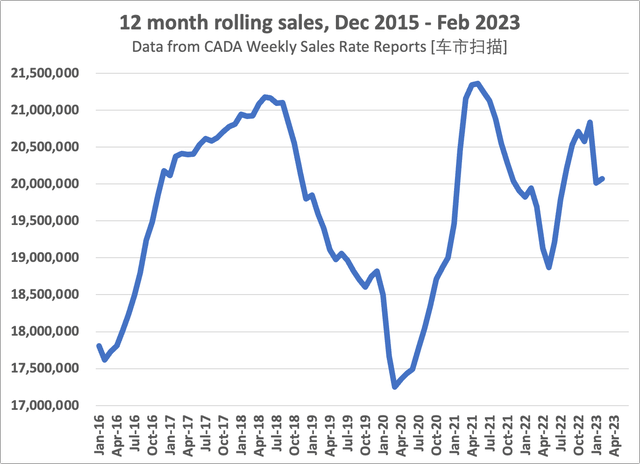
First, China remains the largest vehicle market, surpassing both Europe and North America. But it’s not growing. The migration for towns and farms to cities has ceased, consumers are under pressure as growth remains slow and real estate prices continue to fall, and the working-age population has been falling for a decade. Sales peaked in 2017, and will not expand going forward.
Author’s database, compiled from China Auto Dealers Assoc reports
What are the prospects for CY2023? The government is hoping for 5{515baef3fee8ea94d67a98a2b336e0215adf67d225b0e21a4f5c9b13e8fbd502} growth, but is looking to achieve that through pushing banks to lend for infrastructure and real estate investment. To use a monetary policy aphorism, that’s pushing on a wet string. Local governments saw their fiscal position deteriorate the past two years, and now have bills to pay for the covid testing mandated (but not paid for) by the central government under last year’s rolling lockdowns.
I spent most of my career as a specialist on Japan’s economy, and was in Tokyo in 1992 when their real estate bubble burst, and worked for a Japanese bank before graduate school. I’ve spent days in seminars looking at the evergreening of bad real estate loans, and how that undermined the effectiveness of macro policy. China is going down the same route, in part because that’s the only policy tool Beijing has, given the already complete buildout of regional airports, high speed rail and, lest we forget, a national expressway system that is more extensive than those of the U.S. or Europe – and doesn’t yet need maintenance.
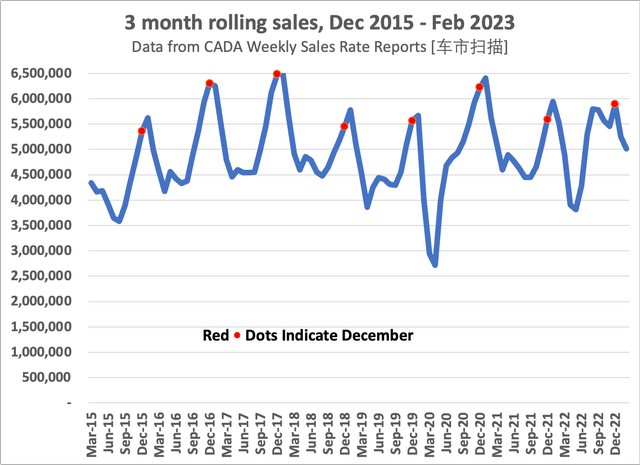
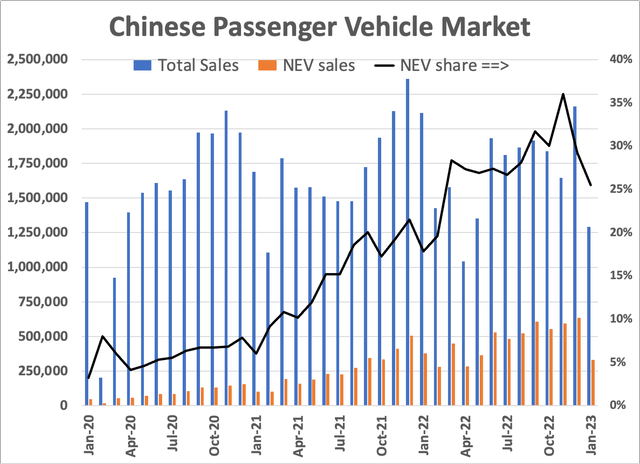
Let’s return to automotive, and look in more detail at passenger vehicle sales. The graph below provides sales using a 3-month moving average. To help with interpretation, December each year is marked with a red dot. First, sales show a distinct seasonal pattern, peaking at the end of winter, in January when the New Year falls later in February, and otherwise (as this winter) in December. Sales then fall through August, in some years with a June bump, before beginning their annual fall ascent.
However, 2022 was different from the previous 7 years, with the rolling average showing an early August peak. That difference represents roughly 700,000 extra sales, sales that will not be booked in the first half of 2023. Compared to recent years, that suggests that sales through July will be down 10{515baef3fee8ea94d67a98a2b336e0215adf67d225b0e21a4f5c9b13e8fbd502}, assuming that consumers will be spending as normal. The Chinese government doesn’t believe that will be the case, accepting lower growth and instead focusing on financial system stability. (See, amongst many possible examples, “Caixin Global, Mar 8, 2023: China’s Financial Shake-Up Shows Policymakers’ Growing Focus on Stability, Risk.”) For the sake of brevity, I won’t examine other indicators, such as commercial vehicle sales. All point in the same direction.
Authors database, compiled from monthly CADA reports
EV Sales
What though of NEV sales? While I otherwise ignore the differentiation, one segment was up in January, PHEV (plug-in hybrids), and by 48{515baef3fee8ea94d67a98a2b336e0215adf67d225b0e21a4f5c9b13e8fbd502}. After all, battery-only EVs don’t fit every use case, and news stories over the Chinese New Year holidays were replete with EV drivers waiting in line to plug into snow-covered chargers, as cold weather depleted their range. There weren’t many PHEV options in 2020, but then not that many EVs were sold, either. The data show the relative weight of PHEVs consistently rising, from about 1 in 8 NEVs sold in 2021Q1 to a bit over 1 in 5 in 2022Q4. That suggests an additional source of pressure on pure EV sales.
Second, the rate of diffusion of NEVs has slowed. Again, as the introduction noted, national incentives have expired and local/provincial ones haven’t increased. Historically, Shanghai has been the single biggest market; altogether, the top 10 cities account for over 1 in 3 NEVs sold (source: my compilation of monthly CPCA reports). Those markets are becoming saturated, with 40{515baef3fee8ea94d67a98a2b336e0215adf67d225b0e21a4f5c9b13e8fbd502} of sales now NEVs. They are also the wealthiest cities, and so are buying the higher-priced vehicles that NEV makers must sell to be profitable. Expanding sales requires moving into Tier 3-4 cities, but those have lower incomes, are losing populations, have governments that are in fiscal straits, and face the largest real estate losses. The latter are the dominant form of household savings, and in a down market are illiquid. (For more details on real estate, see Kenneth Rogoff and Yuanchen Yang, “A Tale of Tier 3 Cities.” IMF Working Paper 22/196, September 2022.)
Authors database, drawn from icauto.com.cn and other sources
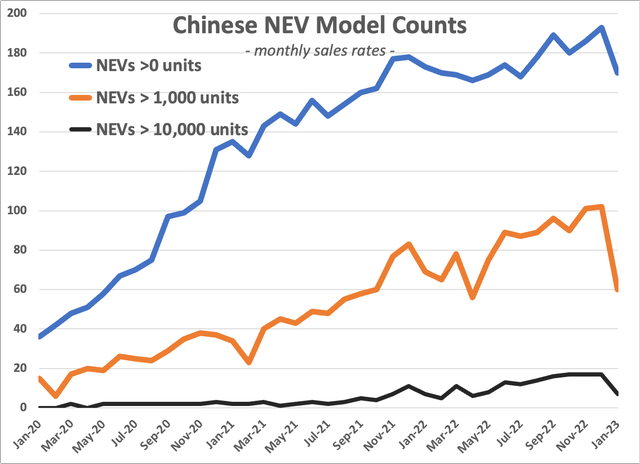
Third, there’s a price war going on. While that’s potentially good for sales volumes, it’s bad for everyone in the industry. Unfortunately for both firms and investors, competition is fierce. I track new model announcements. In 2022, my data include 232 new models and full model changes (and another 466 facelifts and minor changes). Of the new models, 70 were EVs and another 31 PHEVs. This year will see far more, with IHS anticipating 180 new EVs and PHEVs.
Authors database, drawn from icauto.com.cn and other sources
Over the course of 2023, the market will thus become more fragmented, even if some firms exit and some go out of production (as reflected in the blue line of counts of models in my database in the above graph). This should help offset the overall slowdown, as consumers will be more likely to find a model that hits their sweet spot, but it won’t help pricing. At the firm level, the net impact will depend on how many of these are new “top hats” to existing platforms that will come off an existing assembly line. For firms successfully employing a platform strategy, that will increase capacity utilization and economies of scale in component sourcing, even as it decreases sales for each individual model. Whether that will increase net profits (or slow losses) will depend on how much prices deteriorate. I don’t have access to such detailed data, nor do I have the full-time research assistant needed to pull it all together. The only analyst who seems to dive into that level of detail is Eunice Lee at Bernstein, but I have no funds invested with them so no access to those reports, which in any case I wouldn’t be able to cite.
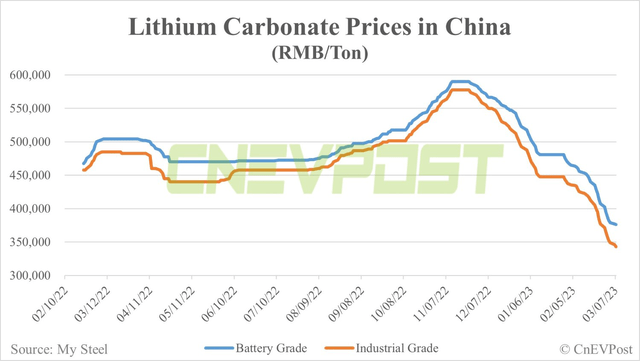
Finally, to me the most sobering item is the 50{515baef3fee8ea94d67a98a2b336e0215adf67d225b0e21a4f5c9b13e8fbd502} fall of lithium carbonate prices since December 2022. It’s not because of a large new mine entering production, or new refining capacity. Carmakers overestimated the end-of-year sales surge of consumers rushing to buy before incentives rolled off (see here), and started paring production plans. They similar underestimated the payback of lower sales in January and particularly February. Why? – because the underlying demand for BEVs is proving below consensus.
CnEVPost
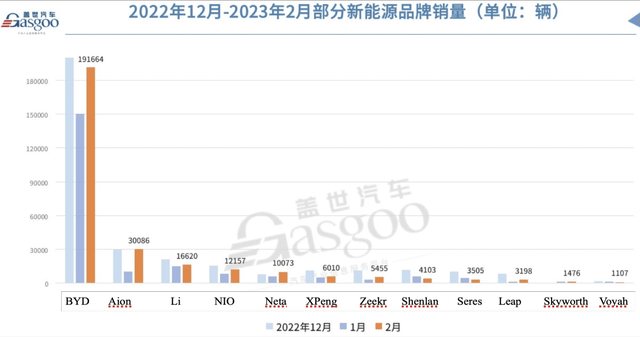
Let’s look at the performance in the major non-Tesla brands (Tesla couldn’t be included because they are slow to release domestic retail data). What the following graph illustrates is nothing short of disaster, because February sales failed in bounce back from the January holiday doldrums. The new entrants need growth to survive. Only 2 firms managed to beat December sales levels: the Guangzhou Automobile Group Co., Ltd. (GNZUF) (“GAC”) Aion brand, whose 4 models racked up sales of 270,000 units in 2022, and the small Neta (also called Hozon in some sources), with 3 models (one launched in November) and 2022 sales of 151,000. I am watching GAC, which is profitable, pays a dividend, and is trading at half of peak. Unfortunately there is no recent analysis on SA, and this article will not attempt to remedy that. Overall, though, I do not believe any of the new entrants in the graph provide “long” investment cases.
Gasgoo web site
Source: auto.gasgoo.com, to which the author appended English company names.
Tesla China
Will Tesla prove robust to these headwinds? How they fare in China in 2023 is central to their growth story and their profitability. The stock price depends on keeping both those narratives intact. Shanghai is Tesla’s largest production facility, so keeping capacity utilization high will be important to controlling costs and preserving margins. Ditto maintaining pricing.
Until we have data for 2023Q1, we will not know whether Tesla has at last dropped its pattern of end-of-quarter retail surges. Changing that habit would mean fewer exports early in a quarter and more later on, and so would leave Europe short of product, leading to a transitional quarter of poor sales. Likewise, in China operations would have to push for more sales early in the month. My own sense of organizational inertia is that such a shift could not be implemented in the space of a month or two, so again would lead to poor sales figures for the transitional quarter. I believe that Tesla management will weigh the gains in operational efficiency against the damage to the growth narrative, and choose the status quo.
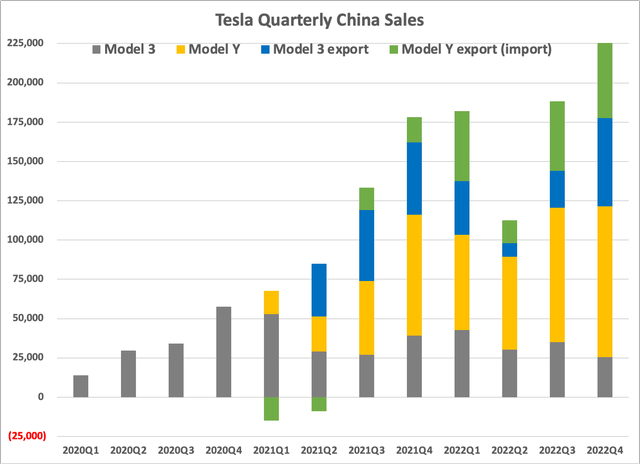
That proviso aside, the data show several things.
One is Tesla’s inability to grow domestic sales of the Model 3, which in fact peaked in 2020Q4. Absent a refreshed interior and new sheet metal to update styling, sales will continue to fall under the onslaught of new models in 2023.
The second is the success of the Model Y, which sells far better than the Model 3 ever has. With a higher selling price but non-battery production costs similar to the Model 3, it is central to Tesla’s profitability.
The third is the dependence of Shanghai on exports, which since 2021Q2 have accounted for over a third of output (2022Q2 was an exception). Without the ability to sell into the European market, Shanghai would operate at under 70{515baef3fee8ea94d67a98a2b336e0215adf67d225b0e21a4f5c9b13e8fbd502} of capacity. Lower labor costs and component costs imply that fixed costs are a higher share. Ironically, that raises Shanghai’s breakeven point. (Thanks to Glenn Mercer for this point.)
Authors database, compiled from multiple underlying sources
All of this raises a number of questions.
First, as Berlin ramps up, how will Shanghai keep utilization high? No other export markets (think Australia) are big enough to absorb the excess, but preliminary data for February show domestic sales below November and December 2022, while exports were over 50{515baef3fee8ea94d67a98a2b336e0215adf67d225b0e21a4f5c9b13e8fbd502} of wholesale shipments (source: CnEVPost: Tesla delivers 33,923 … exports 40,479). I follow China, not Europe, so will lean on comments in the discussion to flesh out scenarios.
Second, Reuters reported on March 1 that Tesla will start producing a refreshed Model 3 – some new sheet metal, a modified interior – in September. However, as I argued previously on SA, the Model 3 is not in a particularly attractive segment, though sedans continue to do better in China than in North America. This should certainly stop the slide in sales, but I do not believe it will offset the limitations of the segment. Furthermore, we have no confirmation from Tesla, and every reason to believe they will miss the target date. Additionally, what will Tesla do to maintain sales of the old version after the new one has its public reveal, while will be before it is actually available for sale? Model changeovers are generally accompanied by price reductions, which with September as the date would hit both the top and bottom line in 2023Q2. Given a long history of delays, however, it’s more likely that this is a story for 2024, not this year.
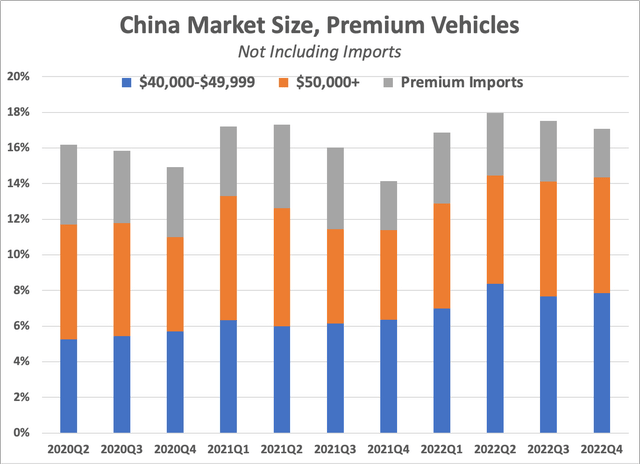
Third, will sales of the Model Y hold up? That single model is now the dominant product for Tesla in China, but it is also a stupendous cash cow, maintaining enviable volume even though it is entering its third year in the Chinese market. My sense is that there is no upside potential. Unlike the U.S., in China the share of the premium market is not expanding, and the dozen or so large, high-income cities that account for most Model Y sales are becoming saturated. Lower lithium prices will support discounting across the NEV spectrum, so will not necessarily help the Model Y. It will however allow premium EV makers with their larger batteries to lower prices more than carmakers operating in lower price brackets. With higher production volumes, and tooling costs now written off, Tesla has more room to discount than new entrants with lower volumes and brand new factories and tooling. So, I also see little downside in volume terms.
Authors database, compiled from various Chinese sources
Conclusions
There are many uncertainties going into 2023. I expect the first half of the year to see much slower growth for NEVs amidst an onslaught of new product. Sales will improve only in 2023Q4, with the normal seasonal upturn, resumed albeit slow economic growth, and lower NEV prices. New entrants in automotive face high hurdles, and I expect another one or two of the smaller NEV players to exit by year’s end, and stillbirths among those just launching their initial products. Watch for additional Chinese EV IPOs – and avoid!
Among the incumbents, GAC remains interesting, with its Aion NEV. Geely Automobile Holdings Limited (OTCPK:GELYF) has about 300,000 in NEV sales, but those are spread across multiple brands and models and corporate entities. That impedes achieving scale in production, and lowers the efficiency of its platform sharing. They nevertheless remain better than other incumbents such as Great Wall, SAIC, VW, GM, Toyota, Honda, Hyundai/Kia, FAW, Dongfeng, Changan, Chery – and on and on. China remains the world’s biggest automotive market, the biggest automotive producer, and is now a net exporter in volume terms. It is also a mature market, and that lowers its attractiveness for investors. Actions speak louder than words: I have yet to take the plunge.
Tesla remains highly profitable in its China operations, but 2023 will be challenging for the Chinese industry as a whole, and Tesla will not be exempt from those pressures. Tesla increasingly depends upon sales of a single product, the Model Y, as the Model 3 is past its prime. The Model Y continues to sell well, and is in a good segment, mid-sized SUVs. However, the premium segment is not expanding, and the steady stream of new NEV models will pressure margins for all producers. Factors such as falling lithium prices help everyone, and with competition, ultimately benefit no one (other, that is, than the final consumer).
In addition, the cash cow of Tesla Shanghai faces a major risk, its reliance on exports to Europe. No other new export markets are large enough to offset any decline there. If Tesla does launch a refreshed Model 3, it will be late in the year so the impact will be in 2024. Meanwhile, while the Cybertruck will launch in the U.S. in late 2023, it is a non-starter in China, where pickups remain utilitarian work trucks that sell in modest numbers in rural areas, and not in the major, high-income cities that comprise Tesla’s core market. Newer, less expensive models are years away and will carry smaller margins multiplied by lower prices.
In sum, Tesla has less downside than the many small players in the NEV market. In line with the NEV market as a whole, Tesla did well in 2022. It’s now payback time, and in line with the NEV market as a whole, Tesla also faces little upside in 2023. That is bad news for a growth stock.
Editor’s Note: This article discusses one or more securities that do not trade on a major U.S. exchange. Please be aware of the risks associated with these stocks.
HONG KONG (AP) — A grinding crackdown that wiped billions of pounds of worth off Chinese technology businesses is easing, but the once-freewheeling field is bracing for considerably slower growth ahead.
Analysts say China’s easing of limitations on companies like e-commerce giant Alibaba and on the net online games enterprise Tencent and speak of guidance for the non-public sector displays Beijing’s selection to refocus on expansion soon after the overall economy was ravaged by the pandemic and limits imposed to struggle COVID-19.
But controls on web information r emain firmly in location. And the crackdown has remaining a “chilling” influence on the market, likely slowing innovation, whilst U.S. constraints versus China’s laptop chips market are hindering development in building leading edge technological innovation in 5G and artificial intelligence.
In January, a best official at China’s central financial institution stated in an interview with point out-owned media that the crackdown on technological know-how providers was “basically” above, including that companies would be inspired to guide financial expansion and produce far more work. That came just weeks after China dropped stringent entry limitations and testing and quarantine requirements that were part of its “zero-COVID” strategy intended to quash the virus.
“With the finish of the zero-COVID coverage, China is returning to prioritizing financial growth, and the engineering sector is certainly a crucial driver of advancement in China and a celebrated resource of innovation,” mentioned Gregory Allen, a senior fellow in the Strategic Systems Method at the U.S. analysis business Heart for Strategic and International Experiments.
Providers like Alibaba and Tencent regulate every day applications and solutions that are applied ubiquitously by substantial swathes of the population – including on the web payments, messaging, food shipping and e-commerce.
This sort of companies flourished for two a long time with scant regulation right before Beijing launched a barrage of anti-monopoly, knowledge stability and other limitations from late 2020, searching for to rein in e-commerce, social media and other businesses it seen as also massive and independent.
Signaling an easing, Didi World — which was ordered to quit new-consumer registrations in 2021 adhering to accusations that it violated data security rules — not too long ago was allowed to resume having on new buyers.
Regulators explained e-commerce giant Alibaba’s finance affiliate Ant Group can go in advance with strategies to elevate $1.5 billion for its client finance unit, an important move forward soon after the government identified as off a prepared IPO two decades back and ordered the business to restructure.
Soon after slamming online video games as “spiritual opium” and implementing rigorous controls on display time for minors, regulators last April started approving new game titles adhering to an eight-month hiatus, with the initial overseas titles greenlighted in December.
Stocks of technology providers, together with Alibaba, Tencent as properly as some others this sort of as food supply business Meituan and lookup motor and artificial intelligence agency Baidu have seen their stock charges almost double due to the fact they hit rock base in late Oct. The current market valuations of these businesses, nevertheless, are however much from their peak in 2019.
The crackdown’s chilling consequences for buyers and business people will linger, Allen explained, considering that the authorities have shown they are eager and ready to forego development to impose controls on the field at any time.
More than the earlier two a long time, many founders of technological innovation companies have stepped down as CEO or chairman of their respective firms – like Alibaba’s Jack Ma, JD.com’s Richard Liu, Bytedance’s Zhang Yiming and Pinduoduo’s Colin Huang.
In January, Alibaba’s economic affiliate Ant Team explained that Ma — as soon as China’s richest male — would give up regulate of the company subsequent a restructuring, and that no solitary shareholder would have regulate. Ma has rarely been found in general public due to the fact regulators pulled the plug on Ant Group’s marketplace debut in Hong Kong and Shanghai following his criticism of China’s economic sector in 2020. He due to the fact reportedly has moved to Tokyo.
“If you were being a technologies entrepreneur in China 5 decades in the past, pretty likely a person like Jack Ma was your hero, your idol, and was exactly what you aspired to attain and the type of man or woman you aspire to turn into,” mentioned Allen. “And to see a gentleman like that type of torn down, I imagine sends a genuinely sturdy information.”
He and other analysts say the crackdown could possibly stifle innovation, as investors and business owners become far more careful about operating in China.
“The crackdown was deep and minimize significantly to the bone, possibly additional than the govt predicted it to,” explained Shaun Rein, founder and controlling director of China Marketplace Research Team in Shanghai. “Because what is occurred is in excess of the final two decades, enterprise capitalists and entrepreneurs have been worried to deploy capital and start off new businesses.”
The value of undertaking cash bargains in China plunged 44{515baef3fee8ea94d67a98a2b336e0215adf67d225b0e21a4f5c9b13e8fbd502} to $62.1 billion in the initially 10 months of 2022 as opposed to the same period in 2021, in accordance to analysis firm Preqin.
Some business owners and undertaking capitalists are using a hold out-and-see angle, “worried in the extended time period that if they spend in a hot sector that the federal government that goes against China’s agenda or does not fit with the government’s agenda for the private sector that they may possibly get wiped out,” Rein reported.
Well-proven web corporations are however at an advantage to other tech industries in China that confront additional uncertainty owing to friction between Washington and Beijing around highly developed know-how and trade as the U.S. seeks to block exports of significant-conclude semiconductors and chip-building machines and to restrict Western dealings with corporations like Huawei Systems, the world’s greatest maker of telecommunications networking equipment.
The Biden administration has stopped approving renewal of licenses to some U.S. corporations that have been providing crucial components to the Chinse tech giant. That’s according to two people common with the subject who have been not authorized to comment publicly on the delicate make a difference and spoke on the condition of anonymity.
Washington steadily has tightened controls in excess of U.S. exports to Huawei but had allowed some organizations like Intel and Qualcomm to offer it processors applied in gadgets like laptops and lessen-conclusion smartphones. The U.S. has justified this sort of sanctions on national safety grounds. Huawei denies the accusations.
Below these types of stress, China has accelerated attempts to grow to be far more self-sufficient in semiconductors and other sophisticated technologies, supplying billions in subsidies and investments for the marketplace. But it remains years at the rear of in some of the most innovative semiconductor manufacturing procedures and a U.S. prohibition versus supporting improvement and generation of integrated circuits at some chip factories in China has deprived Chinese chip corporations of the foreign expertise that has long contributed to its domestic field.
A U.S. ban on promoting essential semiconductor production tools to China is a further impediment.
“It’s 1 issue to go into regions like software program and cloud providers, in which Chinese businesses are currently quite strong,” explained Allen of CSIS.
“It’s a really various detail to choose Chinese providers that are a ten years or two at the rear of in point out-of-the-artwork semiconductor production devices and explain to them to grow up instantly by replicating some of the most state-of-the-art systems that the globe has ever generated.”
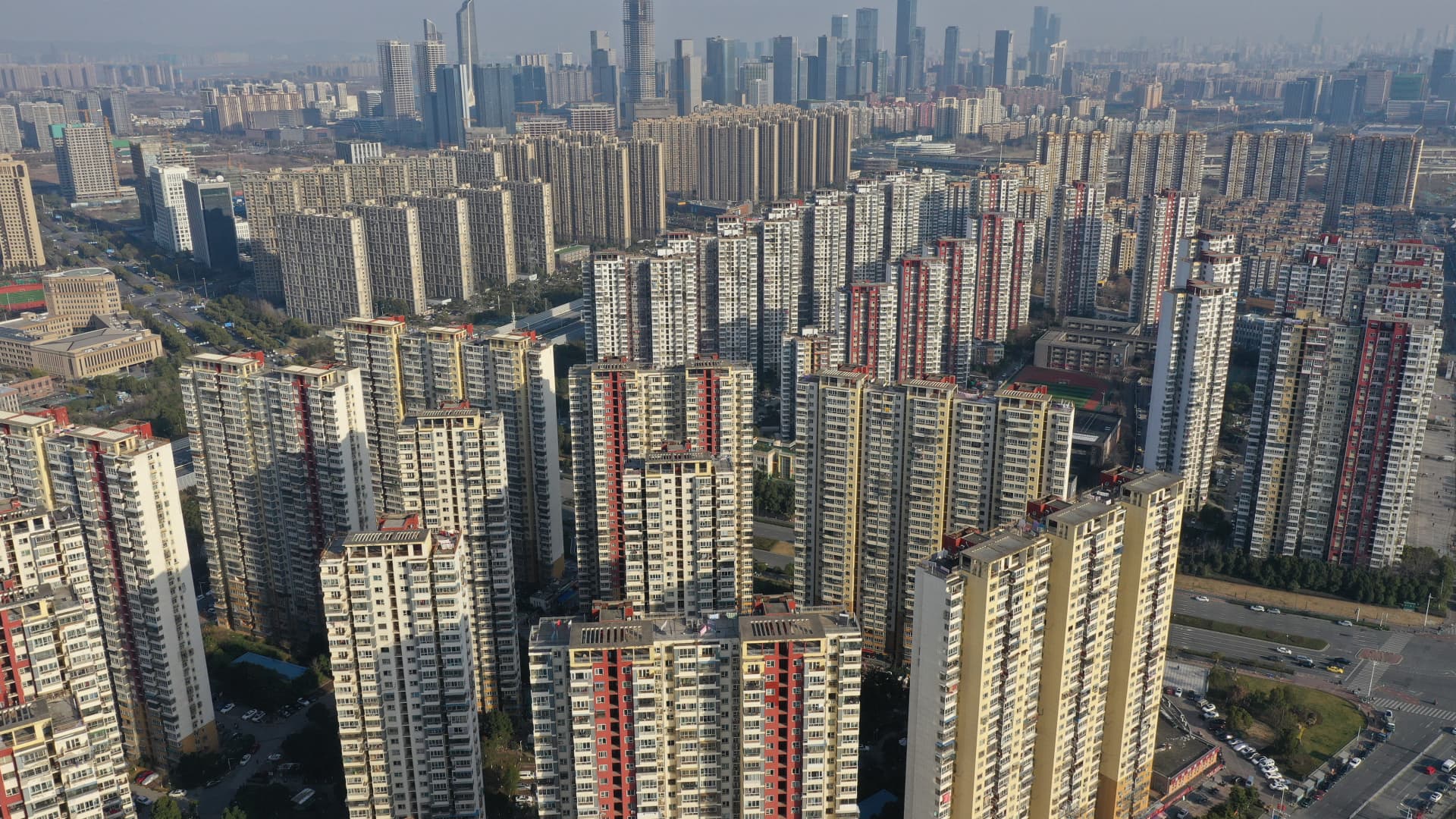
China’s authentic estate industry has slumped in the last two decades soon after Beijing cracked down on developers’ significant reliance on debt for advancement.
Long term Publishing | Upcoming Publishing | Getty Pictures
BEIJING — China demands to do extra in get to correct its authentic estate issues, the Global Financial Fund reported Friday.
The residence sector contributes to about a quarter of China’s GDP and has been a drag on growth, particularly given that Beijing cracked down on developers’ superior reliance on financial debt in 2020.
Chinese authorities started off to simplicity limitations on funding for the sector over the last quite a few months.
“Authorities’ modern coverage measures are welcome, but in our look at added motion will be required in purchase to stop the real estate crisis,” Thomas Helbling, deputy director in the IMF’s Asia Pacific Department, explained in a briefing.
“If you glimpse at the steps, a large amount of them handle funding problems for the builders that are nonetheless in comparatively superior financial health and fitness, so that will enable,” he extra in an job interview with CNBC. “But the difficulties of the property developers’ dealing with critical monetary difficulties are not nonetheless dealt with. The difficulty of the big inventory of unfinished housing much more broadly is not however resolved.”
Apartments in China are usually bought to homebuyers ahead of completion. Covid and monetary issues slowed development so substantially that some homebuyers halted their mortgage payments previous summer season in protest.
Chinese authorities subsequently emphasised the need to assist builders end constructing people pre-bought residences. Continue to, household floor room offered in China dropped by nearly 27{515baef3fee8ea94d67a98a2b336e0215adf67d225b0e21a4f5c9b13e8fbd502} previous calendar year, when real estate investment decision fell by 10{515baef3fee8ea94d67a98a2b336e0215adf67d225b0e21a4f5c9b13e8fbd502}, according to official quantities.
“I consider it would be helpful to point to a way out and … how the restructuring could be accomplished and who will soak up losses if there are any losses,” Helbling claimed. He also known as for added measures to address the huge inventory of unfinished residences.
Read more about China from CNBC Professional
“If not the sector will carry on to slump and continue to be a risk and also constrain households that are overexposed to the residence sector, and will have hard cash tied up and their discounts tied up which will be a handicap for the broader financial restoration,” he said.
Helbling declined to title a particular timeframe in just which authorities wanted to act ahead of the problem got much even worse.
“The quicker you handle draw back hazards the better.”
China suggests it is not a crisis
The IMF investigation was portion of the organization’s most up-to-date report on China, pursuing annual conversations with Chinese officials that ended in November.
The officials pushed back on the IMF’s authentic estate assessment, according to a statement in the IMF report by Zhengxin Zhang, govt director for People’s Republic of China, and Xuefei Bai, senior advisor to the government director, dated Jan. 12.
China’s home market has commonly operated effortlessly and “is not in a ‘crisis’ circumstance,” the assertion mentioned, casting the sector’s condition as “a organic evolution of ‘deleveraging and destocking’ in the previous several years.”
“The relevant pitfalls are regional and only concern unique firms, and their effect on the rest of the globe has been rather compact,” the central financial institution representatives claimed. Searching ahead, the Chinese aspect reported they would function toward making certain the shipping of completed apartments, and merging builders.
Chinese property builders these types of as State Backyard, Longfor and R&F Homes have seen their shares practically double or extra in excess of the previous 60 buying and selling days — about 3 months, according to Wind Information. But trading in shares of a person-time giants Evergrande, Shimao and Sunac have been halted due to the fact March 2022.
The IMF report pointed out that a important portion of investors in Chinese developers’ bonds have been affected.
“As of November 2022, developers that have currently defaulted or are very likely to default — with typical bond costs below 40 p.c of facial area value — represented 38 p.c of the 2020 marketplace share of corporations with available bond pricing,” the report stated.
Study far more about China from CNBC Professional
“The sector’s contraction is also leading to strains in local governments. Falling land sale revenues have lessened their fiscal capability at the same time as community authorities financing motor vehicles (LGFVs) have also substantially improved land buys.”
The IMF on Monday lifted its world-wide growth expectations for the calendar year due to superior-than-predicted growth in significant international locations late past 12 months, softening inflationary pressures and the conclusion of China’s Covid controls.
The new 2.9{515baef3fee8ea94d67a98a2b336e0215adf67d225b0e21a4f5c9b13e8fbd502} forecast for the environment is .2 share points superior than expected in Oct. But it really is nevertheless a slowdown from 3.4{515baef3fee8ea94d67a98a2b336e0215adf67d225b0e21a4f5c9b13e8fbd502} growth in 2022.
For China, the IMF jobs progress of 5.2{515baef3fee8ea94d67a98a2b336e0215adf67d225b0e21a4f5c9b13e8fbd502} this calendar year, faster than the 3{515baef3fee8ea94d67a98a2b336e0215adf67d225b0e21a4f5c9b13e8fbd502} rate in 2022.
The Year of the Rabbit, which commenced final 7 days, is affiliated with positivity, caution, intelligence, deftness and self-security. These are all virtues multinational travel professionals will have to have as they navigate their travelers’ return to the world’s next-biggest economic system now that it has at last reopened following a few decades of Covid-induced isolation.
Will The Return of Chinese Outbound Travelers Inflate Resort Fees Worldwide?
A big concern for all journey managers to take into account, even if their enterprise under no circumstances visits China, is whether the return of the world’s biggest outbound journey marketplace will push up hotel premiums all over the world.
Chinese vacationers invested $255 billion exterior their personal region in 2019, way ahead of 2nd-put United States with $132 billion, according to the Earth Tourism Firm. “As the world’s greatest spender on intercontinental travel—by some margin—China’s reopening could have sizeable impacts on international journey, further more pushing up lodge charges in the world’s major business enterprise cities,” explained Anu Kuchibhotla, head of hotel exercise for Amex GBT World-wide Small business Consulting. “The return of just a portion of Chinese need could place upwards pressure on international lodge price ranges.
“A ton of it will count on visa needs. Retain an eye on which nations are imposing visa restrictions and how China is responding to that,” she reported.
Kuchibhotla highlighted Singapore as a spot to look at for an anticipated surge in Chinese site visitors and consequent amount hikes. Contrary to some of its neighbors, Singapore has not imposed any new Covid-associated constraints on Chinese visitors. “Capacity is constrained in Singapore. It’s not that massive an island,” Kuchibhotla warned.
In other places, paperwork could prevent the return of Chinese tourists for at least a couple of months yet. “It is a lot more difficult for China due to the fact there is pretty minimal visa-absolutely free vacation for our citizens,” claimed BCD Travel controlling director for Larger China Jonathan Kao. “Most destinations you go you need to have a visa. A lot of embassies in China had been closed in December via the Covid outbreak, so there’s a very massive backlog of applications to go by means of. And about 20 {515baef3fee8ea94d67a98a2b336e0215adf67d225b0e21a4f5c9b13e8fbd502} of Chinese passports expired above the past a few a long time simply because the passport renewal functionality was shut down. Now a good deal of people are dashing to get their passports performed.”
CWT China’s prime outbound destinations for the very first week of January have been Hong Kong, the U.S., Singapore and Japan. “Every week we are viewing an boost of 20 per cent in outbound bookings,” said standard manager for China Albert Zhong. “Bookings for the final a few years ended up significantly less than 5 percent of pre-Covid stages but in just two weeks we have achieved about 30 per cent. China can rebound speedier than other markets.”
However, an additional inhibitor on the resurgence of outbound Chinese journey is low airline potential and attendant large fares. CWT information demonstrates regular ticket value to the U.K. and Singapore stays double what it was pre-pandemic, while the U.S. and Germany are 50 to 60 percent higher.
But that is unlikely to hold again Chinese company tourists for substantially more time. “This are unable to last permanently. Airlines are applying to raise capacity and with that raise in frequencies, I am absolutely sure prices will appear down,” explained Zhong.
Although getting into China without having quarantine has been feasible considering that Jan. 8, resuming business enterprise travel there stays fraught with problems: a wave of coronavirus bacterial infections pursuing abandonment of the country’s zero-Covid policy, screening constraints and other bureaucratic hurdles, and painfully superior air fares.
It also stays to be seen how much hunger there is for small business engagement in between the West and China in 2023. Given that China efficiently shut itself off to the outside the house earth by introducing draconian quarantine needs in early 2020, diplomatic relations have soured above many issues—Xinjiang, Hong Kong, Taiwan and Russia to name but a few—although President Xi Jinping has accompanied the scrapping of zero-Covid by adopting a distinctly much more conciliatory tone towards the West in new months.
Nevertheless, some enterprises keep on being wary about returning to China. “Our enterprise as a whole is extremely cautious, and I’m not listening to of any appetite to be the first to get colleagues into or out of China any time shortly,” one particular vacation manager dependable for each individual location outside North America told BTN.
In spite of these uncertainties, there by now is proof of a revival in global vacation in both equally directions. The Countrywide Immigration Administration of China documented that from Jan. 8-12 its agencies inspected an normal of 490,000 entries and exits for every day. That was an increase of 48.9 {515baef3fee8ea94d67a98a2b336e0215adf67d225b0e21a4f5c9b13e8fbd502} in contrast with prior to journey restriction policies have been lifted, despite the fact that however 3-quarters significantly less than the same interval in 2019.
Albert Zhong, CWT’s Beijing-based mostly general supervisor for China, explained best inbound marketplaces for bookings so much have been the United States, Germany, United Kingdom, Switzerland and the Netherlands.
Inside China, a Perception of Optimism
Inside of China, corporate travel specialists are optimistic. “China is all set to welcome guests,” mentioned Zhong. “Everything is returning to normal. We really don’t think the present problem of restricted capability and superior prices will final for long—just a few of months. Points will surely get superior in the next quarter of this yr.”
BCD Vacation controlling director for Larger China Jonathan Kao, based mostly in Shanghai, agreed. “People want to get back again to typical and start off accomplishing business enterprise all over again,” he explained. “Because of the news media, men and women are fearful about the [Covid] predicament, and whether it is harmful in this article. It’s not dangerous, but there is most likely to be a wait-and-see technique. I consider by March and April there will be a lot a lot more traffic coming in.”
Western governments are suspicious of official Chinese reporting on an infection and mortality costs, and there are fears about how noticeably the scenario may be worsened by up to 300 million inhabitants traveling for the two-7 days Spring Festival that commenced on Jan. 22. In accordance to Riskline journey intelligence information team direct Claudia Gualdi, doubts about transparency experienced persuaded 28 nations as of Jan. 18 to enforce pre-departure screening and other measures on outbound travelers from China. China has retaliated with reciprocal limits on inbound guests from individuals countries and has even halted all visa processing for people from Japan and South Korea.
“We consider that inbound company vacation will recuperate slowly and gradually as the place is recording substantial an infection degrees after all over again and businesses will likely be conservative in exposing their vacationers to that risk,” reported Gualdi. “If the vacation is not crucial, the pattern is to postpone it until spring to keep away from infection and the problems relating to visas, paperwork and Covid demands.”
Anu Kuchibhotla, head of the lodge practice for Amex GBT World-wide Company Consulting, also expects company tourists to training caution. “It’s like we have moved 5 steps ahead but two steps again,” she claimed. “If I’m coming again to the U.K. and I’m essential to do screening, do I want to possibility finding stuck in China? I suspect there will not be a large bang of vacation. It will possible be a trickle outcome.”
Travelers keen to enter China quicker rather than later also encounter severely limited availability of flights and ultra-substantial fares as a consequence. Previously this month, Chicago-Beijing return in organization class, for illustration, was $35,000 to $40,000, according to Zhong.
If I’m coming back to the U.K. and I’m necessary to do testing, do I want to risk acquiring stuck in China? I suspect there won’t be a significant bang of vacation. It will probable be a trickle result.”
– Amex GBT’s Anu Kuchibhotla
“Fares have not moved that significantly for this month, but we are looking at rates start to appear down for forward bookings, specially March and April, mainly because of added capacity,” stated Kao. Considering the fact that the commencing of the year, airways have submitted quite a few programs to the Civil Aviation Administration of China for resumption of products and services, normally in March and April. As an instance, Kao cited the Shanghai-Sydney route, on which China Eastern is upgrading from a day by day to a weekly company. Even so, he warned, fares are “still considerably higher than 2019. I think we will see an added lowering of the price tag, in all probability in the next half of the year.”
According to Kao, capability boosts on worldwide routes will be included overwhelmingly by Chinese carriers, which did not lay off staff members in the course of the pandemic and are prepared to return plane to their previous route networks. Western airlines, in contrast, have redeployed their aircraft all over the entire world while China has been shut.
Domestically, flights now exceed 10,000 for each day, claimed Zhong, about 20 p.c down on pre-pandemic levels. Kao reports that Cathay Pacific is increasing to 60-moreover flights for every 7 days from Hong Kong to mainland China. The Hong Kong-Shanghai route is back again to 18 flights weekly, up from just one for each 7 days in November 2022 but continue to well down on the pre-pandemic norm of 12 everyday.
On the accommodation entrance, the condition is considerably rosier for company vacationers. Kao claimed that despite the fact that a several impartial hotels went bust and many closed floors in just their properties, availability stays fantastic. And while flying is expensive, lodging, for now, is the reverse, owing to source exceeding need. “Rates are starting up to raise but they keep on being much lessen than 2019 amounts,” stated Kao.