
Youth ambassadors train for a future in public health : Shots

Youth ambassadors train for a future in public health : Shots

Bithaniya Fieseha, a high school senior, graduates from the Youth Public Health Ambassador program run by the Fairfax County Health Department at West Springfield High School in Fairfax County, Va.

Will Schermerhorn/Fairfax County Health Department


hide caption

toggle caption

Will Schermerhorn/Fairfax County Health Department


Bithaniya Fieseha, a high school senior, graduates from the Youth Public Health Ambassador program run by the Fairfax County Health Department at West Springfield High School in Fairfax County, Va.

Will Schermerhorn/Fairfax County Health Department

Of all the things she could have done on her summer vacation, Bithaniya Fieseha, a senior at West Springfield High School in Fairfax County, Va., decided to study chronic disease, mental health and contact tracing. Some of her friends didn’t understand the appeal.

“I feel like people are like, ‘You wasted your summer,’ ” she says. “But I enjoyed it. I really enjoyed meeting up with everyone, going through the struggle.”

She practiced taking temperatures, weight and blood pressure readings on her family. Fieseha topped it off with an internship at a local health clinic.

Her hard work paid off. On a recent Saturday morning, Fieseha became one of 14 high school students to graduate from the Youth Public Health Ambassador program run by the Fairfax County Health Department. It trains teenagers from underserved communities to become health workers and prepares them for potential careers in public health. The coursework was designed by the Morehouse School of Medicine.

“I think this program gives us a voice because, as minorities, we’re able to see those disparities” in our own surroundings, says Nayla Bonilla, a junior at Justice High School, “I saw that there were so many different avenues into medicine and things we can do in the future that can help our communities thrive.”

The training aims to help shore up the public health workforce, which is in bad shape as the COVID-19 pandemic enters its fourth year. A wave of retirements is expected to further strain health departments over the next few years.

“We need to not only attract people into the fields of healthcare and public health, but we need to attract people of color,” says Dr. Gloria Addo-Ayensu, director of the Fairfax County Health Department, “We need people from our Black and Brown communities to engage in the field so they are able to explain to their communities what health is all about.”

Dr. Gloria Addo-Ayensu, director of the Fairfax County Health Department, spoke with students graduating from the Public Health Youth Ambassador Program at the John Lewis High School library.

Will Schermerhorn/Fairfax County Health Department


hide caption

toggle caption

Will Schermerhorn/Fairfax County Health Department


Dr. Gloria Addo-Ayensu, director of the Fairfax County Health Department, spoke with students graduating from the Public Health Youth Ambassador Program at the John Lewis High School library.

Will Schermerhorn/Fairfax County Health Department

Training gives teens a leg up on future health careers

The health department is working with Edu-Futuro, a local nonprofit, to recruit students with an interest in medicine from Fairfax high schools and help start their career paths.

“At the end of the day, it’s that they successfully enroll in a college or a postsecondary institution, where they will be able to get a degree in a health-related career – and then four years later, they get their first professional job,” says Jorge Figueredo, Edu-Futuro’s director.

Jorge Figueredo, director at the nonprofit Edu-Futuro, tells students that the Youth Ambassador Program sets them on a path to careers in health.

Will Schermerhorn/Fairfax County Health Department


hide caption

toggle caption

Will Schermerhorn/Fairfax County Health Department
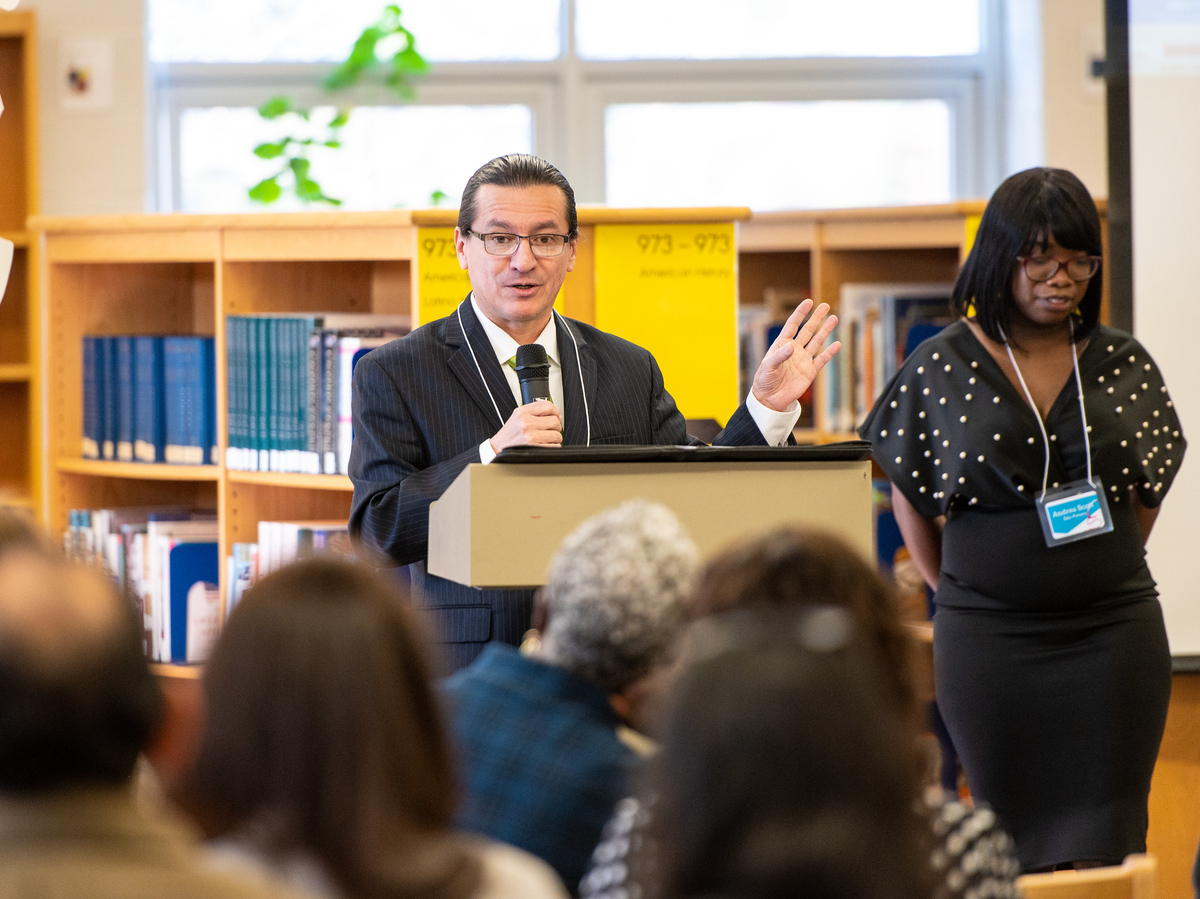

Jorge Figueredo, director at the nonprofit Edu-Futuro, tells students that the Youth Ambassador Program sets them on a path to careers in health.

Will Schermerhorn/Fairfax County Health Department

The program focuses on Hispanic, African-American and African students from low-income families. In Fairfax County, as in much of the country, these racial and ethnic minority groups were hardest hit by COVID.

“There were some real challenges around health literacy,” says Anthony Mingo, director of community health development at the Fairfax County Health Department. Mixed messages at the start of the pandemic blended with historical mistrust in medical institutions. “It created a miserable stew of misinformation,” he says.

Anthony Mingo (center), from the Fairfax Health Department, implored students to consider careers that serve their communities, flanked by Jorge Figueredo from Edu-Futuro (left) and program manager Andrea Scott (right).

Will Schermerhorn/Fairfax County Health Department


hide caption

toggle caption

Will Schermerhorn/Fairfax County Health Department


Anthony Mingo (center), from the Fairfax Health Department, implored students to consider careers that serve their communities, flanked by Jorge Figueredo from Edu-Futuro (left) and program manager Andrea Scott (right).

Will Schermerhorn/Fairfax County Health Department

The new youth ambassadors are fired up about public health. Fieseha found the links between environment and health illuminating. “If you don’t have access to a grocery store, you’re more willing to buy [fast food] because that is the closest food source you have, which contributes to diabetes and high blood pressure,” she says. “How we access our food, how we make income – we don’t realize how much of an impact that makes to our mental health and our physical health.”

Learning about some shady episodes from the history of medicine helped Bonilla understand how the medical field lost trust with some groups.

“[The lessons] were talking about the history of ethical considerations, which I really hadn’t thought about, like the cancer cells from a patient that were used without their consent,” she says, “And it just made me think how minority groups were really taken advantage of for medical research.”

Bonilla plans to organize a health fair to address health disparities; she thinks she might become a pediatrician, to better serve Spanish-speaking kids and parents. Fieseha plans to start an urban garden at her school and wants to become a global advocate for HIV/AIDS in Africa and particularly Ethiopia, where her family is from.

Federal funding to boost health literacy

Both are among the first graduates in the pilot program, which expects to have trained ninety students as health workers by next summer. With a budget of around $240,000, according to the health department, it’s a small sliver in a two-year, $3.8 million Fairfax County-wide project to improve access to COVID information and boost health literacy among vulnerable groups.

The federal government is providing the funding. Fairfax County is one of 73 local governments to receive a grant under a $250 million initiative from the Department of Health and Human Services last year. Each grantee is trying out its own approaches to improve health understanding in their communities, says Roslyn Holliday Moore, deputy program director for HHS’s Office of Minority Health.

Roslyn Holliday Moore, from the U.S. Department of Health and Human Services, says the Youth Public Health Ambassador Program can be adapted to other places.

Will Schermerhorn/Fairfax County Health Department


hide caption

toggle caption

Will Schermerhorn/Fairfax County Health Department
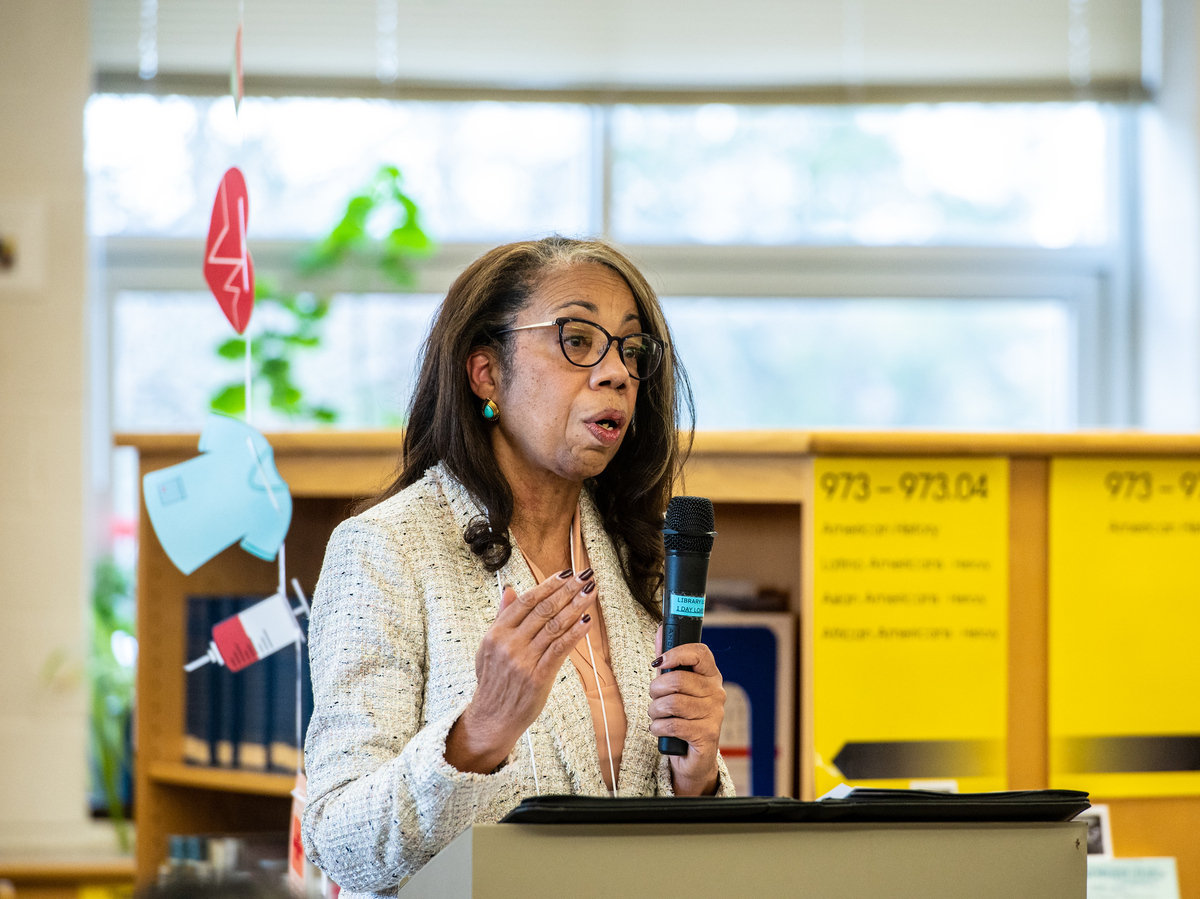

Roslyn Holliday Moore, from the U.S. Department of Health and Human Services, says the Youth Public Health Ambassador Program can be adapted to other places.

Will Schermerhorn/Fairfax County Health Department

The hope is that projects, like Fairfax County’s Youth Ambassador training, can be adapted elsewhere. “For those who are looking at whether people are able to trust, sustain the trust, engage others, this is more than successful,” Holliday Moore says, “And it’s not hard to replicate.”

Holliday Moore addresses a small crowd of parents and students gathered at a high school library for a graduation ceremony. “Do not give up, stay the course,” she says. “You are creating a future here.”

Afterward, there is applause and tears of joy. A Peruvian dance champion performs a traditional dance. An assistant principal sings a line from Bob Marley’s Three Little Birds and assures students he isn’t worried about a thing — with them at the helm.

After some long, bleak pandemic years, everyone in the room is glad to be celebrating teens getting their start in public health.

Christopher Thompson, assistant principal at the John R. Lewis High School, tells students that he’s confident in a future where they’re in charge.

Will Schermerhorn/Fairfax County Health Department


hide caption

toggle caption

Will Schermerhorn/Fairfax County Health Department
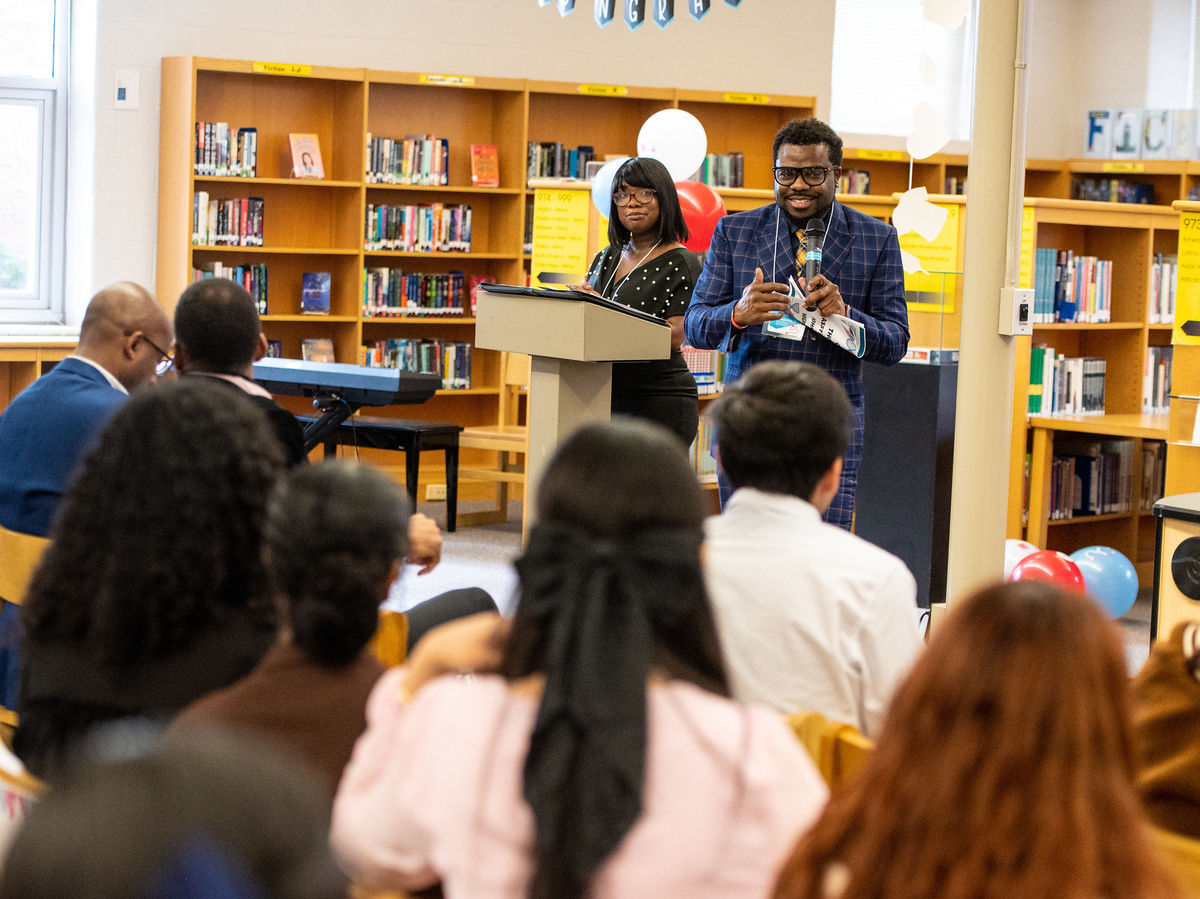

Christopher Thompson, assistant principal at the John R. Lewis High School, tells students that he’s confident in a future where they’re in charge.

Will Schermerhorn/Fairfax County Health Department
Mistaken identity leads to big hospital bill mix-up : Shots

Mistaken identity leads to big hospital bill mix-up : Shots

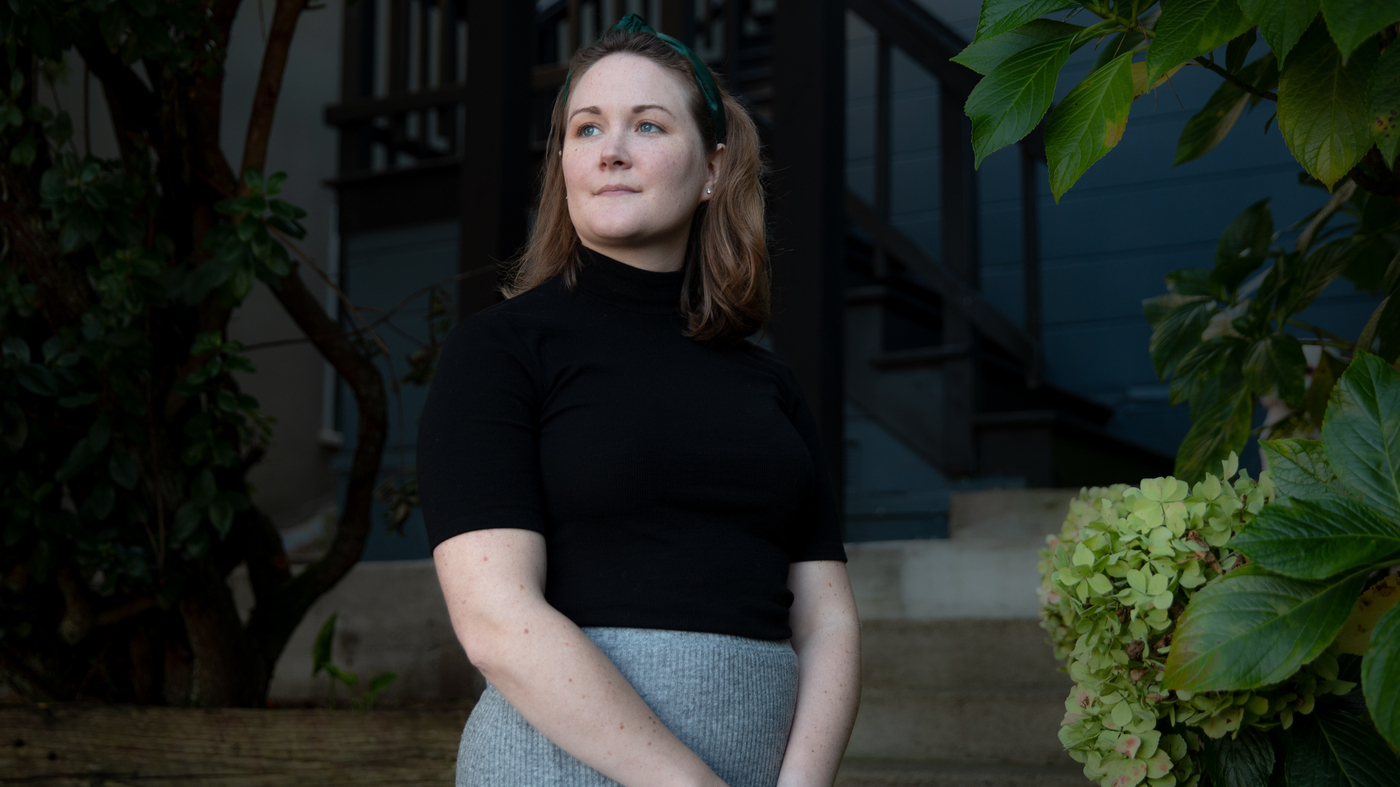
In 2013, Grace E. Elliott spent a night in a hospital in Florida for a kidney infection that was treated with antibiotics. Eight years later, she got a large bill from the health system that bought the hospital. This bill was for an unrelated surgical procedure she didn’t need and never received. It was a case of mistaken identity, she knew, but proving that wasn’t easy.

Shelby Knowles for KHN


hide caption

toggle caption

Shelby Knowles for KHN


In 2013, Grace E. Elliott spent a night in a hospital in Florida for a kidney infection that was treated with antibiotics. Eight years later, she got a large bill from the health system that bought the hospital. This bill was for an unrelated surgical procedure she didn’t need and never received. It was a case of mistaken identity, she knew, but proving that wasn’t easy.

Shelby Knowles for KHN

Earlier this year, Grace Elizabeth Elliott got a mysterious hospital bill for medical care she had never received.

She soon discovered how far a clerical error can reach — even across a continent — and how frustrating it can be to fix.

During a college break in 2013, Elliott, then 22, began to feel faint and feverish while visiting her parents in Venice, Fla., which is about an hour south of Tampa. Her mother, a nurse, drove her to a facility that locals knew simply as Venice Hospital.

In the emergency department, Elliott was diagnosed with a kidney infection and held overnight before being discharged with a prescription for antibiotics, a common treatment for the illness.

“My hospital bill was about $100, which I remember because that was a lot of money for me as an undergrad,” said Elliott, now 31.

She recovered and eventually moved to California to teach preschool. Venice Regional Medical Center was bought by Community Health Systems, based in Franklin, Tenn., in 2014 and eventually renamed ShorePoint Health Venice.

The kidney infection and overnight stay in the E.R. would have been little more than a memory for Elliott.

Then another bill came.

The Patients: Grace E. Elliott, 31, a preschool teacher living with her husband in San Francisco, and Grace A. Elliott, 81, a retiree in Venice, Fla.

Medical Services: For Grace E., an emergency department visit and overnight stay, plus antibiotics to treat a kidney infection in 2013. For Grace A., a shoulder replacement and rehabilitation services in 2021.

Service Provider: Venice Regional Medical Center, later renamed ShorePoint Health Venice.

Total Bill: $1,170, the patient’s responsibility for shoulder replacement services, after adjustments and payments of $13,210.21 by a health plan with no connection to Grace E. Elliott. The initial charges were $123,854.14.

What Gives: This is a case of mistaken identity, a billing mystery that started at a hospital registration desk and didn’t end until months after the file had been handed over to a collections agency.

Early this year, Grace E. Elliott’s mother opened a bill from ShorePoint Health Venice that was addressed to her daughter and sought more than $1,000 for recent hospital services, Elliott said. She “immediately knew something was wrong.”

Months of sleuthing eventually revealed that the bill was meant for Grace Ann Elliott, a much older woman who underwent a shoulder replacement procedure and rehabilitation services at the Venice hospital last year.

Experts said that accessing the wrong patient’s file because of a name mix-up is a common error — but one for which safeguards, like checking a patient’s photo identification, usually exist.

The hospital had treated at least two Grace Elliotts. When Grace A. Elliott showed up for her shoulder replacement, a hospital employee had pulled up Grace E. Elliott’s account by mistake.

“This is the kind of thing that can definitely happen,” said Shannon Hartsfield, a Florida attorney who specializes in health care privacy violations. (Hartsfield does not represent anyone involved in this case.) “All kinds of human errors happen. A worker can pull up the names, click the wrong button, and then not check [the current patient’s] date of birth to confirm.”

It was a seemingly obvious error: The younger Elliott was billed for a procedure she didn’t have by a hospital she had not visited in years. But it took her nearly a year of hours-long phone calls to undo the damage.

At first, worried that she had been the victim of identity theft, Grace E. Elliott contacted ShorePoint Health Venice and was bounced from one department to another. At one point, a billing employee disclosed to Elliott the birthdate the hospital had on file for the patient who had the shoulder replacement — it was not hers. Elliott then sent the hospital a copy of her ID.

It took weeks for an administrator at ShorePoint’s corporate office in Florida to admit the hospital’s error and promise to correct it.

In August, though, Grace E. Elliott received a notice that the corporate office had sold the debt to a collections agency called Medical Data Systems. Even though the hospital had acknowledged its error, the agency was coming after Grace E. Elliott for the balance due for Grace A. Elliott’s shoulder surgery.

“I thought, ‘Well, I’ll just work with them directly,'” Grace E. Elliott said.

Her appeal was denied. Medical Data Systems said in its denial letter that it had contacted the hospital and confirmed the name and address on file. The agency also included a copy of Grace A. Elliott’s expired driver license to Grace E. — along with several pages of the older woman’s medical information — in support of its conclusion.

“A collection agency, as a business associate of a hospital, has an obligation to ensure that the wrong patient’s information is not shared,” Hartsfield said.

In an email to KHN, Cheryl Spanier, a vice president of the collections agency wrote that “MDS follows all state and federal rules and regulations.” Spanier declined to comment on Elliott’s case, saying she needed the written consent of both the health system and the patient to do so.

Elliott’s second appeal was also denied. She was told to contact the hospital to clear up the issue. But because the health system had long since sold the debt, Elliott said, she got no traction in trying to get ShorePoint Health Venice to help her. The hospital closed in September.

Resolution: In mid-November, shortly after a reporter contacted ShorePoint Health, which operates other hospitals and facilities in Florida, Grace E. Elliott received a call from Stanley Padfield, the Venice hospital’s outgoing privacy officer and director of health information management. “He said, ‘It’s taken care of,’ ” Elliott said, adding that she was relieved but skeptical. “I’ve heard that over and over.”

Elliott said Padfield told her that she had become listed as Grace A. Elliott’s guarantor, meaning she was legally responsible for the debt of a woman she had never met.

Elliott soon received a letter from Padfield stating that ShorePoint Health had removed her information from Grace A. Elliott’s account and confirmed that she had not been reported to any credit agencies. The letter said her information had been removed from the collection agency’s database and acknowledged that the hospital’s fix initially “was not appropriately communicated” to collections.

Padfield said the error started with a “registration clerk,” who he said had “received additional privacy education as a result of this incident.”

Devyn Brazelton, marketing coordinator for ShorePoint Health, told KHN the hospital believes the error was “an isolated incident.”

Using the date of birth provided by a hospital worker, Elliott was able to contact Grace A. Elliott and explain the mix-up.

“I’m a little upset right now,” Grace A. Elliott told KHN on the day she learned about the billing error and disclosure of her medical information.

The Takeaway: Grace E. Elliott said that when she asked Padfield, the Venice hospital’s outgoing privacy officer, whether she could have done something to fight such an obvious case of mistaken identity, he replied, “Probably not.”

This, experts said, is the dark secret of identity issues: Once a mistake has been entered into a database, it can be remarkably difficult to fix. And such incorrect information can live for generations.

For patients, that means it’s crucial to periodically review the information on your patient portal — the online medical profile many providers use to manage things like scheduling appointments, organizing medical records, and answering patient questions.

One downside of electronic medical records is that errors spread easily and repeat frequently. It is important to challenge and correct errors in medical records early and forcefully, with every bit of documentation available. That is true whether the problem is an incorrect name, a medication no longer (or never) taken, or an inaccurate diagnosis.

The process of amending a record can be “very involved,” Hartsfield said. “But with patients able now to see more and more of their medical records, they are going to want those amendments, and health systems and their related entities need to get prepared for that.”

Grace A. Elliott told KHN that she had received a call from ShorePoint Health in the previous few months indicating that she owed money for her shoulder replacement.

She asked for a copy of the bill, she told KHN. Months after she asked, it still hadn’t arrived.

KHN (Kaiser Health News) is a national, editorially independent program of KFF (Kaiser Family Foundation).

Blind people still get medical bills they can’t read : Shots

Blind people still get medical bills they can’t read : Shots

Lucy Greco (left), a web-accessibility specialist at the University of California, Berkeley, is blind. She reads most of her documents online, but employs Liza Schlosser-Olroyd as an aide to sort through her paper mail every other month, to make sure Greco hasn’t missed a bill or other important correspondence.

Shelby Knowles for KHN


hide caption

toggle caption

Shelby Knowles for KHN


Lucy Greco (left), a web-accessibility specialist at the University of California, Berkeley, is blind. She reads most of her documents online, but employs Liza Schlosser-Olroyd as an aide to sort through her paper mail every other month, to make sure Greco hasn’t missed a bill or other important correspondence.

Shelby Knowles for KHN

A Missouri man who is deaf and blind said a medical bill he didn’t know existed was sent to debt collections, triggering an 11{515baef3fee8ea94d67a98a2b336e0215adf67d225b0e21a4f5c9b13e8fbd502} rise in his home insurance premiums.

In a different case, from California, an insurer has suspended a blind woman’s coverage every year since 2010 after mailing printed “verification of benefits” forms to her home that she cannot read, she said. The problems continued even after she got a lawyer involved.

And still another insurer kept sending a visually impaired Indiana woman bills she said she could not read, even after her complaint to the Health and Human Services’ Office for Civil Rights led to corrective actions.

Across the U.S., health insurers and health care systems are breaking disability rights laws by sending inaccessible medical bills and notices, a KHN investigation has found. The practice hinders the ability of blind Americans to know what they owe, effectively creating a disability tax on their time and finances.

Crucial notices are often in small print, impossible to read

More than 7 million Americans age 16 and older have a visual disability, according to the National Federation of the Blind. And having medical information and bills delivered in an accessible manner is the right of each of those people, protected under various statutes, including the Americans with Disabilities Act, the Affordable Care Act, and the Rehabilitation Act, disability rights legal experts said.

But some blind patients told KHN that the letters they receive can be impossible to read. Some websites contain coding that is incompatible with screen reader technology, which reads text aloud. Some health care systems and insurers fail to mail documents in Braille, which some blind people read by touch. And others who are visually impaired can read large print, with the possible aid of glasses or magnifying lenses, but the small-print medical bills they get are indecipherable.

“I tell them sending me small-print mail is like hiring a mime to communicate to me from outside my window,” Stuart Salvador told KHN over Skype instant messaging. The 37-year-old lives in Greene County, Mo., and explained that a case of shingles when he was 28 left him with only residual sight and hearing. “I can tell something is there,” Salvador said, “but I have no idea what I’m supposed to be getting from that.”

Bills are sometimes sent to collections before the patient knows there’s a problem

Salvador said it can take up to six hours for him to effectively convert a printed medical bill into Braille. He said he has been sent to collections multiple times by CoxHealth and Mercy hospital systems through their automatic medical debt referral systems after the health care providers sent him bills he could not read. As a result, he said, his home insurance carrier raised his annual premium by 11{515baef3fee8ea94d67a98a2b336e0215adf67d225b0e21a4f5c9b13e8fbd502}, costing him an additional $133.51 and significant hassle.

Nancy Dixon, a spokesperson for Mercy, said that the health system could not find a bill for Salvador that was sent to collections in its records within the past 10 years, and that its policy is to make reasonable accommodations for any patient who requests them. CoxHealth did not respond to requests for comment.

Salvador noted that it’s challenging for him and other visually impaired patients to fight for access to their billing information. If they realize a problem exists, he and other patients told KHN, communicating with the medical systems and insurers can be difficult. Often, they may not even be aware of the problem until it’s too late.

Like Salvador in this instance, some blind patients don’t keep track of written documentation which otherwise might help with a possible legal challenge when overdue billing issues escalate.

Disability rights attorney Albert Elia, who is blind, said blind people stuck with inaccessible bills often are left with two options: to hope for government action or pursue long, costly lawsuits. The National Federation of the Blind, as well as the American Council of the Blind, have sued and won public settlements regarding inaccessible medical information.

The cycle of inaccessibility repeats — over and over

Meredith Weaver, a senior staff attorney for Disability Rights Advocates, who helped monitor the implementation of a blind accessibility settlement agreement with health care giant Kaiser Permanente, said her clients often ask for documents to be sent in Braille or be readable by online screen readers. They then typically receive one document that works for them before the cycle begins anew.

“It felt like whack-a-mole to continually make those requests,” Weaver said.

After the terms of the settlement agreement with Kaiser Permanente expired in 2018, Weaver said, she began to hear from clients who faced the same barriers yet again.

Kaiser Permanente spokesperson Marc Brown said that the health system conducted an accessibility review after KHN informed it of Weaver’s comments, and he said the company found “no significant defects in the platform, nor do we know of any inaccessibility issues” that would limit someone from paying their bill or using its website. (KHN is not affiliated with Kaiser Permanente.)

Websites of many major health insurers pose accessibility problems. ‘It’s shocking to the conscience’

KHN found multiple accessibility issues on the public-facing webpages of Aetna, Anthem Blue Cross and UnitedHealthcare, major insurers that visually impaired and blind customers flagged as having accessibility problems. The errors, which KHN identified with the help of a tool created by WebAIM, a nonprofit web-accessibility organization, include webpage coding that would make it difficult for a blind customer using screen reader technology to shop for a health plan or find an in-network doctor.

After he learned of KHN’s findings, Andrés J. Gallegos, chairman of the National Council on Disability, an independent federal agency that advises the White House and Congress, said the council should look more deeply into the issue.

“It’s shocking to the conscience,” he said, noting the law clearly provides for such accessibility protections.

All three insurance companies said they work hard to make their services accessible and strive to fix member issues.

“It’s the year 2022. Everything is being done electronically; everything is being done online,” said Patrick Molloy, a blind 29-year-old in Bucks County, Penn. “It shouldn’t, in theory, be terribly difficult to make websites and billing platforms accessible to customers with visual impairments. But it’s the world we live in.”

Getting a lawyer involved doesn’t always solve the problem, said Lucy Greco, a web-accessibility specialist at the University of California, Berkeley. The blind 54-year-old sought legal help in early 2020 to stop Anthem Blue Cross from mailing her printed notices she cannot read — which sometimes resulted in lapsed benefits because she could not read the written request to sign and return the documents. She now receives some but not all communication through email, which she had requested, and via the company’s online portal.

Greco pays Schlosser-Olroyd $30 and hour to help sort through bills and personal papers that are still delivered via the mail. Not every blind person can afford such assistance, Greco notes, and even that investment can’t always fix the problem.

Shelby Knowles for KHN


hide caption

toggle caption

Shelby Knowles for KHN


Greco pays Schlosser-Olroyd $30 and hour to help sort through bills and personal papers that are still delivered via the mail. Not every blind person can afford such assistance, Greco notes, and even that investment can’t always fix the problem.

Shelby Knowles for KHN

Greco employs an aide to read her mail to her every other month, to help fill in the gaps, but she has still missed insurance notices and bills. She recently raised the aide’s wages to $30 an hour, as Greco wants to ensure she can retain a trustworthy person with all her personal information. But not everyone can afford to hire an aide.

“It makes you feel helpless and it makes you feel dependent on people you might not want to feel dependent on,” she said.

‘It’s not easy to enforce these laws’

Even when federal entities step in to fix such issues, the problems persist. Kate Kelly, a 61-year-old in Greenwood, Ind., who is visually impaired and has hearing loss stemming from multiple sclerosis, was so fed up with receiving multiple bills in standard-sized text from her insurer, Aetna, that she filed a complaint with the HHS Office for Civil Rights in early 2020.

But after the office came to an agreement with Aetna to stop sending her bills in standard-sized text that fall, she said, Aetna soon resumed sending some documents in text too small for her to read. Kelly pushed HHS to reopen her case. This July, records show, the office closed it due to what it said was a lack of jurisdiction, despite its involvement in obtaining the previous resolution.

Kelly said her large-print bills still get delayed — one from March just came in August — and she is now required to sign for them when they’re delivered. When she tried to use the online portal, she said, her screen reader could not read certain numbers and other information.

“It’s hard to fight back; it’s hard to participate in the system,” she said. “You see why insurance companies get away with it, as it’s not easy to enforce these laws.”

Alex Kepnes, an Aetna spokesperson, said company staffers had reached out to Kelly after KHN’s questions and they “regret the inconvenience that this has caused her.” Kelly said she missed Aetna’s call, and although she called the next day and tried once more to reach the company, she had yet to hear back as of Nov. 28. She did receive a complaint form from the company — the text was in small print she cannot read.

Meanwhile, Kelly said, her utility company manages to get her a bill in large type every month. And she promptly pays it.

KHN (Kaiser Health News) is a national, editorially independent newsroom and program of KFF (Kaiser Family Foundation).

How therapists are trying to heal intergenerational trauma : Shots

How therapists are trying to heal intergenerational trauma : Shots
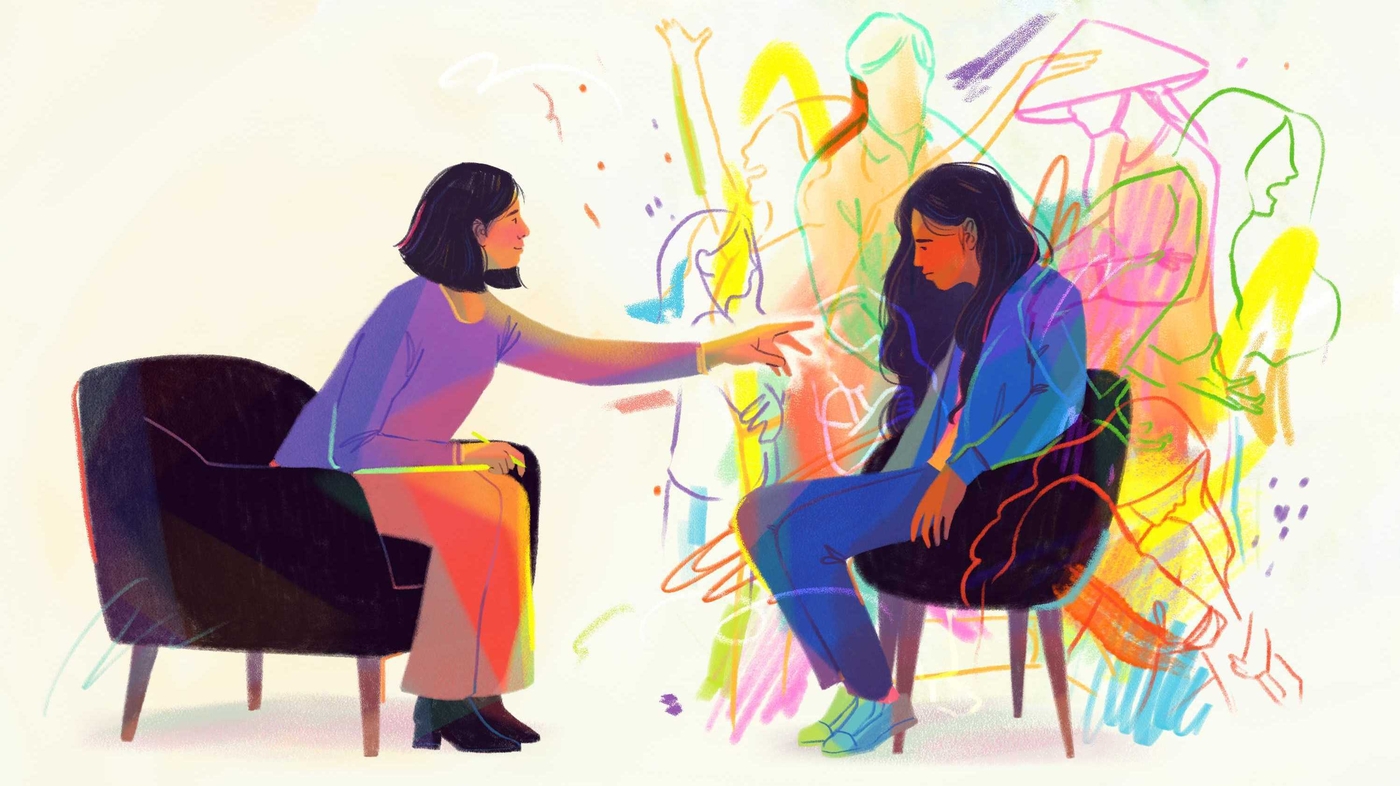
Culturally responsive therapy is a growing trend, as therapists of color try to make counseling more inclusive.

Cambodian American Eden Teng was was born in a refugee camp on the border of Thailand and Cambodia just a few years after the Cambodian genocide. She moved to the U.S. with her mom and aunt when she was 6.

Teng attributes much of her own resilience in transitioning to the U.S. to her exuberant mom, who wore whatever she wanted and wasn’t afraid to defy social norms — even when it was embarrassing for a teenage Teng.

But when she was growing up, Teng also witnessed the negative impacts of historical, racial and intergenerational trauma on her mom’s wellbeing. Teng often felt confused by the way her mom’s emotions could spiral out of control for seemingly no reason, or why why she had so many health problems.

When Teng first encountered psychology in college, she realized that her mother’s past was directly connected to her emotional and physical health. (Scientists are learning that stress and trauma are sometimes linked to chronic illnesses, like hypertension, diabetes and kidney disease.)

It was this realization that compelled Teng to become a therapist; in 2018 she began her graduate studies in Seattle.

But when COVID-19 hit and the Black Lives Matter movement came into full force, with communities of color having a more public conversation about their struggles in the U.S., Teng says she started feeling differently about her training and the profession she’d be entering. She began to notice how dealing with certain issues, including race and immigration, were not given priority in her clinical training — even though she knew how important they are in shaping a life.

“I didn’t feel represented, and I felt that so much of my family’s history just didn’t feel like it was considered,” she says, adding that she was studying under teachers who were predominantly white. “I just felt silenced in my own history [and] my own experience in the work that I was doing.”

Teng’s graduate program isn’t the only one like this. Therapy is a predominantly white field in the U.S. — 80{515baef3fee8ea94d67a98a2b336e0215adf67d225b0e21a4f5c9b13e8fbd502} of psychologists, 63{515baef3fee8ea94d67a98a2b336e0215adf67d225b0e21a4f5c9b13e8fbd502} of counselors and 59{515baef3fee8ea94d67a98a2b336e0215adf67d225b0e21a4f5c9b13e8fbd502} of social workers are white, according to Data USA, a website that constructs visualizations of public federal data.

Many of the founding ideas, techniques and schools of practice of therapy were developed by white scholars or practitioners. As a result, the field has marginalized the experiences of people of color, therapists and patients say. Microaggressions are also pervasive in psychological practice, researchers note, and many immigrants report not attending therapy because of language barriers, a lack of insurance and high costs.

That’s why Teng wanted to take a new approach. For her, that meant joining a growing movement of other counselors hoping to transform the practice of therapy, to make it more accessible and relevant to people of color and — ultimately — to help them find healing.

Embracing a practice of ‘decolonizing therapy’

Teng was initially inspired by people like Dr. Jennifer Mullan, who refer to this work as “decolonizing therapy,” a process of addressing the structural racism and other forms of oppression that keep therapy from serving many marginalized communities.

“I think the best way to describe decolonized therapy is that it is really making space to examine the external pressures, stressors, and layers of oppression that my clients have endured and survived,” Teng says.

She gives the example of microaggressions in the workplace, or job interviews. “There are opportunities that are not given to you because of your identities,” she says, “But if we look at it through the lens of self-esteem, it’s like ‘Something is wrong with you. You just need to think better about yourself,’ right? Like you need to be more positive.”

But for people of color, that framework of just being “more positive” doesn’t always work. It doesn’t account for racism, xenophobia and other forms of discrimination directed toward them. “The challenge,” Teng explains, “is to recognize that how you’re feeling about yourself can also be internalized oppression.”

Teng’s practice in decolonizing therapy digs into family history, helping her clients of color better understand how the historical oppression of their ancestors affects them. She says this is true for people from her own community, who experienced the genocide when the Khmer Rouge regime killed about 2.2 million people. “When we’re talking about Cambodian refugees and immigrants, there’s a history here that is so horrific, rich, and devastating.”

Teng finds children of Cambodian refugees who have been through the genocide can struggle with guilt. “In first-generation or second-generation Cambodian Americans, there’s this experience that your parents have sacrificed or have gone through so much,” she says. “They’ve experienced tremendous loss. And having that sense of their sacrifices, we feel we need to hold that harm and that grief and that pain.”

Holding onto a parent’s pain leads into tricky territory, says Teng. “We also feel that we have to transcend it by being perfect or striving to be so successful that we are becoming millionaires … versus really being with the gentleness of the grief, and the emotions that are being held and passed down.”

Using culturally responsive techniques

To respond to these issues, Teng has developed a few approaches that are different from the way she was trained. First, Teng often brings in the family to her practice.

“This may mean that we involve parents in sessions so that we can hear from their point of view,” she says. “When we’re in that space, there are a lot of opportunities to shed light on the impacts of being a child of immigrants. And through that lens — of being someone like a first generation immigrant — we can discuss the harm that is very much connected to the harm that parents have navigated.”

Teng supports the children and parents in openly discussing experiences like racism and genocide in a secure and validating environment. She says many who survived the genocide, had to suppress their feelings. “And so, when you have the experience of suppressing those [painful] emotions, you’re also suppressing joy and connection, belonging.”

Allowing her clients and their parents to experience the full spectrum of emotions can be healing, she says. “[They] can allow for positive attachments and relationships that feel meaningful.”

Teng also works against the stereotype of the detached therapist-as-expert. She makes clear to her clients that she may not have all of the answers, and prefers to be transparent with her clients about her own intergenerational trauma. “When we can really be with what’s hurting, we know we’re together in this,” she says. “I’m a part of this collective healing journey with my clients.”

Growing acceptance of the role of historical trauma

Like Teng, Ramona Beltran became interested in decolonizing therapy because of the issues she was seeing in her community of origin. She identifies as Xicana of Yaqui and Mexica descent and is a professor of social work at the University of Denver.

When she was at the start of her career, several of her family members passed away before they reached 60 years old and she found herself asking what the links are between her community’s history of trauma and their health.

When Beltran entered a doctorate program to study historical trauma 20 years ago, she wasn’t taken seriously at first, she says — such as when she gave some presentations on the theoretical framework of historical trauma and healing. “I remember this one [presentation] where they forwarded me the feedback, and several people were like, ‘This is political. It’s ideological. It doesn’t count as research. There’s nothing empirical about this. This isn’t like real academic work.'”

Now, Beltran says things have changed, “I teach a whole class on historical trauma and healing, and it’s always one of the classes that gets filled up right away,” she says. “And that, to me, is progress.”

When she was working on her master’s degree in social work, she says, she noticed that all of the evidence-based styles of practice she had learned in grad school weren’t enough.

“They were just like these kind of mainstream approaches to therapy that were generated from, primarily white, primarily middle class families,” Beltran remembers. “And so maybe they would be translated into Spanish, but to me, what I was seeing was that those practices weren’t really generating a lot of healing.”

Now when she teaches, Beltran emphasizes that decolonizing can take different forms, depending on the experience of the therapist and the shared experiences of the community the therapist is trying to reach.

She highlights three key aspects of culturally responsive therapy: building authentic relationships, ensuring community representation, and re-connecting with one’s cultural background. Like Teng, Beltran is especially interested in working with clients to help them see their culture as a form of intergenerational strength, rather than suffering.

A growing need for culturally responsive therapy

While therapists like Beltran and Teng are committed to making therapy more inclusive, communities of color continue to struggle with getting access to therapists. Teng gets a lot of people contacting her who she simply cannot help. “I’m only licensed to see folks in my area, and there are so many that are interested. And it breaks my heart every time, where I’m not able to provide support.”

She notes that this is especially common for clients living in areas with few clinicians available. “I had one from Kansas most recently, who was like, ‘We don’t have any Khmer therapists anywhere in the state.’ But, unfortunately, I’m not able to provide that service.”

Teng knows what it’s like to lack access to therapy. “I myself haven’t had a therapist of my own who practiced the way that I do until most recently,” she says.

But there have been some recent moves in the right direction, Teng says. Organizations like Inclusive Therapists created the BIPOC Therapy Fund to provide financial help for at least four initial sessions for people of color seeking therapy. The Asian Mental Health Collective also created the Lotus Therapy Fund to provide financial support to Asian therapy seekers for eight sessions.

And the largest professional organization of psychologists in the U.S. is also promising to make changes. Last year, the American Psychological Association issued a formal apology for its role in what it called “promoting, perpetuating and failing to challenge racism, racial discrimination and human hierarchy in the U.S.“

The APA promised to support more research centered on non-Western perspectives, provide more access to culturally competent training, and create more opportunities for people of color to enter the field of psychology. This August, the organization committed $1.1 million to a new Racial Equity Fund to carry out these three goals.

Teng says she hopes to see more funds dedicated to helping people of color get access to therapy that recognizes their history and experiences.

“There’s no way that we can just say that we’re going to look at this from a cultural lens without actually looking through the historical, intergenerational lens,” she says. “And so, it has to be comprehensive and interconnected for it to truly honor the human being that is in front of you.”

How black athletes pioneered the sport of distance running : Shots

How black athletes pioneered the sport of distance running : Shots

Cover of Running While Black byAlison Mariella Desir.

Penguin Random House


hide caption

toggle caption

Penguin Random House


Cover of Running While Black byAlison Mariella Desir.

Penguin Random House

Runners are skinny white people. This was what Alison Mariella Désir thought until she came across a social media post from a friend, a 200-pound Black man, who was training for his first marathon.

Looking for a way to break through a persistent bout of depression, she signed up for a marathon as well. Much to her surprise, after 16 weeks of training with a Leukemia & Lymphoma Society running club in Manhattan’s Central Park, Désir completed the race. And from then on she was hooked.

In her new memoir Running While Black: Finding Freedom in a Sport That Wasn’t Built for Us, Désir tells the story of her non-traditional path to long distance running. Along the way, she reframes the history of American running by including the contributions of little known, yet influential Black runners in the narrative. Runners like ultra-marathon pioneer Ted Corbitt, Olympian and activist Wyomia Tyus and the first Black woman to win a marathon Marilyn Bevans, among others.

In the decade since her start in the sport, she’s completed many runs, including the New York and Boston Marathons and the Run For All Women from Harlem to Washington, DC. She’s also served as a founding co-chair of the Running Industry Diversity Coalition, a nonprofit founded in July 2020 that is devoted to increasing racial equity and fostering greater inclusion across all aspects of the sport and associated industry.

As Running While Black makes a case for why anyone might consider giving running a try, it also delivers a searing indictment of the ways in which the running industry perpetuates white supremacy and the marginalization of non-white voices. Désir also advocates for concrete steps the sport can take toward becoming more inclusive.

Author Alison Désir says running helped her reconnect with her body and gain insight into herself. She founded the running group Harlem Run to help other people of color find their way into the sport.

Brandon Williams


hide caption

toggle caption

Brandon Williams


Author Alison Désir says running helped her reconnect with her body and gain insight into herself. She founded the running group Harlem Run to help other people of color find their way into the sport.

Brandon Williams

Désir spoke to NPR about how running transformed her relationship to her body, starting a running club in Harlem focused on attracting more people of color to the sport, and what she tells people who are intimidated by marathons.

This interview has been edited for length and clarity.

When did you first get the idea to write this book?

After the murder of Ahmaud Arbery [in 2020]. I wrote this [op-ed] piece right before Mother’s Day, which is also Ahmaud’s birthday, about this new weight of living in this world as a Black woman with a son, who one day may find himself in spaces where he’s unable to move freely through, where he has to correct himself or make himself small in order to appease the white gaze. And I talked about how the running industry, the running community, has always been deeply racially divided.

The op-ed went viral. Black folks were like, ‘Thank you for finally putting this into words, what our experience is.’ And many white people were completely shocked, had never considered what it was to run as somebody who was not white. And I was like, ‘Okay, I need to write this book so that it hopefully draws awareness to these inequities and enacts some change.’

Give us an example of how running has changed your life and why embodiment is important.

When I was running my first marathon I was depressed, I was struggling with anxiety. My body was like a shell and all I wanted was to mute any kind of feeling that I had. I was drinking, I was overdosing on NyQuil [and] taking Xanax. And what running provided for me was my body was awakened again. It was simple things like recognizing that, Oh, when I run this distance, I have pain in my muscles and that means that I’ve been working hard. [Or], ‘when I’m running at this pace, my breath sounds like this.’

I just started to notice what was going on with my body and receive that feedback, which is a really powerful force. Many of us are so disconnected from our bodies, we start to lose sense of what it’s telling us. So running for me was reconnecting with who I was.

And I want that experience for everybody. It doesn’t necessarily just come through running, it can come through walking, kayaking, hiking, any activity that’s repetitive, that allows you to receive feedback and gain insight into yourself.

Wyomia Tyus breaks the tape to win the women’s 100-meter Olympic final, October 15, 1968, in Mexico City, beating out teammate Barbara Ferrell, center, who was second, and Irena Szewinski, left, of Poland who was third. Tyus’s time of 11.0 seconds, bettered the official world and Olympic records.

AP


hide caption

toggle caption

AP

When did you know that running was going to become an important part of your life, and something you wanted to share with your community?

I completed that first marathon and I knew that I wanted to continue running. But I also knew that throughout my experience, there were mostly white people around. I wanted to ultimately share this transformation with other people like me. I knew that there were other Black people in my community, who if only they started long distance running, they could feel the same things that I felt. They could see their world expanding. They could feel a deep sense of connection. They could really work out problems on the run.

So I started this organization, Harlem Run. It was through building it that I first became aware that there was an industry – that there are people who want to sell us things. There are people who are feeding this idea of who a runner is. At the time, I thought that a runner was a skinny white person. I remember looking at magazines and thinking, ‘Wow, there are only white people on the cover.’ I started to realize these messages didn’t just appear in my head, I’m consuming the industry the way that this sport is commodified.

At what point did you know that you were making a difference with Harlem Run?

I knew that I was making a difference when the same people [kept] coming back. It was people who were looking forward to this Monday evening activity, because there was the opportunity to share stories with folks. People were sharing really vulnerable pieces of themselves. People were challenging themselves physically. And also, as adults, we don’t really get an opportunity to feel a part of something like when you’re younger. So people finally felt like they had this other community. And I remember one of the guys asking “can we make sweatshirts with Harlem Run on them?” And I was like, ‘Oh, my gosh, people want to scream from the rooftops that this is theirs. ‘

You started out writing about the history of running and then you discovered something new about the contributions of Black Americans to running. Tell us about that.

I was on this panel about the legacy of Ted Corbitt. [I learned] that without Ted Corbitt and the New York Pioneer Club, an organization from Harlem founded by three Black men [in 1936], there would be no long distance running movement. It blew my mind. I thought, well, we were there, like we’ve been here this entire time, we’re responsible for why the sport exists. And yet, we’re made to feel secondary or excluded? And that shook me. On one hand, it made me realize, well, it’s my responsibility. Ted Corbitt and others, they blazed the trail and now I have to carry the torch and tell this story. But it also made me realize just how fragile history is and how in the wrong hands, history is contorted in a way that Black and brown folks don’t even matter.

Left: Archival photo of Ted Corbitt. Right: Ted Corbitt at the 1975 New York City Marathon.

Gary Corbitt/ Screenshot by NPR/Alamy Stock Photo


hide caption

toggle caption

Gary Corbitt/ Screenshot by NPR/Alamy Stock Photo

So tell us more about Ted Corbitt and the impact of the New York Pioneer Running Club.

Corbitt was born in the South and he lived in New York. He was just an incredible athlete. He would run like 20 miles a day, 10 miles to work 10 miles back. He was regularly running 100-mile races. Many people call him the grandfather of long distance running, or the father of the ultra marathon.

He’s the one who ushered in this movement of precise mileage, of actually marking courses. He brought this concept of, if we want our sport to grow, we really have to have accurate measuring. That laid the foundation for long distance running being competitive and being taken seriously.

Perhaps most importantly, Ted Corbitt is the person who had the idea for the five borough New York City Marathon. If you were to Google that information right now, you will likely not find that story, because a white man is credited for that.

New York Road Runners, which manages the New York City Marathon, directly descended from the New York Pioneer Club. [The founders] were revolutionary in saying that this would be a club for people of all races. This was before baseball was integrated. This was revolutionary, having Jewish people, Black people and Irish folks running together. You’re talking about really the creation of what we say [now] about running being accessible. Those are ideas from Black folks. It’s a civil rights story.

Watch Ted Corbitt’s son Gary Corbitt talk about his father’s legacy.


VICE TV
YouTube

You can find a bust of Ted Corbitt in the New York Roadrunners’ RunCenter. But when you think about who has been championed, and whose name is said, it is not any of the folks from the New York Pioneer Club, or Ted Corbitt. That’s something that New York Road Runners is working to address, but it’s sort of like we’re going back to make a correction. Everybody should have known his name.

And I just think like, Wow, what an impact would that have been? If I had known that Ted Corbitt, and these three Black men in Harlem and this organization existed, I would have known that long distance running is for me, because my people helped create it.

I have to say that it is a mind-bending thing to realize that the father of ultra-marathons was a Black man running to work.

Exactly. On the one hand, we regularly hear things like Black people don’t do X or like, this is white people [stuff]. But then on the other hand, you think about the climate in which Ted Corbitt was running, where often he had to skip events because they were dangerous for him [as a Black man], or he would use the Green Book in order to figure out where he could stay in the country. There were instances where the New York Pioneer Club actually decided not to participate in a race, because they would have to stay in segregated dorms, and they decided to protest that. There’s just levels to the ways in which we are divorced from our stories and our histories, and then made to believe that something is not for us. I hope that my book forces people to question the stories that are being told.

What do you hope stakeholders in the running industry will take away from your book?

The last third [of my book] is challenging the industry to take action. And I put it in the context of “will the industry have the endurance to stick with it?” Because long distance running is an endurance sport. And what I hope is through reading this book that people feel called to continue to take action.

In the past two years, there was a lot of excitement and interest initially, because these issues of racial inequity felt really tangible. [Now] it has sort of trickled out and it’s no longer making the news, so it doesn’t feel as urgent. But I hope that a book like this reminds people that while the work is urgent, it’s a marathon. It’s about your daily choices as an individual. It’s about your civic engagement. It’s about the decisions that you make in the boardroom. It’s about who’s in your marketing materials.

And on the other side of it, I also hope that Black folks realize that whether or not the industry changes as fast as we’d like it to, we are resilient, powerful, innovative and we will continue to create our own spaces where we can thrive.

What would you say to people who might be intimidated by long distance running?

Running is really hard. If it weren’t hard, everyone would be doing it. But I will say that it’s not that it gets easier, but that you become more equipped at doing it. You get more comfortable with the discomfort, and you get stronger. And it becomes something that you love.

For many people, when they think of running, they’re thinking of a particular person or a particular experience that they’ve seen. So when they say I can’t run, it’s because they’re thinking of Allyson Felix running the 400 meters in the Olympics. But running is many things. You can move in a way that will be good for your body. And that can start as walking, that can be run-walking. So I would say give yourself some grace, but by all means, try it.

Beandrea July (@beandreadotcom) is a writer and audio producer from Dayton, Ohio.

Montana health officials call out hospitals for too little charity : Shots

Montana health officials call out hospitals for too little charity : Shots

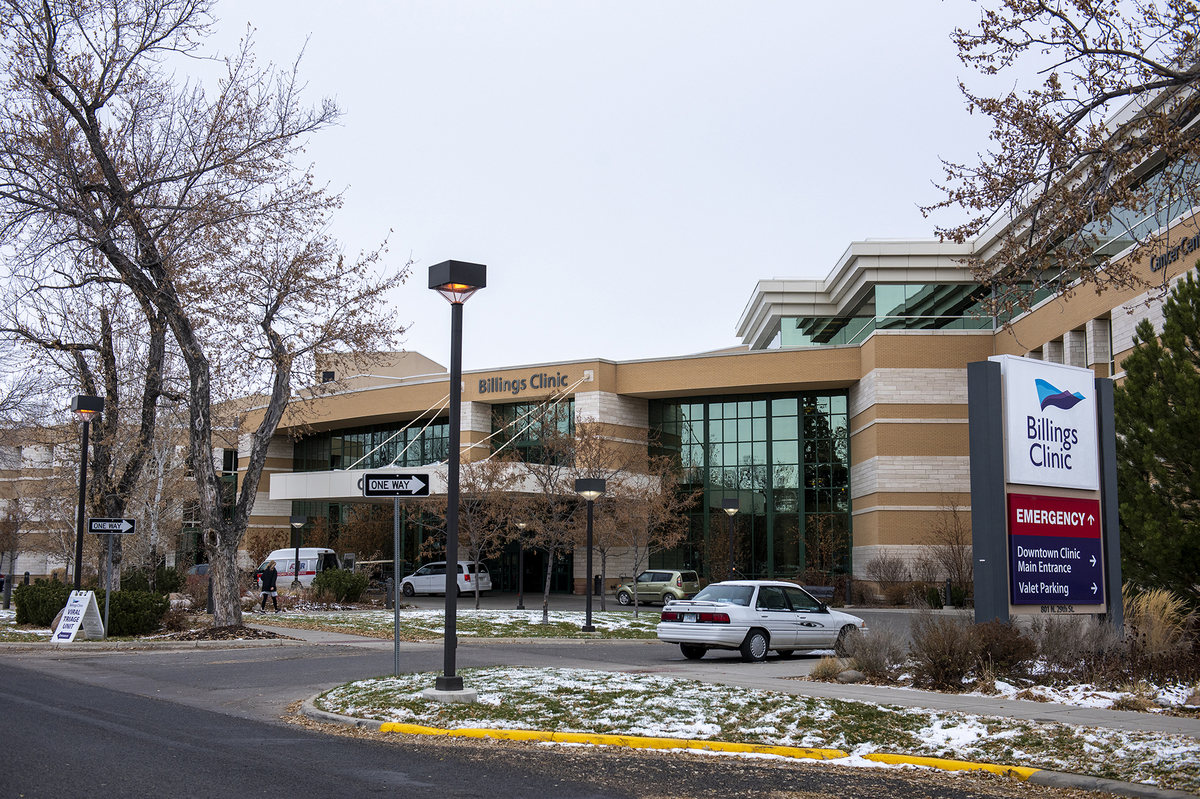
Montana health officials are seeking to increase oversight of nonprofit hospitals amid debate about whether they pay their fair share. The proposal comes nine months after a KHN investigation found that some of Montana’s wealthiest hospitals, such as the Billings Clinic, lag behind state and national averages in community giving.

Lynn Donaldson/Bloomberg via Getty Images


hide caption

toggle caption

Lynn Donaldson/Bloomberg via Getty Images


Montana health officials are seeking to increase oversight of nonprofit hospitals amid debate about whether they pay their fair share. The proposal comes nine months after a KHN investigation found that some of Montana’s wealthiest hospitals, such as the Billings Clinic, lag behind state and national averages in community giving.

Lynn Donaldson/Bloomberg via Getty Images

Montana health officials are proposing to oversee and set standards for the charitable contributions that nonprofit hospitals make in their communities each year to justify their access to millions of dollars in tax exemptions.

The proposal is part of a package of legislation that the state Department of Public Health and Human Services will ask lawmakers to approve when they convene in January. It comes two years after a state audit called on the department to play more of a watchdog role and nine months after a KHN investigation found some of Montana’s wealthiest hospitals lag behind state and national averages in community giving.

A call for more transparency in what counts as charity

Montana state Sen. Bob Keenan, a Republican who has questioned whether nonprofit hospitals deserve their charity status, calls the proposal a start that could be expanded on later.

“Transparency is the name of the game here,” Keenan says.

The IRS requires nonprofit hospitals to tally what they spend to “promote health” to benefit “the community as a whole.” How hospitals count such contributions to justify their tax exemptions is opaque and varies widely. National researchers who study community benefits have called for tightening standards for what counts toward the requirement.

Montana is one of the most recent states to consider imposing new rules or increasing oversight of nonprofit hospitals amid questions about whether they pay their fair share. Dr. Vikas Saini, president of the national health care think tank Lown Institute, says that both at a state and local level, people in California are exploring whether to monitor hospital community benefits and enforce new standards. Last year, Oregon initiated a minimum amount that nonprofit hospitals must spend on community benefits. And Massachusetts has updated its community benefits guidelines in recent years, pushing hospitals to give more detailed assessments of how the spending lines up with identified health needs.

Montana hospital industry officials say they want to work with the state to shape the proposed legislation, which they say the industry would support if it doesn’t conflict with federal rules. Saini says that to have an impact, any legislation would have to go beyond federal requirements.

Major tax breaks are at stake

In recent years, more people, like Keenan and Saini, have questioned whether nonprofit hospitals are contributing enough to their communities to deserve the major tax breaks they get while becoming some of the largest businesses in town.

“The hospitals are sort of the pillars of communities, but people are starting to ask these questions,” Saini says.

Saini’s institute reviews hospitals’ giving each year and has found that the majority of nonprofit systems nationwide spend less on what the institute calls “meaningful” benefits than the estimated value of their tax breaks. Actions the institute counts include financial aid to patients and community investments such as food assistance, health education or services offered at a loss, including addiction treatment.

The 2020 Montana audit found that hospitals in the state report benefits vaguely and inconsistently, making it difficult to determine whether their charity status is justified. However, state lawmakers didn’t address the issue in their 2021 biennial legislative session, and a Legislative Audit Division memorandum issued in June found the state health department had “made no meaningful progress” toward developing oversight of nonprofit hospitals’ charitable giving since then.

KHN found that Montana’s nearly 50 nonprofit hospitals directed roughly 8{515baef3fee8ea94d67a98a2b336e0215adf67d225b0e21a4f5c9b13e8fbd502} of their total annual expenses, on average, toward community benefits in the tax year that ended in 2019. The national average was 10{515baef3fee8ea94d67a98a2b336e0215adf67d225b0e21a4f5c9b13e8fbd502}.

In some cases, hospitals’ giving percentages have declined since then. For example, in the tax year that ended in 2019, Logan Health-Whitefish — a small hospital that’s part of the larger Flathead Valley health system — reported that less than 2{515baef3fee8ea94d67a98a2b336e0215adf67d225b0e21a4f5c9b13e8fbd502} of its overall spending went toward community benefits. In its latest available documents, for the period ending in 2021, the hospital reported spending less than 1{515baef3fee8ea94d67a98a2b336e0215adf67d225b0e21a4f5c9b13e8fbd502} of its expenses on community benefits while it made $15 million more than it spent.

An alternative to oversight?

Logan Health spokesperson Mellody Sharpton says the medical system’s overall community benefit is equal to nearly 9{515baef3fee8ea94d67a98a2b336e0215adf67d225b0e21a4f5c9b13e8fbd502} of its spending, reaching across its six hospitals. It also has clinics throughout the valley. “It’s important to consider our organization’s community benefit as a whole,” Sharpton says, “as our facilities collaborate to ensure the appropriate care is provided at the appropriate facility to meet our patients’ health needs.”

State health officials asked lawmakers to allow the agency to draft a bill that would give the health department clear authority to require hospitals to submit annual reports that include data on community benefit and charity care. The measure also would allow the department to develop standards for that spending on community benefit, according to the department’s description of its proposal.

“We see a great need here to move the ball forward,” state health department leader Charlie Brereton told lawmakers in August.

Montana Hospital Association President Rich Rasmussen says his organization wants to work with the health department in honing the legislation but says the definition of what counts as benefits should remain broad so hospitals can respond to their area’s most pressing needs.
Furthermore, he says, hospitals are already working on their own reporting standards. This year, the association created a handbook for members and set a 2023 goal for hospitals to uniformly report their community benefits, Rasmussen says. The association declined to provide a copy of the handbook, saying it would be available to the public once hospitals are trained on how to use it later this fall.

The association also plans to create a website that will serve as a one-stop shop for people who want to know how hospitals are reporting community benefits and addressing local health concerns, among other things.

Republican state Rep. Jane Gillette says she supports increased health department oversight and the idea behind the association’s website, but doesn’t think the hospital industry should produce that public resource alone. Gillette says she plans to introduce legislation to require hospitals to report community benefits data to a group outside the industry — such as the state — which would then post the information online.

Hospitals have resisted new rules like these in the past

In the past, hospitals have resisted attempts to impose new rules on community benefit spending. In an interview with KHN last year, Jason Smith, then Bozeman Health’s chief advancement officer, said the system supported efforts to improve reporting contributions “outside of new legislation,” adding that hospitals can do better work without “state oversight bodies being placed in the arena with us.”

Asked whether the health system still stands by that statement, Denise Juneau, Bozeman Health’s chief government and community affairs officer, says hospital officials hope any new legislation will align with existing federal guidelines. She says Bozeman Health will continue to work with the Montana Hospital Association to define and provide better information on community benefit, with or without new legislation.

A lawmaker would have to back the state’s proposal by mid-December to keep it alive.

KHN (Kaiser Health News) is a national, editorially independent project of the Kaiser Family Foundation.