

Medicaid grew a lot during the pandemic. Soon, it will shrink again. : Shots

Medicaid grew a lot during the pandemic. Soon, it will shrink again. : Shots

George Mink Jr. is a health care outreach worker in Delaware County, Pa. He worries about what will happen when vaccines are no longer paid for by the federal government. (Kimberly Paynter/WHYY)

Kimberly Paynter/WHYY


hide caption

toggle caption

Kimberly Paynter/WHYY


George Mink Jr. is a health care outreach worker in Delaware County, Pa. He worries about what will happen when vaccines are no longer paid for by the federal government. (Kimberly Paynter/WHYY)

Kimberly Paynter/WHYY

Robert, who lives in Philadelphia, knows signing up for Medicaid can be tricky with his ADHD, so he brought his daughter along to help him fill out the paperwork.

“If we miss one little detail, they would reject you,” says Robert, who has had the government health insurance for people on low incomes in the past. “I usually get two applications, so if I mess up on one. I can do the other one.”

This time, with his daughter’s help, the application only took Robert a half hour. (NPR agreed to use Robert’s first name only because he has a medical condition he would like to keep private.)

Signing up for Medicaid correctly is about to become an important step for enrollees again after a three-year break from paperwork hurdles. In 2020, the federal government recognized that a pandemic would be a bad time for people to lose access to medical care, so it required states to keep people on Medicaid as long as the country was in a public health emergency. The pandemic continues and so has the public health emergency, most recently renewed on Jan. 11.

But the special Medicaid measure known as “continuous enrollment” will end on March 31, 2023 no matter what. It was part of the budget bill Congress passed in Dec. 2022. Even if the public health emergency is renewed in April, states will begin to make people on Medicaid sign up again to renew their coverage. And that means between 5 and 14 million Americans could lose their Medicaid coverage, according to the Kaiser Family Foundation, the nonpartisan health policy organization..

The federal Department of Health and Human Services expects 6.8 million people to lose their coverage even though they are still eligible, based on historical trends looking at paperwork and other administrative hurdles. Pre-pandemic, some states made signing up for and re-enrolling in Medicaid very difficult to keep people off the rolls.

In the three pandemic years, the number of Americans on Medicaid and CHIP – the Children’s Health Insurance Program – swelled to 90.9 million, an increase of almost 20 million.

Jenn Lydic is the director of social services and community engagement at the Public Health Management Corporation, a nonprofit that runs six health centers in Philadelphia. She says the reprieve from renewal paperwork “allowed for a continuity that I think has really been lifesaving for a lot of folks.”

“I know so many patients who have now been able to really finally get ahead of a lot of their health conditions,” Lydic says.

Research shows that disruptions in Medicaid coverage can lead to delayed care, less preventative care, and higher health care costs associated with not managing chronic conditions like diabetes and substance-use disorder.

Philadelphia Health Commissioner Cheryl Bettigole worked in city health centers for years. She said the continuous Medicaid enrollment and pandemic measures like free access to COVID-19 tests and treatments have been a big advance. She would like to see some of that last.

“There was this moment with the pandemic in which we recognized that it was really important for everybody to have access to care. And we’ve somehow changed our minds about that,” says Bettigole. “If we were to have a newer, better vaccine that lasts longer, we would want everyone to get that. We recognized it for a moment, for a single condition, and now we’re kind of walking back from that. I do think that’s a pity.”

The boosted Medicaid rolls mean the country has a historically high rate of people with insurance at 92{515baef3fee8ea94d67a98a2b336e0215adf67d225b0e21a4f5c9b13e8fbd502}. That rate is likely to erode as Medicaid winnows down again. States do have some discretion on how they re-start the sign up process. It could take a few months to a year. If a state finds someone to be no longer eligible for Medicaid, they won’t be cut off immediately, said Jennifer Tolbert, associate director for the program on Medicaid and the uninsured at the Kaiser Family Foundation. The Pennsylvania Department of Human Services said it will take a full year to do this and is working to make sure no one experiences a lapse in health coverage.

The federal government also increased Medicaid funding to the states in 2020, and that increased funding won’t start phasing out until the end of 2023. Tolbert added that the move to keep people enrolled on Medicaid continuously is truly unprecedented, but there will be some lasting changes from the pandemic.

For instance, Oregon will allow children who qualify for Medicaid to enroll at birth, and stay enrolled until age 6, without having to reapply. Washington, California, and New Mexico are considering similar policies as well.

Another concern is what happens when the federally-funded supply of COVID-19 vaccines and tests ends. Last August, the federal government announced they do not have more funds from Congress to pay for COVID-19 vaccines. In March 2022, the federal government stopped paying for tests for uninsured patients.

George Mink Jr. is a community activist for Health Educated, a nonprofit in Delaware County that has hosted vaccine clinics, health fairs, and webinars. He took advantage of free Covid testing and vaccines early in the pandemic. Mink said he might not have gotten tested if he had to have health insurance or pay for it himself. He has not had any serious health issues, but in 2020, a close family friend died from COVID-19. Mink and his family got tested and found out they were positive.

“Who knows what could have happened?’ he says. “We still would have been … infecting other people. It made a major difference.”

Mink is also up to date with his COVID-19 vaccinations, but worries about what will happen when the vaccines are no longer free: “What if in two months, we got a new variant coming and now I need a new booster, and now I can’t afford it?”

Dr. Kristin Motley, a pharmacist, founded Health Educated, an outreach organization in Delaware County, Pa. Flyers for the podcast she hosts with George Mink Jr. (Kimberly Paynter/WHYY)

Kimberly Paynter/WHYY


hide caption

toggle caption

Kimberly Paynter/WHYY
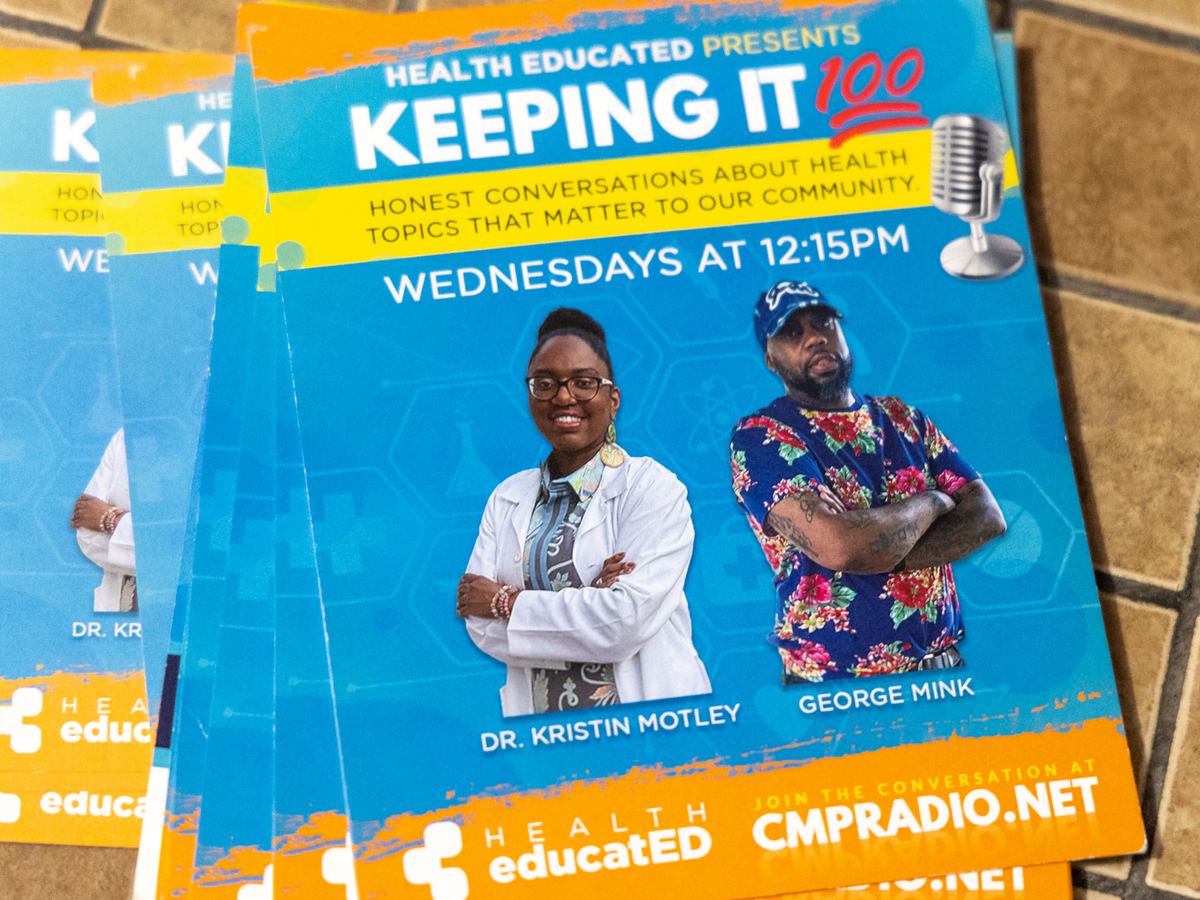

Dr. Kristin Motley, a pharmacist, founded Health Educated, an outreach organization in Delaware County, Pa. Flyers for the podcast she hosts with George Mink Jr. (Kimberly Paynter/WHYY)

Kimberly Paynter/WHYY

The health departments in Pennsylvania and Delaware say they plan to keep providing free tests and vaccines for the foreseeable future, and that the federal government has yet to say when the free vaccine supply will be cut off.

Pharmacist Kristin Motley, the founder of the Health Educated nonprofit where Mink works, will be sorry to see the free vaccines go.

“It allowed us to go into the community, wherever people were and to say, you don’t have to register, you don’t have to bring I.D., you don’t have to bring insurance. You just come,” she says. “That was really nice to be able to help people in that way with no red tape, no bureaucracy. It was so seamless.”
Therapy by AI holds promise and challenges : Shots

Therapy by AI holds promise and challenges : Shots
Some companies and researchers think smart computers might eventually help with provider shortages in mental health, and some consumers are already turning to chatbots to build "emotional resilience."

Just a year ago, Chukurah Ali had fulfilled a dream of owning her own bakery — Coco’s Desserts in St. Louis, Mo. — which specialized in the sort of custom-made ornate wedding cakes often featured in baking show competitions. Ali, a single mom, supported her daughter and mother by baking recipes she learned from her beloved grandmother.

But last February, all that fell apart, after a car accident left Ali hobbled by injury, from head to knee. “I could barely talk, I could barely move,” she says, sobbing. “I felt like I was worthless because I could barely provide for my family.”

As darkness and depression engulfed Ali, help seemed out of reach; she couldn’t find an available therapist, nor could she get there without a car, or pay for it. She had no health insurance, after having to shut down her bakery.

So her orthopedist suggested a mental-health app called Wysa. Its chatbot-only service is free, though it also offers teletherapy services with a human for a fee ranging from $15 to $30 a week; that fee is sometimes covered by insurance. The chatbot, which Wysa co-founder Ramakant Vempati describes as a “friendly” and “empathetic” tool, asks questions like, “How are you feeling?” or “What’s bothering you?” The computer then analyzes the words and phrases in the answers to deliver supportive messages, or advice about managing chronic pain, for example, or grief — all served up from a database of responses that have been prewritten by a psychologist trained in cognitive behavioral therapy.

That is how Ali found herself on a new frontier of technology and mental health. Advances in artificial intelligence — such as Chat GPT — are increasingly being looked to as a way to help screen for, or support, people who dealing with isolation, or mild depression or anxiety. Human emotions are tracked, analyzed and responded to, using machine learning that tries to monitor a patient’s mood, or mimic a human therapist’s interactions with a patient. It’s an area garnering lots of interest, in part because of its potential to overcome the common kinds of financial and logistical barriers to care, such as those Ali faced.

Potential pitfalls and risks of chatbot therapy

There is, of course, still plenty of debate and skepticism about the capacity of machines to read or respond accurately to the whole spectrum of human emotion — and the potential pitfalls of when the approach fails. (Controversy flared up on social media recently over a canceled experiment involving chatbot-assisted therapeutic messages.)

“The hype and promise is way ahead of the research that shows its effectiveness,” says Serife Tekin, a philosophy professor and researcher in mental health ethics at the University of Texas San Antonio. Algorithms are still not at a point where they can mimic the complexities of human emotion, let alone emulate empathetic care, she says.

Tekin says there’s a risk that teenagers, for example, might attempt AI-driven therapy, find it lacking, then refuse the real thing with a human being. “My worry is they will turn away from other mental health interventions saying, ‘Oh well, I already tried this and it didn’t work,’ ” she says.

But proponents of chatbot therapy say the approach may also be the only realistic and affordable way to address a gaping worldwide need for more mental health care, at a time when there are simply not enough professionals to help all the people who could benefit.

Someone dealing with stress in a family relationship, for example, might benefit from a reminder to meditate. Or apps that encourage forms of journaling might boost a user’s confidence by pointing when out where they make progress.

Proponents call the chatbot a ‘guided self-help ally’

It’s best thought of as a “guided self-help ally,” says Athena Robinson, chief clinical officer for Woebot Health, an AI-driven chatbot service. “Woebot listens to the user’s inputs in the moment through text-based messaging to understand if they want to work on a particular problem,” Robinson says, then offers a variety of tools to choose from, based on methods scientifically proven to be effective.

Many people will not embrace opening up to a robot.

Chukurah Ali says it felt silly to her too, initially. “I’m like, ‘OK, I’m talking to a bot, it’s not gonna do nothing; I want to talk to a therapist,” Ali says, then adds, as if she still cannot believe it herself: “But that bot helped!”

At a practical level, she says, the chatbot was extremely easy and accessible. Confined to her bed, she could text it at 3 a.m.

“How are you feeling today?” the chatbot would ask.

“I’m not feeling it,” Ali says she sometimes would respond.

The chatbot would then suggest things that might soothe her, or take her mind off the pain — like deep breathing, listening to calming music, or trying a simple exercise she could do in bed. Ali says things the chatbot said reminded her of the in-person therapy she did years earlier. “It’s not a person, but, it makes you feel like it’s a person,” she says, “because it’s asking you all the right questions.”

Technology has gotten good at identifying and labeling emotions fairly accurately, based on motion and facial expressions, a person’s online activity, phrasing and vocal tone, says Rosalind Picard, director of MIT’s Affective Computing Research Group. “We know we can elicit the feeling that the AI cares for you,” she says. But, because all AI systems actually do is respond based on a series of inputs, people interacting with the systems often find that longer conversations ultimately feel empty, sterile and superficial.

While AI may not fully simulate one-on-one individual counseling, its proponents say there are plenty of other existing and future uses where it could be used to support or improve human counseling.

AI might improve mental health services in other ways

“What I’m talking about in terms of the future of AI is not just helping doctors and [health] systems to get better, but helping to do more prevention on the front end,” Picard says, by reading early signals of stress, for example, then offering suggestions to bolster a person’s resilience. Picard, for example, is looking at various ways technology might flag a patient’s worsening mood — using data collected from motion sensors on the body, activity on apps, or posts on social media.

Technology might also help improve the efficacy of treatment by notifying therapists when patients skip medications, or by keeping detailed notes about a patient’s tone or behavior during sessions.

Maybe the most controversial applications of AI in the therapy realm are the chatbots that interact directly with patients like Chukurah Ali.

What’s the risk?

Chatbots may not appeal to everyone, or could be misused or mistaken. Skeptics point to instances where computers misunderstood users, and generated potentially damaging messages.

But research also shows some people interacting with these chatbots actually prefer the machines; they feel less stigma in asking for help, knowing there’s no human at the other end.

Ali says that as odd as it might sound to some people, after nearly a year, she still relies on her chatbot.

“I think the most I talked to that bot was like 7 times a day,” she says, laughing. She says that rather than replacing her human health care providers, the chatbot has helped lift her spirits enough so she keeps those appointments. Because of the steady coaching by her chatbot, she says, she’s more likely to get up and go to a physical therapy appointment, instead of canceling it because she feels blue.

That’s precisely why Ali’s doctor, Washington University orthopedist Abby Cheng, suggested she use the app. Cheng treats physical ailments, but says almost always the mental health challenges that accompany those problems hold people back in recovery. Addressing the mental-health challenge, in turn, is complicated because patients often run into a lack of therapists, transportation, insurance, time or money, says Cheng, who is conducting her own studies based on patients’ use of the Wysa app.

“In order to address this huge mental health crisis we have in our nation — and even globally — I think digital treatments and AI can play a role in that, and at least fill some of that gap in the shortage of providers and resources that people have,” Cheng says.

Not meant for crisis intervention

But getting to such a future will require navigating thorny issues like the need for regulation, protecting patient privacy and issues of legal liability. Who bears responsibility if the technology goes wrong?

Many similar apps on the market, including those from Woebot or Pyx Health, repeatedly warn users that they are not designed to intervene in acute crisis situations. And even AI’s proponents argue computers aren’t ready, and may never be ready, to replace human therapists — especially for handling people in crisis.

“We have not reached a point where, in an affordable, scalable way, AI can understand every sort of response that a human might give, particularly those in crisis,” says Cindy Jordan, CEO of Pyx Health, which has an app designed to communicate with people who feel chronically lonely.

Jordan says Pyx’s goal is to broaden access to care — the service is now offered in 62 U.S. markets and is paid for by Medicaid and Medicare. But she also balances that against worries that the chatbot might respond to a suicidal person, ” ‘Oh, I’m sorry to hear that.’ Or worse, ‘I don’t understand you.’ ” That makes her nervous, she says, so as a backup, Pyx staffs a call center with people who call users when the system flags them as potentially in crisis.

Woebot, a text-based mental health service, warns users up front about the limitations of its service, and warnings that it should not be used for crisis intervention or management. If a user’s text indicates a severe problem, the service will refer patients to other therapeutic or emergency resources.

Cross-cultural research on effectiveness of chatbot therapy is still sparse

Athena Robinson, chief clinical officer for Woebot, says such disclosures are critical. Also, she says, “it is imperative that what’s available to the public is clinically and rigorously tested,” she says. Data using Woebot, she says, has been published in peer-reviewed scientific journals. And some of its applications, including for post-partum depression and substance use disorder, are part of ongoing clinical research studies. The company continues to test its products’ effectiveness in addressing mental health conditions for things like post-partum depression, or substance use disorder.

But in the U.S. and elsewhere, there is no clear regulatory approval process for such services before they go to market. (Last year Wysa did receive a designation that allows it to work with Food and Drug Administration on the further development of its product.)

It’s important that clinical studies — especially those that cut across different countries and ethnicities — continue to be done to hone the technology’s intelligence and its ability to read different cultures and personalities, says Aniket Bera, an associate professor of computer science at Purdue.

“Mental-health related problems are heavily individualized problems,” Bera says, yet the available data on chatbot therapy is heavily weighted toward white males. That bias, he says, makes the technology more likely to misunderstand cultural cues from people like him, who grew up in India, for example.

“I don’t know if it will ever be equal to an empathetic human,” Bera says, but “I guess that part of my life’s journey is to come close.”

And, in the meantime, for people like Chukurah Ali, the technology is already a welcome stand-in. She says she has recommended the Wysa app to many of her friends. She says she also finds herself passing along advice she’s picked up from the app, asking friends, “Oh, what you gonna do today to make you feel better? How about you try this today?”

It isn’t just the technology that is trying to act human, she says, and laughs. She’s now begun mimicking the technology.

Obamacare hits a record number of signups : Shots

Obamacare hits a record number of signups : Shots
An illustration of cookie jars labeled "HMO" and "PPO."

The Very affordable Treatment Act health insurance plan marketplaces just strike a report: Virtually 16 million people signed up for the insurance policies also regarded as Obamacare.

That is about a million much more people than signed up for ACA well being insurance plan last calendar year, and enrollment is even now open up on Health care.gov and in most condition marketplaces until Sunday, January 15. (Enrollment is open up till January 31 in California, Washington, D.C., New Jersey, New York and Rhode Island. In Massachusetts, it is open right until January 23.)

What is driving the upward development? The massive cause is that the programs are less costly for persons than they applied to be. The federal govt has pumped billions of dollars in current several years into subsidies to keep expenditures down for consumers. Wellbeing officials say 4 out of 5 enrollees qualify for designs that expense $10 or much less for each thirty day period. And 5 million people who are uninsured qualify for zero dollar high quality ideas, according to a new investigation from the Kaiser Family Foundation.

A different rationale why a lot more men and women are signing up is probably simply because you can find extra logistical help. The Very affordable Care Act made a method of “navigators” – people throughout the country who are properly trained to support shoppers recognize their choices and get signed up for a overall health strategy. It can be a assistance paid by means of govt grants.

The Trump administration slashed the funding for this system. The Biden administration shored it up. Katie Roders Turner is executive director of the Relatives Health care Basis. Her firm is component of the Tampa Bay Navigator Project in Florida, which went from getting a crew of 16 navigators to 35 this year – much more than double the employees.

“This yr we definitely caught our stride,” Roders Turner states. “We have been actually ready to spread out the require and the demand amongst those navigators.”

Delighted tears in central Florida

A single of the people her group aided in modern weeks was Erin Dimmig. She and her husband, Tyler, are 30 several years outdated and they dwell in Plant Town, Florida. Suitable now, she describes herself as “really expecting” – she’s owing with her very first child in February.

This drop, “my spouse received a new task give and that places him in a 90-working day insurance coverage hole, and we have been due in 60 days,” she describes. They couldn’t find the money for to maintain shelling out for the insurance plan they’d had by way of his outdated occupation – COBRA was heading to value them $1,600 a month.

She says she experienced no thought the place to start to appear for options. She googled her way to Health care.gov, the federal marketplace, which Florida and 32 other states use. (Condition-based internet sites can also be accessed through Healthcare.gov). She commenced to response issues like size of household, money, and other aspects. “As soon as you click the ‘you’re pregnant’ button, there is certainly all kinds of perplexing questions, and I was completely in more than my head,” she says.

She clicked above to the directory to find navigators in her space, and found a local community centre on the list. “I known as and they were like, ‘Well, Jorge will come in on Thursday.'”

So the Dimmigs went to see Navigator Jorge Masson at a nearby social company company. Heading in, Erin Dimmig worried she would be uninsured when she went into labor.

“We walked by means of the whole procedure with Jorge. He assisted us decide on a system that labored for us. It basically finished up functioning out better to break up our coverage,” she claims. “It will conclude up preserving us about $9,000 with childbirth and all of that. I cried when we observed out that we have been heading to be conserving a ton of income.”

The Dimmigs are not completed working with health and fitness coverage. Just after the baby’s born, they’ll want to add the child to their strategy, and figure out whether to indicator up for the new employer-based program when her husband gets suitable. But she’s not nervous. “Jorge explained that he would support walk us by that,” she says.

On time or late? It’s a cultural debate : Shots

On time or late? It’s a cultural debate : Shots
People who lose track of time aren't rude, researchers say — they may just be listening to their inner timekeeper instead of an external clock. Living according to "event time" has its benefits.

Are you, like me, chronically late? Do you squeeze in “one more thing” before you leave home, only to lose track of time? Do you frequently show up to meetings or gatherings 15 minutes or more after you intended?

Have you been told by your friends and family that you’re being disrespectful and not valuing their time?

Maybe it’s partly their problem, anthropologists (goaded by an NPR reporter with a stake in this) say. Maybe your peers obsessed with being on time are actually holding a narrow — and relatively newly established — perspective. Maybe they’re off base in thinking that for time to be meaningful it needs to be productive, even billable.

Sure, there are situations where being punctual or even a little early is highly valuable and consequential. If you don’t get to the airport gate before it closes, the plane leaves without you. If you’re consistently late to work, you might lose your job. And when it’s time for a rocket launch, every team member needs to be working in sync to get to BLASTOFF.

But often, in other situations, there’s room for give-and-take. Maybe your friends and family members need to chill and stop considering their perspective on punctuality to be clearly and in every way superior.

“We’ve created this schema that somehow ‘being on time’ is evidence of how much you value something,” says Irma McClaurin, an anthropologist, independent scholar and founder of the Black Feminist Archive, which is based at the University of Massachusetts Amherst. Equating punctuality with high value is a shortsighted view of history and a narrow view of world cultures, she and other scholars say.

“Clock time” versus “event time” — how did we get here?

Strictly timing our day by the clock — the whole notion of being on time — took off with the Industrial Revolution in the 18th and 19th centuries, McClaurin explains. That’s when the increasing demands of factory work and the growth of railroads combined with the new boom in factory-made clocks and watches to create a new, more rigid expectation of punctuality.

Today, the focus on “synchronizing watches” is still valuable in cities and urban workplaces where a large group of people need to synchronize their activities to achieve a goal. But being less rigid with time, anthropologists, historians and other researchers tell me, continues to have its place and advantages too.

In the 1990s, McClaurin traveled to the small Central American country of Belize as a U.S. graduate student studying the way women organized in their communities. There, she had a revelation — that the importance of being on time is not a universal fact, but a cultural construct.

Whereas in the U.S., where “you’re valued according to how timely you are,” she says, a missed appointment in Belize, at least back then, was no big deal: “Something comes up and they’re not trying to be disrespectful, but sometimes the bus is late, sometimes there’s an accident,” McClaurin says. There was a general cultural recognition, she says, that “people aren’t always in control of the management of time.”

While some highly industrialized nations operate on what scholars call “clock time,” where the time of day governs when an activity begins and ends, Belize was on “event time,” where social events have a stronger influence on the flow of activities. It’s a way of life that was much more common historically and still remains the way of life for much of the world today.

“I think that’s what we have to put in our head,” McClaurin says. “The way that we measure time is really constructed.”

There are variations within cultures too

My friend Danielle Hardoon, an American Montessori teacher and consultant, has been notoriously late since childhood, at least according to the clock. She recently moved from the U.S. to Valencia, Spain, which is generally considered a more laid-back, event-time-oriented society. People go home for lunch; they take afternoon siestas. “For dinner, for sure, if someone invites you to dinner at 8 p.m., you can show up at 10 p.m. and you’re totally fine,” Danielle says. Still, even by Spanish standards, she admits, she often runs “late.”

In any given culture, there are clock-time and event-time people living in it — sometimes synchronously and sometimes not, says Anne-Laure Sellier, a business professor at HEC Paris who studies the time mindsets of individuals. “For my work, it doesn’t matter what culture you’re from,” she says. What she’s interested in across cultures is how people regulate themselves.

None of us is completely one way or the other in the way we organize our time, Sellier has learned, and most people can successfully function in both modes. But a clock-time person is more likely to look to external time cues — a schedule or a clock — to figure out when to go from one activity to the next, while an event-timer moves along when they “feel” it’s time, based on social interactions they’re engaged in and whatever else is going on around them. Whichever of the two orientations you have, “it doesn’t just shape your activities — it shapes the way you think about the world and the way you make decisions,” Sellier says.

Sellier and her collaborator, Tamar Avnet, chair of the marketing department at Yeshiva University in New York City, found in their research that clock-timers cede more than their schedules to the clock — they cede agency too. “If you’re a clock[-timer], you’re basically surrendering the control of your life to an external mechanism,” says Avnet. That runs counter to a commonly held belief that people who are punctual consider themselves masters of time.

Event-timers, on the other hand, feel some control over the flow of their days, even if they can’t control everything that happens to them, Avnet says. For instance, if two people are taking a bus to a meeting they’ve scheduled at 9 a.m. and the bus breaks down, the clock-timer feels stress that the meeting now won’t start until 9:30 a.m. The schedule is thrown off and the day is ruined. The event-timer, in contrast, sees that the commute will take longer but assumes that the planned meeting will eventually happen, even if later. Studies suggest event-timers tend to see less chaos in the world at large.

And event-timers tend to be more attuned to their emotions, Sellier says, because they rely on how they’re feeling to make decisions throughout their day. They’re better at immersing themselves in the moment, adapting to unexpected situations and savoring positive feelings of all kinds.

“We find it with joy, excitement, pride, gratitude,” Sellier says. “It holds all across the spectrum of positive emotions.”

Meanwhile, clock-timers are more likely to compartmentalize tasks and distance themselves emotionally from situations. That allows them to more easily bring a social or business engagement to a close quickly and leave when the watch dictates, rather than when intuition tells them it is time to move on. It’s efficient, but it leaves “less time to stop and smell the roses,” says Avnet.

For the record, Sellier and Avnet are not lobbying against reliance on clock time, which they say helps improve efficiency and coordination between people. And clock-timers, they note, have their advantages too — they tend to be highly organized “doers” who get things done when they say they will. The trick for organizations, social groups and people of all orientations is to know when to deploy clock-time skills and when to lean into the more intuitive skills of event time.

“The problem,” Sellier says, “is that society, particularly in the U.S. but also to a large extent in Europe, is very clock time [in the way things are organized], so we are unnecessarily weeding out people who have different talents.”

Make way for flexibility

The point is not to heap equal and opposite judgments on clock- and event-timers but to make room for both views, time scholars say. “It’s not bad. It’s not good. It’s just different,” McClaurin says.

The mental and emotional frame we each use to measure and value time is one of many personal perspectives we develop across our lives, influenced by our surroundings and experiences, says Tony Whitehead, a professor emeritus from the University of Maryland, who has trained Peace Corps volunteers on how to better communicate across differences. “When we experience behaviors [that are different from ours], we negatively evaluate them,” Whitehead says.

Changing that mindset requires listening — actively listening — to the person on the other side, Whitehead says, “to understand that we all have certain things that affect our lives, and to make room for the other person’s [as well].”

Once you accept that the other person has a different construct of time, that realization can defuse the anger and the blame, says Avnet. For example, she knows a couple where “lateness” was a constant source of friction. “It was always that he wanted to leave the house, and she wasn’t ready. He thought she didn’t respect him. She thought he was nagging and pressuring her,” Avnet says. But after hearing about Sellier and Avnet’s research, the couple realized they just have different time styles. “They’re not angry anymore,” Avnet says. “She literally tells me I saved the marriage.”

How to play nicely with someone who has a different time style

Sellier, an event-timer, and Avnet, a clock-timer, have worked through this tension in their own research collaboration. “I think of it as a carriage with two horses pulling very strongly in different directions, but we’re still moving forward,” Sellier says. Avnet works up a timeline for their research and checks in with Sellier frequently to make sure the deadlines are realistic.

“When we work together, I know that when I send an email to Anne-Laure, I’ll get a response when I get a response — sometimes in an hour, sometimes a week,” Avnet says. “I know I have to put pressure on us to finish it. But she is not insulted by it.”

There’s no magic solution to working well together — it’s just a constant give-and-take between two people with different styles. In each case, the consideration is “What’s the reward?” Avnet says. With a deadline looming, if Avnet’s preference is to submit what they have, while Sellier would rather get an extension, both sides stop to consider: Would the additional time result in a much better paper? Or is it good enough?

Collaborating with event-timers also takes trust, Sellier says, because they are often vague on when something will get done. “It can be very hard to tell whether an event-timer is hard at work or scratching their belly, right until the output is there,” the self-described event-timer says. In addition to managing uncertainty, “you need to get good at [reading] whether the person you are working with is hardworking and seriously invested in what you’re doing,” she says.

Collaborating across time styles has made their work better and more creative, they say, as they’re able to harness the advantages of both clock time and event time.

And their findings have had a personal impact on Sellier. Now, if she’s tardy, “I apologize because I’m aware of social norms,” she says. “But I don’t feel guilty about it.”

This story is part of our periodic science series “Finding Time — a journey through the fourth dimension to learn what makes us tick.”

A health insurance alternative left a pastor with a big hospital bill : Shots

A health insurance alternative left a pastor with a big hospital bill : Shots

Jeff and Kareen King received a hospital bill for $160,000 a few weeks after Jeff had a procedure to restore his heart rhythm.

Bram Sable-Smith/KHN


hide caption

toggle caption

Bram Sable-Smith/KHN


Jeff and Kareen King received a hospital bill for $160,000 a few weeks after Jeff had a procedure to restore his heart rhythm.

Bram Sable-Smith/KHN

Kareen King calls it “the ultimate paradox”: The hospital that saved her husband Jeff’s heart also broke it.

What Happened Jeff King, of Lawrence, Kan., needed his heart rhythm restored to normal with a procedure called an ablation — sooner rather than later, his doctor said. Jeff asked the hospital for a cost estimate, but said he didn’t hear back before his scheduled surgery in January 2021 at Stormont Vail Health in Topeka, Kan.

The real pain came when the bill arrived in the mail a few weeks later. The Kings, who were uninsured at the time, were on the hook for nearly all of the cost.

Jeff King, 63, Lawrence, Kan.

Approximate Medical Debt: $160,000

Medical Issue: Heart ablation

Jeff and Kareen King received the bill for $160,000 a few weeks after Jeff had the procedure to restore his heart rhythm. The Kings were initially on the hook for almost all of it.

Instead of signing up for traditional health insurance, the Kings had joined what’s called a “medical cost-sharing plan” with a company called Sedera, which describes its service as a “refreshing non-insurance approach to managing large and unexpected health care costs.” With this alternative to health insurance, members agree to share one another’s expenses. The plans are often faith-based and have surged in popularity in recent years because they can be cheaper than traditional insurance — the Kings said their plan cost $534 a month, plus an additional $118 a month to join a direct primary care medical practice.

But the sharing plans offer fewer protections than insurance and come with provisos. The Kings said their plan did not fully cover preexisting conditions like Jeff’s heart condition for the first two years of coverage — and he needed the surgery after 16 months.

In a statement a Sedera spokesperson said it’s important that members understand the cost-sharing model and membership guidelines. “Sedera members read and agree to these prior to joining,” the statement read.

The Kings have dabbled in all sorts of health coverage in their 42 years of marriage. Jeff’s work as an evangelical pastor in his hometown of Osage City, Kan., almost never provided insurance for the couple or their five children, all of whom are now grown. The exception came during Jeff’s most recent stint leading a congregation, starting in 2015. Kareen remembered feeling “unworthy” of the $1,800 a month the congregation paid for their insurance.

“We certainly had never come up with those kinds of premiums ourselves,” she recalled.

But Jeff decided he had to leave that job in 2018. He said he felt forced out over differences with some of his congregants on eternal damnation (“As a loving parent, I could never punish my child forever”) and gay marriage (“Maybe God is a whole lot more inclusive than we are”).

After Jeff resigned, the Kings briefly bought insurance through the Affordable Care Act marketplace, but later dropped it because they weren’t eligible for subsidies and felt they couldn’t afford it.

That’s when they joined the Sedera plan. They knew the preexisting condition clause was a gamble, but medication had managed Jeff’s heart condition for years, and they didn’t expect he’d need medical procedures to address it.

What’s Broken: Without employer-sponsored insurance or federal subsidies to help fund their coverage, the Kings felt priced out of traditional insurance. But being uninsured left them exposed to hospital charges that ordinary patients typically never see.

Hospital charges are generally understood by health economists to bear little resemblance to the actual prices that are typically paid. Instead, they are more of an opening salvo in the high-stakes negotiations between hospitals trying to get as much money as they can for providing care and insurance companies trying to pay as little as possible.

But patients lack the bargaining power of large insurers, which may cover hundreds of thousands of patients in any given hospital’s catchment area. For patients like Jeff, the main recourse is to go through a hospital’s financial assistance program, although even with that help many patients can’t afford the bills hospitals send them.

Stormont Vail’s assistance program eventually knocked about $107,000 off Jeff’s original bill a few months later. Sedera provided a negotiator to help him haggle over costs.

Stormont Vail provided $19.5 million in financial assistance in tax year 2020 and wrote off about $13 million in bad debt, according to tax filings. Its net revenue from patient services was $838.7 million.

Bill Lane, a Stormont Vail administrator, said that in addition to providing financial assistance, the hospital works with patients facing high bills and offers payment plans with zero interest. Payments are often in the range of 10{515baef3fee8ea94d67a98a2b336e0215adf67d225b0e21a4f5c9b13e8fbd502} of a person’s monthly income,” Lane said. For some patients the hospital has a “catastrophic discount” program that caps their balance at 30{515baef3fee8ea94d67a98a2b336e0215adf67d225b0e21a4f5c9b13e8fbd502} of their gross household income. The hospital also works with a local bank to provide loans to patients to pay their bills. And the hospital sometimes sends patient balances to debt collection agencies.

Lane said he generally recommends that patients carry traditional insurance. He also said the hospital offers a “patient estimates module” and suggests patients wait to schedule surgery, if possible, if they want an estimate “to make an informed decision.”

What’s Left: Despite Sedera’s two-year waiting period to cover preexisting conditions, the plan did give Jeff $15,000 to help with his bills. After Jeff paid that to the hospital and then negotiated for several months, his final balance was reduced to $37,859.34 in November 2021.

For his payment plan, Jeff said he was told the hospital would accept no less than $500 per month — the equivalent of an additional mortgage payment for the Kings. Jeff estimates it will take the family more than six years to pay it off.

“I never expected this to not cost me anything,” Jeff said, “but I wasn’t expecting what it turned out to be either.”

The Kings are piecing together the funds to pay what they owe the hospital. A few months after Jeff’s ablation, they sold their home in Osage City — where they raised five children and where Jeff grew up — and bought a smaller house in Lawrence. They had hoped to use that money to build their retirement account, since Jeff’s decades of pastoral work didn’t include a pension or 401(k).

Instead, the home sale is helping pay Jeff’s medical debt. Kareen has part-time jobs, and the couple leveraged their life insurance policy, as well.

Jeff began work as a hospice chaplain — for the extra income, but especially to qualify the couple for health insurance. That meant less time for his passion project, running a nonprofit called Transmuto through which he provides spiritual guidance.

In February, Kareen checked again on whether the couple could afford Affordable Care Act insurance so Jeff could get back to Transmuto full time. Her Google searches for the federal government’s health insurance marketplace (HealthCare.gov) instead unwittingly landed her on websites that sell consumer information to insurance brokers. Speaking to one of those brokers on the phone, she bought what she said she was told was an Aetna plan. But it turned out to be a membership in a cost-sharing plan with a company called Jericho Share, which has received over 160 complaints on the Better Business Bureau website in the past year.

Jericho Share spokesperson Mark Hubbard said in a statement that the organization is “issuing full refunds when there is consumer confusion” and is continuing to “evaluate and update our marketing efforts to increase transparency and awareness.”

Hubbard also said Jericho Share is cooperating with regulators in California and New Hampshire that have questioned whether the organization meets state requirements of a health care sharing ministry. California is also questioning whether Jericho Share has indeed received 501(c)(3) nonprofit status from the IRS.

After canceling that plan and getting their money back, the Kings eventually did sign up for an ACA marketplace plan. Jeff has reduced his hours as a chaplain, freeing up more time for Transmuto. All in all, the couple feels pretty fortunate.

“It’s just so tragic the way our system is,” Jeff said. “It puts so many people into impossible financial straits.

KHN (Kaiser Health News) is a national, editorially independent program of KFF (Kaiser Family Foundation).

Goals for a healthy 2023? Keep them low-key and sustainable : Shots

Goals for a healthy 2023? Keep them low-key and sustainable : Shots
Sometimes the best new year's resolution is quiet time and self care.

It’s 2023, and after the last couple years we’ve all had on this planet, a lot of people are not in the mood for goal-setting. In fact, for many of us, maybe the best advice right now is to just lean back and get better at doing nothing. (Seriously, this is NPR giving you permission to relax. It’s for your own good.)

Still, if you find yourself taking stock of your life and health and looking for ideas to reset, science has your back. Here are a handful of evidence-based suggestions from NPR’s recent health reporting that could help you refresh body and mind.

The best part? These ideas are less about will power and more about finding new motivation for self care. Here’s to feeling better with less self-judgment this year!

1) Set healthy boundaries to protect your energy

In a nod to Shonda Rhimes’ 2016 bestseller Year of Yes, podcast host and Broadway producer Zach Stafford is declaring 2023 his “year of maybe.”

“It is exhausting to say yes to every single thing,” Stafford said on his podcast Vibe Check. “I want to be intentional about everything I do, whether it’s a work project or just getting drinks with someone.”

Many of us could benefit from setting boundaries around how we spend our time and energy, but we often worry about how other people might feel if we say “no thanks.”

Therapist Nedra Glover Tawwab, author of Set Boundaries, Find Peace – talked to NPR’s Life Kit team about navigating this tricky territory. Her tips include:

  • Check for signs, such as a surge in anxiety, that indicate you might need a boundary. 
  • If a friend wants to connect and you’re not in the right headspace, say that and call them back later.
  • Say no to requests that you don’t actually have the time or energy to fulfill.

Maybe 2023 is the year you start teaching others how to treat you.

Food journalist Barry Estabrook did the research and learned that most diets don’t really work in the long term for most people.

Michele Abercrombie/NPR


hide caption

toggle caption

Michele Abercrombie/NPR


Food journalist Barry Estabrook did the research and learned that most diets don’t really work in the long term for most people.

Michele Abercrombie/NPR

2) Skip the fad diet and forge your own path

Every year, there are an abundance of memberships, apps, cookbooks and smoothies available to help us lose weight or get healthier. But do these things work?

After his doctor “read him the riot act” over his high blood pressure and cholesterol, investigative food journalist Barry Estabrook dove into the diet world. He pored over nutrition studies, interviewed weight-loss gurus, and dug into the history of American dieting. He tried a dozen diets over three years and ended up sticking to none.

Estabrook documented his food journey in a book called Just Eat: One Reporter’s Quest for a Weight-Loss Regimen That Works. He eventually lost some weight without gaining it back – after he tuned in to his own particular habits and preferences. He shared some of his takeaways with NPR, such as:

  • Be realistic about your lifestyle. Do you have the time to chop lots of vegetables, or bake bread from scratch? Try changes that don’t require a massive overhaul. 
  • “Lead” your diet instead of following one. Observe how you eat normally and identify a few areas you could adjust.  Estabrook realized he took in a lot of calories through drinking alcohol, so he cut back.
  • Watch what you habitually chow down on. Estabrook noticed he was eating three or four bags of calorie-dense potato chips a week, just because they came with his sandwich.

Learn more about Estabrook’s misadventures, and the ways most diets fail us. And if his approach sounds like too much work, explore how intuitive eating lets you eat exactly what feels right to you.

3) Go ahead, have a little fun

Playing with Legos, roller skating, watching horror films … whatever you’re into, make more time for it in 2023. Last year when NPR asked some of our journalists to write about their hobbies, passions and pursuits, what came out is that these things can be empowering, perspective-shifting and just plain delightful.

Roller skating can bring joy.

Daniel Limpi/Getty Images/EyeEm

Kia Miakka Natisse is the co-host of NPR’s Invisibilia wrote about the liberating pleasure of taking up roller skating as an adult: “I have thrown myself into this hobby wholeheartedly, in a way that surprises me sometimes. It feels a lot like love,” she wrote. And that held true even when she kept falling. “As an adult, I’m not used to feeling that awkward in my body. I got real familiar with picking myself off the floor.”

Be inspired by Kia, or by Meredith Rizzo who discovered that fossil hunting helped stress melt away and put her into a flow state. Find your own thing this year that you do for no other reason besides fun. Because, as NPR reported, taking time for moments of joy can help rewire our brains to be more attuned to positive feelings and give us more of them.

Read more of our I’m really into series and then get out there and so something fun of your own.

4) Get off your butt, with a friend

At a line dancing social event held in Washington D.C., dancers showed off their moves set to hip-hop and R&B music.

Meredith Rizzo/NPR


hide caption

toggle caption

Meredith Rizzo/NPR


At a line dancing social event held in Washington D.C., dancers showed off their moves set to hip-hop and R&B music.

Meredith Rizzo/NPR

Two tough realities about adulthood: It gets harder to make new friends, and to find time for exercise. If you’re like us, you might have joined a handful of day trips with hiking groups looking for company on the trail. But you also may have passed up the opportunity, worrying: Will the pace be too fast or the trail too steep? Will there be anyone my age in the group?

For Black Americans interested in spending time outdoors, those concerns can extend to, “Will there be anyone else who looks like me on the trail?” or “Am I going to have to deal with racism while trying to enjoy nature?” Jessica Newton founded Black Girls Hike, now called Vibe Tribe Adventures, to share the benefits of stress relief and camaraderie with other Black women. As NPR reported, her group and others like it are helping people of color “fit in” out-of-doors.

She’s onto something. Finding a squad – or even just one good friend – can make it easier to get active. It makes it less about will power and more about fun and bonding. Here are a few other ideas to find social connection while getting sweaty:

5) Start a podcast habit

Tuning in to a podcast that makes you happy can be a great way to practice some mellow me-time. Even if you’re a loyal public radio listener, it feels good to take breaks from the news, and tune in to something a little more personal.

Take for instance, NPR’s Life Kit, a podcast based around the belief that everyone needs a little help being human. Episodes run the gamut, from how to use spices to punch up a meat-free meal, to how host a successful theme party, to how to talk to someone who is considering suicide. And they’re all based on interviews with experts, and about 15 to 20 minutes long.

Don’t miss Life Kit’s New Years resolution planner, with 40+ tips and ideas. Listen to the show and subscribe on the NPR One App, or wherever podcasts are found.

Want to try something a little different? Peruse these fifteen binge-worthy podcasts from across the NPR Network.